On This Page8 sections
Quick answer: Dax Raad is Co-creator at OpenCode, best known for building OpenCode and Zen. This profile focuses on verified professional work, public product decisions, and why that work matters to AI-assisted software development.

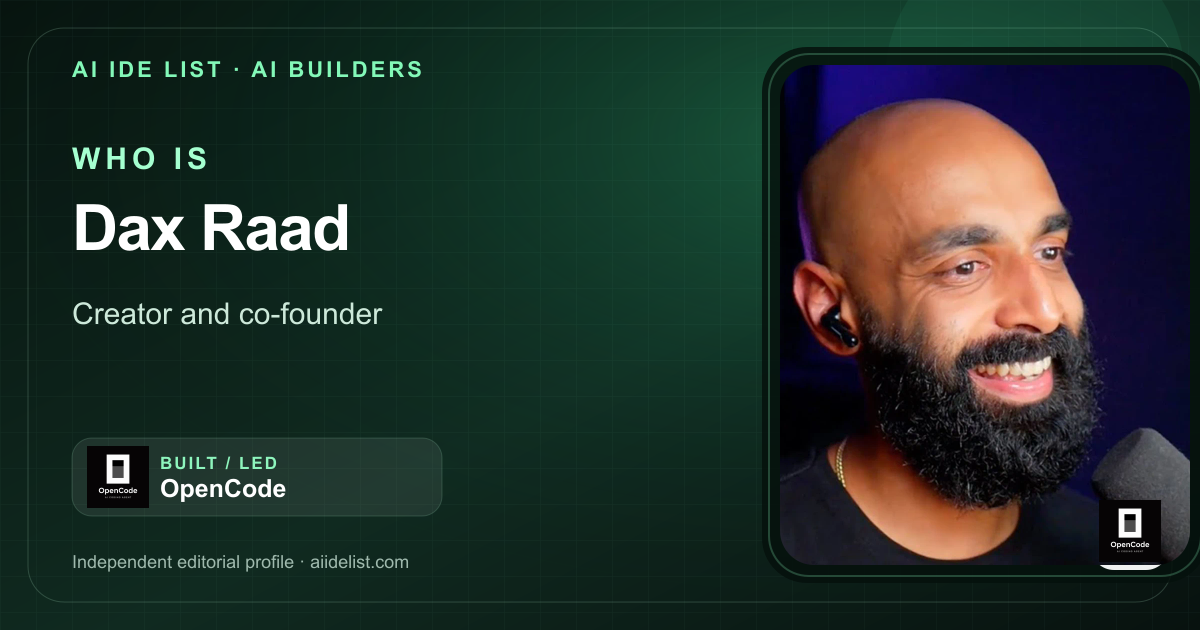
Dax Raad. Public speaker or profile photograph used for editorial identification. Photo source.
Dax Raad at a glance
| Current role | Co-creator |
| Company / project | OpenCode |
| Known for | building OpenCode and Zen |
| Field | AI coding agents and developer tools |
| Profile checked | August 31, 2026 |
Who is Dax Raad?
Dax Raad is the creator and co-founder associated with OpenCode, the open-source coding agent built around terminal workflows and broad model choice. He became a prominent voice in developer tools as OpenCode grew from an alternative CLI into a larger ecosystem spanning terminal, desktop, providers, and hosted model access through Zen.
This page deliberately avoids unverified claims about private life, age, family, wealth, or education. The useful reason to follow Dax Raad is the work: building OpenCode and Zen, the decisions behind that work, and the way those decisions affect developers.
Career context
Raad entered software shortly after high school, started a company around 2012, experienced an acquihire, and later led engineering and consulted across startups. Frustration with AWS tooling drew him into SST, where his work on infrastructure and developer experience eventually helped set the stage for OpenCode.
What is Dax Raad's role in OpenCode?
OpenCode's appeal comes from control. Developers can inspect the project, choose providers, bring their own credentials, and keep familiar terminal conventions. Raad has explained that the original motivation was to remove the friction of leaving an editor, copying code into a browser, and manually restoring context. The product instead lets the agent operate where the repository and developer already are.
The product itself is part of a wider market shift. A coding assistant once meant autocomplete inside an editor. The current generation can inspect repositories, run commands, use browsers and external tools, create isolated worktrees, work in the cloud, and return changes for review. Read our OpenCode profile for the product-level view, or browse the complete AI coding tool directory.
Built, led, and related products
- OpenCode — a model-independent, open-source coding agent.
- SST, OpenNext, and OpenAuth — developer infrastructure projects emphasizing control and practical deployment.
- OpenCode Zen — hosted model access designed to preserve provider choice inside OpenCode.
Explore more profiles in the AI Builders Hall of Fame, then compare the products themselves in the AI coding tool directory.
What does Dax Raad's work say about AI development?
Raad's interviews repeatedly emphasize taste, restraint, and real product quality over feature-count competition. As agents make implementation cheaper, deciding what should be built becomes more important, not less. That argument distinguishes OpenCode from marketing that treats raw generation speed as the only measure of progress.
That distinction matters because frontier models are increasingly available through several products. Durable advantages often come from the harness around the model: context selection, permissions, memory, environments, verification, interaction design, and the product judgment that decides how much autonomy to expose.
Why Dax Raad matters
Dax Raad belongs in the AI Builders Hall of Fame because building OpenCode and Zen connects a recognizable product with a specific builder. Understanding the people behind these tools makes the market easier to read: model announcements explain capability, while builders explain why that capability becomes one workflow instead of another.
For teams choosing a coding agent, the builder's philosophy can be as revealing as a feature table. It influences whether a product is open or closed, terminal- or editor-first, session- or task-centered, local or cloud-oriented, and optimized for close collaboration or high-throughput delegation. Those trade-offs are also why direct AI tool comparisons remain more useful than a single universal ranking.
Career and product timeline
- Around 2012: Starts a software company with a friend and later goes through an acquihire.
- Later: Leads engineering and consults across startup products.
- Around 2021: Joins SST’s existing founding team after first contributing as a user and investor.
- 2024–2026: Creates and expands OpenCode across terminal, desktop, providers, and Zen model access.
What to watch next
The next useful signals will be concrete launches, technical writing, interviews, and changes to OpenCode. We will update this profile when Dax Raad's public responsibilities change or when new first-party material adds meaningful detail. A changing job title alone is less important than evidence of what the person is actually building.
Related AI builders
- Explore every AI Builder in the AI IDE List Hall of Fame.
You can also explore Tibo Sottiaux's Codex and ChatGPT profile, our Codex CLI guide, and our Claude Code guide to move between people, products, and competing development philosophies.
Frequently asked questions
What is Dax Raad known for?
Dax Raad is best known for building OpenCode and Zen. The claim is based on the first-party and reliable sources listed below, not on private biographical databases.
What is Dax Raad's current role?
As of August 31, 2026, Dax Raad is Co-creator at OpenCode. AI-company roles change quickly, so the checked date is part of the answer.
Is this an official biography?
No. This is an independent editorial profile from AI IDE List. It summarizes publicly documented professional information and links readers to original sources for verification.
Sources
Last verified: August 31, 2026. AI IDE List may update this page as roles, products, and public information change.
Continue Reading
More articles connected to the same themes, protocols, and tools.
OpenCode 2.0 Is Here: Code Mode, Background Agents, and a Major Rebuild of the Open-Source Coding Agent
Cloudflare Void: Open-Source SDK, CLI, and Platform for Full-Stack Vite Apps on Workers

GenOffice: The Open-Source AI Office Suite That Edits Your Files Directly (Not Just Chats About Them)
Referenced Tools
Browse entries that are adjacent to the topics covered in this article.