
On This Page8 sections
Key Takeaways
- Codex reset is now a recurring user need, not a one-off curiosity. r/codex moderators now redirect reset-related posts into a dedicated Reset Megathread, showing that the topic is frequent enough to require its own moderation flow.
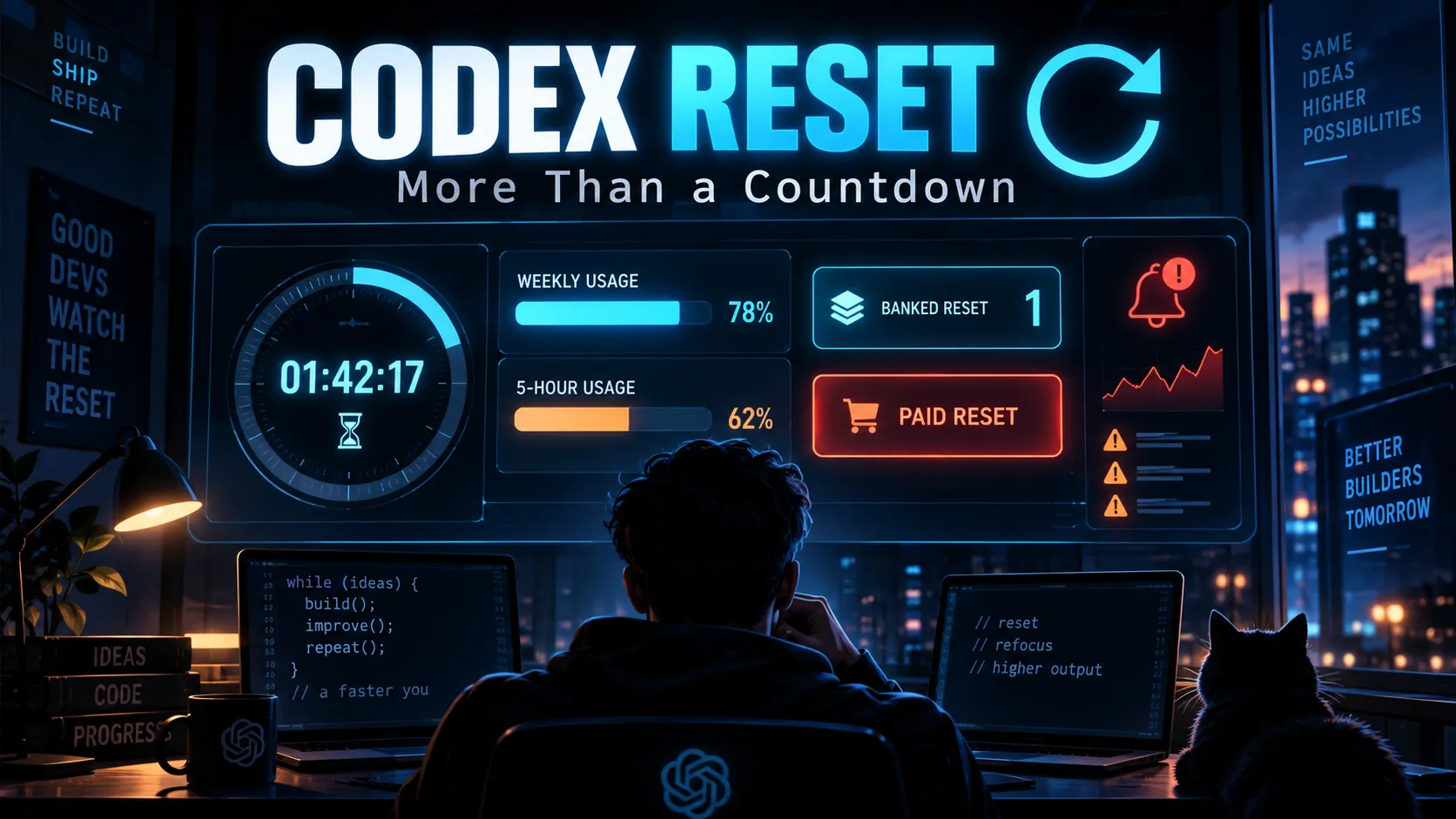
- Users want more than a countdown. The real questions are: Did Codex reset? Was it global or banked? Should a banked reset be used now? Why did usage change? Is a paid reset worth triggering?
- OpenAI treats banked resets and global resets differently. A banked reset is stored for later use; an automatic or global reset is applied directly to eligible usage limits.
- Using a full banked reset changes the weekly reset date. It refreshes eligible 5-hour and weekly Codex usage windows and moves the weekly schedule.
- Paid instant resets add a cost decision. Eligible Plus and Pro personal accounts can buy an instant reset, but it pulls the normal weekly allowance forward instead of adding a separate bonus week.
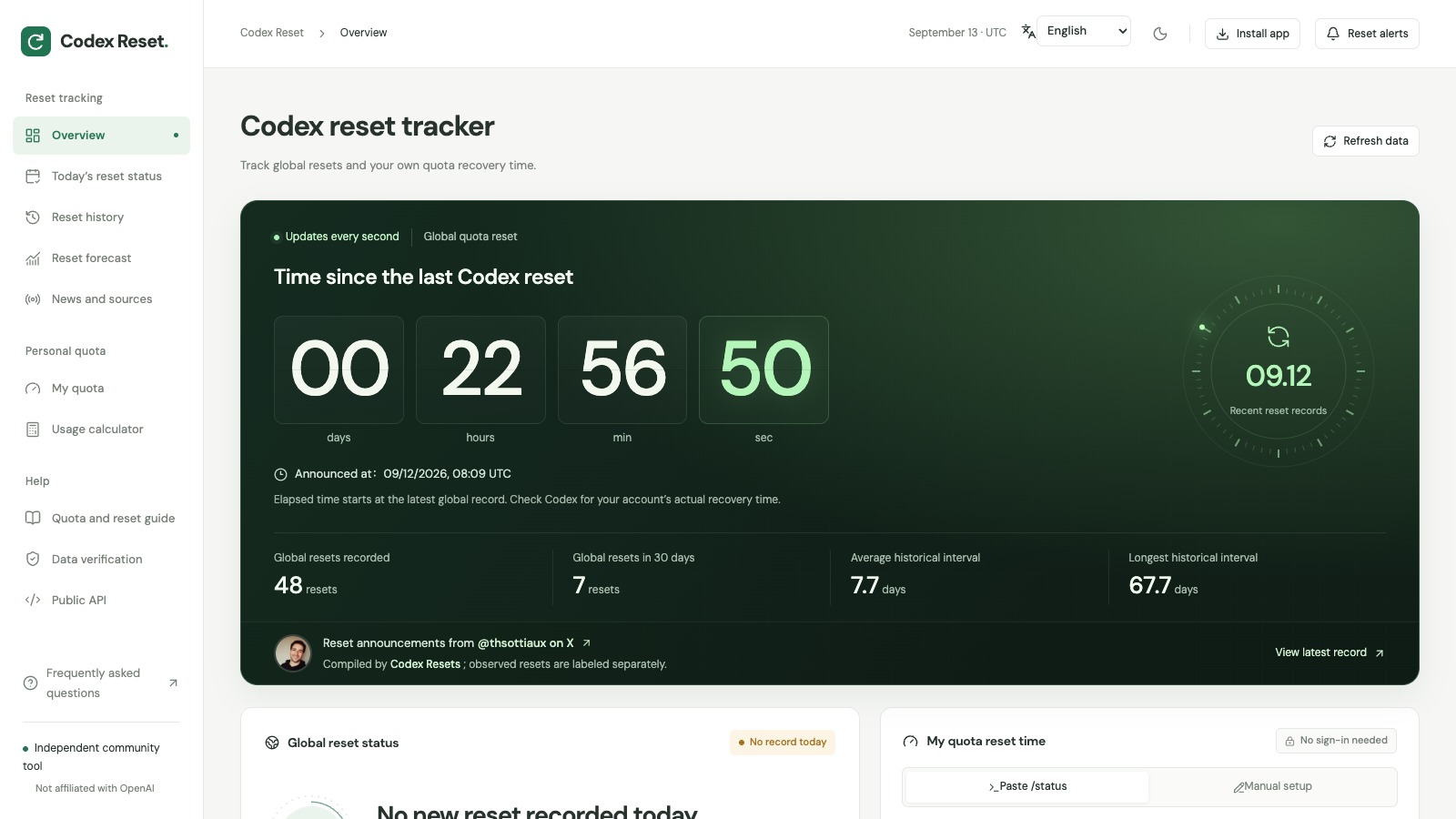
- The latest publicly confirmed shared reset found in this review completed on September 12, 2026. Tibo Sottiaux said the reset had fully propagated after announcing one as part of an Astra quality update.
Why Codex Reset Became a Real Product Need
Codex usage is no longer governed by one simple clock.
A heavy user may simultaneously have a 5-hour allowance, a weekly allowance, a personal reset date, one or more banked resets, and the possibility of a global reset. Paid instant resets add another option. When any of those states changes unexpectedly, users have to decide whether to keep working, conserve quota, redeem a saved reset, buy a reset, or wait.
That is why the keyword Codex reset has grown beyond a basic informational query.
On September 12, 2026, a highly upvoted r/codex thread described the frustration of keeping roughly 70% of weekly allowance in reserve, only to have a global reset move the next weekly reset date. The post received more than 500 votes and generated extensive discussion about planning, wasted capacity, banked resets, and unpredictable timing.
The demand is strong enough that r/codex moderators now funnel reset discussions into a Reset Megathread.
The underlying need is therefore timing, interpretation, and decision support.
The Four Questions Users Are Actually Asking
Did Codex reset?
This is the immediate-status intent.
Users need to know whether a reset was merely announced, is rolling out, or has completed.
That distinction mattered on September 11–12. A reset was first announced as landing by midnight; a later post stated that it had fully propagated. Those are two different operational states: scheduled and completed.
A reliable tracker should classify events as:
- Confirmed completed
- Scheduled
- Rolling out
- Banked reset announced
- Hint or speculation
- No confirmed reset
A prediction or social-media hint should never be shown as confirmed capacity.
When is the next Codex reset?
This is the prediction intent, but there is an important limitation: public global resets are not guaranteed on a fixed schedule.
OpenAI explicitly says future resets are not guaranteed and that eligibility, affected usage limits, timing, and expiration can vary by offer, plan, workspace, and region.
A trustworthy product should therefore separate four concepts:
Personal reset: the user's own reset time shown in Usage settings.
Global reset: a reset OpenAI applies directly to eligible accounts.
Banked reset: a saved one-time reset the user can redeem later.
Forecast: an estimate based on public history or signals, clearly labeled as unconfirmed.
This is more useful than a countdown pretending an unannounced reset has a known date.
Global, Banked, Personal, and Paid Resets Are Different
OpenAI defines a banked reset as a one-time Codex usage-limit reset saved on the account until it is used or expires. It is not purchased credit and does not permanently increase a plan's normal allowance.
The current reset types can be summarized as follows:
- Banked reset: stored for later and manually applied.
- Global or automatic reset: directly applied to eligible usage limits.
- Personal scheduled reset: the normal account-specific usage window returning.
- Paid instant reset: an immediate paid reset offered to some eligible Plus and Pro personal accounts.
The difference became especially visible during the GPT-6 Astra rollout. OpenAI says eligible Plus, Pro, and Business users received banked resets on September 3 and September 4, while a September 7 global reset applied immediately and could not be saved for later.
For users, both can look like more capacity. Operationally, they are very different.
Why Banked Reset Timing Matters
The most important banked-reset detail is easy to miss.
OpenAI states that using a full banked reset refreshes eligible 5-hour and weekly Codex usage windows and changes the weekly reset date.
That means a banked reset is not simply an extra weekly allowance stacked on top of the current one.
Consider two cases.
Scenario A
- Weekly remaining: 2%
- Natural reset: 5 days away
- Banked reset: expires soon
Using the reset may provide substantial immediate value because almost no included weekly capacity remains.
Scenario B
- Weekly remaining: 78%
- Natural reset: tomorrow
- Banked reset: expires in three weeks
Using it immediately may be much less attractive because significant current capacity remains and the reset changes the weekly schedule.
This explains why users repeatedly ask questions such as should I use my reset now? and how do I maximize a banked reset? A Reddit discussion specifically focuses on maximizing banked-reset value because redeeming one restarts the cycle rather than simply adding another full week.
A useful decision calculator should consider:
- weekly percentage remaining
- 5-hour percentage remaining
- personal weekly reset time
- banked-reset expiration
- number of saved resets
- confirmed public reset announcements
- whether additional capacity is needed immediately
The tool should explain the trade-off instead of declaring a universally correct answer.
The Global Reset Planning Problem
Global resets create a different problem: users cannot control when they are applied.
The September 12 r/codex discussion included users who had deliberately saved allowance, users who redeemed a banked reset shortly before the global reset, and users who said their planning assumptions changed after the shared reset moved the next reset date.
A related GitHub feature request asks OpenAI to issue future global resets as banked reset credits instead of directly overwriting the active usage window. The request argues that forced resets can create planning problems when users still have unused capacity.
That reveals an important product opportunity: a reset impact calculator.
For example:
Weekly remaining before reset: 68%
Previous personal reset date: Sep 14
Global reset applied: Sep 12
New reset date: Sep 19
The goal should be to explain what changed, not to claim that every user gained or lost the same amount of quota.
Codex Reset Not Working Is Its Own Search Intent
Reset troubleshooting is another clear demand cluster.
Recent GitHub issues include reports where a full reset restored the weekly meter but did not clear the 5-hour window, where a banked reset was consumed while weekly allowance stayed low, and where usage temporarily returned after a reset before reverting again.
These reports do not prove one platform-wide bug. They show that Codex reset not working deserves a dedicated troubleshooting flow.
OpenAI recommends refreshing Settings → Usage, checking the correct account or workspace, and allowing a short time for the dashboard to update. If the problem continues, Support may need the relevant offer, date and time, time zone, a Usage screenshot, the Codex client, and the model used.
A strong troubleshooting page should walk users through:
- Identify the expected reset type.
- Check both the 5-hour and weekly meters.
- Confirm the active account or workspace.
- Refresh or reopen Usage settings.
- Compare the weekly reset date before and after redemption.
- Record the exact time, client, and model if the state remains inconsistent.
- Escalate with the minimum evidence OpenAI requests.
That is far more useful than another generic FAQ.
Abnormal Usage Drain Belongs Next to Reset Tracking
Some users search for resets because they unexpectedly ran out of quota.
Recent GitHub and Reddit reports describe usage percentages dropping unexpectedly, reverting after resets, or changing sharply within short periods.
A reset product should therefore answer another question:
Is this only my account, or are other users seeing the same thing?
An incident layer could show:
- recent community report volume
- relevant GitHub issues
- official status context
- first observed time
- affected client or plan when known
- whether the symptom looks like display state, reset application, or actual consumption
This turns a countdown page into a monitoring tool.
Paid Resets Create a New Cost Decision
OpenAI now documents paid weekly Work and Codex rate-limit resets for eligible ChatGPT Plus and Pro personal accounts.
The key detail is that a purchased instant reset pulls the normal weekly allowance forward rather than adding a separate bonus entitlement. The new weekly period starts with the first Work or Codex request after the reset is applied, and the next automatic weekly reset is scheduled seven days after that first request.
That means paid-reset value depends on context.
Someone at 0% weekly usage with six days remaining faces a very different decision from someone with 45% remaining and eight hours until the natural reset.
A paid reset calculator could use:
Weekly remaining: 0%
Natural reset in: 5d 18h
Reset price: account-specific
Urgent work required: yes
Its job should be to show the trade-off between paying now and waiting, not to produce a universal recommendation.
Long-Running Agents Make Reset Timing More Important
Reset management also affects unattended agent workflows.
A July GitHub feature request proposes letting users queue one banked reset so it is redeemed only after a real usage-limit block. The motivation is long-running Codex tasks that may stop while the user is away even though a saved reset is available.
That suggests several high-value features beyond a web page:
- banked-reset expiration reminders
- browser alerts
- webhook notifications
- a machine-readable reset-status endpoint
- incident alerts
- warnings when a confirmed global reset changes planning assumptions
A public reset API could expose a compact state:
{
  "lastPublicReset": "2026-09-12T08:09:00Z",
  "status": "completed",
  "type": "global",
  "nextPublicReset": null,
  "confirmed": true
}
Personal account percentages should remain separate unless the user explicitly provides or authorizes them.
Why a Simple Countdown Page Is No Longer Enough
A page that only says last reset: three days ago is increasingly easy to copy.
The stronger product is a Codex Usage Control Center with six layers:
Verified public status — distinguish scheduled, rolling out, completed, and banked-credit events.
Personal reset context — let users track their own 5-hour and weekly windows.
Banked reset intelligence — explain expiry, remaining capacity, and timing trade-offs.
Paid reset analysis — show how buying a reset changes the weekly period.
Incident monitoring — surface clusters of reset or usage anomalies without presenting community reports as official outages.
Alerts — notify users when a reset is confirmed instead of forcing them to monitor social media.
The competitive advantage is not better guessing. It is better interpretation.
SEO Opportunities Around Codex Reset
The topic should be built as a search-intent cluster rather than one oversized article.
High-intent targets include:
codex resetdid codex reset todaynext codex resetcodex reset timecodex reset schedulecodex weekly resetcodex 5 hour resetcodex banked resetcodex banked reset expirationshould I use my codex resetcodex reset not workingcodex usage dropping fastcodex paid resetcodex reset history
Each query needs a different answer.
Did Codex reset today? needs verified status.
Should I use my Codex reset? needs a calculator.
Codex reset not working needs troubleshooting.
Codex paid reset needs mechanism and cost context.
This is where utility pages can outperform generic SEO content.
Common Mistakes
Treating every public post as a completed reset. Announcements, rollout notices, banked credits, and completed resets are different states.
Publishing an exact next-reset countdown without evidence. Historical frequency can support a forecast, not a guaranteed schedule.
Ignoring personal reset dates. A public global reset and an account's normal weekly window are not the same thing.
Confusing banked resets with paid instant resets. One is saved for later; the other applies immediately.
Assuming eligibility is universal. OpenAI says availability can vary by plan, account, workspace, billing country, region, and promotion.
Treating community reports as official incidents. They are useful signals, but they require clear labeling.
Optimizing for hype over trust. A page that says no confirmed reset when evidence is weak is more valuable than an unsupported probability presented as fact.
Conclusion
Codex reset has become a recurring operational problem for developers managing 5-hour limits, weekly limits, banked resets, global reset events, and paid instant resets.
The latest September 2026 behavior makes the opportunity especially clear. OpenAI now documents multiple reset mechanisms, while community discussions show that users are actively trying to understand how each one affects remaining allowance and future reset dates.
The strongest product is not another page that guesses the next reset.
It is the place users check before and after a reset: verified status, reset type, personal timing, banked-reset expiry, paid-reset trade-offs, abnormal-usage signals, troubleshooting, and alerts.
That is the difference between a Codex reset tracker and a tool developers can rely on.
Continue Reading
More articles connected to the same themes, protocols, and tools.

Referenced Tools
Browse entries that are adjacent to the topics covered in this article.