
On This Page8 sections
Key Takeaways
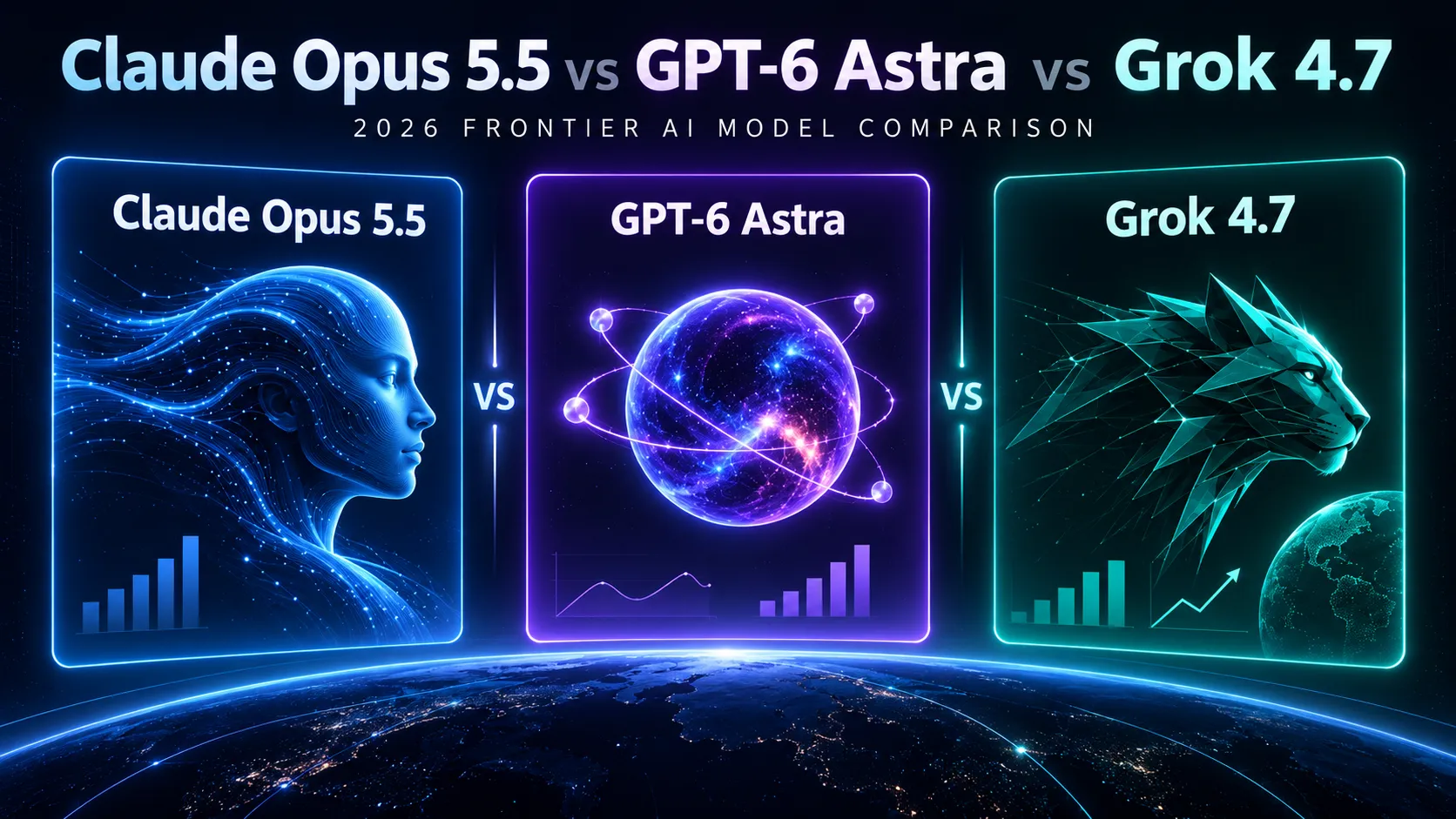
As of September 23, 2026, Claude Opus 5.5, GPT-6 Astra, and Grok 4.7 are three of the most important frontier models for coding, agents, research, and professional knowledge work. They compete in the same broad category, but their economics and strongest use cases are meaningfully different.
- Claude Opus 5.5 is the strongest all-around coding and agentic-work option in the latest independent Artificial Analysis results. At max effort it scores 58 on the Artificial Analysis Intelligence Index, ahead of GPT-6 Astra max at 53 and Grok 4.7 xhigh at 46. ([Artificial Analysis][1])
- Opus 5.5 High may be more important than Opus 5.5 Max for production use. Artificial Analysis measures High at an Intelligence Index of 54 with an estimated $1.82 cost per benchmark task, versus Astra max at 53 and $3.26. ([Artificial Analysis][2])
- GPT-6 Astra remains unusually strong in science, mathematics, computer use, and difficult end-to-end workflows. OpenAI reports 64.6% on Terminal-Bench Science 0.1, 97.6% on FrontierMath Tier 4 v2, 96.0% on GPQA Diamond, and 96.3% on its 512K-1M MRCR long-context test. ([OpenAI][3])
- Grok 4.7 has the lowest headline token prices at $2 per million input tokens and $6 per million output tokens below 200K prompt tokens, but high reasoning-token consumption can make difficult tasks cost more than the sticker price suggests. ([Grok API Documentation][4])
- There is no universal winner. For large codebases and long-running coding agents, Opus 5.5 is the most compelling default. For frontier science and computer-use-heavy workflows, Astra deserves serious consideration. For low-latency, cost-sensitive API workloads, Grok 4.7 is a strong alternative.
Last updated: September 23, 2026.
Claude Opus 5.5 vs GPT-6 Astra vs Grok 4.7 at a Glance
| Model | Claude Opus 5.5 | GPT-6 Astra | Grok 4.7 |
|---|---|---|---|
| Release | Sep. 22, 2026 | Sep. 3, 2026 | Sep. 21, 2026 |
| Context window | 1M | 1.05M | 500K |
| Max standard output | 128K | 128K | No fixed text-output limit stated in xAI release notes |
| Input price / 1M | $4 | $10 | $2 below 200K prompt tokens |
| Cached input / 1M | $0.20 | $1 | $0.50 below 200K |
| Output price / 1M | $20 | $50 | $6 below 200K |
| Reasoning controls | Adaptive, always on | low to max | low to xhigh |
| Default effort | medium | configurable | high |
| Main positioning | Long-running coding and knowledge work | Hardest end-to-end work | Coding, agents, knowledge work |
Anthropic documents a 1M-token context window, 128K maximum standard output, $4/M input pricing, $20/M output pricing, and $0.20/M cache reads for Opus 5.5. Its default effort is medium, and adaptive thinking cannot be disabled. ([Claude Platform][5])
OpenAI documents 1.05M context and 128K maximum output for GPT-6 Astra, priced at $10/M input, $1/M cached input, and $50/M output at standard short-context rates. Requests with more than 272K input tokens are billed at 2x input/cache rates and 1.5x output rates for the full request. ([OpenAI Developers][6])
xAI documents 500K context for Grok 4.7. Below 200K prompt tokens it costs $2/M input, $0.50/M cached input, and $6/M output; above 200K, those rates rise to $4, $1, and $12 respectively. ([Grok API Documentation][7])
The pricing difference is therefore more complicated than simply saying Grok is cheapest and Astra is most expensive. Prompt length, cache reuse, reasoning effort, and output-token consumption can change the real cost of completing a task by several times.
What Changed With This Generation of Frontier Models?
The most important shift is that frontier-model competition is no longer mainly about answering isolated prompts.
The leading models are increasingly optimized for long-horizon execution:
- navigating a repository,
- using terminals and browsers,
- calling external tools,
- editing many files,
- validating their own changes,
- working across very large contexts,
- and continuing until a multi-stage task is actually complete.
That makes older comparisons based mostly on short academic question answering increasingly incomplete.
Claude Opus 5.5 is explicitly positioned for long-running agentic coding and knowledge work. Anthropic says the model is more than 30% faster in output generation than Opus 5 and that typical workloads can cost about 40% less because both token prices and token consumption have improved. ([Anthropic][8])
GPT-6 Astra is positioned differently: OpenAI calls it its most capable model for the hardest end-to-end work, including complex reasoning, coding, computer use, research, and document creation. ([OpenAI Developers][6])
Grok 4.7 focuses heavily on coding, agentic work, and professional knowledge tasks while maintaining aggressive API pricing. xAI says it uses a larger base model than Grok 4.6 and was trained with a longer reinforcement-learning run weighted toward tasks that take hours rather than minutes. ([SpaceXAI][9])
The practical question is therefore not simply which model knows more? It is which model completes the relevant workflow with the best combination of quality, reliability, latency, and total cost?
Independent Benchmark Comparison
Vendor benchmarks are useful, but direct comparisons should prioritize evaluations run under a common methodology.
Artificial Analysis' current Intelligence Index v4.3.2 combines ten evaluations spanning agentic professional work, SaaS automation, terminal coding, scientific coding, long-context reasoning, knowledge reliability, physics reasoning, and general difficult reasoning. ([Artificial Analysis][2])
| Configuration | Intelligence Index | Terminal-Bench 4.0 | SciCode | Humanity's Last Exam | AA-LCR v1.1 | Cost per task |
|---|---|---|---|---|---|---|
| Claude Opus 5.5 Max | 58 | 60% | 67% | 61% | 85% | $5.98 |
| Claude Opus 5.5 High | 54 | 57% | 60% | 56% | 83% | $1.82 |
| GPT-6 Astra Max | 53 | 59% | 56% | 55% | 81% | $3.26 |
| Grok 4.7 xHigh | 46 | 26% | 57% | 43% | 77% | $3.74 |
The Max-versus-Max comparison is especially notable. Artificial Analysis measures Opus 5.5 Max at 58, five points above Astra Max, with stronger results on Terminal-Bench, SciCode, Humanity's Last Exam, AA-Briefcase, GDPval-AA, and AA-LCR in that test suite. Astra performs better on GDP.pdf and slightly better on AA-Omniscience, while CritPt is tied. ([Artificial Analysis][10])
However, Opus Max is not the obvious production setting. It uses about 119K output tokens per Artificial Analysis task, including about 84K reasoning tokens, versus 27K output tokens for Astra Max. That drives Opus Max's measured task cost to $5.98 despite its lower token prices. ([Artificial Analysis][10])
Opus 5.5 High is arguably the more commercially interesting configuration. It scores 54 versus Astra Max's 53, while Artificial Analysis measures its average task cost at $1.82 versus $3.26 for Astra Max. It also generates roughly 36K output tokens per task rather than 119K at Opus Max. ([Artificial Analysis][2])
That illustrates a critical lesson for 2026 model selection:
The highest reasoning setting is not automatically the best production setting.
Coding: Which Model Is Best for Software Engineering?
Claude Opus 5.5
Coding is where Opus 5.5 makes its strongest case.
Anthropic reports 66.4% on Terminal-Bench 4.0, 54.4% on FrontierCode 1.1 Main, and 57.8% on CursorBench 4.0 at the configurations used in its launch evaluation. Anthropic also explicitly cautions that benchmark margins at this capability level do not always translate cleanly into real-world differences. ([Anthropic][11])
More important than a single score is the model's behavior on large, messy engineering jobs. Anthropic reports early-access examples involving codebase-wide audits, migrations, multi-repository work, and sessions running for many hours. These examples are vendor-reported rather than independent proof, but they match the model's design goal: fewer redundant steps, better context retention, and more complete edits. ([Anthropic][8])
This makes Opus 5.5 particularly suitable for:
- large repository exploration,
- multi-file refactoring,
- framework migrations,
- debugging across several services,
- code review,
- test repair,
- dependency upgrades,
- and autonomous coding agents that may run for hours.
Its $0.20/M cache-read price is also significant. Agentic coding repeatedly reuses repository context, instructions, dependency metadata, and earlier tool results. Cheap cache reads can matter more than nominal input price in long sessions.
GPT-6 Astra
Astra is also a serious coding model.
OpenAI reports 57.9% on Terminal-Bench 4.0, 74.1% on DeepSWE v1.1, 64.5% on FrontierCode 1.1 Extended, and 53.3% on FrontierCode 1.1 Main. ([OpenAI][3])
Its more distinctive advantage appears when coding becomes part of a larger workflow involving browsing, computer use, specialized software, research, or multiple tools.
A particularly important Codex feature is Astra's approach to sessions that exceed one context window. OpenAI says Codex can preserve notes across context windows and search earlier context rather than relying only on repeated summarization through conventional compaction. This can preserve details about failed approaches, requirements, and earlier test results during extremely long debugging or refactoring sessions. ([OpenAI][3])
For ordinary repository coding, Opus 5.5 currently has the stronger price-performance case. For complex end-to-end work where coding is only one part of the job, Astra can be more compelling.
Grok 4.7
xAI markets Grok 4.7 as its most capable model for coding and knowledge work. Its own launch benchmarks report 46.3% on CursorBench 4.0, 71.0% on DeepSWE v1.1 at high effort, and 38.0% on Terminal-Bench 4.0. ([SpaceXAI][9])
Independent results are more mixed. Artificial Analysis measures Grok 4.7 xhigh at 26% on Terminal-Bench 4.0, materially below Opus 5.5 High at 57% and Astra Max at 59% in its unified evaluation. ([Artificial Analysis][12])
That gap is a useful warning: benchmark names alone do not guarantee identical harnesses, prompts, tools, sampling, or scoring conditions. Vendor-reported numbers should not be merged into one leaderboard unless the evaluation setup is genuinely comparable.
For coding, Grok 4.7 looks most attractive when price, responsiveness, and scale matter more than squeezing out the highest success rate on difficult multi-hour terminal tasks.
Agentic Knowledge Work
Modern AI models increasingly compete on professional tasks such as analyzing documents, building spreadsheets, using SaaS applications, researching companies, creating presentations, and executing multi-step business processes.
Artificial Analysis' AA-Briefcase v1.1 measures agentic professional work. In its current comparisons, Opus 5.5 High scores 1705 Elo, Grok 4.7 xhigh scores 1657, and Astra Max scores 1569. Opus 5.5 Max reaches 1822. ([Artificial Analysis][2])
The pattern is important:
- Opus 5.5 is especially strong on long-form agentic knowledge work.
- Grok 4.7 is much more competitive on professional work than its overall Intelligence Index might imply.
- Astra's strongest differentiation appears in other areas, particularly computer use and scientific workflows.
This is why choosing a model solely from one aggregate score can be misleading. A model with a lower overall index may still be an excellent fit for a narrow production workload.
Science, Math, and Computer Use: Where Astra Stands Out
GPT-6 Astra's clearest differentiation is in difficult scientific and computer-use tasks.
OpenAI reports:
- 64.6% on Terminal-Bench Science 0.1,
- 97.6% on FrontierMath Tier 4 v2,
- 96.0% on GPQA Diamond,
- 100% on ExploitBench,
- 88.0% on SRE-Bench,
- and 96.3% on its MRCR v2 8-needle evaluation in the 512K-1M range. ([OpenAI][3])
These are OpenAI-reported results, so they should not be treated as identical to independent cross-provider benchmarking. Still, they show where Astra's engineering effort is concentrated.
Astra is particularly relevant when an agent needs to combine reasoning with real software interfaces: browser navigation, scientific applications, computer control, data inspection, visual QA, or multi-tool workflows.
For developers building autonomous research systems or computer-use agents, that capability can matter more than a small difference on a generic intelligence index.
Context Windows: 1M Is Not the Same as 1M
At headline level, Opus 5.5 and Astra both operate around the one-million-token class, while Grok 4.7 offers 500K.
But context-window economics differ.
Claude Opus 5.5
Opus 5.5 provides a 1M context window by default, with standard pricing across that window. It supports up to 128K standard output tokens. ([Claude Platform][5])
For repository-scale coding, RAG, or document analysis, the lack of a long-context surcharge can be valuable.
GPT-6 Astra
Astra supports 1.05M tokens, slightly more than Opus. However, once a prompt exceeds 272K input tokens, OpenAI charges 2x input/cache rates and 1.5x output rates for the entire request. ([OpenAI Developers][6])
A nominal $10/M input request can therefore become $20/M at long context.
Grok 4.7
Grok offers 500K context, but pricing changes after 200K prompt tokens. Rates rise from $2/$0.50/$6 to $4/$1/$12 for input, cached input, and output. ([Grok API Documentation][4])
For RAG systems, repository agents, or giant-document pipelines, developers should therefore model the actual prompt-length distribution, not just compare advertised context limits.
Speed and Latency
Speed has at least three different meanings:
- time to first token,
- output tokens per second,
- time to finish the task.
A model can feel fast in chat because it starts responding immediately while still taking longer to solve a complex job.
Artificial Analysis measures Grok 4.7 xhigh at roughly 0.86 seconds to first token, making it extremely responsive in interactive applications. Its measured output speed is about 39 tokens per second. ([Artificial Analysis][12])
In the same independent dataset, Opus 5.5 High produces around 90 tokens per second, versus about 58 tokens per second for Astra Max. The measured time to first answer token is much longer for deep-reasoning configurations, especially Astra Max, because reasoning can occur before visible answer tokens appear. ([Artificial Analysis][2])
These numbers are workload- and configuration-dependent, but they highlight a practical distinction:
- Grok 4.7 is attractive when immediate responsiveness matters.
- Opus 5.5 High combines strong reasoning with high decode throughput.
- Astra Max may spend substantially more time reasoning before presenting an answer on difficult prompts.
For background agents, first-token latency may barely matter. For chat products, IDE autocomplete, or user-facing copilots, it can be critical.
Pricing: Token Price Is Not Task Price
The headline API pricing suggests a simple order:
- Grok 4.7: cheapest
- Claude Opus 5.5: middle
- GPT-6 Astra: most expensive
That is true per uncached token at short context, but it is not necessarily true per completed task.
Artificial Analysis reports the following weighted average cost per Intelligence Index task:
| Configuration | Estimated cost per task | Output tokens per task |
|---|---|---|
| Claude Opus 5.5 High | $1.82 | 36K |
| GPT-6 Astra Max | $3.26 | 27K |
| Grok 4.7 xHigh | $3.74 | 81K |
| Claude Opus 5.5 Max | $5.98 | 119K |
([Artificial Analysis][2])
This is one of the most useful findings in the comparison.
Grok's $6/M output price is dramatically lower than Opus' $20/M and Astra's $50/M, but Grok 4.7 xhigh uses far more output and reasoning tokens in this benchmark suite. Artificial Analysis measures roughly 81K output tokens per task for Grok xhigh, compared with 36K for Opus High and 27K for Astra Max. ([Artificial Analysis][12])
Likewise, Opus Max demonstrates the opposite problem: maximum reasoning raises its intelligence score, but its output-token consumption expands sharply.
The correct production metric is therefore:
cost per successfully completed task
not:
cost per million tokens
The Hidden Advantage of Prompt Caching
Caching becomes increasingly important as agent systems repeatedly send large blocks of stable context.
Typical reusable context includes:
- repository maps,
- project instructions,
- dependency manifests,
- system prompts,
- API schemas,
- tool definitions,
- product documentation,
- and long conversation histories.
Opus 5.5's cache-read price is $0.20/M, compared with $1/M for Astra and $0.50/M for Grok 4.7 below its long-context threshold. ([Claude Platform][5])
For a coding agent repeatedly operating on the same repository context, that difference can materially change the monthly bill.
This is one reason Opus 5.5 can be more cost-effective for agentic coding than its $4/M base input price initially suggests.
Which Model Should You Use?
Choose Claude Opus 5.5 for Large Codebases and Long-Running Coding Agents
Opus 5.5 is the strongest default when the workflow involves:
- autonomous coding,
- large repository understanding,
- multi-file refactors,
- migrations,
- debugging,
- code review,
- repeated use of cached project context,
- or long agent sessions.
High effort is the configuration worth testing first. In current independent measurements, it retains most of the model's frontier capability while using dramatically fewer reasoning tokens than Max. ([Artificial Analysis][2])
Move to Max when the expected value of solving a particularly hard task justifies the additional token consumption.
Choose GPT-6 Astra for the Hardest Multidisciplinary Work
Astra is particularly compelling for:
- scientific computing,
- mathematics,
- computer-use agents,
- browser-heavy workflows,
- cybersecurity research within appropriate authorization,
- difficult architecture problems,
- specialized desktop software,
- and end-to-end tasks that mix research, coding, documents, and tools.
The model's integration with Codex also matters. Long sessions can preserve notes and retrieve earlier context after the active context window fills, reducing dependence on lossy repeated compaction. ([OpenAI][3])
The tradeoff is pricing: Astra's $10/M input and $50/M output rates are materially above Opus 5.5 and Grok 4.7, with additional long-context premiums beyond 272K input tokens. ([OpenAI Developers][6])
Choose Grok 4.7 for Low-Latency and Price-Sensitive Workloads
Grok 4.7 is attractive when the workload values:
- low first-token latency,
- low unit token pricing,
- high-volume API calls,
- routine coding,
- research assistance,
- classification and transformation,
- tool-calling agents,
- and professional knowledge tasks where its AA-Briefcase performance is competitive.
The main caution is reasoning efficiency. At xhigh effort, the model can consume enough reasoning tokens that low per-token pricing does not guarantee the lowest task cost. ([Artificial Analysis][13])
For production systems, medium or high should be benchmarked before defaulting to xhigh.
A Better Production Strategy: Route Tasks Instead of Picking One Model
For serious AI products, the strongest architecture may be multi-model routing rather than committing every request to one flagship model.
A practical routing policy could look like this:
Routine classification / extraction / lightweight generation
        ↓
Lower-cost model

Interactive low-latency agent task
        ↓
Grok 4.7 medium/high

Repository coding / refactoring / debugging
        ↓
Claude Opus 5.5 medium/high

Hard scientific / computer-use / multidisciplinary task
        ↓
GPT-6 Astra high/max

Task failed verification
        ↓
Escalate effort or switch model
The key is to route based on task difficulty and verification outcome, not brand preference.
A production system can first attempt a task with a cheaper effort level, run tests or validators, then escalate only if the output fails. This approach often provides better economics than running every request at the maximum reasoning setting.
How to Benchmark These Models on Your Own Workload
Public benchmarks are useful for discovery, but a production decision should use a private evaluation set.
A strong test set should contain real tasks sampled from the actual application, including failure cases.
For coding agents, measure:
- task completion rate,
- tests passed,
- regressions introduced,
- files changed unnecessarily,
- number of tool calls,
- elapsed time,
- human corrections required,
- input tokens,
- cached tokens,
- reasoning/output tokens,
- and total dollar cost.
For research or knowledge-work agents, measure:
- factual accuracy,
- citation correctness,
- completeness,
- hallucination rate,
- spreadsheet or document quality,
- tool-use failures,
- retries,
- and human review time.
The most useful metric is often not benchmark accuracy. It is:
successful tasks / total production cost
For high-value workflows, another useful metric is:
human minutes saved / model cost
These metrics capture what public leaderboards cannot: whether a model actually improves the economics of the specific product.
Common Comparison Mistakes
Comparing Vendor Benchmarks as If They Used the Same Harness
Anthropic reports 66.4% for Opus 5.5 on Terminal-Bench 4.0, OpenAI reports 57.9% for Astra, and xAI reports 38.0% for Grok 4.7 in their respective materials. ([Anthropic][11])
Those numbers are informative, but differences in harnesses, effort settings, tools, retries, and evaluation procedures can affect results.
Independent evaluations using one methodology are better for direct comparison.
Assuming Maximum Reasoning Is Always Better
Opus 5.5 demonstrates why this fails. Max improves the Artificial Analysis Intelligence Index from 54 at High to 58, but measured cost per task rises from $1.82 to $5.98 and output-token use rises from 36K to 119K. ([Artificial Analysis][2])
For many applications, the incremental accuracy is not worth more than tripling the cost.
Looking Only at Input and Output Prices
Token consumption is model-dependent. A $6/M model can cost more per solved task than a $20/M model if it reasons several times longer.
Ignoring Long-Context Surcharges
Astra changes pricing above 272K input tokens, while Grok changes pricing above 200K. A RAG or coding workload that routinely crosses those boundaries can have very different economics from short-chat usage. ([OpenAI Developers][6])
Ignoring the Agent Harness
Claude Code, Codex, Grok Build, Cursor, and custom agent frameworks can materially affect outcomes.
Tool definitions, context management, planning loops, sandbox design, terminal integration, browser access, memory, and verification can sometimes matter as much as the underlying model.
By 2026, comparing only model names is increasingly incomplete. The real unit of comparison is model + harness + tools + effort setting + verification loop.
Final Verdict by Use Case
| Use case | Strongest starting point | Why |
|---|---|---|
| Large repository coding | Claude Opus 5.5 High | Strong independent coding/agent results with favorable task economics |
| Long autonomous coding sessions | Claude Opus 5.5 High | 1M context, cheap cache reads, strong long-horizon focus |
| Maximum aggregate benchmark capability | Claude Opus 5.5 Max | Highest current Artificial Analysis Intelligence Index among these configurations |
| Science and advanced mathematics | GPT-6 Astra | Exceptional vendor-reported science and math results |
| Computer-use-heavy agent | GPT-6 Astra | Explicit focus on browser and computer use |
| Cheapest headline API tokens | Grok 4.7 | $2/M input and $6/M output below 200K prompts |
| Lowest visible-response latency | Grok 4.7 xHigh in current AA measurements | Approximately 0.86s time to first token |
| Cost-efficient frontier reasoning | Claude Opus 5.5 High | 54 AA Intelligence score at $1.82 measured cost per task |
These are starting points rather than permanent rules. Model updates, provider infrastructure, agent harnesses, and workload composition can change the result.
Conclusion
Claude Opus 5.5 currently presents the strongest overall case for developers building coding agents and long-running knowledge-work systems. Its combination of frontier benchmark performance, a 1M-token context window, inexpensive cache reads, and lower API pricing makes the High effort setting particularly attractive.
GPT-6 Astra remains a different kind of flagship. It is expensive, but its strengths in science, mathematics, computer use, long-context reasoning, and difficult end-to-end workflows make it a strong escalation model for tasks where failure costs more than inference.
Grok 4.7 is the pricing and responsiveness challenger. Its nominal API rates are excellent and its first-token latency is extremely low, but developers should measure reasoning-token consumption before assuming it will be cheapest on difficult jobs.
The most effective 2026 architecture is therefore unlikely to be a permanent choice between Claude, GPT, and Grok. It is a measured routing system: use a cost-efficient model and effort level by default, verify the output, and escalate only when the task requires more capability.
Before committing production traffic, build a private evaluation set from real tasks, measure success rate, total task cost, latency, and human rework, and rerun it whenever any of these frontier models changes.
Continue Reading
More articles connected to the same themes, protocols, and tools.



Referenced Tools
Browse entries that are adjacent to the topics covered in this article.