
On This Page8 sections
Key Takeaways
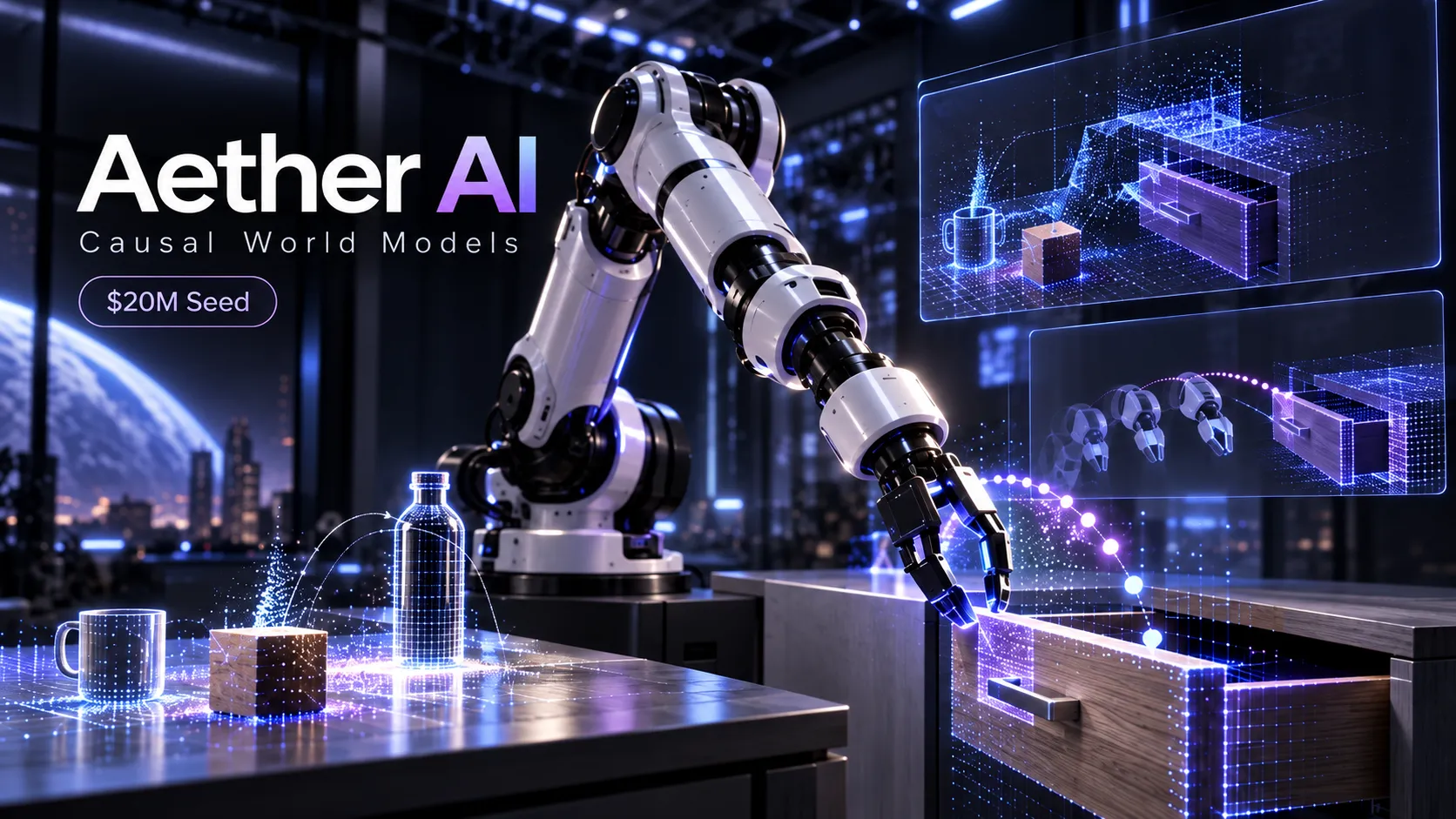
- Aether AI is a frontier artificial intelligence company developing Causal World Models that aim to help machines understand how actions change the physical world.
- Founded by causal machine learning researcher Professor Biwei Huang, the company announced a $20 million seed funding round in June 2026, led by MPCi.
- Its flagship research model, CausalWM, is a 16-billion-parameter embodied world model trained on approximately 31,000 hours of video. It predicts motion, three-dimensional geometry, and future video through a structured reasoning process.
- CausalWM achieved a 66.04 TWB-Score, ranking first among 36 models in the September 11, 2026 TriWorldBench leaderboard snapshot. That historical result should not be confused with a permanent ranking.
- Aether AI also develops CD-LAM, which improves action controllability in video world models, and RSIAgent, a framework that enables AI agents to improve through exploration and reusable memory without changing model weights.
- Research code and model weights are available, but CausalWM requires substantial GPU resources and license acceptance. A publicly priced commercial API has not been identified.
- The company's initial commercial focus is Physical AI and robotics, with longer-term ambitions involving scientific discovery and causal reasoning.
What Is Aether AI? is an artificial intelligence research company focused on developing systems that understand not just what is likely to happen, but why it happens and how different actions could change the outcome.
Its central technology is called a Causal World Model, an AI architecture designed to learn relationships between observations, actions, physical mechanisms, and future states.
Traditional generative AI excels at recognizing patterns and producing plausible outputs. A video model, for example, can generate realistic footage of a robot picking up a cup. However, realistic video does not necessarily demonstrate that the model understands the forces, contacts, and geometric constraints involved in the action.
Aether AI is investigating how to bridge this gap.
Rather than treating physical intelligence as another image or video generation problem, the company focuses on predicting the consequences of interventions in the environment.
Consider a robotic arm attempting to move a glass bottle into a drawer. A useful physical world model should account for the bottle's position, the gripper's motion, possible collisions, and the spatial relationship between the object and drawer.
Changing the starting position or intended action should produce a correspondingly different prediction.
This distinction has practical consequences. A model that generates convincing videos but ignores action instructions provides limited value for robotic planning. A model that faithfully predicts the consequences of alternative actions could potentially support safer planning, simulation, and training.
Aether AI's stated ambition is to develop an intelligent reasoning layer between robotic perception and physical control.
Importantly, Aether AI is primarily a research and Physical AI company, not a conventional consumer AI chatbot or online video generator.
Who Founded Aether AI, and How Much Funding Has It Raised?
Aether AI was founded by Professor Biwei Huang, an Assistant Professor at the University of California San Diego whose research focuses on causal discovery, machine learning, and related areas of artificial intelligence.
Her research background includes work associated with Carnegie Mellon University and the Max Planck Institute for Intelligent Systems. Aether AI's corporate announcement also identifies her contributions to open-source causal machine learning projects, including Causal-Learn and Causal-Copilot.
On June 18, 2026, Aether AI publicly announced the completion of a $20 million seed financing round.
According to the funding announcement published by GlobeNewswire, the round was led by MPCi, with participation from Inno Angel Fund, SWC Global, Unity Ventures, and other investors.
| Company Detail | Information |
|---|---|
| Company | Aether AI |
| Official website | aetherlabs.ai |
| Founder | Professor Biwei Huang |
| Research focus | Causal AI, world models, Physical AI, robotics |
| Announced funding | $20 million seed round |
| Funding announcement | June 2026 |
| Lead investor | MPCi |
| Initial commercial market | Physical AI and robotics |
| Public flagship model | CausalWM |
| Additional research | CD-LAM and RSIAgent |
The company stated that its funding would support research, engineering infrastructure, recruitment, and initial commercial deployments.
Its career listings include positions spanning causal representation learning, robotics, reinforcement learning, and distributed AI infrastructure.
These roles provide evidence of the company's technical priorities, although recruitment plans should not be mistaken for evidence of completed products or paying customers.
Aether AI has not publicly established a verified recurring revenue figure, standard commercial valuation, or comprehensive paying-customer count. Its seed financing amount should not be interpreted as its valuation.
Why Aether AI Is Betting on Causal World Models
The central challenge behind Aether AI's research is the difference between statistical prediction and causal reasoning.
A conventional predictive model may learn that particular images, objects, and movements are frequently followed by specific outcomes. This can be highly effective when future situations resemble the training data.
However, a system operating in the physical world must often confront interventions and unfamiliar conditions.
For example, imagine a robotic arm pushing a box across a table.
A conventional video prediction model might correctly predict that the box moves forward because similar movements occur frequently in its training data.
A more useful causal model should also consider what would happen if the box were heavier, friction increased, the arm pushed from a different angle, or another object blocked the path.
These changes matter because real-world actions alter the underlying system, rather than merely changing the next frame in a sequence.
Causal reasoning offers several potential advantages:
- Counterfactual prediction: Estimating what might happen under an alternative action.
- Intervention awareness: Distinguishing changes caused by an action from unrelated changes in the environment.
- Better generalization: Potentially transferring learned mechanisms to unfamiliar situations.
- Data efficiency: Using structured relationships to reduce dependence on repeated examples of nearly identical situations.
- Failure analysis: Identifying why an action produced an unexpected result.
These are research objectives rather than capabilities that have been conclusively demonstrated across all real-world environments.
A model can produce physically meaningful intermediate representations without proving that it has discovered genuine causal relationships. Establishing causal understanding requires careful intervention-based evaluation, controlled experiments, and tests outside the training distribution.
That distinction is important when interpreting Aether AI's published results.
CausalWM: Aether AI's Flagship 16B World Model
On September 19, 2026, Aether AI introduced CausalWM, short for Causal Chain-of-Thought Reasoning for Embodied World Model.
The model contains approximately 16 billion parameters and was developed to improve the prediction of future physical states using explicit intermediate reasoning steps.
The CausalWM research paper describes a system that processes visual observations and control conditions while learning to represent physical dynamics through motion and geometry.
Instead of directly generating future video from an initial frame, CausalWM follows a structured sequence:
Initial Observation → Optical Flow → 3D Pointmaps → Future RGB Video
Each predicted intermediate representation becomes part of the context for the following prediction.
Step 1: Predicting Optical Flow
Optical flow represents apparent movement between image frames.
For a robot manipulation task, it can describe how the robotic gripper and surrounding objects are expected to move.
This stage gives the model an explicit representation of motion before it attempts to generate the final appearance of the scene.
Step 2: Predicting Three-Dimensional Geometry
The second stage generates 3D pointmaps representing spatial structure in camera coordinates.
These representations help describe how objects are arranged in three-dimensional space and how that arrangement evolves during motion.
Geometry matters because two actions that appear visually similar may have different outcomes depending on depth, object placement, and spatial constraints.
CausalWM uses the generated motion representation when predicting this geometric information.
Step 3: Generating Future RGB Video
Finally, the model predicts the future visual sequence using the original observation, instruction, generated motion, and predicted geometry.
The purpose is to make future video generation depend on intermediate physical representations instead of relying exclusively on implicit patterns inside the generative model.
According to the official technical explanation, the architecture uses a shared diffusion Transformer and causal attention masking to maintain the intended prediction order.
A later prediction cannot provide information to an earlier reasoning stage during training. This helps align training with the order followed at inference time.
Why this matters: Motion and geometry are not merely extra outputs for visualization. They actively condition subsequent predictions, providing a mechanism for more structured control over generated futures.
However, this architectural constraint does not independently establish that the model has learned universally valid physical causality.
How Was CausalWM Trained?
CausalWM was trained using approximately 31,000 hours of embodied video drawn from 20 dataset families.
The reported data includes egocentric human activity, real-robot demonstrations, and simulated manipulation.
Aether AI describes a three-stage training process.
| Training Stage | Main Technique | Primary Objective |
|---|---|---|
| Stage 1 | Large-scale video pre-training | Learn visual dynamics and future video prediction |
| Stage 2 | Causal Chain-of-Thought mid-training | Learn motion and geometry representations in sequence |
| Stage 3 | Multi-objective reinforcement learning | Improve physical consistency, visual quality, and task-related outcomes |
Stage 1: Video Pre-training
The model builds on the LTX-2.3 video generation architecture. This stage provides broad video generation capabilities and introduces language-conditioned and action-related prediction.
The training process also incorporates latent action representations to learn motion from video when explicit robot action labels are limited or heterogeneous.
Stage 2: Causal Reasoning Training
The model learns to predict optical flow, depth-related geometry, and future video through a fixed ordering.
Intermediate targets are extracted automatically from video data, reducing the need for a manually written reasoning trace for each training example.
The generated intermediate predictions are then reused as context for later stages.
Stage 3: Reinforcement Learning
The final stage applies multi-objective reinforcement learning to generated outcomes.
Rather than rewarding visual similarity alone, the training process considers physical consistency, visual quality, and task-related behavior.
This is significant because visually impressive video is not necessarily suitable for robotics. A model must also preserve object relationships and react appropriately to control conditions.
The combination of large-scale data, structured intermediate representations, and outcome-based optimization is the central technical contribution behind CausalWM.
CausalWM Benchmarks: How Good Is It Really?
CausalWM's initial research results are promising, but they require careful interpretation.
Two important benchmarks are TriWorldBench and PAI-Bench.
| Benchmark | Reported CausalWM Score | Evaluation Setting |
|---|---|---|
| TriWorldBench | 66.04 | Action-conditioned, multi-view world modeling |
| PAI-Bench robot domain | 89.9 | Language-conditioned robotic video generation |
TriWorldBench Results
On September 11, 2026, CausalWM achieved a 66.04 TWB-Score, placing first among 36 models in the leaderboard snapshot reproduced by the research team.
The evaluation examines consistency across multiple robot camera perspectives, including head and wrist views.
This is important because a robot's predicted world should remain compatible across viewpoints. An object cannot plausibly occupy contradictory physical positions simply because the camera changes.
The first-place result is tied to a specific historical snapshot. Leaderboards change as new models are submitted, so the September result should not automatically be presented as CausalWM's current live ranking.
PAI-Bench Results
In the robot domain of PAI-Bench, the researchers reported an RO Score of 89.9 for CausalWM, compared with 89.7 for NVIDIA Cosmos 3 Super in their local evaluation.
The reported evaluation used 174 prompts across five seeds, producing 870 generated videos, with Qwen3-VL-235B-A22B-Instruct serving as an automated evaluator.
The CausalWM project page explains important differences in the evaluation setup.
CausalWM's prompts were rewritten to better match its pre-training captions, while Cosmos 3 Super used settings derived from its technical report. Other comparison scores were taken from the official leaderboard rather than reproduced under one fully identical local configuration.
Therefore, the small numerical advantage over Cosmos 3 Super should not be interpreted as definitive proof that CausalWM is universally superior.
What the Benchmarks Do Not Prove
Strong video prediction scores are not equivalent to physical robot task success.
Researchers evaluating practical deployment should distinguish:
- Visual realism from action-following accuracy.
- Geometric consistency from real-world physical correctness.
- Automated evaluator scores from measured robot completion rates.
- Short-horizon predictions from stable long-horizon planning.
- Performance on benchmark scenes from performance on unfamiliar environments.
CausalWM provides evidence that structured physical representations can improve embodied world modeling. Its broader real-world reliability remains an open research question.
CD-LAM: Improving How World Models Understand Actions
Aether AI's research also includes CD-LAM, or Causally Debiased Latent Action Model.
The technique addresses another important limitation of video-based world models: generated futures can appear realistic while responding incorrectly to supplied actions.
Latent Action Models attempt to infer action representations from video without requiring explicit action labels for every example.
However, conventional reconstruction-based training can unintentionally encode irrelevant visual information, including camera changes, background motion, and stationary scene details.
This creates a form of visual confounding. The model may learn correlations between action representations and future video that do not faithfully represent the commanded motion.
CD-LAM attempts to correct that problem before downstream world-model training.
Its approach includes embodiment-focused reconstruction, action-centric contrastive learning, and latent-space calibration.
The research team's CD-LAM analysis reports the following results.
| Model Scale | Baseline Action-Following Error | CD-LAM Error | Reported Improvement |
|---|---|---|---|
| 2B | 34.00 | 19.63 | Approximately 42% lower |
| 14B | 40.29 | 29.87 | Approximately 26% lower |
The researchers also report that roughly 3,000 to 4,000 robot-action adaptation updates can reach a reference performance level that required 50,000 updates for the baseline.
This suggests that improving the action representation can reduce subsequent adaptation requirements.
However, fewer optimization updates do not necessarily translate into an identical reduction in total GPU costs or wall-clock training time.
The publicly released research artifacts also have important scope limitations: the available 2B research checkpoints depend on compatible external base models and data, while full 14B reproduction requires additional assets.
CD-LAM is not validated as a standalone real-world robot policy or safety controller.
The CD-LAM paper and GitHub repository provide additional architectural and implementation details.
RSIAgent: Aether AI's Research Into Self-Improving AI Agents
Another notable project associated with Aether AI is RSIAgent, a framework for autonomous exploration and recursive self-improvement in digital environments.
Unlike CausalWM, which focuses on physical world prediction, RSIAgent investigates how software agents can become more capable in unfamiliar applications without updating their underlying model parameters.
The system combines three specialized agents:
- Curriculum Agent: Selects useful exploration tasks and identifies areas where additional practice may be valuable.
- Actor Agent: Interacts with software environments, executes operations, and records successful or unsuccessful experiences.
- Verifier Agent: Independently evaluates whether a task was completed correctly and provides feedback.
Its exploration strategy progresses from broad investigation toward focused practice on difficult cases.
Verified experiences are consolidated into reusable memory. During downstream evaluation, that memory is frozen and made available to the execution agent.
The idea is significant because improvement does not always require retraining a foundation model. Better environment-specific knowledge, reliable verification, and reusable experience can also improve task execution.
RSIAgent Benchmark Results
The RSIAgent research release reports the following results.
| Benchmark | Without RSI | With RSIAgent |
|---|---|---|
| OSWorld 2.0 partial-credit score | 71.97% | 78.98% |
| OSWorld 2.0 full-credit rate | 37.80% | 42.68% |
| Agents' Last Exam partial-credit score | 83.75% | 84.82% |
| Agents' Last Exam full-credit rate | 49.25% | 50.75% |
These are manuscript-reported aggregates, not fully matched independent leaderboard submissions.
The published methodology explains that some results retain baseline scores, while selected retries and execution budgets differ between conditions.
Consequently, the findings support the potential value of autonomous experience accumulation but should not be interpreted as proof that every RSIAgent configuration consistently outperforms the strongest proprietary computer-use systems.
Another important limitation is memory quality. An agent can preserve incorrect lessons if its verifier accepts incomplete or misleading outcomes.
This makes reliable verification essential for any self-improving agent architecture.
Developers can explore the RSIAgent source code and research paper.
How to Run CausalWM Locally
Aether AI has released CausalWM inference code and model weights, allowing qualified developers and researchers to experiment with the model.
However, running CausalWM is substantially more demanding than using a typical cloud-based image or video generation service.
The official implementation requires:
- Python 3.10 or newer, with Python 3.11 used in the tested environment.
- A CUDA-compatible NVIDIA GPU.
- The CausalWMv1 model checkpoint.
- The LTX-2.3 base model assets.
- The Gemma-3-12B text encoder.
- Sufficient GPU memory and storage for the model components.
The reference implementation has been tested on a single NVIDIA H200 GPU. This does not establish that comparable performance or memory requirements can be achieved on ordinary consumer GPUs.
Step 1: Install the Repository
The official installation workflow uses uv and an isolated Python environment.
git clone https://github.com/AetherLabsAI/CausalWM.git
cd CausalWM
uv venv --python 3.11
source .venv/bin/activate
uv pip install -e packages/ltx-core -e .
Step 2: Obtain the Required Model Assets
Researchers must download the relevant checkpoints from their publishers and accept any applicable access conditions.
The required assets include:
- AetherLabs-AI/CausalWM for the CausalWMv1 weights.
- Lightricks/LTX-2.3 for the compatible video backbone assets.
- The Google Gemma-3-12B text encoder specified in the CausalWM documentation.
The CausalWM Hugging Face repository is publicly listed but requires users to accept access conditions before downloading restricted files.
Step 3: Generate a Predicted Future
Once the required assets are available locally, an example inference command is:
python inference.py --image examples/inputs/single_arm_0090.jpg --prompt 'The robotic gripper closes the file cabinet drawer.' --checkpoint /path/to/CausalWMv1.safetensors --base-ckpt /path/to/ltx-2.3-22b-dev.safetensors --text-encoder-dir /path/to/gemma-3-12b --out-dir outputs/demoReplace the placeholder paths with the actual checkpoint locations.
The official default configuration generates 121 frames at 640 × 480 resolution and 16 FPS, equivalent to approximately 7.6 seconds of video.
The generation process uses four denoising steps for each of the three prediction stages by default.
Outputs include a future RGB video, optical flow visualization, pointmap visualization, and diagnostic files.
These intermediate outputs are valuable because they allow researchers to inspect whether the motion and geometry predictions are compatible with the final generated sequence.
The released checkpoint is specifically tailored for PAI-Bench-G. Researchers should not assume that downloading this checkpoint automatically reproduces every result in the full research paper.
For supported options and implementation changes, consult the official CausalWM repository.
Is Aether AI Free? Pricing, API Access, and Licensing
As of October 9, 2026, Aether AI's publicly documented offering is primarily research-oriented.
| Product or Resource | Public Availability | Pricing or Licensing |
|---|---|---|
| Aether AI website | Public | Free to read |
| CausalWM research paper | Public | Free access |
| CausalWM inference code | Public GitHub repository | Subject to repository license |
| CausalWM model weights | Hugging Face with access conditions | No public per-generation price |
| RSIAgent source code | Public repository | Apache 2.0; execution costs remain |
| CD-LAM research code | Public repository | Code and model dependencies have separate terms |
| Hosted commercial CausalWM API | No verified public offering | No verified API price |
CausalWM is distributed under the LTX-2 Community License Agreement, and its dependencies may have separate terms, including those governing Gemma.
Consequently, the availability of source code and model weights does not automatically grant unrestricted commercial deployment rights.
Before integrating CausalWM into a paid product, developers should check whether the intended business model, organization size, hosted inference service, and redistribution workflow comply with every relevant license.
Researchers should also account for infrastructure costs. Downloadable models are not necessarily inexpensive to operate, particularly when large GPU instances are required.
For most casual users, CausalWM is not currently a convenient substitute for hosted consumer video generation platforms.
Aether AI vs NVIDIA Cosmos 3, Google Genie 3, and World Labs
Aether AI operates within the broader world-model research ecosystem, but the leading projects in this space pursue different capabilities.
| Company or Model | Primary Focus | Distinguishing Capability |
|---|---|---|
| Aether AI CausalWM | Embodied causal world modeling | Explicit motion and geometry reasoning before future video generation |
| NVIDIA Cosmos 3 | General Physical AI foundation modeling | Unified physical reasoning, world generation, and action generation |
| Google DeepMind Genie 3 | Interactive world simulation | Real-time generation of explorable environments |
| World Labs Marble | Spatial intelligence and 3D world creation | Persistent, navigable 3D environments and developer integration |
Aether AI vs NVIDIA Cosmos 3
NVIDIA Cosmos 3 combines multimodal reasoning, world generation, and action generation within a unified model architecture.
Cosmos 3 also benefits from NVIDIA's extensive GPU software ecosystem, developer tooling, training resources, and deployment infrastructure.
CausalWM takes a more specialized approach, emphasizing explicit intermediate representations of motion and geometry during future prediction.
The two approaches overlap in Physical AI research, but differ in architecture, deployment maturity, and the breadth of supported tasks.
Aether AI vs Google Genie 3
Google DeepMind's Genie 3 emphasizes real-time interactive world simulation, allowing generated environments to respond to user navigation and actions.
CausalWM is primarily designed around embodied physical prediction, particularly robot-related tasks.
A model optimized for interactive exploration is not necessarily the best model for robotic action following, and vice versa.
Aether AI vs World Labs
World Labs focuses on spatial intelligence and the creation of persistent, explorable 3D worlds.
Its Marble technology and World API support workflows such as generating spatial environments from images, video, or text.
Aether AI instead emphasizes the dynamics of actions and interventions within physical systems.
The key distinction is between generating a world, interacting with a world, and predicting how specific interventions change that world. These capabilities are related but should not be treated as interchangeable.
Potential Real-World Applications of Aether AI
Aether AI's research could support multiple categories of intelligent systems if its methods continue to demonstrate reliable transfer into real-world deployments.
1. Robot Manipulation
A world model could help estimate the outcome of alternative grasping, pushing, or object-placement actions before a robot executes them.
This is particularly relevant when contact geometry and object movement determine success.
2. Industrial Automation
Factories and warehouses contain complex environments where physical actions must satisfy geometric and operational constraints.
More accurate action-conditioned prediction could help with planning, simulation, and recovery from unexpected situations.
3. Synthetic Robot Training Data
World models may generate possible trajectories and observations that complement real demonstrations.
However, synthetic data must be checked for physical fidelity. Unrealistic rollouts can reinforce incorrect behaviors instead of improving them.
4. Agent Training and Computer Use
RSIAgent demonstrates a related principle in digital environments: agents can explore unfamiliar tools, verify outcomes, and reuse accumulated operational experience.
This approach could be useful for complex software environments where task procedures and interface constraints are not fully represented in foundation-model training data.
5. Scientific Discovery
Aether AI's long-term vision extends to domains such as biology and medicine, where researchers need to distinguish causal mechanisms from correlations.
Applications might include hypothesis generation and intervention planning, but these remain long-term research directions rather than verified clinical products.
How to Evaluate CausalWM Beyond Marketing Benchmarks
For researchers considering CausalWM, the most informative evaluation is not simply whether a generated video looks realistic.
A useful testing protocol should examine whether the output changes appropriately when the underlying action changes.
Test 1: Action Intervention
Keep the initial frame unchanged while changing the intended action. Compare whether the generated object motion responds to the modification.
Test 2: Zero-Action Control
Request minimal or no movement where supported by the conditioning interface. Unexpected motion may expose instability or weak action conditioning.
Test 3: Geometry Consistency
Inspect the predicted pointmaps alongside future RGB frames. Look for contradictory object positions, distorted contact relationships, or impossible depth changes.
Test 4: Unseen Objects and Environments
Evaluate scenes that differ from the familiar robot demonstrations used during training. Performance degradation can reveal limited generalization.
Test 5: Long-Horizon Stability
Investigate whether prediction errors accumulate over repeated or extended rollouts. Short clips can conceal failures that become severe in multi-step tasks.
Test 6: Actual Task Outcomes
Where a safe, controlled robotics setup is available, compare model predictions against observed task execution, collision outcomes, and completion rates.
For credible comparisons, researchers should use matched prompts, equivalent computational budgets, multiple random seeds, clearly specified checkpoints, and consistent scoring methods.
These tests provide more actionable evidence than a single visual-quality score.
Current Limitations and Open Questions
Aether AI's research is promising, but important challenges remain unresolved.
Causal representation is not automatically causal identification. Predicting optical flow and geometry in sequence creates useful structure, but it does not guarantee that learned variables correspond to true causal mechanisms.
Physical simulation errors can compound. Small errors in object placement or motion may become significant across multiple actions.
Real-world feedback is essential. A visually convincing forecast should not be trusted as the sole basis for operating physical hardware.
Computational requirements remain substantial. The reference CausalWM implementation relies on large GPU infrastructure, making broad consumer access difficult without additional optimization or hosted services.
Released checkpoints may cover only part of the research scope. The publicly available CausalWMv1 checkpoint is tailored for a particular benchmark-oriented configuration.
Benchmark advantages can be configuration-dependent. Prompt modifications, evaluator choice, inference budgets, and checkpoint versions can materially affect comparisons.
Commercial adoption is not yet established by public evidence. Funding, recruiting, and research results do not independently establish product-market fit or significant recurring revenue.
Long-term success will depend on whether the company's causal techniques reliably improve physical task completion, adaptation efficiency, and deployment economics.
Frequently Asked Questions
What does Aether AI do?
Aether AI develops causal world models intended to help AI systems reason about physical actions, interventions, and their consequences. Its initial commercial focus is robotics and Physical AI.
What is CausalWM?
CausalWM is Aether AI's 16B embodied world model. It generates optical flow, 3D pointmaps, and future RGB video through sequential physical reasoning stages.
Is CausalWM open source?
Its research code and model weights are publicly listed, but the model is distributed under the LTX-2 Community License and Hugging Face access conditions. Public availability should not be confused with unrestricted commercial licensing.
Can CausalWM run on a consumer GPU?
The official reference implementation was tested on an NVIDIA H200. Comparable support for ordinary consumer GPUs has not been established in the public reference documentation.
Is Aether AI a video generator?
CausalWM generates future video, but its main research purpose is physically meaningful prediction for embodied systems, not general-purpose entertainment video generation.
Is Aether AI better than NVIDIA Cosmos 3?
CausalWM achieved strong results in specific research evaluations, including a slightly higher reported local PAI-Bench robot-domain score than Cosmos 3 Super. That does not prove overall superiority because architectures, deployment environments, and evaluation settings differ.
Who founded Aether AI?
Aether AI was founded by Professor Biwei Huang, a researcher in causal machine learning at UC San Diego.
How much funding has Aether AI raised?
The company announced a $20 million seed financing round in June 2026. That figure represents disclosed financing, not a publicly verified valuation or annual revenue.
What is RSIAgent?
RSIAgent is an autonomous exploration framework that combines curriculum planning, software execution, independent verification, and persistent memory to improve performance in unfamiliar digital environments without changing model weights.
Does Aether AI offer a public API?
As of October 9, 2026, a publicly priced commercial CausalWM API has not been verified. Researchers can access the published code and model assets under their applicable terms.
Conclusion
Aether AI represents an important research direction in the evolution of artificial intelligence: moving beyond systems that recognize patterns and generate plausible content toward systems that can reason more explicitly about actions and consequences.
Its $20 million seed financing, research leadership, and growing portfolio of technical projects make it a noteworthy participant in the emerging Physical AI ecosystem.
The company's flagship CausalWM model demonstrates how structured predictions of motion and geometry can influence future video generation. CD-LAM addresses the reliability of action representations, while RSIAgent explores how autonomous experience and verification can improve agent behavior without updating foundation-model weights.
Together, these projects suggest a broader strategy centered on learning useful mechanisms rather than relying exclusively on statistical prediction.
However, benchmark performance and research demonstrations are only early indicators. The decisive evidence will come from reproducible evaluations, robust performance in unfamiliar environments, and measurable improvements in actual robotic tasks.
For researchers and developers exploring this field, the most useful starting points are the official Aether AI website, the CausalWM research project, and the CausalWM GitHub repository.
Explore the published research, examine the intermediate predictions, and evaluate action-following accuracy before considering real-world deployment.
Continue Reading
More articles connected to the same themes, protocols, and tools.

Referenced Tools
Browse entries that are adjacent to the topics covered in this article.