
 SupersetA desktop code editor and control plane for running many coding agents in parallel.
Conductor
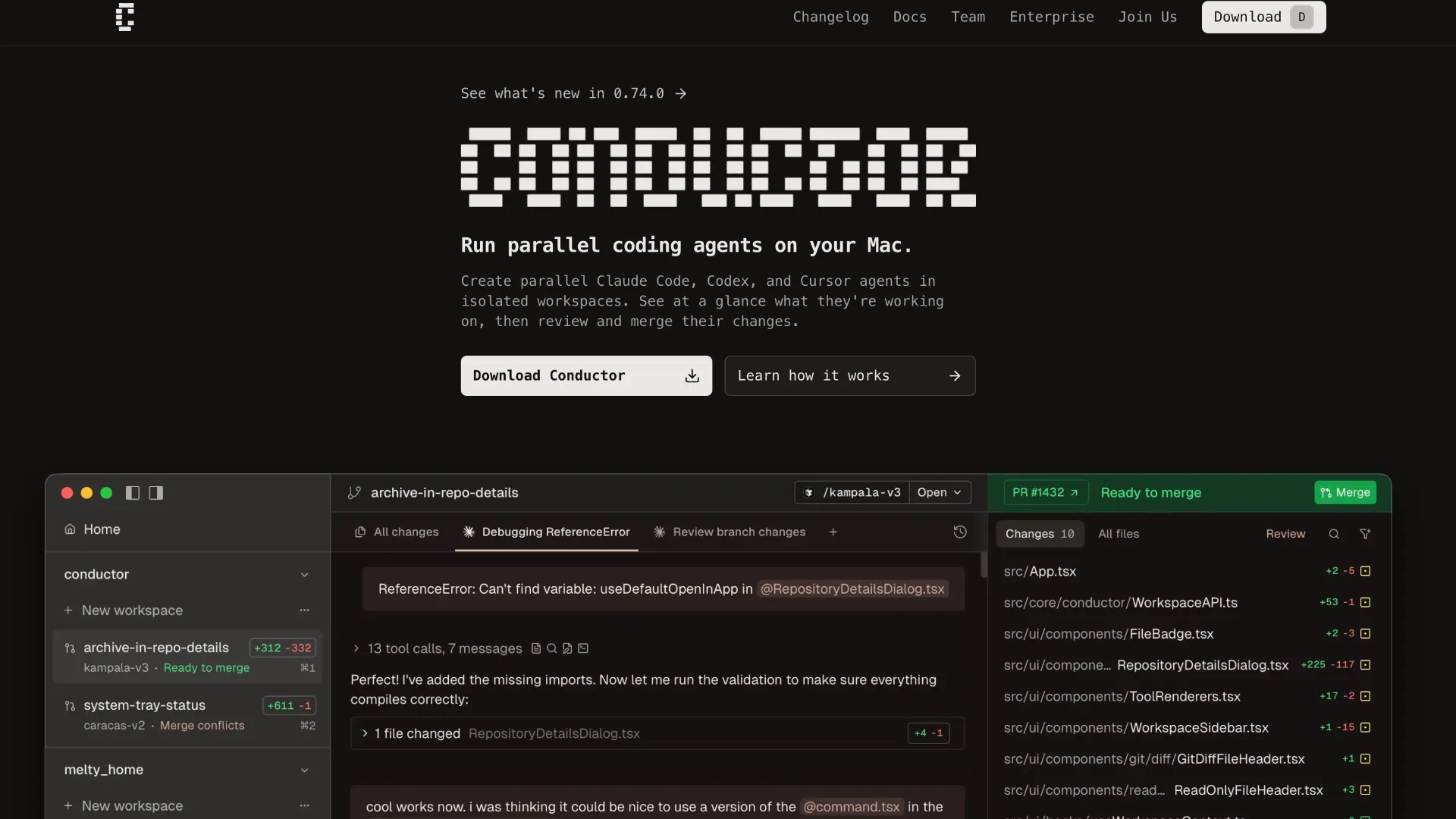
A standalone macOS orchestration layer for coordinating multiple coding-agent runtimes across isolated workspaces, testing environments, and pull request workflows.
Information checked: Jul 10, 2026 ·View sources
Tool details
- Type
- Developer workflows
- Platforms
- macOS
- Free plan
- Yes
- Open source
- No
- Bring your own key
- Yes
- Local models
- Yes
Overview
Best for
- Mac developers running several coding-agent tasks simultaneously
- Teams dividing features, bugs, experiments, or issues into independent branches
- Claude Code and Codex users who want a visual orchestration interface
- Repositories that need repeatable setup and run scripts for every worktree
- Developers who want to review agent diffs before opening pull requests
- Workflows that use different coding agents for implementation, testing, and review
Strengths
- Makes parallel coding-agent work easier to inspect and manage than separate terminal windows.
- Supports multiple agent ecosystems instead of locking each repository to one harness.
- Isolated branches and worktrees reduce collisions between independent tasks.
- Combines local execution, testing, code review, and pull request management in one interface.
- Reuses existing Claude, OpenAI, Cursor, and OpenCode credentials.
- The local macOS app is currently free.
Limitations & trade-offs
- Windows or Linux developers needing a native desktop application
- Organizations requiring every agent process to run inside a strict security sandbox
- Users looking for an AI-native text editor with inline autocomplete
- Projects that cannot be divided into branch-based units of work
- Low-resource machines expected to run many agents and development environments concurrently
- Teams requiring publicly documented self-service cloud pricing
- The desktop application is currently limited to macOS.
- Worktree isolation is not a security sandbox.
- Agents run with the permissions of the logged-in macOS user.
- Provider subscriptions and token usage are billed separately.
- Running several agents and development servers can consume substantial local resources.
- The application is proprietary, and cloud pricing is not publicly documented.
Get started
Pricing & usage limits
Free tier available
Local App$0
Conductor is free to use locally. Model usage is billed separately by the selected agent provider.
Conductor CloudNot publicly listed
Cloud workspaces are available through an early-access program.
EnterpriseCustom
Contact Conductor for organizational deployment, privacy, security, and workflow requirements.
Pricing checked: Jul 10, 2026 · Subscription, usage limits, and model costs may be billed separately.
Features & details
Workspace Orchestration
- One isolated Git worktree and branch per task
- Parallel workspaces with separate processes and context
- Workspace creation from branches, pull requests, and issues
- Automatic workspace archiving and restoration
Agent Runtimes
- Managed Claude Code and Codex installations
- Cursor Agent sessions through the Cursor API
- OpenCode provider and local-model support
- Multiple agent tabs within the same workspace
Review and Delivery
- Built-in unified and commit-filtered diff viewer
- Inline feedback sent back to coding agents
- Pull request creation, checks, comments, and merging
- Checkpoints and turn-by-turn change history
Project Environments
- Repository setup, run, and archive scripts
- Separate ports for parallel development servers
- Spotlight testing from the repository root
- Shared repository settings and instruction files
Controls and Integrations
- Plan, fast, reasoning, goal, and personality controls
- MCP server support for compatible harnesses
- GitHub and Linear issue workflows
- Provider subscriptions and API-key authentication
Why Choose Conductor?
Conductor addresses a coordination problem that appears after developers move beyond using one coding agent at a time. Running several terminal agents manually is possible, but the developer must create worktrees, remember which branch belongs to each session, reproduce environment setup, monitor background processes, and eventually determine which changes are safe to merge.
The product turns those operational details into a visible workflow. Instead of treating the chat window as the primary unit of work, Conductor treats a workspace as a shippable stream with its own code state, runtime, review status, and integration path. This distinction matters because agent output becomes easier to evaluate when it is attached to a branch and an executable environment rather than buried in a collection of terminal transcripts.
Conductor is also model-layer agnostic within the runtimes it supports. A team can use one agent for implementation, another for investigation, and a third for review without manually maintaining separate terminal layouts. Conductor does not normalize every agent into an identical experience, however; capabilities such as planning, goals, checkpoints, skills, and reasoning controls still depend on the selected harness.
Core Workflow
A productive Conductor workflow begins by dividing a larger objective into units that could reasonably be reviewed and merged independently. Each unit becomes a workspace based on its own branch. This creates a clearer boundary than assigning several vague prompts against the same checkout and hoping the resulting edits do not overlap.
Repository configuration should prepare every new workspace automatically. Dependency installation, ignored environment files, generated configuration, and development-server commands need to work without manual repair. Once this foundation is reliable, launching another agent becomes inexpensive enough that parallelism saves time rather than creating setup work.
The developer then assigns bounded tasks to the appropriate agent runtime. An exploratory task might ask one agent to trace the cause of a bug without changing code, while another workspace tests an alternative implementation. Work that must share an evolving code state can remain in one workspace with multiple agent tabs; work that may be accepted or discarded independently belongs in separate workspaces.
The final stage should be treated as integration rather than prompt completion. A task is not finished merely because an agent stops responding. The branch should run successfully, the diff should match the intended scope, automated checks should pass, review comments should be resolved, and the pull request should remain small enough for a human to understand.
Where Conductor Fits Best
Conductor is most useful when a developer already trusts terminal-based coding agents but finds the surrounding Git and process management increasingly expensive. Examples include implementing several unrelated backlog items, testing competing fixes for a difficult defect, splitting a migration by package, or asking independent agents to investigate frontend, backend, and test failures.
It also fits repositories where a feature branch must be executed before it can be judged. Visual changes, API modifications, database migrations, and full-stack behavior are difficult to review from generated text alone. Separate run environments allow each candidate branch to be inspected in a form closer to the final application.
Another practical use case is separating implementation from verification. One agent can write the change while another reviews the same branch, looks for missing cases, or repairs the tests. This does not remove the need for human review, but it can expose disagreements earlier than a workflow in which one agent both creates and approves its own solution.
The product provides less leverage for developers who mainly request small edits from one agent, rarely maintain concurrent branches, or already have a reliable custom tmux-and-worktree system. In those workflows, the additional application layer may organize activity without materially reducing effort.
Comparison to Alternatives
Superset is the closest conceptual alternative because both products center on running several coding-agent sessions in isolated Git worktrees. The decision is likely to depend on platform support, openness, team functionality, remote execution, interface preferences, and how closely each product supports the agent runtimes already used by the team.
Vibe Kanban approaches the problem from a task-board perspective. It is a stronger candidate when planning, prioritization, and assignment should remain visible as Kanban issues before an agent begins execution. Conductor is more workspace-centric, making it attractive when the primary concern is moving local code from an isolated runtime through review and into a pull request.
Nimbalyst similarly provides a visual environment for parallel agent work but places more emphasis on an integrated workspace experience. Developers should compare how each tool handles environment setup, browser previews, inline review, worktree cleanup, provider credentials, and switching back to an existing editor.
Parallel Code is relevant to teams prioritizing open-source availability and broader desktop-platform support. Conductor may be preferable for users who value its native Mac workflow and rapidly expanding integrations, while an open-source alternative can be easier to audit, modify, or deploy under internal requirements.
Claude Code, Codex, Cursor, and OpenCode are not exact replacements for Conductor because they perform the agent work that Conductor coordinates. A developer can use those tools without Conductor, but doing so means taking direct responsibility for worktrees, process isolation, status tracking, review, and cleanup.
Best Configuration
The first configuration priority is making workspace creation deterministic. Setup scripts should install only what is missing, copy the minimum required local configuration, and fail with understandable messages. Scripts that depend on the original checkout, fixed absolute paths, or one global port will undermine parallel execution.
Use repository-level settings for conventions that should apply to everyone and local settings for machine-specific paths or personal commands. Checked-in agent instructions such as AGENTS.md or CLAUDE.md should describe architecture, verification commands, prohibited changes, and completion criteria without embedding secrets or environment-specific assumptions.
Assign a separate port to each runnable workspace and avoid sharing mutable local state unless the project explicitly supports concurrency. Databases, emulators, container names, caches, and background workers may need workspace-specific identifiers in addition to separate web-server ports.
Permission prompts should remain enabled for unfamiliar repositories and high-risk tasks. A worktree protects the main checkout from ordinary branch collisions, but it does not prevent an agent from reading unrelated files, accessing credentials available to the user, running destructive shell commands, or reaching external services.
Keep parallel task count below the machine's practical limit. More agents do not automatically produce more useful work. Build systems, language servers, browser instances, test suites, and development databases can exhaust memory or CPU before the model sessions themselves become the bottleneck.
Migration Notes
Developers migrating from manually managed terminal agents should begin with one repository and a small number of independent tasks. Existing branches do not need to be abandoned, but environment scripts should be tested inside a fresh worktree before relying on them across several sessions.
A common migration failure is assuming that every ignored file will appear automatically in a new workspace. Projects often depend on .env files, local certificates, generated credentials, package-manager state, or untracked configuration. These dependencies should be explicitly copied, regenerated, or replaced with workspace-safe defaults.
Teams moving from a single-agent workflow also need to adjust task design. Parallelism works when ownership boundaries are clear. Assigning two workspaces to modify the same central module can move the conflict from the working directory to the merge stage, where resolving it may cost more than running the tasks sequentially.
Existing provider authentication can generally be reused, but teams should confirm which credential path is active. A subscription login, direct API key, compatible gateway, and OpenCode provider may have different billing, retention, and model-access policies even when they appear through the same Conductor interface.
Practical Tradeoffs of Parallel Agent Work
The main benefit of parallelism is elapsed-time reduction, not guaranteed engineering-quality improvement. Several agents can investigate independent questions simultaneously, but every accepted branch still creates review and integration work. The limiting factor may shift from writing code to understanding diffs and choosing among competing implementations.
Branch isolation also does not eliminate architectural inconsistency. Agents working independently may introduce different abstractions, duplicate utilities, or make incompatible assumptions about shared interfaces. Repository guidance and task decomposition become more important as the number of simultaneous workspaces grows.
Conductor works best when humans remain responsible for prioritization and integration. The application can make agent state visible and reduce mechanical Git work, but it cannot determine whether several locally correct changes form a coherent product. The highest-leverage workflow is therefore controlled concurrency: enough parallel tasks to reduce waiting, but not so many that review becomes the new bottleneck.
Model support & data privacy
Supported models
- Anthropic Claude
- OpenAI Codex
- Cursor Composer 2.5
- OpenCode Zen
- OpenCode Go
- OpenRouter
- Baseten
- Cerebras
- Vercel AI Gateway
- ChatGPT
- GitHub Copilot
Privacy & data handling
Local workspace files and chat history are stored on the Mac rather than on Conductor's servers. Model requests go to the selected provider, while Conductor collects account information, feature analytics, computer metadata, crash data, and some error details through its infrastructure and PostHog. Agents execute with the current user's local permissions and are not sandboxed by Conductor.
Guides, reviews & fixes
No published guides yet. Start with the official documentation above.
Product updates
Official changelogNo verified product updates listed yet. Follow this tool to see new relevant content in Saved.
See the content timelineAlternatives
SupersetA desktop code editor and control plane for running many coding agents in parallel. Vibe KanbanAn open-source Kanban and worktree layer for coordinating multiple coding agents.
 NimbalystA visual, open-source workspace for parallel coding agents and artifact-driven development.
 Parallel CodeA lightweight desktop control center for side-by-side coding agents in isolated worktrees.
Sources & verification
Verification dates record when this directory checked the information. Product release dates appear separately above.
Official websiteConductor DocumentationHarness DocumentationIsolated Workspaces DocumentationParallel Agents DocumentationSecurity and Permissions DocumentationPrivacy DocumentationConductor EnterpriseConductor CloudConductor ChangelogOfficial Brand Kit
Directory revision history
Directory positioning, pricing status, supported harnesses, platform availability, and privacy information were reviewed against official documentation.
Version 0.74.0 added project filtering, collaboration alpha functionality, stronger Git fallback behavior, and expanded in-app pull request management.
Version 0.72.0 improved agent message prioritization, provider-key controls, cloud synchronization, and background-task handling.
Version 0.70.0 added multiple configurable run scripts for monorepos, tests, and development processes.
Version 0.68.0 introduced experimental OpenCode support and additional workspace controls.
Conductor announced a $22 million Series A and outlined plans to expand beyond local Mac-based agent orchestration.