
 OpenCodeOpenCode is an open-source coding-agent harness for terminal, desktop, and IDE workflows with broad provider support, BYOK, and an optional OpenCode Go subscription for curated open models.
MiMo Code
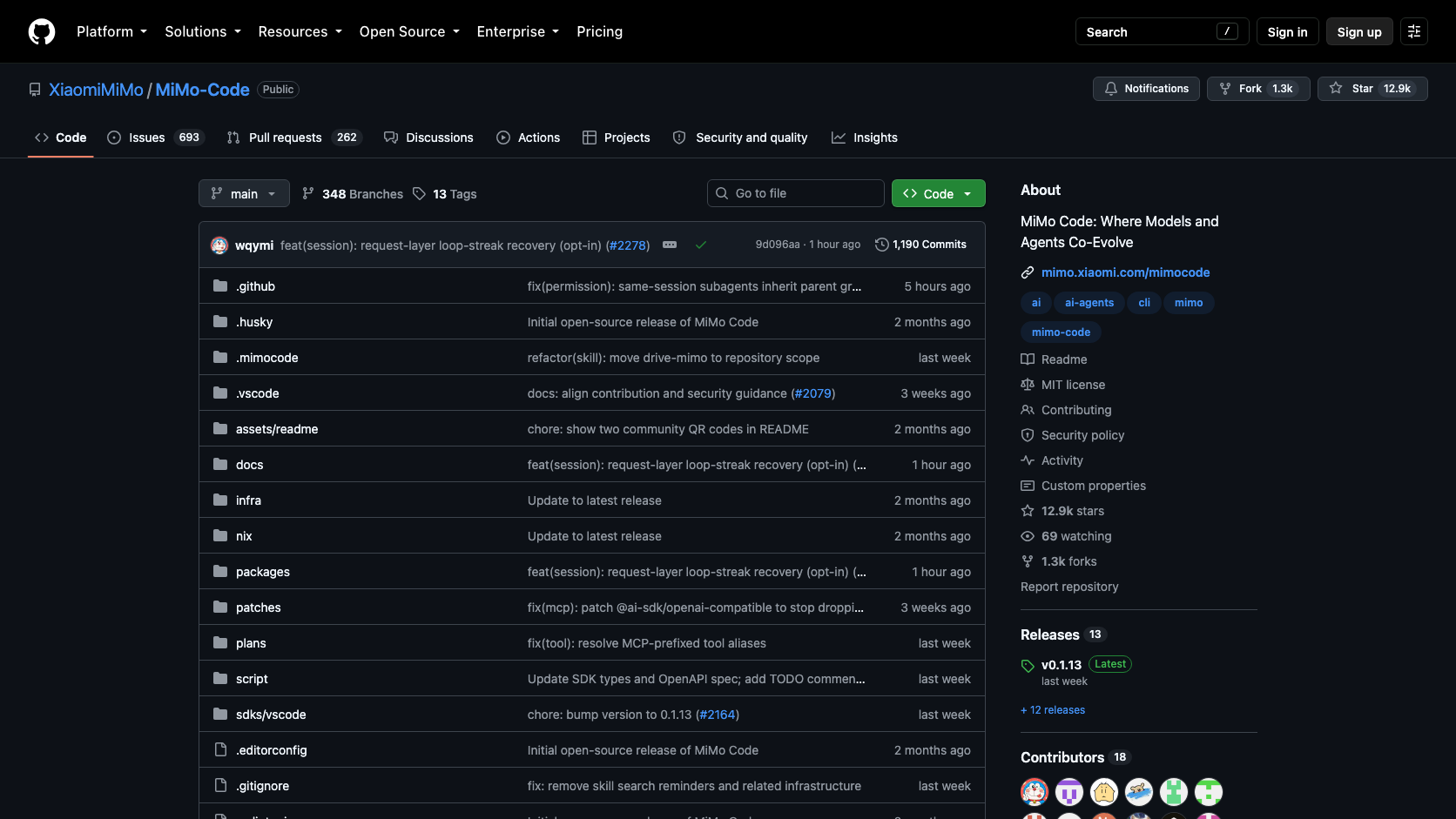
MiMo Code is Xiaomi's terminal-native coding harness. It extends an OpenCode foundation with MiMo-focused workflows, memory, subagents, and reusable compositions.
Information checked: Aug 29, 2026 ·View sources
Tool details
- Type
- CLI agents
- Platforms
- macOS, Linux, Windows terminals
- Free plan
- Yes
- Open source
- Yes
- Bring your own key
- Yes
- Local models
- Yes
Overview
Best for
- Developers seeking an open-source terminal coding agent.
- MiMo model users who want a first-party harness.
- Teams experimenting with memory and reusable agent compositions.
Strengths
- Open-source and modifiable under the MIT license.
- Persistent memory and Compose add durable workflows.
- OpenCode roots make the architecture familiar to open-harness users.
- Supports provider-controlled and self-managed configurations.
Limitations & trade-offs
- Teams that need a mature commercial support contract.
- Users who prefer a polished visual IDE.
- Organizations that do not want to manage model credentials.
- A younger ecosystem than Claude Code or Codex CLI.
- Open-source setup requires users to manage provider keys and updates.
- Some documentation and community material may be bilingual.
- Provider compatibility and tool behavior should be validated per environment.
Get started
Pricing & usage limits
Free tier available
Open-source software$0
The MIT-licensed agent is free; model API or infrastructure charges may still apply.
Pricing checked: Aug 29, 2026 · Subscription, usage limits, and model costs may be billed separately.
Features & details
Agent Modes
- Build mode for implementation
- Plan mode for structured reasoning
- Compose reusable workflows
- Persistent project memory
Orchestration
- Specialized subagents
- Multi-step task delegation
- Workflow composition
- Long-session context management
Open Harness
- MIT-licensed source code
- OpenCode-based architecture
- Provider configuration
- Terminal-native operation
MiMo Code Review 2026
MiMo Code is Xiaomi's open-source terminal coding agent, built from the OpenCode foundation with persistent memory, Build and Plan modes, subagent orchestration, and reusable Compose workflows.
What Is MiMo Code?
MiMo Code is Xiaomi's terminal-native coding harness. It extends an OpenCode foundation with MiMo-focused workflows, memory, subagents, and reusable compositions.
It is not only a model wrapper: the project adds persistent memory, orchestrated subagents, and Compose workflows on top of a familiar open agent foundation.
Core Features
Agent Modes
- Build mode for implementation
- Plan mode for structured reasoning
- Compose reusable workflows
- Persistent project memory
Orchestration
- Specialized subagents
- Multi-step task delegation
- Workflow composition
- Long-session context management
Open Harness
- MIT-licensed source code
- OpenCode-based architecture
- Provider configuration
- Terminal-native operation
How It Fits an Agentic Development Workflow
MiMo Code is most useful when its permissions, repository scope, model access, and review checkpoints are configured before the first large task. Start with a bounded project, verify the generated changes or analysis, and only then expand access. This matters because agentic tools can move faster than a conventional assistant and can also amplify a bad assumption.
For teams, the practical evaluation should cover setup time, context quality, task completion rate, review burden, model or infrastructure cost, security controls, and how easily a human can interrupt or redirect work.
Best Use Cases
- Developers seeking an open-source terminal coding agent.
- MiMo model users who want a first-party harness.
- Teams experimenting with memory and reusable agent compositions.
Pricing
- Open-source software: $0. The MIT-licensed agent is free; model API or infrastructure charges may still apply.
Pricing and limits can change quickly. The figures or plan descriptions above were checked against official information on 2026-08-29; verify the official site before purchasing.
Privacy, Security, and Deployment
The agent can run from source, but privacy depends on the configured model provider and tools. Review API retention, shell permissions, MCP servers, and stored memory before use with sensitive repositories.
Any coding agent or developer tool with repository, terminal, browser, or secret access should be introduced with least-privilege credentials, protected branches, mandatory review, isolated test environments, and clear log-retention rules.
Limitations
- A younger ecosystem than Claude Code or Codex CLI.
- Open-source setup requires users to manage provider keys and updates.
- Some documentation and community material may be bilingual.
- Provider compatibility and tool behavior should be validated per environment.
Alternatives
- OpenCode
- Claude Code
- Qwen Code
- Gemini CLI
- Goose
The best alternative depends on whether the priority is an AI-native editor, a terminal harness, autonomous cloud execution, code review, mobile control, or a shared orchestration layer.
Verdict
A credible open-source CLI agent with more differentiation than a thin model wrapper, especially for users who value persistent memory and composable subagent workflows.
Official Sources
Model support & data privacy
Supported models
- Xiaomi MiMo
- OpenAI-compatible providers
- Provider integrations inherited from OpenCode
Privacy & data handling
The agent can run from source, but privacy depends on the configured model provider and tools. Review API retention, shell permissions, MCP servers, and stored memory before use with sensitive repositories.
Guides, reviews & fixes
No published guides yet. Start with the official documentation above.
Product updates
No verified product updates listed yet. Follow this tool to see new relevant content in Saved.
See the content timelineAlternatives
OpenCodeOpenCode is an open-source coding-agent harness for terminal, desktop, and IDE workflows with broad provider support, BYOK, and an optional OpenCode Go subscription for curated open models. Claude CodeClaude Code is Anthropic's terminal coding agent for repository work, subagents, hooks, MCP, and automation, with growing operational tooling for API cost analysis and feedback.
 Qwen CodeQwen Code is an open-source terminal coding agent optimized for Qwen Coder models and designed for developers who want agentic code understanding, editing, automation, and tool use from the command line.
 Gemini CLIGemini CLI is Google’s open-source terminal coding agent for Gemini-powered development workflows, now positioned as a legacy tool transitioning toward Antigravity CLI for future agent-first development.
 GooseGoose is a general developer agent that emphasizes open infrastructure, provider choice, and extensibility. It can operate as a desktop application, a terminal agent, or an API component.
Sources & verification
Verification dates record when this directory checked the information. Product release dates appear separately above.
Directory revision history
Created a complete English draft profile from current official sources; kept unpublished for editorial review.