On This Page8 sections
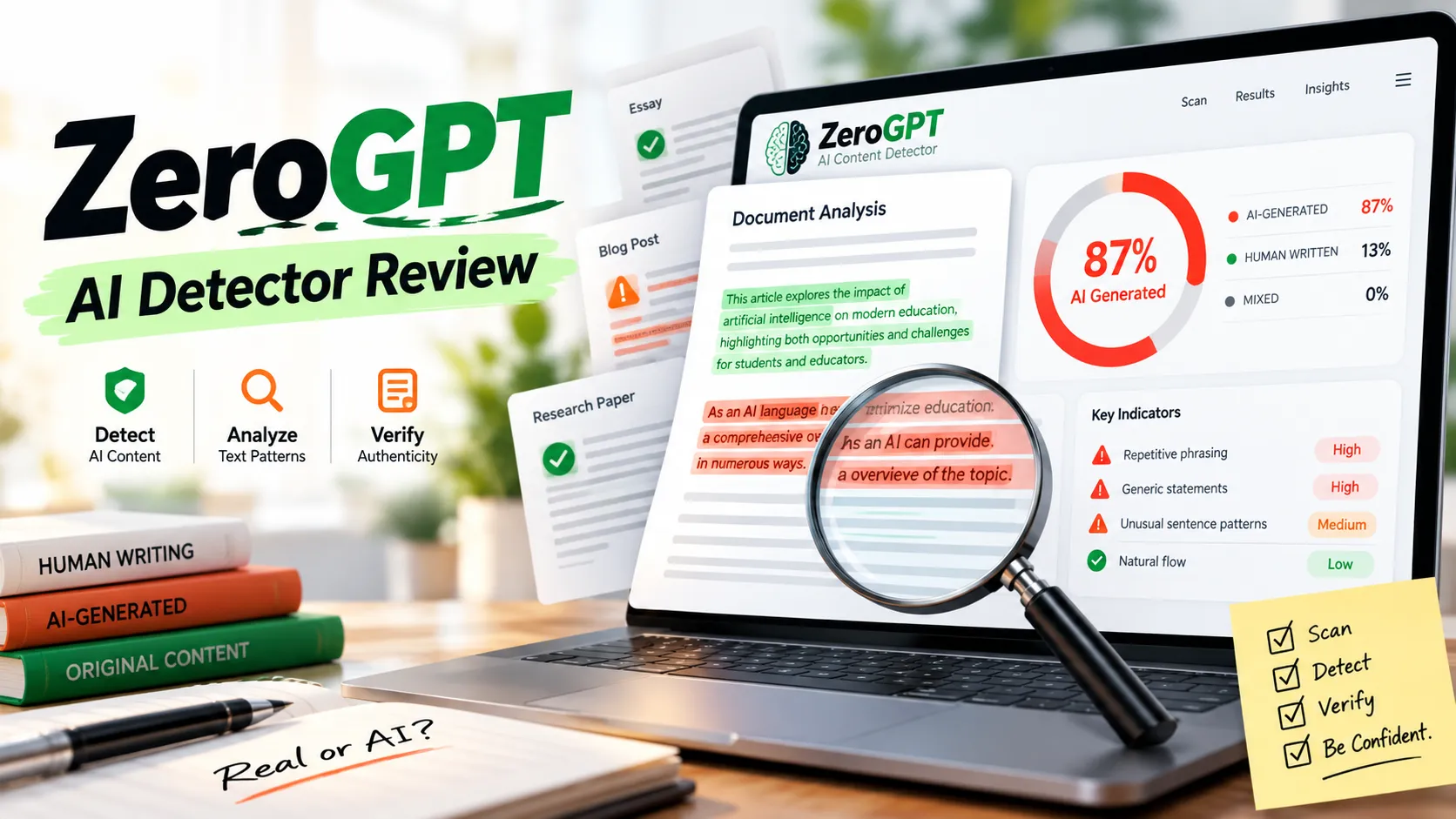
ZeroGPT is one of the most recognizable AI content detection tools, offering a quick way to assess whether text may have been generated by ChatGPT, Claude, Gemini, or another large language model. Its appeal is straightforward: paste text into a browser, run a scan, and receive an AI detection score with highlighted passages.
However, the growing use of AI detectors in education, publishing, recruitment, and SEO has raised an important question: Can ZeroGPT reliably distinguish human writing from AI-generated content?
The answer is more complicated than the percentage displayed by the tool. ZeroGPT offers a convenient detection workflow, but independent research has documented meaningful accuracy limitations and false-positive risks.
This 2026 review examines ZeroGPT's functionality, detection methodology, independent benchmark results, pricing, privacy policies, and practical alternatives. It also explains how to interpret detection scores without confusing statistical predictions with proof of authorship.
Key Takeaways
- ZeroGPT is an AI content detector and writing toolkit available at zerogpt.com. Its core feature estimates whether written content resembles text produced by a large language model.
- Free AI detection is available. In October 2026, the public detection interface displayed a 15,000-character input limit. Account requirements and additional usage restrictions may vary.
- ZeroGPT reports accuracy exceeding 98% in its internal evaluations, but that figure should not be interpreted as independently verified performance across every writing style, language, and AI model.
- A 2025 peer-reviewed study reported 64.35% accuracy and a 16.67% false-positive rate for ZeroGPT in one academic-text detection scenario.
- A May 2026 community benchmark reported 88.2% accuracy and an 18.4% human false-positive rate across 1,000 English-language samples. This was an independently published community test, not a peer-reviewed study.
- Detection scores are not proof of authorship. Human-written text can be flagged as AI, while edited AI-generated text can escape detection.
- ZeroGPT and GPTZero are different products. Their similar names should not be confused when comparing features, accuracy, or subscription plans.
- The best use of ZeroGPT is preliminary content screening, followed by human review and stronger evidence when the outcome could affect a person's education, employment, or reputation.
What Is ZeroGPT?
ZeroGPT is a web-based AI detection platform designed to identify writing patterns associated with text-generating artificial intelligence systems.
Rather than identifying a specific author, ZeroGPT analyzes submitted text and produces a classification indicating whether it appears human-written, AI-generated, or potentially mixed.
The platform is marketed toward several audiences:
- Students: Reviewing written assignments and understanding AI detection results.
- Educators: Screening essays and other academic submissions for possible AI assistance.
- Editors and publishers: Reviewing externally submitted articles and manuscripts.
- SEO professionals: Checking content production workflows and investigating heavily templated writing.
- Businesses: Screening content submissions and supporting editorial quality assurance.
- Researchers: Exploring how AI-generated and human-written passages differ statistically.
ZeroGPT has also expanded beyond text detection into an AI productivity suite. Its official website lists tools for plagiarism checking, paraphrasing, summarization, grammar correction, translation, AI humanization, and AI-generated image and video detection.
According to its October 7, 2026 Terms of Use, ZeroGPT is operated by Olive Works LLC, a Wyoming-based company in the United States.
The service should not be confused with GPTZero, an independently operated AI detection platform with a different product offering and development history.
How Does the ZeroGPT AI Detector Work?
ZeroGPT describes its detection technology as DeepAnalyse, a proprietary system that examines linguistic and statistical patterns associated with machine-generated text.
According to the official ZeroGPT FAQ, its approach incorporates token patterns, entropy, burstiness, and features learned by classification models trained on human and AI-generated writing.
These concepts help explain why an AI detector can sometimes identify machine-generated text, but they also explain why mistakes occur.
1. Text predictability and perplexity
Large language models predict likely sequences of tokens. Some AI-generated passages contain highly predictable wording, sentence transitions, and grammatical structures.
Perplexity is a statistical measure associated with how predictable a sequence is to a language model. Lower perplexity can sometimes indicate repetitive or conventional wording.
However, predictable writing is not exclusive to AI. Technical documentation, standardized business reports, and essays written by non-native English speakers may also contain relatively predictable language.
2. Burstiness and sentence variation
Burstiness broadly describes variation in linguistic patterns, such as sentence length and complexity.
Human writing may alternate between short statements, long explanations, unusual expressions, and stylistic inconsistencies. Some AI-generated passages are more uniform.
These are tendencies rather than reliable rules. A skilled human writer may produce exceptionally consistent prose, while an AI model can generate varied and unconventional sentences.
3. Learned classification patterns
Modern detection systems can use trained classifiers to recognize combinations of linguistic signals that distinguish examples of human writing from examples of AI output.
Their performance depends on the representativeness of their training data, the types of models evaluated, document length, language, and editing history.
A detector trained primarily on one generation of language models may perform differently when evaluating newer models or heavily revised content.
4. Sentence-level highlighting
ZeroGPT displays highlighted passages that its system identifies as more consistent with AI-generated writing.
This helps reviewers locate suspicious sections, but highlighting does not establish that a particular sentence was produced by an AI model.
An important technical distinction is that ZeroGPT generally makes predictions from the submitted text itself. It is not equivalent to checking a verified document creation history, an authenticated watermark, or a record of the prompts used to generate the content.
How to Use ZeroGPT: Step-by-Step Guide
ZeroGPT's main detection workflow can be completed in a browser without installing specialized software.
Step 1: Open the official website
Visit zerogpt.com and locate the AI detection interface.
Be careful with similarly named websites. Different domains using ZeroGPT-like branding may be operated by unrelated services and may have different privacy policies or subscription terms.
Step 2: Prepare the document
Copy the text to be evaluated. Where possible, use at least 150–200 words.
ZeroGPT's own FAQ recommends this minimum and states that longer passages, particularly those containing 500–1,000 words or more, generally produce more stable assessments.
For longer documents, preserve logical paragraph boundaries and avoid combining unrelated authors or writing styles into one sample.
Step 3: Paste or upload the content
Enter the text into the detection field or use the available file upload feature.
ZeroGPT documents support for common text formats, including TXT, DOCX, and text-based PDF documents.
Scanned PDFs may require optical character recognition before their contents can be analyzed reliably.
Step 4: Run the detection
Select the detection action and allow the platform to analyze the submitted content.
The result typically includes an overall assessment and highlighted passages.
Step 5: Interpret the findings carefully
Review the full document rather than concentrating exclusively on its overall score.
For example, a document may contain standardized introductions, quotations, technical definitions, or frequently used explanations that resemble AI-generated language despite having been written by a human.
Step 6: Investigate important discrepancies
If a human-written document receives a high AI score, compare the flagged passages with available drafting evidence, document revisions, citations, and the author's normal writing style.
A secondary detector may provide another opinion, but agreement between two classifiers is not equivalent to independent proof.
Is ZeroGPT Accurate? Independent Research and 2026 Benchmark Results
ZeroGPT's reliability is the most consequential aspect of its product offering.
The company describes its detection model as highly accurate and reports results exceeding 98% in internal evaluations. However, such figures depend on testing conditions, including the text samples selected, classification thresholds, and versions of the models being evaluated.
Independent evaluations show that performance can differ substantially.
2025 peer-reviewed research
A study by Ahmad R. Pratama, published in PeerJ Computer Science in June 2025, compared ZeroGPT, GPTZero, and DetectGPT in academic writing scenarios.
The research examined original scholarly abstracts, AI-generated abstracts, and AI-assisted revisions using language models including ChatGPT o1 and Gemini 2.0 Pro Experimental.
In the study's first experimental scenario, ZeroGPT recorded:
| Metric | ZeroGPT result |
|---|---|
| Overall classification accuracy | 64.35% |
| Human false-positive rate | 16.67% |
| AI false-negative rate | 45.14% |
The false-positive rate represents human-written samples incorrectly classified as AI-generated. The false-negative rate represents AI-generated samples incorrectly classified as human-written.
These results are specific to the study's datasets and experimental conditions, not a universal measurement of ZeroGPT's current accuracy.
The full research is available through PeerJ Computer Science.
May 2026 independent community benchmark
A publicly documented 2026 AI Detector Benchmark evaluated four detectors using 1,000 English-language text samples, evenly divided between 500 human-written and 500 AI-generated examples.
The evaluation was completed on May 14, 2026.
| Detector | Overall accuracy | Human false-positive rate |
|---|---|---|
| GPTZero | 98.70% | 2.20% |
| GPTHumanizer | 98.00% | 0.00% |
| Sapling | 88.60% | 19.40% |
| ZeroGPT | 88.20% | 18.40% |
ZeroGPT correctly identified 474 of the 500 AI-generated samples, corresponding to a 94.8% AI detection rate. However, it also incorrectly flagged 92 of the 500 human-written samples.
The benchmark is useful because it discloses sample counts, prediction rules, evaluation scripts, and limitations. Nevertheless, it is a community-maintained evaluation rather than a peer-reviewed academic publication. Its results should be interpreted within the scope of the published dataset and methodology.
What do these studies establish?
The two evaluations measured different datasets, detection conditions, and periods. Their accuracy percentages cannot be compared directly to establish whether ZeroGPT improved or deteriorated between 2025 and 2026.
They do establish an important practical point: ZeroGPT can detect many AI-generated passages, but false positives remain a meaningful risk.
No single benchmark can establish a permanent accuracy percentage for a continuously updated AI detector.
Why False Positives Matter More Than They First Appear
A false positive occurs when an AI detector incorrectly identifies human-written content as AI-generated.
This error can be particularly damaging in academic and professional settings because the consequence may be an accusation rather than a simple content-quality warning.
The problem becomes clearer when detection results are considered alongside the actual prevalence of AI-generated submissions.
Consider a hypothetical collection of 1,000 documents in which 10% are AI-generated and 90% are human-written.
Applying the sensitivity and false-positive rate reported for ZeroGPT in the May 2026 benchmark produces approximately the following outcomes:
| Hypothetical outcome | Estimated documents |
|---|---|
| Actual AI-generated documents | 100 |
| Actual human-written documents | 900 |
| AI documents correctly flagged | 95 |
| Human documents incorrectly flagged | 166 |
| Total documents flagged as AI | 261 |
Under these assumptions, only about 36% of flagged documents would actually be AI-generated.
This is an illustrative calculation, not an observed real-world result. It assumes the benchmark's detection characteristics transfer unchanged to the hypothetical document collection, which may not occur in practice.
Nevertheless, it demonstrates the base-rate problem: even a detector that identifies a high percentage of AI-generated samples can produce many incorrect accusations when most submitted documents are genuinely human-written.
For schools, publishers, and employers, the human false-positive rate can therefore be more consequential than headline detection accuracy.
Can ZeroGPT Detect ChatGPT, Claude, Gemini, and Other AI Models?
ZeroGPT markets its detector as supporting text generated by multiple large language model families, including OpenAI's GPT models, Anthropic's Claude, and Google's Gemini.
The official website also references other model families such as DeepSeek and Grok.
However, advertised model coverage is not the same as independently validated performance for every model version.
Detection difficulty changes according to several factors:
- Model generation: Newer models may produce different linguistic patterns from older systems.
- Prompt complexity: Detailed instructions can significantly alter vocabulary, tone, structure, and sentence variation.
- Editing intensity: Human revision can change the statistical characteristics of initially AI-generated text.
- Text length: Short passages provide fewer signals for classification.
- Subject matter: Academic, legal, technical, and formulaic writing can resemble model-generated content.
- Language: Detection accuracy in English does not automatically establish equivalent reliability across other languages.
- Mixed authorship: A document combining human and AI writing may be harder to categorize than fully human or fully machine-generated text.
A particularly important limitation involves heavily edited text. Once a human substantially rewrites AI output, the distinction between human authorship and AI assistance becomes less clear.
Similarly, a document written by a human and corrected with an AI grammar assistant may exhibit some machine-associated patterns without being predominantly AI-authored.
These limitations make provenance evidence, disclosure policies, and editorial judgment important complements to automated detection.
Does ZeroGPT Detect Human Writing as AI?
Yes. Human-written material can receive an AI classification.
One explanation is that detectors evaluate statistical features rather than observing the writing process directly.
A highly structured document may use predictable sentence constructions, conventional transitions, and limited vocabulary, all of which can overlap with patterns learned from AI-generated text.
Academic research has also identified fairness concerns.
In a 2023 study published in Patterns, researchers led by Weixin Liang examined AI detector behavior on writing by native and non-native English speakers.
Across seven detectors in that study, the average false-positive rate for essays by non-native English writers was 61.3%. The investigation suggested that limited linguistic variation and greater text predictability contributed to classification bias.
This 61.3% figure is a result across the detectors studied, not a ZeroGPT-specific accuracy measurement.
The broader finding remains relevant: writing style, language proficiency, and document type can influence detection outcomes.
The research is available in Patterns.
If original human writing receives a suspicious score, the appropriate response is to examine supporting evidence rather than automatically rewrite the content to satisfy the detector.
Useful evidence may include document revision history, earlier drafts, research notes, citations, and records of the actual writing process.
How Should ZeroGPT AI Detection Scores Be Interpreted?
A displayed AI percentage can appear more definitive than it actually is.
For example, a score of 85% should not automatically be interpreted as an independently calibrated 85% probability that a particular person used AI.
A model's percentage can represent an internal classification score, an estimated proportion of AI-like content, or another proprietary measure, depending on how the system defines its output.
Without an independently validated calibration procedure, the score should be treated as a screening signal rather than a forensic probability.
A responsible interpretation follows three principles:
1. Separate suspicion from proof. A high AI score indicates that the detector found patterns it associates with AI-generated text. It does not independently establish the document's creation history.
2. Consider the type of writing. A standardized legal clause, a short product description, and a personal narrative should not necessarily be interpreted using identical expectations.
3. Review supporting information. Detection results become more useful when combined with author interviews, revisions, source verification, and relevant editorial policies.
For content operations, scores are most useful for prioritizing review rather than automatically accepting or rejecting submissions.
ZeroGPT Free vs. Paid: Pricing and Usage Limits
ZeroGPT provides free access to its core detection functionality and offers additional subscription and business options.
As of October 2026, the official pricing page identifies the following categories:
| Plan category | Intended use | Important considerations |
|---|---|---|
| Free | Occasional AI detection and basic writing tools | Usage and character limits apply |
| Personal subscriptions | Individuals requiring higher usage or additional functionality | Confirm current billing and included features |
| Business and Education | Organizational workflows and team usage | Compare document allowances, administrative features, and billing terms |
| Enterprise | Customized organizational deployments | Commercial arrangements and security requirements may require negotiation |
| API access | Programmatic content analysis and integrations | Usage-based billing and API-specific restrictions may apply |
The public detection field displayed a limit of 15,000 characters during the October 2026 website review. That interface limit should not be confused with a guaranteed daily allowance or a universal limit across all account types.
ZeroGPT's pricing page also advertises discounts for annual billing. Because promotional discounts, included quotas, and subscription prices may change, the checkout page should be treated as authoritative before purchasing.
Organizations considering paid access should compare the total cost per document rather than focusing exclusively on the advertised monthly subscription price.
For example, a publisher scanning thousands of articles should consider average article length, expected scan frequency, whether individual paragraphs require additional checks, and whether batch processing is included.
What Other Features Does ZeroGPT Offer?
ZeroGPT has evolved into a broader writing and content verification platform.
AI Humanizer
The humanizer reformulates text to make it read more naturally. It can be useful for editing repetitive phrasing, but there is no universal guarantee that rewritten material will escape AI detection or preserve every factual detail.
Plagiarism Checker
The plagiarism checker searches for similarities with existing sources. This addresses a different question from AI detection.
A document can be entirely human-written and still contain plagiarism. Conversely, AI-generated text may not match existing sources closely enough to trigger a plagiarism result.
AI Paraphraser
The paraphraser rewrites passages while attempting to preserve meaning. All outputs should be checked for factual consistency, attribution, and unwanted changes in emphasis.
Grammar and Spelling Checker
This feature helps identify grammar, spelling, and punctuation problems, making it relevant to routine editorial quality control.
AI Summarizer
The summarizer condenses longer text into shorter explanations or key points. Its output should be checked against the original source, especially for numerical or technical material.
AI Image and Video Detectors
ZeroGPT also advertises separate tools for evaluating potentially AI-generated images and videos. These are distinct services from the text detector and should not be assumed to share the same accuracy characteristics.
API and Batch Processing
ZeroGPT offers API-related functionality for businesses integrating content analysis into existing workflows. Its documentation references options such as batched processing, usage management, and organizational controls.
For developers, API availability does not eliminate the need to validate error handling, classification thresholds, rate limits, version changes, and privacy requirements.
ZeroGPT vs. GPTZero: What Is the Difference?
ZeroGPT and GPTZero are separate AI detection services, despite having very similar names.
| Category | ZeroGPT | GPTZero |
|---|---|---|
| Main purpose | AI text detection and writing utilities | AI text detection and authorship review |
| Free access | Available with restrictions | Available with restrictions |
| Detection output | Overall assessment and highlighted text | Detection results with passage-level analysis |
| Additional tools | Humanizer, paraphraser, plagiarism checker, image and video tools | Features oriented toward writing analysis and verification |
| Organizational use | API, education, business and enterprise options | Education, publishing and organizational workflows |
| Independent accuracy | Mixed performance across published studies | Strong performance in certain published benchmarks |
In the 2025 academic study discussed earlier, GPTZero achieved 97.22% accuracy in the first experimental scenario, compared with 64.35% for ZeroGPT.
The May 2026 community benchmark also reported higher overall accuracy and fewer human false positives for GPTZero than for ZeroGPT.
These findings support considering GPTZero as an alternative for users prioritizing detection accuracy. However, they do not establish that GPTZero will outperform ZeroGPT on every future model, writing style, or dataset.
The practical distinction is product focus: ZeroGPT combines detection with a broad collection of writing tools, while GPTZero places greater emphasis on authorship analysis and verification workflows.
Best ZeroGPT Alternatives in 2026
The most suitable alternative depends on the specific review task, acceptable false-positive risk, and integration requirements.
| Tool | Main use case | Considerations |
|---|---|---|
| GPTZero | Educational and professional AI writing assessment | Compare institutional features and current detector validation |
| Copyleaks | Enterprise AI detection and plagiarism workflows | Evaluate integration requirements, language support, and volume-based costs |
| Originality.ai | Publisher-oriented content screening | Confirm current model performance and scanning allowances |
| Sapling AI Detector | AI text detection and developer-oriented workflows | Review detection thresholds and supported languages |
| Turnitin | Academic integrity and institutional review | Availability and functionality depend on institutional access |
| ZeroGPT | Quick checks combined with writing utilities | Convenient workflow, but independent tests identify false-positive risks |
No detector should be selected solely because it publishes the highest accuracy claim.
For high-volume use, a more defensible evaluation compares false positives, false negatives, supported languages, document formats, cost, retention policies, and performance on representative content.
Is ZeroGPT Safe? Privacy and Data Handling
ZeroGPT's privacy practices matter because users may submit unpublished articles, academic research, commercial documents, or other material that has not been publicly released.
Its Privacy Policy, updated October 7, 2026, states that private user content is not used to train, retrain, or fine-tune AI models.
The policy also states that user content may be processed by service providers when required to operate the platform.
An important distinction concerns retention.
While ZeroGPT's FAQ emphasizes that submitted text is not published or used for model training, its detailed privacy policy allows temporary processing and retention where reasonably necessary for operations, security, diagnostics, backups, legal compliance, and similar purposes.
Therefore, a no-training commitment should not be interpreted as proof that every copy of submitted content disappears immediately after a scan.
Recommended precautions:
- Avoid uploading confidential contracts, unpublished inventions, personal records, or sensitive customer information without appropriate authorization.
- Remove personal identifiers and confidential information when testing document samples.
- Review the current privacy policy rather than relying exclusively on marketing claims.
- For business or institutional use, verify retention terms, subprocessors, data processing agreements, and available deletion controls.
- Consider an approved internal evaluation process when documents cannot be transmitted to third-party services.
For ordinary public writing, ZeroGPT may be a convenient screening tool. For confidential material, legal and organizational data-handling requirements should take priority over convenience.
Should SEO Writers Use ZeroGPT to Check AI Content?
AI content detection is sometimes promoted as a way to determine whether an article will perform well in Google Search.
That interpretation is misleading.
Google's official guidance on generative AI content emphasizes helpfulness, originality, reliability, and compliance with spam policies.
The use of AI does not automatically make an article low quality. Conversely, text that receives a human classification from ZeroGPT is not automatically useful, accurate, original, or search-engine compliant.
For SEO professionals, the more important questions are whether the article:
- Provides information that directly satisfies the reader's search intent.
- Includes original examples, evidence, demonstrations, or analysis.
- Presents accurate claims with appropriate supporting references.
- Avoids unnecessary repetition and keyword stuffing.
- Demonstrates relevant expertise and editorial accountability.
- Clearly distinguishes verified information from estimates or speculation.
- Offers meaningful value beyond competing search results.
A human-written article with inaccurate claims and thin content can still perform poorly. An AI-assisted article containing substantial research, original analysis, and careful human review may offer readers considerable value.
ZeroGPT scores should not be used as a replacement for E-E-A-T evaluation or editorial quality control.
How to Evaluate an AI Detector Before Using It Professionally
Organizations adopting ZeroGPT or another detector should conduct a small, representative validation rather than relying entirely on vendor claims.
A practical evaluation framework includes the following steps.
1. Assemble a labeled sample collection. Include verified human writing, known AI output, and mixed-authorship documents. Preserve the creation history so labels can be independently checked.
2. Match the real workload. A university should evaluate authentic academic writing. A publisher should include articles resembling the genres and lengths it normally accepts.
3. Include difficult cases. Test short passages, technical documentation, non-native English writing, translated text, heavily edited AI output, and standardized templates.
4. Measure several outcomes. Record overall accuracy, false-positive rate, false-negative rate, and performance by language and document length.
5. Evaluate uncertain cases. Determine whether the review process allows authors to provide drafts, references, or other evidence before a decision is made.
6. Repeat evaluations after product changes. Detection services may update classifiers without announcing every technical change. Historical benchmark results can become outdated.
7. Establish human review requirements. Define which decisions can be automated and which require additional investigation or independent authorization.
This methodology produces evidence that is more relevant to an organization's actual documents than a generic headline accuracy percentage.
Frequently Asked Questions About ZeroGPT
Is ZeroGPT free?
Yes. ZeroGPT advertises free access to its AI detection tools, subject to usage restrictions. It also offers paid subscriptions, business services, and API access. The official pricing page should be checked for current allowances and billing terms.
Is ZeroGPT 100% accurate?
No. No independently established evidence supports treating ZeroGPT as a perfectly accurate authorship detector. Published studies and community benchmarks have documented both false positives and false negatives.
Can ZeroGPT detect ChatGPT-generated writing?
ZeroGPT is designed to identify patterns associated with ChatGPT and other language models. Detection success depends on the model version, writing style, text length, editing history, and evaluation conditions.
Can ZeroGPT detect Claude and Gemini?
ZeroGPT advertises detection coverage for multiple AI model families, including Claude and Gemini. However, the existence of model coverage does not guarantee equal accuracy for every version or output type.
Why does ZeroGPT say human-written content is AI?
Human writing can contain predictable vocabulary, standardized structures, and low-variation phrasing that overlap with characteristics of AI-generated text. Detection errors can also arise from limited samples, domain differences, and model calibration.
Can a ZeroGPT result prove academic cheating?
No. A detection score should not serve as the sole basis for an academic misconduct finding. Appropriate review includes institutional policy, document history, additional evidence, and an opportunity for the author to respond.
Does ZeroGPT check plagiarism?
Yes. ZeroGPT offers a separate plagiarism checker. Plagiarism detection evaluates similarity to existing sources, whereas AI detection estimates whether writing resembles machine-generated content. These functions answer different questions.
Does ZeroGPT work with PDF documents?
ZeroGPT documents support for text-based PDF files. Image-only or scanned PDFs may require OCR before reliable text analysis is possible.
Does ZeroGPT save submitted text?
ZeroGPT states that private user content is not used for AI model training. Its detailed privacy policy nevertheless permits processing and limited retention for specified operational, security, backup, and legal purposes. Sensitive content should be handled accordingly.
Is ZeroGPT better than GPTZero?
The answer depends on the intended use. ZeroGPT offers a broad writing toolkit, while GPTZero emphasizes AI detection and authorship review. Certain independent benchmarks have reported stronger detection performance for GPTZero, but results may differ across datasets and future product versions.
Can ZeroGPT determine whether Google considers content AI-generated?
No. A ZeroGPT score is not an official Google Search classification. Google evaluates content using its own ranking and spam systems, and ZeroGPT results should not be presented as a direct measurement of Google ranking quality.
Conclusion
ZeroGPT remains a convenient option for users who want quick AI content screening without configuring a complicated detection system. Its accessible interface, sentence-level highlighting, and collection of supplementary writing tools make it practical for preliminary review.
However, the strongest conclusion from independent research is that detection results require context. ZeroGPT's advertised internal accuracy claims should be distinguished from external evaluations, including a 2025 peer-reviewed academic study reporting 64.35% accuracy in one scenario and a May 2026 community benchmark reporting 88.2% accuracy with an 18.4% human false-positive rate.
These findings do not establish a permanent accuracy figure. They demonstrate why automated authorship classification should be treated as probabilistic screening rather than definitive evidence.
For casual content checks, ZeroGPT provides an accessible starting point. For education, publishing, recruitment, or compliance, organizations should prioritize transparent evaluation, low false-positive risk, and human oversight.
To evaluate ZeroGPT responsibly, visit the official AI detector, compare several non-sensitive samples with known authorship, and review the results alongside independent evidence before relying on the tool for important decisions.
Continue Reading
More articles connected to the same themes, protocols, and tools.



Referenced Tools
Browse entries that are adjacent to the topics covered in this article.