On This Page8 sections
Key Takeaways
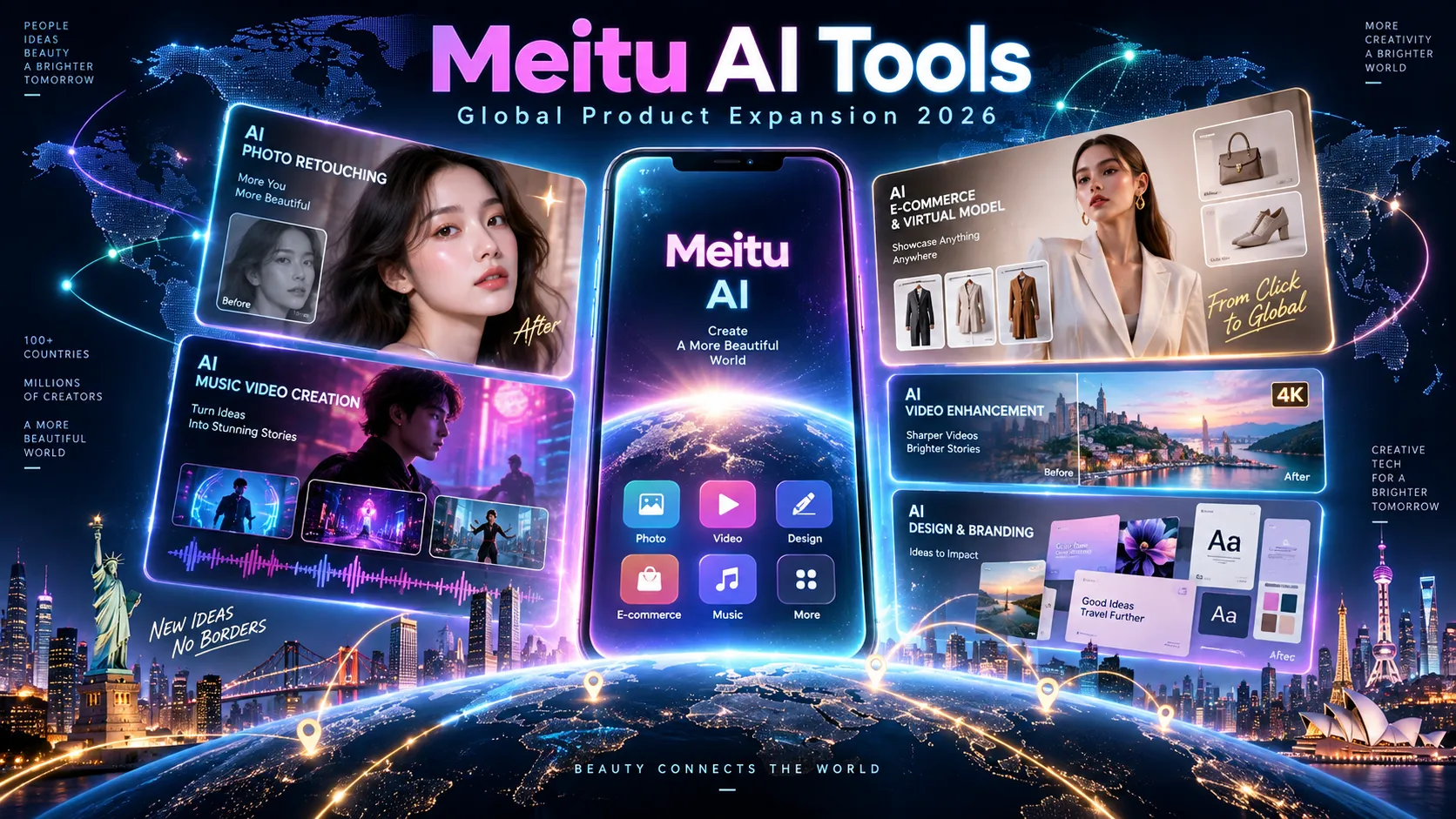
- Meitu is evolving from a photo-editing company into a global AI product ecosystem. Its publicly identifiable portfolio spans 26 products and service offerings across consumer imaging, commercial video, e-commerce, professional retouching, AI Agents, and developer infrastructure.
- Picchi reached $1.11 million in annual recurring revenue (ARR) as of October 9, 2026, equivalent to approximately $92,500 in monthly recurring revenue (MRR) on a simple ARR-divided-by-12 basis.
- MVLAND reached $680,000 ARR, representing approximately $56,667 in monthly revenue run rate. Both products emerged from Meitu's internal AI innovation studio program.
- Vmake Labs reached approximately $5 million ARR by June 2026, equivalent to an estimated monthly recurring revenue run rate of $416,667, making it one of Meitu's most commercially significant disclosed AI-native international products.
- Ten internal AI innovation studios were established over the preceding year. Two demonstrated product-market fit, seven remained in operation, and three had ended exploration as of Meitu's 18th anniversary.
- Meitu's AI strategy now prioritizes product judgment over raw AI productivity. Management believes selecting the right customer problem matters more than generating additional code, images, or features.
- Most individual product revenue figures remain undisclosed. The MRR estimates in this article are calculations derived from reported ARR, not separately verified monthly receipts.
Meitu at 18: From Beauty Apps to a Global AI Product Portfolio
On October 10, 2026, Chinese imaging technology company Meitu celebrated its 18th anniversary. Founder, Chairman, and CEO Wu Xinhong used the occasion to introduce the company's AI organizational evolution strategy, version 2.0.
The announcement offered a rare look inside the commercial operations of a major consumer software company transitioning toward AI-native products.
For more than a decade, Meitu was primarily associated with photo editing, beautification, selfie cameras, and video enhancement. Products such as Meitu, BeautyCam, and Wink built significant consumer audiences.
The company's newer portfolio tells a different story.
Rather than attempting to incorporate every emerging AI capability into one super-app, Meitu is developing specialized products for different audiences and workflows.
Examples include:
- Picchi, which learns photographers' preferred editing styles.
- MVLAND, which converts music into structured video productions.
- Vmake Labs, which creates social video advertisements and marketing content.
- KOOZEE, which produces fashion photography and virtual try-on imagery for online sellers.
- Designkit, which organizes commercial design and marketing workflows around AI Agents.
- RoboNeo, which explores collaborative AI Agents for short-form drama production.
These products target different users, purchasing motivations, and monetization opportunities.
The company is effectively combining a mature consumer software business with an internal system for launching smaller, specialized AI companies.
Meitu's June 2026 product announcement explicitly described a shift from delivering isolated software functions toward delivering complete creative outcomes.
That distinction explains much of the company's current direction.
Meitu's 2026 Business Performance: The Financial Foundation
Meitu's global expansion is supported by a substantial existing business.
According to its 2026 interim results, covering the six months ended June 30, 2026:
| Metric | Reported result | Significance |
|---|---|---|
| Total revenue from continuing operations | RMB 2.21 billion | Up 22.1% year over year |
| Photo, video, and design product revenue | RMB 1.77 billion | Up 30.9% year over year |
| Adjusted net profit attributable to owners | RMB 652 million | Up 39.5% year over year |
| Global monthly active users | 282 million | Large existing distribution base |
| Monthly active users outside mainland China | More than 100 million | Meaningful international reach |
| Global paying subscribers | 18.44 million | Approximately 6.5% subscription penetration |
| Paying subscribers for productivity applications | 2.35 million | Growing professional and commercial segment |
| Productivity application monthly active users | 33 million | Up 43.5% year over year |
| AI-driven productivity application ARR | Approximately RMB 620 million | Established recurring-revenue business |
The most important distinction is between consumer scale and professional monetization.
Meitu reported that productivity applications generated approximately 50% higher average revenue per paying user than leisure applications.
This suggests that business-oriented image and video workflows may support stronger monetization than conventional photo filters, even without comparable user numbers.
International growth is equally important. The company reported that monthly active users of productivity applications outside mainland China grew by more than 80% year over year.
East Asia, Latin America, and Europe were notable contributors to overseas paying subscriber growth.
However, the more than 100 million overseas monthly active users represent Meitu's broader product ecosystem. They should not be attributed to its recently launched AI tools individually.
Meitu AI Products Revenue: ARR and Estimated MRR in 2026
Monthly recurring revenue, or MRR, is an important SaaS metric because it provides a monthly view of recurring subscription commitments.
Annual recurring revenue, or ARR, annualizes recurring subscription activity.
A useful approximation is:
Estimated MRR equivalent = Reported ARR / 12
This calculation is appropriate for comparing revenue run rates, but it does not establish the amount of revenue actually collected or recognized in a particular calendar month.
Products With Publicly Disclosed ARR
| Product | Reported ARR | ARR equivalent per month | Reporting date | Disclosure status |
|---|---|---|---|---|
| Vmake Labs | Approximately $5,000,000 | Approximately $416,667 | June 2026 | Official Meitu interim results |
| Picchi | $1,110,000 | $92,500 | October 9, 2026 | Founder disclosure at anniversary event |
| MVLAND | $680,000 | Approximately $56,667 | October 9, 2026 | Founder disclosure at anniversary event |
The Vmake figure comes from Meitu's August 2026 interim-results announcement. The Picchi and MVLAND figures were disclosed in Wu Xinhong's anniversary speech and independently reported by Guandian.
Important: These are three different product-level annualized revenue snapshots, including different reporting dates. Their monthly equivalents should not be treated as audited MRR, actual cash receipts, or a synchronized monthly revenue report.
The products should also not be added to Meitu's RMB 620 million productivity ARR as though they were independent of the group portfolio. Depending on accounting scope, their revenue may already be represented in broader figures.
What About Other Meitu Products?
No independently verified product-level ARR or MRR figure was identified for BeautyPlus, AirBrush, Winkit, KOOZEE, RoboNeo, Designkit, Kumoo, or most of the other products in this directory.
For these products, the correct classification is not publicly disclosed, rather than zero or an estimated amount derived from downloads.
App downloads, social media followers, website visits, and paid subscription prices are insufficient to establish MRR without reliable conversion, retention, pricing-mix, and billing data.
Complete Meitu AI Products List: 26 Apps, Tools, and Platforms
Meitu's current public product ecosystem is broader than the products displayed on its primary corporate homepage.
The directory below combines the company's official product portfolio, publicly presented brands from Starii, products listed by Pixocial, and mobile applications published by Starii Tech on Google Play.
It identifies 26 distinct products or service offerings. The list includes consumer apps, international SaaS platforms, business solutions, and technology infrastructure. It is not a claim that all 26 are independent overseas SaaS companies or have demonstrated product-market fit.
Where a product appears in multiple company portfolios, it is counted only once.
1. Meitu's Core Imaging and Productivity Products
| # | Product | Main function | Market orientation | Public product MRR |
|---|---|---|---|---|
| 1 | Meitu | AI photo editing, portraits, creative image effects | Consumer, international presence | Undisclosed |
| 2 | BeautyCam | AI selfie camera, portrait photography, beauty enhancement | Consumer, international presence | Undisclosed |
| 3 | Wink | AI video enhancement, portrait retouching, image restoration | Consumer and creator, global | Undisclosed |
| 4 | Picchi | Personalized AI retouching, Style DNA, batch processing | International creator markets | $92,500 ARR-derived equivalent |
| 5 | Designkit | AI commercial design, product listings, marketing materials | International and China-focused offerings | Undisclosed |
| 6 | Kaipai | AI talking videos, scripts, presenter and marketing workflows | Primarily China-focused | Undisclosed |
| 7 | Kumoo | Professional batch portrait retouching and RAW photography | International professional photography | Undisclosed |
| 8 | ZCOOL | Designer community, creative resources and commercial collaboration | Primarily China-focused | Undisclosed |
| 9 | WHEE | AI art, image creation and fan-oriented visuals | Primarily China-focused | Undisclosed |
| 10 | RoboNeo | AI Agent-assisted short dramas and video storytelling | International-capable offering | Undisclosed |
| 11 | MVLAND | AI music videos, music analysis and storyboard creation | International music creators | ~$56,667 ARR-derived equivalent |
| 12 | Artflo | Visual inspiration and conceptual creative workflows | English-language creative platform | Undisclosed |
| 13 | MeituHub | AI imaging models, tools and production workflows | Developer and professional markets | Undisclosed |
| 14 | EveLab Insight | AI skin analysis and beauty industry solutions | International B2B | Undisclosed |
| 15 | Meitu AI Open Platform | Imaging technology APIs and model infrastructure | Technology and enterprise platform | Undisclosed |
The primary portfolio illustrates Meitu's deliberate segmentation strategy.
Meitu and BeautyCam address everyday consumer editing. Wink focuses on video quality and portrait enhancement. Picchi and Kumoo target more specialized image-production workflows.
Designkit and Kaipai serve commercial content production. RoboNeo and MVLAND address AI-assisted storytelling and more complex video creation.
MeituHub and the AI Open Platform function as infrastructure rather than conventional stand-alone consumer apps.
2. Starii and Its International AI Product Portfolio
Starii is an important part of Meitu's broader corporate ecosystem. Meitu's 2025 interim report identified Starii Holdings as a subsidiary, while Starii's own website publicly associates the company with Vmake Labs, MVLAND, Artflo, ZAWA, and KOOZEE.
The following table lists seven additional products not already counted in the primary Meitu directory.
| # | Product | Main function | Market orientation | Public product MRR |
|---|---|---|---|---|
| 16 | Vmake Labs | AI UGC videos, product advertisements, video enhancement | Global e-commerce and marketing | ~$416,667 ARR-derived equivalent |
| 17 | ZAWA | AI brand design, social posts, visual content and videos | International business creators | Undisclosed |
| 18 | KOOZEE | AI clothing photography, virtual models and fashion videos | Global fashion e-commerce | Undisclosed |
| 19 | Winkit | AI video upscaling, repair, enhancement and retouching | International mobile users | Undisclosed |
| 20 | Neopix | AI video and image upscaling, restoration and denoising | International mobile users | Undisclosed |
| 21 | Starii AI Beauty Editor | AI beauty filters and photo/video enhancement | International mobile users | Undisclosed |
| 22 | Glenti | Film camera, CCD effects and vintage photography | International mobile users | Undisclosed |
There are several important distinctions inside this group.
Wink and Winkit are separate products. Their overlapping names and video enhancement capabilities should not be interpreted as evidence that they share the same revenue, subscriptions, or customer base.
Vmake Labs has both web and mobile distribution. Its website and application listings represent one product family rather than automatically separate businesses.
ZAWA has evolved beyond video effects. Its current website positions it around brand identity, social content, visual design, promotional videos, and a brand-aware AI Agent. Some mobile store descriptions still emphasize video and social editing.
KOOZEE focuses specifically on apparel commerce. Its tools span virtual try-on, garment presentation, model generation, marketplace listing images, and fashion video production.
Starii's product pages have also listed MITOTO, an AI fashion and customized-product concept. It is not included in the 26-product main list because its current independent commercial status and public MRR could not be established to the same standard as the products above.
3. Pixocial's International Consumer and Professional Products
Pixocial operates additional international creative products that may be overlooked when searching only Meitu's main corporate website.
Meitu's 2025 interim report identified Pixocial as a subsidiary, while Pixocial's own product directory lists BeautyPlus, BeautyPlus Cam, AirBrush, AirBrush Studio, and ZAWA.
Because ZAWA has already been counted under Starii, the four additional products are:
| # | Product | Main function | Market orientation | Public product MRR |
|---|---|---|---|---|
| 23 | BeautyPlus | AI beauty editing, creative photo effects and image enhancement | International consumer market | Undisclosed |
| 24 | BeautyPlus Cam | Selfie camera under the BeautyPlus product family | International mobile market | Undisclosed |
| 25 | AirBrush | AI portraits, facial retouching and social content creation | International creators and consumers | Undisclosed |
| 26 | AirBrush Studio | Professional AI portrait editing through web and desktop workflows | International prosumer market | Undisclosed |
Pixocial also promotes API, SDK, and integration capabilities for external developers. These are business capabilities rather than additional independent consumer products.
Its portfolio follows a recognizable segmentation model: BeautyPlus emphasizes accessible consumer editing, while AirBrush moves toward more specialized portrait enhancement and creator workflows.
Other Associated Products and Capabilities
Several additional names appear in Meitu's historical or supporting business ecosystem:
- MeituGenius: AR virtual makeup and smart-mirror experiences for beauty retail.
- MeituKey and MeituSpa: Beauty hardware and skin-related products identified in corporate reporting.
- MiracleVision: Meitu's foundation model and visual AI technology stack, rather than an independent consumer SaaS product.
- MT Lab: Meitu's imaging technology research organization.
- MakeupPlus, MOKI, Gemix, SnapPass and related historical experiments: Products or applications that have appeared in earlier company or app records, but whose current independent operating status requires separate verification.
These names are not automatically included in the 26-product count. Counting a model, an SDK, a mobile app, and its companion website as four separate businesses would overstate portfolio breadth.
Picchi: How AI Style Learning Became a Million-Dollar ARR Product
Picchi is one of the clearest examples of Meitu's AI-native incubation strategy.
Traditional portrait editing workflows rely on sliders, presets, manual skin retouching, color grading, and repeated adjustments.
Picchi changes the interaction model. Instead of requiring users to reproduce every adjustment, it attempts to learn their preferred editing style and apply that style consistently to new images.
Its three major capabilities include:
- Style DNA: Learns a user's signature editing preferences and applies them across images.
- Creator DNA: Applies visual styles inspired by creator-specific aesthetics.
- Batch AI enhancement: Automates repetitive processing while supporting high-resolution output.
The value proposition is especially relevant to photographers, influencers, and creators who need visual consistency across many photographs.
For these users, the problem is not necessarily producing one impressive image. It is maintaining a recognizable aesthetic across dozens or hundreds of deliverables.
According to Meitu's interim-results announcement, Picchi developed momentum in Japan, South Korea, and Thailand.
By October 9, its ARR had reached $1.11 million, or an annualized monthly equivalent of $92,500.
Commercial insight: Style learning creates a potentially stronger retention mechanism than a conventional filter collection. Once users build a personalized workflow, switching tools may require recreating editing preferences, templates, and output standards.
That switching-cost advantage remains a product hypothesis until supported by cohort retention data, which Meitu has not publicly provided for Picchi.
MVLAND: The Business Case for AI Music Video Generation
MVLAND approaches generative video through a specific professional task: turning music into complete visual productions.
A generic text-to-video model generates short clips. A music video requires additional creative decisions, including rhythm alignment, recurring characters, scene transitions, emotional progression, editing, and synchronization.
MVLAND combines several of these steps into one workflow:
- Upload a music track or select an available audio asset.
- Analyze rhythm, tempo, musical structure, and emotional changes.
- Develop a visual concept with characters, scenes, and shot planning.
- Generate and revise storyboards and video sequences.
- Assemble and export a completed music video.
This workflow addresses a common limitation of general-purpose video generators: individual video clips do not automatically form a coherent music video.
MVLAND reached $680,000 ARR as of October 9, 2026.
Meitu also disclosed that the product generated approximately RMB 220 per paying subscriber per month around its 2026 interim reporting period.
That amount was approximately 13 times Meitu's blended average revenue per paying user when annualized and compared on the company's stated basis.
This figure describes spending among MVLAND's paying subscribers, not the average spending of every visitor or registered user.
Commercial insight: A narrowly focused creative platform can support meaningful monetization without matching the audience size of a general consumer app.
The relevant competitive comparison is not only with AI video generators, but also with traditional music video production, freelance editing, stock footage, and professional post-production software.
Vmake Labs: A $5 Million ARR Example of AI Video Commercialization
Vmake Labs has one of the strongest publicly disclosed revenue signals among Meitu's international AI-native products.
Its approximately $5 million ARR in June 2026 corresponds to an annualized monthly equivalent of approximately $416,667.
Meitu reported that Vmake Labs' monthly active users increased more than 54% year over year by June 2026.
The product combines:
- AI-generated UGC-style product videos.
- AI avatars and promotional video creation.
- Video enhancement and upscaling.
- Video background and object removal.
- Creative templates and video style recreation.
- E-commerce product showcases.
- Video translation and localization capabilities.
Its positioning differs from general-purpose AI video products because it emphasizes content that businesses can distribute through social media and commercial marketing channels.
This positioning is especially relevant to international merchants running frequent creative campaigns.
An online seller rarely needs only one promotional video. It may need different hooks, aspect ratios, languages, product variants, seasonal concepts, and audience-specific advertisements.
A workflow that repeatedly produces these assets has more opportunities for recurring usage than a one-time novelty video effect.
However, ARR does not reveal Vmake's gross margin, paid acquisition costs, customer retention, or the proportion of its revenue generated through usage-based credits.
These missing metrics are important when evaluating the sustainability of an AI video business with potentially significant inference costs.
KOOZEE: Why Fashion E-Commerce Is an Attractive AI Vertical
KOOZEE is particularly relevant to founders researching AI image-generation SaaS opportunities.
Its specialization is fashion e-commerce rather than general image generation.
The platform offers workflows including:
- Flat-lay clothing image generation.
- Ghost mannequin images.
- AI fashion models and virtual try-on.
- Clothing color, texture, and pattern changes.
- Model pose and background changes.
- Amazon listing imagery and A+ content.
- Shopify product photography workflows.
- Fashion marketing videos.
The underlying commercial task is straightforward: transform an existing product image into multiple assets suitable for online selling.
A fashion retailer may need five to ten image variations for a single SKU, then repeat that process for hundreds of products.
That creates demand for batch processing, consistency, realistic garment representation, and platform-specific export formats.
The most valuable technical capability is not simply image quality. It is product fidelity.
An AI-generated clothing image can be visually impressive yet commercially unacceptable if it changes the garment's stitching, fit, fabric texture, buttons, or proportions.
For an e-commerce production workflow, these errors can create misleading product representations and additional manual review costs.
KOOZEE therefore competes on the reliability of the complete listing workflow, not only the realism of individual AI models.
Its official website also demonstrates a detailed SEO acquisition strategy with dedicated pages for virtual try-on, ghost mannequins, fashion models, marketplace content, and product comparisons.
Commercial insight: Industry-specific landing pages are most defensible when each page corresponds to a functioning tool and a clearly defined customer task.
KOOZEE's individual revenue and MRR remain undisclosed, so its extensive product scope should not be interpreted as proof of profitability.
Designkit, ZAWA, and RoboNeo: The Move From Single AI Tools to Agent Teams
Three additional products demonstrate how Meitu is moving beyond isolated model calls.
Designkit: AI Commercial Design
Designkit offers workflows around marketplace product images, marketing graphics, product detail pages, social posts, and promotional videos.
Meitu announced an AI Design Team upgrade in June 2026, moving toward collaboration among specialized agents.
The operational goal is greater consistency between product understanding, asset generation, copywriting, layout, and final delivery.
ZAWA: AI Brand Identity and Social Content
ZAWA, previously associated with the X-Design brand, now emphasizes on-brand content generation.
Its website includes brand identity, logos, posters, social assets, product videos, and reusable brand information.
This targets a different problem from generic design generation: a business needs multiple creative assets that consistently represent the same brand.
RoboNeo: Collaborative AI Storytelling
RoboNeo explores AI-assisted short dramas and content production.
The product direction includes coordinating creative tasks that would traditionally involve different roles, such as writing, visual development, storyboard planning, and video production.
The principal challenge is maintaining narrative and character consistency across scenes.
These products highlight a broader development pattern: the product layer is shifting from prompt execution toward coordinated task completion.
For AI software companies, the most defensible product may be the workflow and resulting output rather than exclusive access to a particular model.
Meitu's AI Innovation Studios: How the Incubation Model Works
Meitu's 18th-anniversary speech disclosed that ten AI innovation studios had been established during the preceding year.
Two had demonstrated product-market fit: Picchi and MVLAND.
Seven studios remained operational, while three had ended exploration.
This represents a current PMF validation proportion of approximately 20%, but it is not the final success rate of the entire cohort because several studios remain active.
The studio system includes distinct stages and financing triggers.
| Stage | Financial or operating trigger | Organizational response |
|---|---|---|
| Initial incubation | Approximately RMB 10 million budget framework per studio | Small teams validate user demand and commercialization |
| Midpoint evaluation | RMB 3 million or RMB 5 million of budget consumed | Reassess market traction, team fit, and whether to continue |
| Marketing support | ARR reaches $200,000 | Additional promotional funding under the announced mechanism |
| Product graduation | ARR remains above $500,000 | Eligibility to move into the next product tier |
| Distribution expansion | ARR reaches $5 million | Potential traffic support from Meitu's existing product ecosystem |
The RMB 10 million figure refers to the approximate budget framework for an individual studio, not the total funding allocated to all ten studios.
The company also introduced a more systematic approach to evaluating whether a team matches a product opportunity, along with part-time incubation opportunities for employees working on mature products.
The underlying principle is that investment should follow validated outcomes rather than organizational enthusiasm alone.
The Three Product Tiers
Meitu has divided its product portfolio into three operating groups.
Tier 1: Established leaders. Products such as Meitu, BeautyCam, and Wink operate at annual revenue scales exceeding RMB 100 million. Their priorities include international expansion, commercialization depth, margins, and operating profit.
Tier 2: Growth products. Products such as WHEE, ZCOOL, and RoboNeo emphasize revenue acceleration and disciplined team size. The announced organizational model limits teams to fewer than 50 people and connects incentives to ARR growth.
Tier 3: Incubation products. Early products focus on lean staffing, agent-assisted execution, rapid experimentation, and product-market fit.
This structure matters because mature consumer apps and early-stage AI startups require different performance indicators.
A mature app can prioritize profit contribution. A newly launched AI tool should instead focus on validated demand, customer retention, and whether its economics justify additional investment.
Meitu Hatch Catch: Extending the Incubation Model Beyond Employees
The company has also extended its incubation approach to external developers.
In June 2026, Meitu announced a product innovation challenge supported by up to RMB 100 million in overall incubation funding.
The Meitu Hatch Catch program offered selected projects a 12-week incubation process and potential investment support of up to RMB 5 million per project.
Its eligibility criteria emphasized AI-native visual applications designed for global markets, with an existing product and initial seed users.
This is an important difference from competitions that evaluate only concepts or pitch decks.
An existing product creates opportunities to evaluate actual user behavior, usage frequency, feature adoption, and willingness to pay.
The externally announced Hatch Catch funding mechanism is separate from the internal RMB 10 million studio budget framework and should not be conflated with it.
Why Meitu Is Investing in So Many Specialized AI Products
Meitu's portfolio strategy can be explained through four complementary advantages.
1. Shared Technical Infrastructure
Image editing, video enhancement, subscriptions, user identity, payments, and model serving can be reused across products.
Meitu has also invested in its MiracleVision visual AI model family. At its June 2026 product event, the company reported that an average of 96.3% of generative AI feature calls across its imaging products between January and May came from its proprietary model capabilities.
That is a usage-share metric for relevant features, not proof that every Meitu product exclusively uses an internal model.
2. Shared Visual Quality Capabilities
Meitu has longstanding experience in portrait aesthetics, image processing, and visual effects.
These capabilities can potentially improve output quality in specialized workflows such as facial retouching, product photography, and commercial content creation.
3. Centralized International Distribution
A small product studio may have the technical ability to launch a product but lack experience in advertising, localization, influencer marketing, and international customer acquisition.
Meitu's shared distribution organization is designed to address those weaknesses.
The strategic advantage is not free traffic for every product. It is the ability to deploy specialized growth resources after a product demonstrates evidence of demand.
4. Portfolio Diversification
Different AI markets have different demand patterns.
Selfie filters depend heavily on consumer engagement and aesthetic trends. Professional retouching depends on repeat client work. Video advertising depends on ongoing marketing campaigns. Fashion imagery depends on product catalog turnover.
Operating several specialized products may reduce dependence on any single creative workflow or consumer trend, although it also increases coordination and portfolio management complexity.
From AI Productivity to Product Judgment: The Core Message of Organization 2.0
One of the most notable disclosures from Meitu's anniversary speech was that AI-generated code already accounted for more than 90% of the company's code generation activity, according to management.
The company also described more than RMB 10 million in internal AI computing investment over the preceding year.
These numbers illustrate extensive AI adoption, but they do not independently demonstrate corresponding productivity or profit gains.
Wu Xinhong identified a fundamental organizational challenge: AI had accelerated execution faster than employees' ability to judge which tasks were valuable.
Teams could generate extensive reports without stronger conclusions, create applications before validating demand, or complete more work without improving commercial results.
The proposed response was to emphasize judgment, user understanding, aesthetic quality, and measurable outcomes.
This has direct implications for AI product development.
Generating a working interface is increasingly inexpensive. Identifying a recurring customer problem remains difficult.
Creating hundreds of images is straightforward. Determining which images are commercially usable requires domain expertise.
Shipping a video generation feature may take days. Building a product that users repeatedly purchase requires a different set of capabilities.
The competitive advantage therefore moves from output volume toward the quality of product decisions.
What Independent AI Developers Can Learn From Meitu
Meitu's corporate scale cannot be reproduced by a small independent team, but several parts of its strategy are directly applicable.
Focus on a Narrow Commercial Workflow
Instead of launching another generic image generator, target one repeatable task with a clear economic benefit.
Examples include:
- AI wedding photography batch retouching.
- Product photography for a particular marketplace.
- Restaurant promotional video generation.
- Real estate listing video localization.
- AI garment photography for small apparel sellers.
- Music visualization for independent musicians.
The product should solve an identifiable job rather than merely showcase model capabilities.
Validate Revenue Before Scaling Acquisition
An early AI product should measure:
- Activation rate: the share of signups completing their first useful task.
- First-paid-conversion rate: the share of relevant users making an initial purchase.
- Repeat usage: whether customers return when the original task recurs.
- Refund and cancellation rates: whether output quality meets customer expectations.
- Gross margin per generated deliverable: revenue less directly attributable variable costs.
- Acquisition payback: how quickly gross profit covers customer acquisition expenses.
A product can generate impressive registration numbers while still failing to establish sustainable demand.
Design Pricing Around Real Usage
A pure subscription may work for habitual retouching and design tasks.
Compute-intensive video generation often benefits from a hybrid approach combining recurring subscriptions with credits or usage-based billing.
However, credit systems should clearly disclose generation costs, resolution limits, retries, expiry policies, and whether failed jobs consume credits.
Unexpected consumption rules can damage trust even when model output quality is strong.
Build Distribution Into Product Design
Vmake, ZAWA, Designkit, and KOOZEE demonstrate how functional landing pages can align with commercial search intent.
A useful acquisition structure might include:
- Category pages explaining a complete workflow.
- Specific tool pages that users can actually operate.
- Use-case pages for professional industries.
- Platform-specific pages for marketplaces and social channels.
- Comparison pages that explain genuine feature differences.
Publishing thousands of thin pages around interchangeable AI features is not a substitute for product utility or strong search quality.
Risks and Limitations in Meitu's Global AI Expansion
The portfolio also faces meaningful challenges.
Model commoditization: Image and video capabilities are becoming accessible through multiple providers. A feature that was differentiated six months ago may become standard infrastructure.
High inference costs: Advanced video generation and enhancement can create material operating expenses. Revenue growth does not guarantee attractive unit economics.
Brand overlap: Products such as Wink, Winkit, and Neopix occupy adjacent quality-enhancement categories. Multiple brands can support market segmentation, but they may also create overlapping acquisition and development expenses.
Creative consistency: AI-generated fashion assets, music videos, and short dramas require visual continuity and factual fidelity, not simply impressive single-frame results.
Commercial rights and privacy: Users should examine data retention, consent, intellectual property rights, commercial output terms, and the treatment of uploaded portraits or brand assets.
Incomplete revenue transparency: Three publicly disclosed ARR figures cannot establish the financial performance of an entire portfolio. Several products may remain experimental, and individual margins or retention metrics are unavailable.
Portfolio attribution: Corporate product listings, subsidiary brands, websites, and mobile applications can overlap. Portfolio size should not be treated as a direct measure of independently profitable companies.
Frequently Asked Questions
How many AI tools does Meitu have in 2026?
A combined review of Meitu's corporate portfolio, Starii brands, Pixocial products, and the Starii mobile developer catalog identifies 26 distinct products and service offerings in the directory above. The count includes domestic-first applications, consumer apps, business platforms, and technical infrastructure. It is not the number of confirmed overseas SaaS businesses.
What is Picchi's MRR?
As of October 9, 2026, Picchi had $1.11 million in disclosed ARR. Dividing that amount by twelve produces an estimated monthly recurring revenue equivalent of $92,500. Actual reported monthly receipts were not separately disclosed.
What is MVLAND's MRR?
MVLAND had $680,000 ARR as of October 9, 2026. Its estimated monthly equivalent is approximately $56,667. This is an annualized calculation, not a verified monthly revenue statement.
How much revenue does Vmake Labs generate?
Meitu reported approximately $5 million in Vmake Labs ARR by June 2026, equal to an estimated $416,667 monthly run rate. Its actual revenue recognized during any specific month and its profit margin were not disclosed in that announcement.
Are BeautyPlus and AirBrush part of Meitu?
BeautyPlus and AirBrush are listed under Pixocial, which Meitu identified as a subsidiary in its corporate reporting. They operate under independent consumer-facing brands and should be distinguished from products listed directly on Meitu's corporate homepage.
Is Winkit the same as Wink?
No. Wink and Winkit are presented as separate applications, although both serve video enhancement and editing needs. Their subscriber numbers and revenue should not be combined without relevant company disclosures.
What is the difference between Picchi and Kumoo?
Picchi emphasizes personalized style learning and AI-assisted aesthetic replication. Kumoo emphasizes professional photography production, batch editing, RAW workflows, and consistent commercial portrait delivery. Both address retouching, but their workflow priorities differ.
Does Meitu publicly disclose MRR for every product?
No. Detailed individual MRR figures are generally unavailable. Any directory claiming precise monthly revenue for all Meitu AI tools without company disclosures, verified payment data, or an explicitly documented estimation model should be treated cautiously.
Conclusion
Meitu's 18th anniversary marked a substantial change in how the company describes its future.
Its strategy is no longer limited to adding AI features to established beauty and photo-editing applications. The company is developing a broader system of specialized creative products supported by shared technology, visual expertise, global distribution, and revenue-based incubation mechanisms.
Picchi's $1.11 million ARR, MVLAND's $680,000 ARR, and Vmake Labs' approximately $5 million ARR provide concrete evidence that specialized AI visual workflows can generate meaningful recurring revenue.
At the same time, the absence of public revenue figures for most other products means that portfolio breadth should not be confused with portfolio profitability.
The clearest lesson for AI entrepreneurs is that better models and faster development are only part of the equation. Products still need a specific audience, a repeatable customer problem, acceptable unit economics, and distribution that reaches buyers.
Explore the official offerings from Picchi, MVLAND, Vmake Labs, and KOOZEE to compare how different AI workflows are packaged, delivered, and monetized. Their continued product development and future financial disclosures will provide a useful benchmark for the next generation of independent AI businesses.
Continue Reading
More articles connected to the same themes, protocols, and tools.


Referenced Tools
Browse entries that are adjacent to the topics covered in this article.