
On This Page8 sections
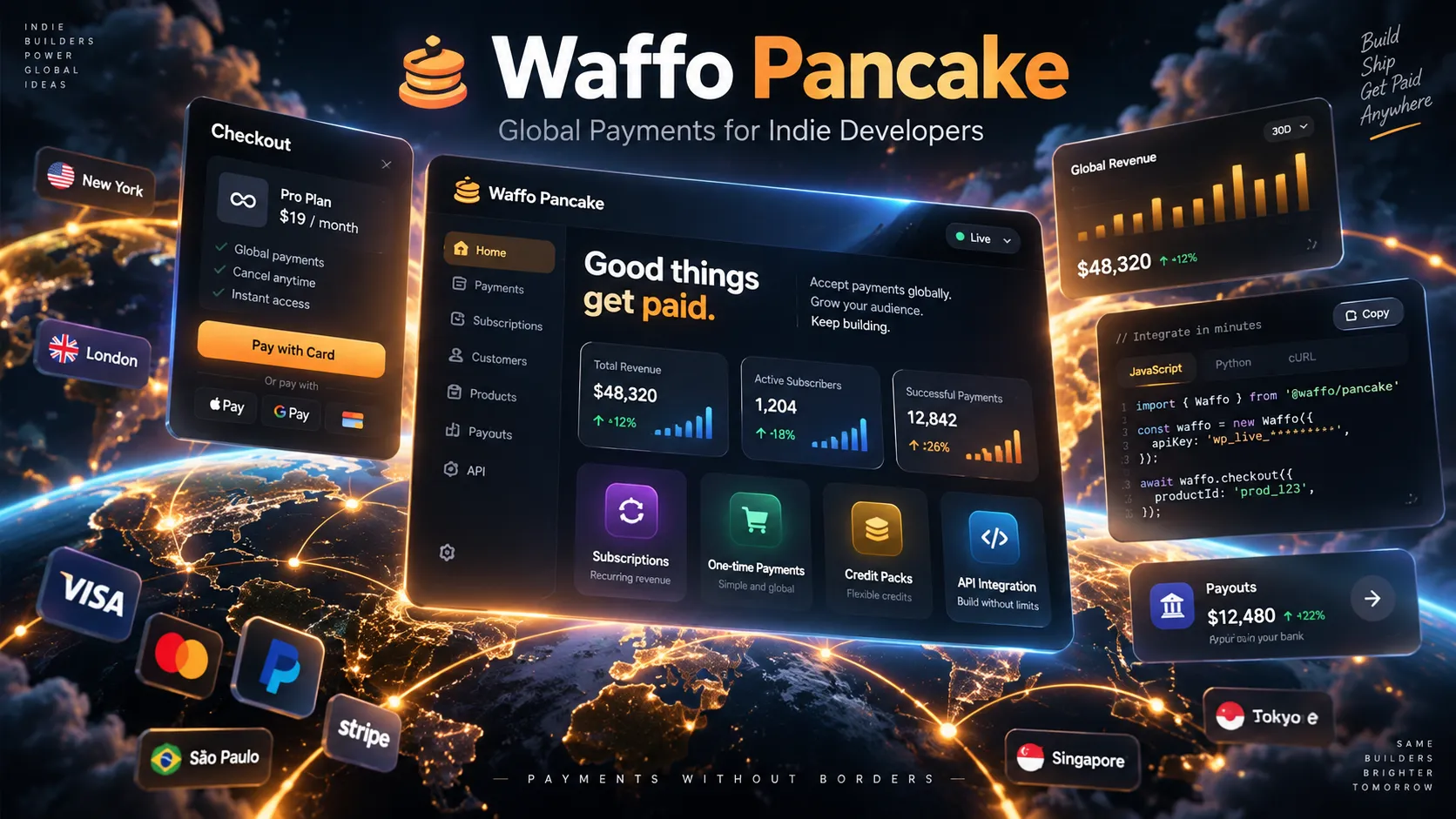
Waffo Pancake is a global payment and billing platform designed for independent developers, AI product builders, and SaaS founders who want to sell digital products internationally without building their own payment infrastructure.
Its central selling point is simple: developers can potentially accept international payments without establishing an overseas company. Waffo Pancake operates as a Merchant of Record (MoR), taking responsibility for the legal sale, applicable indirect taxes, payment processing, and important compliance workflows.
The platform advertises a base card processing rate of 3.9% + $0.50 per successful transaction, with no monthly subscription or setup fee. It also provides subscriptions, hosted checkout, developer APIs, webhooks, AI-assisted integration, and customer self-service tools.
However, the advertised transaction rate is not the entire cost. Payout fees, settlement delays, refund charges, and merchant eligibility restrictions can materially affect the economics of using the service.
This guide examines what Waffo Pancake actually offers, how its payment model works, what developers pay, and when it makes sense compared with Stripe, Paddle, Lemon Squeezy, and Creem.
Key Takeaways
- Waffo Pancake is a Merchant of Record platform, not merely a card payment gateway. It acts as the legal seller for supported digital transactions.
- No overseas LLC is required for eligible individual merchants. However, identity verification, store approval, and product compliance checks still apply.
- The advertised card fee is 3.9% + $0.50. WeChat Pay transactions have a published rate of 3.9% without the fixed $0.50 charge.
- Additional fees matter: Payouts cost 1% with a $10 minimum. Refunds cost $1, and the original processing fee is not returned.
- Global checkout does not mean global merchant payouts. As of October 8, 2026, the detailed payout documentation lists mainland China payouts in CNY through bank cards or Alipay.
- Settlement is not instant. Sales normally have an approximately 10-business-day settlement waiting period before becoming available for withdrawal.
- Subscription billing is included, supporting weekly, monthly, quarterly, and yearly plans, trials, cancellations, and plan changes.
- AI coding integration is a major product focus. Official SDK documentation, an AI Skill, and an LLM-readable documentation file help developers integrate checkout with coding agents.
- AI-generated content products require additional review. Model disclosure, independent branding, content moderation, and published acceptable-use policies are important requirements.
- Best suited for eligible digital businesses: Independent SaaS developers and AI product founders are the primary target audience, especially those who can use the currently documented payout channels.
What Is Waffo Pancake? is a developer-focused global payment product built within the broader Waffo payments ecosystem.
Waffo's wider business provides payment infrastructure for digital industries. Pancake focuses on a more specific customer segment: independent developers and small software businesses that need a relatively straightforward way to monetize products internationally.
The platform targets several problems that frequently delay international product launches.
A developer may have already built a functional web application but still need to solve company registration, international payment acceptance, subscription billing, tax collection, customer invoicing, and payout arrangements.
Traditional payment service providers can handle payment acceptance, but the seller remains responsible for many legal and tax obligations.
Waffo Pancake attempts to reduce that burden through its Merchant of Record model.
Its core product capabilities include:
- Hosted checkout pages and permanent payment links.
- One-time purchases and recurring subscriptions.
- Dynamic pricing for credits, overages, and other variable charges.
- Customer management and transaction reporting.
- Tax calculation, collection, and remittance within covered markets.
- Fraud screening and payment dispute management.
- TypeScript SDK and API integration.
- Webhook notifications for payment and subscription events.
- AI-assisted integration resources.
- Merchant payout management.
The product is particularly relevant to developers selling software subscriptions, AI generation credits, API access, digital downloads, and other eligible digital products.
How Does Waffo Pancake Work?
The most important concept behind Waffo Pancake is Merchant of Record, usually abbreviated as MoR.
Under a typical payment service provider arrangement, the software company sells directly to the customer. The payment processor facilitates the transaction, while the seller remains responsible for relevant tax registrations, invoices, consumer obligations, and other compliance requirements.
Under an MoR arrangement, the MoR becomes the legal seller of record for the transaction.
For a typical Waffo Pancake purchase, the process works as follows:
- A developer creates a digital product or subscription plan in Waffo Pancake.
- The developer adds a hosted checkout link or integrates checkout through the API.
- A customer selects the product and enters the required billing information.
- Waffo Pancake processes the payment as the Merchant of Record.
- The platform calculates applicable indirect taxes and handles the covered compliance obligations.
- The merchant's application receives payment events through webhooks.
- Revenue is settled into the merchant balance after the applicable waiting period.
- The merchant requests a payout using an eligible withdrawal method.
The practical advantage is that software developers can avoid building several pieces of international commerce infrastructure independently.
However, an MoR does not eliminate every legal or tax responsibility of the developer. Merchants can still have obligations involving their own income taxes, business operations, intellectual property, customer relationships, and local regulations.
MoR coverage should always be interpreted according to the provider's contract, supported jurisdictions, and approved product categories.
Waffo Pancake Features Explained
1. Merchant of Record and Global Tax Handling
Waffo Pancake advertises payment and tax coverage across 173 countries and markets.
Its MoR service is designed to handle applicable sales taxes, VAT, GST, and related checkout compliance obligations within supported jurisdictions.
This is especially relevant to international SaaS businesses because digital tax rules vary considerably between markets.
A customer purchasing a subscription in Germany may be subject to different tax requirements from a customer purchasing the same subscription in Japan or Australia.
An MoR can centralize these obligations, reducing the need for a small software business to manage numerous tax registrations independently.
The coverage figure is a provider claim rather than proof that every product, payment method, or merchant payout destination is available in all 173 markets.
2. Subscription Billing
Waffo Pancake supports recurring billing intervals including weekly, monthly, quarterly, and yearly subscriptions.
Developers can configure recurring products, trial periods, and subscription lifecycle management.
Available subscription states include pending, trialing, active, past_due, canceling, canceled, expired, and closed.
These states are useful when building SaaS access-control systems.
For example, a customer who cancels an active monthly subscription may retain access until the paid billing period ends. Applications should not immediately revoke access simply because the subscription enters canceling.
The subscription system also supports plan changes, with different behavior for upgrades and downgrades.
However, developers should understand the limitations. According to the official subscription documentation, a failed renewal receives one payment-channel retry, generally around the next day. If that retry fails, the subscription is canceled.
This is less flexible than billing systems with configurable multi-attempt dunning sequences and extended grace periods.
3. One-Time Payments and Dynamic Pricing
Waffo Pancake supports fixed-price one-time products, subscription products, and dynamic checkout amounts.
Dynamic pricing is especially useful for AI products that sell prepaid credits or charge for variable usage.
For example, an AI video application could offer a monthly subscription together with additional credit packs.
The recurring subscription would be represented by a subscription product, while additional credits could be purchased through separate one-time orders.
Dynamic pricing is implemented through a server-generated price snapshot when creating a checkout session.
An important distinction is that Waffo Pancake does not provide a complete native usage-metering engine. Developers still need to measure token consumption, generated images, API calls, or other usage inside their own systems.
Pancake can process the resulting charges, but it does not automatically determine how many AI credits each customer has consumed.
4. Hosted Checkout
Waffo Pancake provides hosted checkout pages that can be linked directly from a website.
Permanent product purchase links follow a structure such as:
https://checkout.waffo.ai/{store-slug}/{product-slug}The hosted checkout collects information required for payment processing and applicable tax calculations.
It supports branding options such as logos, theme colors, light and dark modes, and border-radius customization.
According to the official checkout documentation, the interface supports 19 languages, while the underlying payment page supports additional localized languages.
Visa, Mastercard, Apple Pay, and Google Pay are documented payment methods. The availability of wallets depends on the customer's device, browser, and region.
WeChat Pay is also advertised as available, although its eligible currencies, product types, and merchant categories require additional attention.
Permanent product links and API-generated checkout sessions behave differently. API sessions are single-use and have an expiration period, so developers should not reuse the same session URL for multiple orders.
5. Customer Portal
Waffo Pancake includes a customer portal for supported post-purchase operations.
Customers can view purchases, manage subscriptions, access invoices, and perform available self-service actions.
This reduces the need for each SaaS product to implement an entire billing administration interface from scratch.
However, customer portal capabilities depend on the subscription configuration. For example, self-service plan changes require compatible product groups and the relevant feature settings.
6. Developer APIs and Webhooks
Waffo Pancake provides developer APIs and an official TypeScript SDK named @waffo/pancake-ts.
Its API architecture uses REST endpoints for write operations and GraphQL for reading data.
Webhooks notify applications when important events occur, including completed orders, subscription activations, successful renewals, cancellations, payment failures, and refunds.
For AI and SaaS products, these notifications are essential for keeping user entitlements synchronized with actual payment status.
Waffo Pancake Pricing: What Does It Really Cost?
The advertised payment processing fee is competitive with several established MoR platforms.
However, the most useful comparison includes every significant fee rather than looking only at the headline transaction rate.
The following fee schedule reflects the official Waffo Pancake documentation checked in October 2026.
| Fee Type | Published Fee |
|---|---|
| Successful card or digital wallet payment | 3.9% + $0.50 |
| WeChat Pay | 3.9%, no fixed fee |
| Failed payment after 3DS is triggered | $0.30 per qualifying attempt |
| Failed checkout before authentication | $0 |
| Refund processing | $1 per refund |
| Original processing fee after refund | Non-refundable |
| Payout | 1% of payout amount |
| Minimum payout fee | $10 per payout request |
| Initial chargeback | $25 |
| Chargeback representment | $10 when filed |
| Pre-arbitration | $25 |
| Monthly subscription fee | $0 |
| Setup fee | $0 |
These fees are important because payment processing costs depend on transaction size, refunds, disputes, and withdrawal behavior.
Example: Selling a $30 SaaS Subscription
For a $30 card transaction:
Customer payment:       $30.00
Percentage fee (3.9%):   $1.17
Fixed payment fee:       $0.50
Total transaction fee:   $1.67
Balance after fee:      $28.33
The effective processing rate is approximately 5.57% before payout fees, taxes, and any currency conversion effects.
Example: 100 Customers Paying $30
Assume a SaaS product processes 100 successful card payments of $30 each, with no refunds, disputes, or additional taxes included in this simplified example.
Gross revenue:             $3,000.00
Payment processing fees:    $167.00
Merchant balance:         $2,833.00
Payout fee (1%):             $28.33
Remaining value:          $2,804.67
This is a hypothetical USD-equivalent calculation, not a guaranteed settlement quote. Actual receiving amounts depend on supported payout currencies, applicable taxes, conversion, and any receiving-bank charges.
Why Small Transactions Can Become Expensive
The fixed $0.50 fee matters more when the product has a low selling price.
For a $5 card purchase, the processing fee is $0.695, approximately 13.9% of the sale before payout costs.
For a $100 card purchase, the fee is $4.40, equivalent to 4.4%.
This creates an important pricing consideration for AI credit products.
Selling many tiny credit packs may produce a significantly higher effective processing rate than selling larger bundles.
Developers should evaluate average order value, conversion rates, and refund exposure rather than optimizing only for the advertised percentage.
Payouts: The Most Important Limitation to Check
Waffo Pancake's marketing emphasizes global selling and direct merchant payouts. Its detailed operational documentation, however, describes narrower currently available payout coverage.
As of October 8, 2026, the official payout guide states that current payouts are available to merchants in mainland China, settled in CNY through supported mainland Chinese bank cards or Alipay.
Other merchant payout regions and currencies are described as planned expansions.
This distinction is critical for businesses that need settlement to a US company bank account, a Hong Kong bank account, or a multicurrency business account.
The ability to charge international customers does not automatically mean a particular merchant can withdraw funds to their preferred country or account type.
How Long Do Waffo Pancake Payouts Take?
The documented payment cycle has two stages.
First, revenue must become available for withdrawal. A successful sale normally enters an approximately 10-business-day settlement waiting period. Hong Kong public holidays are used when counting these business days.
Second, the merchant requests a payout. After funds become available, eligible merchants can request withdrawal through a supported bank-card or Alipay channel.
The documentation says bank-card payouts requested before 15:00 Beijing time on a business day can arrive the same day, while later requests normally arrive on the next business day. Alipay transfers are generally faster but may involve additional reviews.
Therefore, references to fast payouts should not be confused with immediate access to revenue after the original customer purchase.
Identity Verification and Company Payouts
Waffo Pancake requires identity verification before merchants can connect a payout account and withdraw funds.
The official identity guide also states that company-entity payout verification is still being finalized, with the currently documented flow using individual identity information.
This is particularly important for incorporated SaaS businesses that need revenue deposited directly into their corporate accounts.
Merchants should confirm business-account support before relying on the platform for production revenue.
Alipay Withdrawal Limits
The payout documentation also lists additional restrictions for personal Alipay settlement:
- A maximum of RMB 50,000 per individual payout.
- A cumulative limit of RMB 300,000 per recipient each year.
- Potential requests for transaction documentation on larger withdrawals.
These restrictions make the payout method suitable for some independent developers but potentially limiting for higher-revenue businesses.
Can Individuals Use Waffo Pancake Without a Company?
Waffo Pancake specifically promotes onboarding without an overseas LLC for eligible individual merchants.
That does not mean every person or product is automatically accepted.
Before enabling live payments, Waffo performs a store-level business review.
According to the official account review guide, merchants typically need:
- A publicly accessible and functional product website.
- Clear descriptions of the products being sold.
- Visible and accurate pricing.
- Public Terms of Service and Privacy Policy pages.
- A functioning customer support contact.
- Accurate individual or business information.
- Compliance with the platform's restricted-product policies.
The documented review normally takes one to three business days, although individual cases may take longer.
Test-mode payments can be configured before approval, but live transactions require the store review to pass.
A developer should also distinguish between avoiding overseas incorporation and avoiding local tax obligations. Personal income or business tax obligations may still apply depending on the developer's jurisdiction.
Special Requirements for AI Image and Video Products
Waffo Pancake is particularly interested in AI-native products, but AI generation businesses are not automatically approved.
The official AIGC compliance guidance establishes additional requirements for applications that generate images or videos.
Independent Product Branding
AI applications must use their own product identities rather than falsely presenting themselves as official products of an underlying AI model provider.
A product can explain that it uses recognized AI models, but it should not imply a formal partnership or endorsement without authorization.
Transparent Model Disclosure
Waffo expects AI generation applications to identify the underlying models they actually use.
A vague statement such as advanced AI technology may not be sufficient for the platform's review requirements.
Recognized examples discussed in the documentation include Flux, Seedream, Gemini-related image generation, GPT Image, Veo, Kling, Seedance, and Wan.
Content Moderation
AI generation products need functioning moderation procedures covering user prompts and generated outputs.
The documentation recommends checks before generation, checks after generation, and additional moderation when content is publicly displayed.
Waffo also documents a content-safety service called Prompt Sift, although developers can implement their own compliant moderation systems.
Published Acceptable Use Policy
AI products are expected to publish policies addressing prohibited content, intellectual property infringement, impersonation, harmful material, and enforcement procedures.
These requirements explain why approval for an AI product may involve more than simply having a functioning checkout page.
A platform that generates AI images without content moderation or meaningful product information should not assume it will pass review.
How to Integrate Waffo Pancake Into a SaaS Application
Waffo offers several integration methods, ranging from hosted payment links to fully programmatic checkout.
Step 1: Create a Merchant Account
Visit the Waffo Pancake merchant dashboard and create an account.
Create a store and configure the products or subscription plans that customers will purchase.
Step 2: Configure the Billing Model
Choose whether each commercial offer is a one-time purchase, subscription, or dynamically priced checkout.
For an AI product, a common structure is:
- Basic Monthly: A recurring plan with a fixed credit allowance.
- Pro Monthly: A higher-priced subscription with additional capacity.
- Credit Pack: A one-time purchase that adds prepaid credits.
The developer's own backend should remain responsible for managing credit balances, consumption, and access permissions.
Step 3: Install the TypeScript SDK
npm install @waffo/pancake-tsStep 4: Initialize the SDK
import { WaffoPancake } from '@waffo/pancake-ts';

const client = new WaffoPancake({
  merchantId: process.env.WAFFO_MERCHANT_ID!,
  privateKey: process.env.WAFFO_PRIVATE_KEY!,
});
The merchant ID and private key should be stored securely in server-side environment variables.
Never expose the private key in browser JavaScript, a public Git repository, or a client-side application bundle.
Step 5: Create a Checkout Session
const session = await client.checkout.createSession({
  storeId: 'store_xxx',
  productId: 'prod_xxx',
  productType: 'onetime',
  currency: 'USD',
});

console.log(session.checkoutUrl);
The SDK returns a checkout URL that can be used to direct the buyer to the hosted payment page.
This example is illustrative and assumes that the store, product, and API credentials have already been configured.
Step 6: Process Webhooks Securely
Payment confirmation should be handled through verified server-side events rather than relying only on a browser redirect.
For example, an application might listen for order.completed before activating a purchased credit pack or for subscription.activated before enabling subscription benefits.
Recommended implementation practices include:
- Verify webhook authenticity using the current official signing mechanism.
- Store processed event identifiers to prevent duplicate fulfillment.
- Update entitlements based on the subscription lifecycle, not checkout navigation alone.
- Log failed event processing and support safe retries.
- Never treat unverified client-submitted payment status as proof of purchase.
The integration documentation provides the available events, SDK guidance, and testing workflow.
Step 7: Test Before Going Live
Waffo provides a test environment for checkout integration.
Developers should verify successful payments, declined payments, subscription transitions, refunds, and webhook handling before enabling production transactions.
The final production step includes completing the required store review.
Waffo Pancake and AI Coding Agents
One of the platform's notable features is its emphasis on AI-assisted payment integration.
Waffo provides an LLM-readable documentation resource at docs.waffo.ai/llms-full.txt, along with an official integration skill and SDK resources.
These materials are intended for coding assistants such as Claude Code, Cursor, and OpenAI Codex.
Developers can give a coding agent a structured integration request instead of manually translating the billing documentation into implementation steps.
For example, the following prompt can be adapted for an existing TypeScript application:
Read https://docs.waffo.ai/llms-full.txt and the official Waffo Pancake integration skill.

Integrate Waffo Pancake into this application.

Requirements:
1. Create server-side checkout sessions.
2. Support monthly subscriptions and prepaid credit packs.
3. Store API credentials securely in environment variables.
4. Implement verified payment and subscription webhooks.
5. Make webhook processing idempotent.
6. Synchronize subscription access and credit balances.
7. Add test-mode integration coverage.
8. Do not activate paid access based only on a redirect URL.
9. Document the production configuration and remaining manual steps.

Review the existing project structure before making changes.
This approach can reduce repetitive implementation work, especially in projects developed with AI coding assistants.
However, AI-generated billing code should always undergo security review and end-to-end testing. Payment integration errors can result in duplicate credits, unauthorized access, lost transactions, and inconsistent subscription states.
Waffo Pancake vs. Stripe, Paddle, and Lemon Squeezy
Waffo Pancake competes with several established payment and Merchant of Record platforms.
The most important comparison is not simply the processing percentage. These platforms differ in merchant responsibility, payout destinations, ecosystem maturity, payment coverage, and available billing features.
| Platform | Published Starting Price | Model | Main Consideration |
|---|---|---|---|
| Waffo Pancake | 3.9% + $0.50 | Merchant of Record | Payout coverage and additional withdrawal fees |
| Paddle | 5% + $0.50 | Merchant of Record | Established SaaS billing ecosystem |
| Lemon Squeezy | 5% + $0.50 | Merchant of Record | Digital product commerce and subscription tools |
| Stripe Payments | 2.9% + $0.30 for standard US domestic cards | Payment processor | Seller generally retains tax and merchant obligations |
| Stripe Managed Payments | Additional 3.5% on top of applicable Payments fees | Merchant of Record | Separate MoR offering within the Stripe ecosystem |
These are published reference rates, not guaranteed all-inclusive quotes. International card surcharges, currency conversion, additional services, merchant location, and negotiated rates can change the total.
Stripe's standard processing rate should not be presented as directly equivalent to a complete MoR service. Stripe also offers Managed Payments as a separate MoR product.
Official pricing information is available from Stripe, Paddle, and Lemon Squeezy.
Waffo Pancake vs. Stripe
Stripe offers extensive payment APIs, broad developer tooling, and substantial control over billing architecture.
For an incorporated business that already has suitable banking arrangements and tax infrastructure, standard Stripe Payments can be attractive.
Waffo Pancake instead prioritizes an MoR arrangement and simplified international digital selling for eligible merchants.
The comparison becomes more nuanced when Stripe Managed Payments is included, because Stripe now also provides a Merchant of Record option.
The decision should consider payout eligibility, total fees, business entity requirements, payment methods, and integration requirements rather than transaction fees alone.
Waffo Pancake vs. Paddle
Paddle provides established MoR services designed for SaaS businesses, including subscriptions, tax compliance, and lifecycle management.
Waffo's advertised card transaction rate is lower than Paddle's standard published checkout rate.
However, a business with international corporate payout requirements should compare the complete settlement terms before assuming Waffo is cheaper overall.
Paddle may be more appropriate when existing operational requirements depend on mature global SaaS billing and payout infrastructure.
Waffo Pancake vs. Lemon Squeezy
Lemon Squeezy targets software sellers, digital creators, and online businesses with an integrated commerce platform.
Its published base rate is 5% + $0.50, although additional fees can apply to certain transactions.
Waffo's differentiators include its 3.9% headline rate, AI integration resources, and focus on individual developers.
Lemon Squeezy remains relevant for businesses prioritizing its established digital-commerce tools and merchant payout capabilities.
Can Developers Migrate From Stripe or Creem?
Waffo provides a migration CLI named @waffo/pancake-migrate.
It currently documents migration support for Stripe and Creem.
The interactive migration command is:
npx @waffo/pancake-migrateThe tool can migrate supported product catalog information, pricing, images, and selected settings.
But there is an important limitation: the tool does not automatically transfer active subscriptions, saved customer payment methods, or existing customer billing authorizations.
This means migration is not a seamless replacement of the live billing backend for existing subscribers.
A safe migration strategy involves importing products, testing the new checkout, operating both processors during the transition, and allowing customers to establish new payment authorizations.
The official migration guide also notes that coupons and discounts are not currently supported by the Pancake migration path.
Developers with substantial existing recurring revenue should treat subscription migration as a customer communication and retention project, not simply a CLI operation.
Limitations and Risks Developers Should Understand
1. Restricted Payout Coverage
The currently documented mainland-China-only CNY payout arrangement is the most consequential limitation for merchants outside that settlement corridor.
Businesses should confirm the exact legal recipient, bank eligibility, currency, and withdrawal workflow before processing significant revenue.
2. Settlement Delays
A roughly 10-business-day settlement waiting period can affect working capital, especially for AI services that incur model inference costs immediately after customer purchases.
Developers may need sufficient cash reserves to pay API providers before customer revenue becomes withdrawable.
3. Additional Fees
Refund fees, non-refundable processing fees, failed authentication charges, payout fees, and chargeback costs affect net margins.
The advertised 3.9% rate should never be treated as the complete effective cost of operating the service.
4. Strict Product Eligibility
Waffo Pancake primarily supports digitally delivered products and services.
Physical goods, many human-delivered services, gambling products, unauthorized copyrighted material, and several high-risk categories are prohibited.
AI generation applications, certain games, VPN services, and other categories may require additional review.
The restricted-product policy should be checked before development work begins.
5. Subscription Recovery Is Relatively Simple
The currently documented renewal recovery flow relies on a single payment-channel retry rather than a highly configurable dunning schedule.
SaaS businesses that depend heavily on advanced subscription recovery should test whether this behavior meets their retention requirements.
6. No Complete Usage Metering
For usage-based AI products, developers remain responsible for counting requests, tokens, generations, or consumed credits.
Waffo can process charges resulting from those calculations, but it does not replace a specialized metering system.
7. Trial Protection Requires Identity Integration
The official documentation explains that trial protection depends on a stable buyerIdentity supplied through authenticated checkout.
Anonymous checkout does not provide the same protection against repeated trial claims using different customer details.
This is particularly important for AI services that offer expensive free generation credits.
8. Production Approval Is Still Required
The ability to register without a company does not eliminate business review, verification, or compliance obligations.
A functional website, transparent pricing, appropriate legal pages, and clearly described products remain necessary.
Who Should Consider Waffo Pancake?
Independent developers without overseas companies: Eligible individuals who need global digital checkout and can receive payouts through supported channels may find the MoR model attractive.
Early-stage SaaS founders: The combination of checkout links, subscriptions, and APIs can shorten the path from product launch to initial monetization.
AI product builders: Products selling generation credits, subscriptions, or API access can use Pancake for payment collection while maintaining their own usage and access-control systems.
Developers using AI coding agents: The SDK, structured documentation, and integration skill are useful for agent-assisted implementation.
Existing Stripe or Creem users evaluating alternatives: The migration CLI may reduce catalog setup work, although live subscriptions still require a separate transition plan.
Waffo Pancake is less suitable for companies requiring unsupported corporate payout destinations, physical-product sellers, prohibited business categories, or platforms needing advanced recurring billing features that are not yet available.
Frequently Asked Questions
Is Waffo Pancake a Merchant of Record?
Yes. Waffo Pancake operates as a Merchant of Record for supported digital transactions, handling the legal sale and specified tax and payment compliance responsibilities.
Does Waffo Pancake Require an LLC?
Eligible individual merchants can register without establishing an overseas LLC. However, live payment approval, identity verification, product review, and payout eligibility still apply.
How Much Does Waffo Pancake Charge?
The published standard rate for successful card transactions is 3.9% + $0.50. Additional fees apply to payouts, refunds, qualifying failed payment attempts, and chargebacks.
Does Waffo Pancake Support Subscriptions?
Yes. It supports recurring subscription billing, free and paid trials, subscription lifecycle events, and plan changes, subject to its documented restrictions.
Does Waffo Pancake Support WeChat Pay?
Yes, Waffo documents WeChat Pay support. Its published fee is 3.9% without a fixed transaction charge. Some currency and product restrictions apply, including CNY pricing being limited to eligible one-time products.
Can Waffo Pancake Send Payments to US or Hong Kong Business Bank Accounts?
Its detailed documentation currently lists mainland China CNY payouts through supported bank cards or Alipay, with additional corridors described as future expansions. Merchants needing US or Hong Kong business-account settlements should obtain confirmation of eligibility before adoption.
How Long Does It Take to Receive Money?
Successful sales normally have an approximately 10-business-day settlement waiting period. Once funds become available, the merchant can request a payout, with arrival depending on the supported payment channel and any review requirements.
Can AI Coding Agents Integrate Waffo Pancake?
Yes. Waffo provides structured documentation, an official skill, and SDK resources for agent-assisted payment integration. Generated code should still undergo security review and testing.
Does Waffo Pancake Work for AI Image Generators?
Potentially. AI image and video generation products are subject to additional requirements involving branding, model disclosure, content moderation, acceptable-use policies, and product approval.
Is Waffo Pancake Better Than Stripe or Paddle?
The answer depends on the merchant's legal structure, payout destination, business model, payment coverage, and total operating costs. Waffo has a lower advertised card transaction rate than several MoR competitors, but additional fees and payout restrictions can change the comparison.
Conclusion
Waffo Pancake addresses a genuine problem for independent software developers: accepting global payments while minimizing the complexity of company formation, indirect tax compliance, and billing infrastructure.
Its Merchant of Record model, 3.9% + $0.50 advertised card pricing, subscription tools, SDK, and AI-assisted integration resources make it an interesting option for developers launching SaaS and AI products.
The more important question, however, is not simply how quickly developers can add checkout to a website. It is whether the complete payment lifecycle works for their business.
Payout eligibility, settlement delays, refund economics, product approval, and subscription behavior should all be evaluated before processing significant revenue.
For eligible independent developers using supported payout channels, Waffo Pancake deserves consideration alongside established MoR providers.
For incorporated businesses requiring international corporate settlements or advanced subscription infrastructure, Stripe, Paddle, and Lemon Squeezy may offer more suitable arrangements depending on the use case.
Visit Waffo Pancake, review the official fee schedule and payout documentation, then verify merchant eligibility and complete a small end-to-end transaction test before adopting the platform for production billing.
Continue Reading
More articles connected to the same themes, protocols, and tools.

Referenced Tools
Browse entries that are adjacent to the topics covered in this article.