On This Page8 sections
Key Takeaways
- MiMo V2.6 is Xiaomi's new open-weight, omnimodal AI model family for reasoning, coding, agents, and long-horizon workflows.
- The flagship MiMo-V2.6-Pro-RL uses a sparse Mixture-of-Experts architecture with 1.02T total parameters and 42B activated parameters, while MiMo-V2.6-Flash-RL uses 309B total parameters and 15B activated parameters. Both support a 1M-token context window and text, image, video, and audio inputs.
- Xiaomi's main technical idea is not simply scaling model size. MiMo V2.6 applies a large mixed reinforcement-learning run across coding, general agents, visual tasks, and cybersecurity under a strategy the team calls "You Only RL Once."
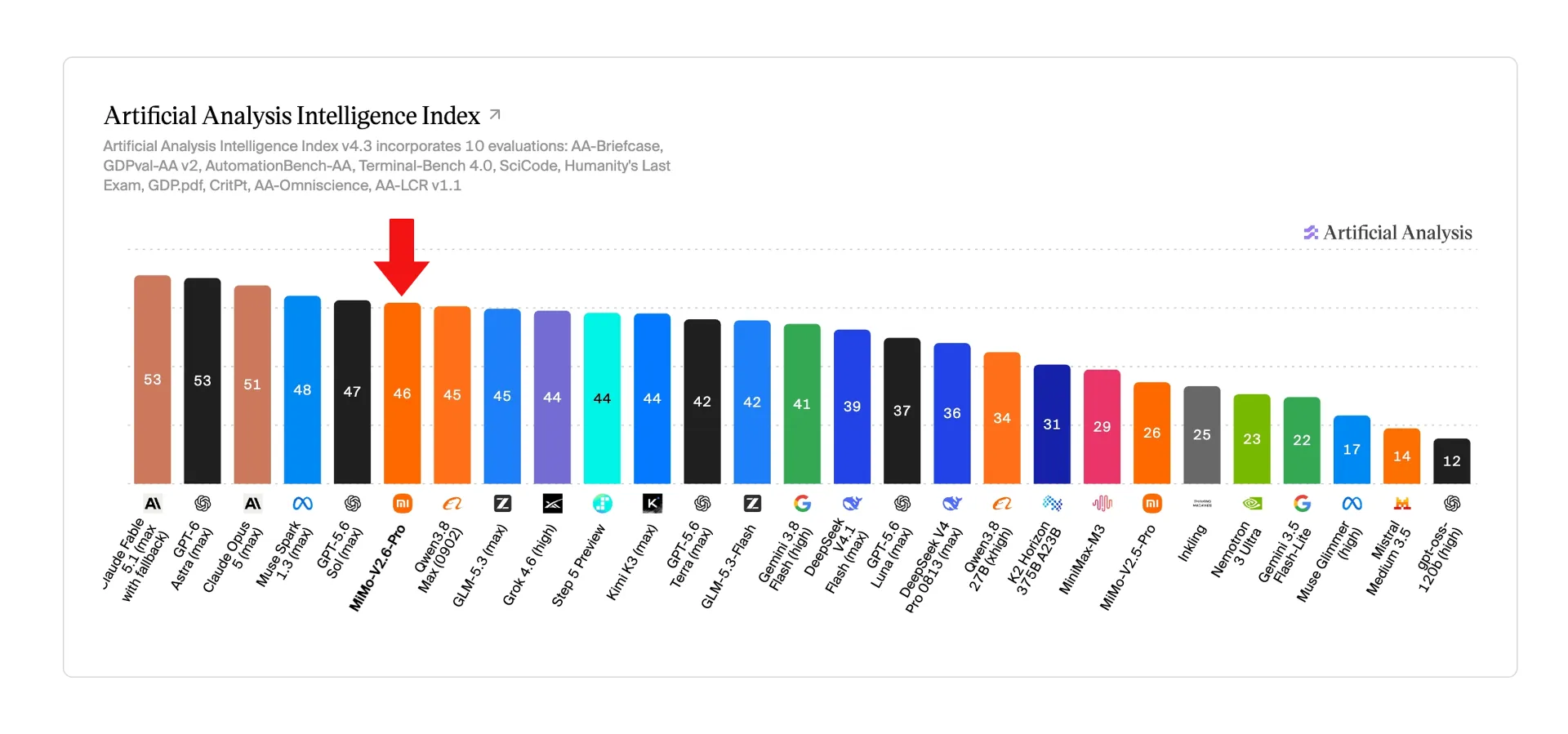
- Independent testing from Artificial Analysis gives MiMo-V2.6-Pro an Intelligence Index score of 46 and measured output speed of about 129.7 tokens per second on Xiaomi's API.
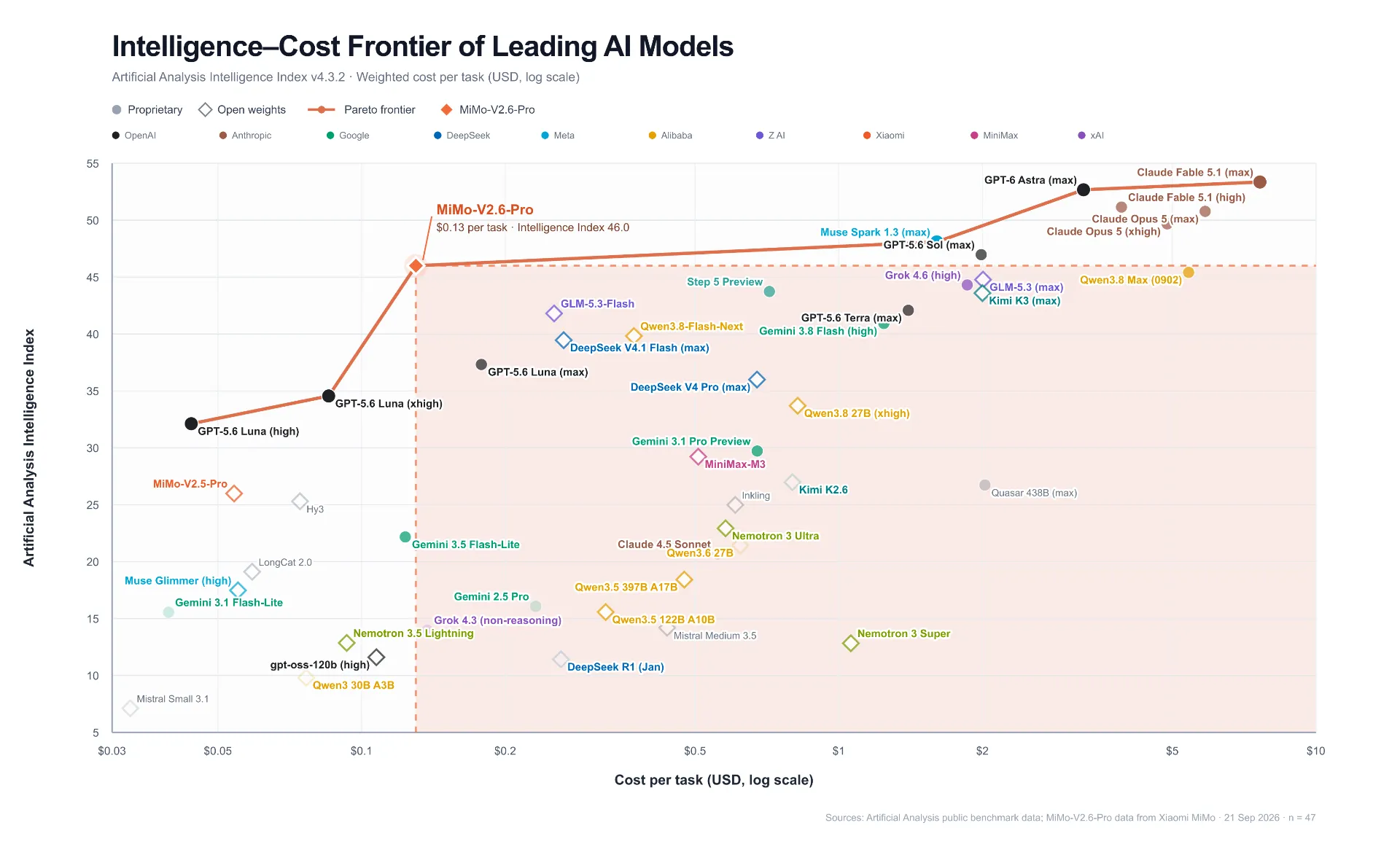
- Official API pricing is unusually low for a model in this capability range: Pro costs $0.435/M uncached input tokens and $0.87/M output tokens, while Flash costs $0.14/M input and $0.28/M output. Batch inference is priced at 50% of the real-time rate.
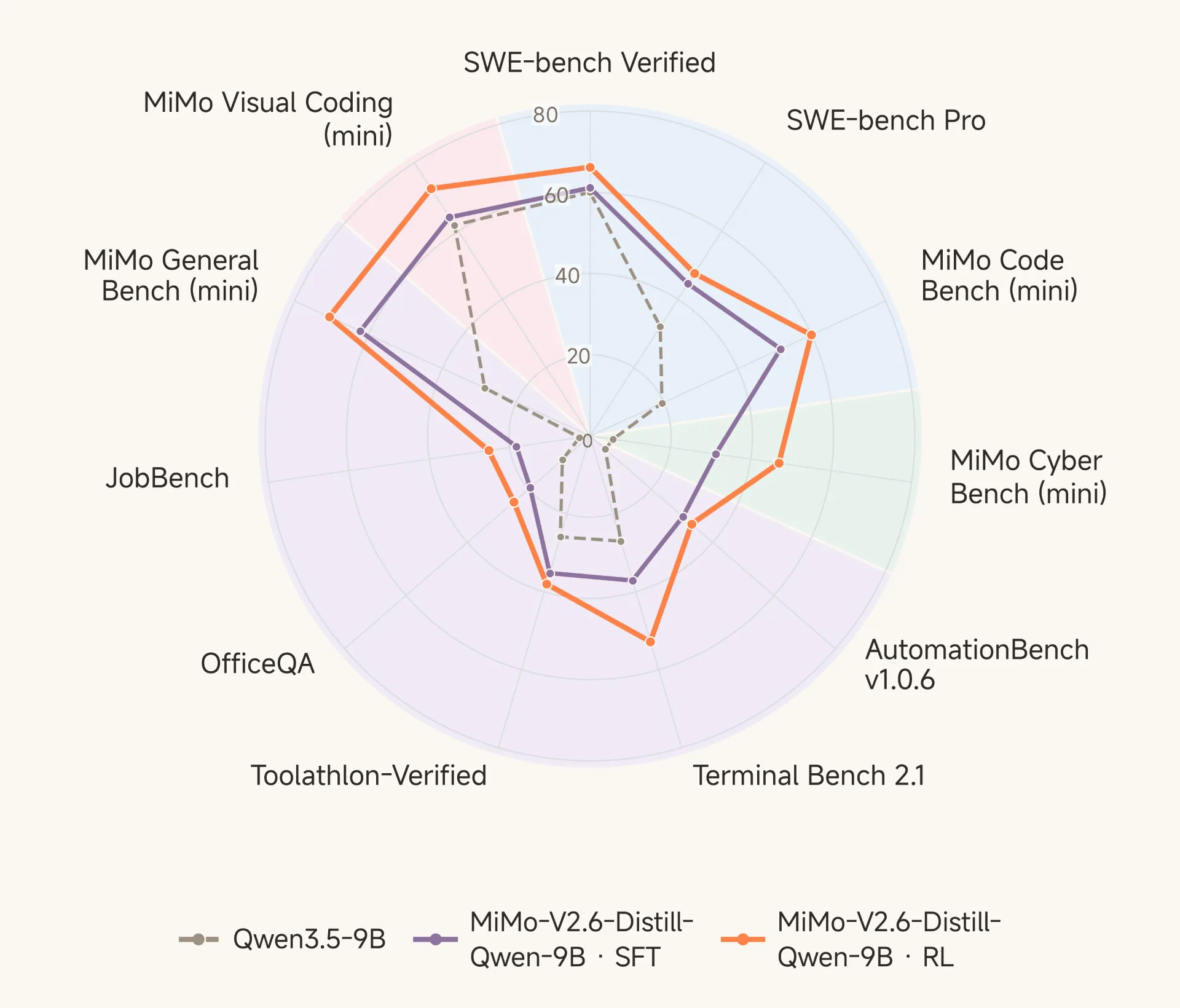
- Xiaomi also released MiMo-V2.6-Distill-Qwen-9B, a 9B agentic model fine-tuned from Qwen3.5-9B on MiMo-generated data, primarily as a practical starting point for agentic reinforcement-learning research.
What Is MiMo V2.6?
MiMo V2.6 is Xiaomi's latest family of large AI models designed around agentic work rather than ordinary chatbot conversations.
The release focuses on tasks where a model must do more than generate a single answer: navigate tools, inspect large repositories, execute multi-step workflows, reason over multimodal inputs, recover from failed attempts, and remain coherent across long trajectories.
The family currently centers on three open-weight checkpoints:
| Model | Architecture | Active Parameters | Context | Main Role |
|---|---|---|---|---|
| MiMo-V2.6-Pro-RL | 1.02T sparse MoE | 42B | 1M | Highest capability |
| MiMo-V2.6-Flash-RL | 309B sparse MoE | 15B | 1M | Lower-cost, high-throughput deployment |
| MiMo-V2.6-Distill-Qwen-9B | 9B Qwen3.5-based model | 9B dense model | Varies by deployment | Agentic RL research and smaller-scale experimentation |
Both Pro and Flash natively accept text, images, video, and audio and produce text. Xiaomi lists a maximum output length of up to 128K tokens for its hosted Pro service.
This makes MiMo V2.6 less interesting as simply another chat model and more interesting as an agent foundation model for coding assistants, automated operations, research workflows, multimodal analysis, and backend decision systems.
MiMo V2.6 Pro vs Flash
The most important choice is not whether to use MiMo V2.6, but which variant should handle which workload.
MiMo-V2.6-Pro
MiMo-V2.6-Pro is the flagship model.
Its official architecture includes:
- 1.02 trillion total parameters
- 42 billion activated parameters per token
- 384 routed experts, with 8 activated
- 70 Transformer layers
- 1M-token maximum context
- A hybrid of sliding-window and global attention
- A 681M-parameter MiMo ViT vision encoder
- Dedicated audio encoders
- A five-layer speculative decoder for faster token generation
Pro is the better fit when the cost of a bad answer is higher than the incremental token cost: large codebase changes, long-running agents, complex research, difficult debugging, or workflows involving many dependent steps.
MiMo-V2.6-Flash
Flash uses the same general design philosophy but is substantially smaller:
- 309B total parameters
- 15B activated parameters
- 256 routed experts, with 8 activated
- 48 Transformer layers
- 1M-token context
- The same broad text, image, video, and audio input support
Flash is more attractive for high-volume applications such as classification, routing, extraction, scoring, moderation, lightweight code changes, repetitive agent steps, and structured backend decisions.
In other words:
Pro should be treated as the stronger problem solver. Flash should be treated as the economical workhorse.
Why MiMo V2.6 Is Technically Interesting
The biggest story is not the parameter count. It is the post-training strategy.
"You Only RL Once"
Many AI systems optimize different capabilities with separate training stages or domain-specific reinforcement-learning runs.
MiMo V2.6 instead mixes multiple task families into one reinforcement-learning process, including:
- Coding
- General-purpose agent tasks
- Visual tasks
- Cybersecurity
- Multiple agent harnesses
Xiaomi calls this approach "You Only RL Once."
The underlying idea is that strategies learned in one domain may transfer into another. A model that becomes better at inspecting failures, choosing tools, recovering from errors, and minimizing unnecessary actions in coding can potentially reuse those behaviors in general agent tasks.
The model card describes a fully asynchronous Group Relative Policy Optimization setup using 1,568 prompts × 16 rollouts per training step, with billions of tokens processed in an update.
That is important because MiMo V2.6 is not being positioned merely as a bigger pretrained model. Xiaomi is explicitly trying to scale agent experience during reinforcement learning.
Groupwise Agentic Grading: Improving the Reward Signal
One difficulty with reinforcement learning for agents is that a binary success signal can be too weak.
Suppose two coding agents both pass all tests:
- Agent A takes 25 tool calls, rewrites unrelated files, and burns 80,000 tokens.
- Agent B takes 8 tool calls and produces the same correct result.
A simple pass/fail verifier gives both trajectories the same reward.
MiMo V2.6 introduces mechanisms called Groupwise Reward Synthesis (GRS) and Groupwise Advantage Redistribution (GAR).
The system compares multiple successful trajectories and attempts to reward higher-quality solutions, not merely solutions that technically pass. Xiaomi says this is intended to favor shorter paths, better-quality outputs, and lower token consumption.
For real-world agents, this matters because efficiency is part of intelligence. A model that eventually succeeds after 40 retries can be far more expensive and less reliable than one that reaches the same answer in five steps.
MOPD2: Distillation After Reinforcement Learning
MiMo V2.6 also introduces Multi-Prefix Multi-Teacher On-Policy Distillation, abbreviated as MOPD2.
The technique mixes autonomous student rollouts with trajectories derived from teacher and supervised-fine-tuning prefixes. Instead of regenerating every earlier step of a long agent trajectory, training can focus directly on important decision points.
This is especially useful for tasks that are difficult to verify automatically.
The practical goal is straightforward: retain the exploration benefits of reinforcement learning while efficiently transferring stronger decision patterns into the final model.
MiMo V2.6 Benchmarks
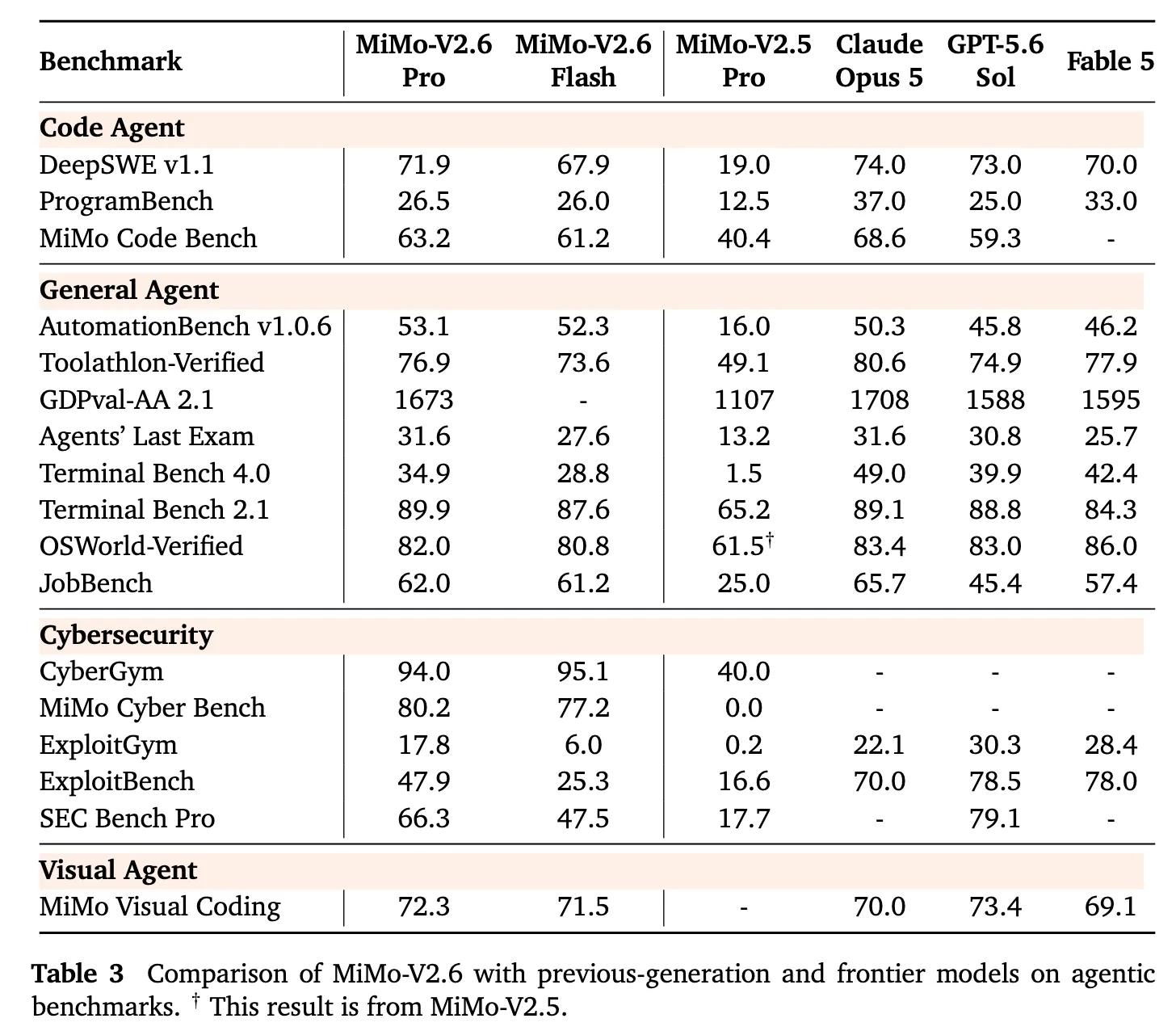
Benchmarks should be read carefully because Xiaomi's launch table includes both public and internal evaluations.
The vendor-published results include:
| Benchmark | MiMo V2.6 Pro | MiMo V2.6 Flash | MiMo V2.5 Pro |
|---|---|---|---|
| DeepSWE v1.1 | 71.9 | 67.9 | 19.0 |
| AutomationBench v1.0.6 | 53.1 | 52.3 | 16.0 |
| Toolathlon-Verified | 76.9 | 73.6 | 49.1 |
| Terminal Bench 4.0 | 34.9 | 28.8 | 1.5 |
| Terminal Bench 2.1 | 89.9 | 87.6 | 65.2 |
| JobBench | 62.0 | 61.2 | 25.0 |
| MiMo VisualCoding | 72.3 | 71.5 | — |
These figures show a very large jump over MiMo V2.5 Pro in Xiaomi's own evaluation table, especially on agentic coding and general-agent tasks.
However, the table also shows why MiMo V2.6 should not be described as universally superior to every frontier model. For example, Xiaomi reports 34.9 on Terminal Bench 4.0 for Pro, below the comparison scores listed for several leading proprietary models in the same table.
That distinction matters for E-E-A-T: MiMo V2.6 is highly competitive, but benchmark leadership depends on the task.
Independent Artificial Analysis Results
Independent data makes the launch more notable.
Artificial Analysis reports:
- 46 on its Intelligence Index
- About 129.7 output tokens/second
- 1M-token context
- 1T total / 42B active parameters
- Open weights under the MIT license
Artificial Analysis' September 2026 release tracker also lists MiMo-V2.6-Pro at an Intelligence Index score of 46, the same headline composite score shown for Grok 4.7 at launch.
The more important point is not the tie itself. It is that MiMo reaches that tier while being offered at a substantially lower API price than many frontier-class models.
MiMo V2.6 Pricing
Pricing is one of MiMo V2.6's strongest competitive advantages.
Real-Time API Pricing
| Model | Cache Hit Input | Uncached Input | Output |
|---|---|---|---|
| MiMo V2.6 Pro | $0.0036/M | $0.435/M | $0.87/M |
| MiMo V2.6 Flash | $0.0028/M | $0.14/M | $0.28/M |
Xiaomi also lists domestic CNY pricing of ¥3/M uncached input and ¥6/M output for Pro, and ¥1/M input and ¥2/M output for Flash.
Batch API Pricing
For workloads that do not require immediate responses, Xiaomi's Batch API costs 50% of the real-time API rate.
That reduces Flash to:
- $0.07/M uncached input
- $0.14/M output
and Pro to:
- $0.2175/M uncached input
- $0.435/M output
This changes where large models can economically be used.
Tasks such as offline classification, large-scale content analysis, evaluation, enrichment, labeling, and scheduled data processing can become cheap enough to treat an LLM more like conventional backend infrastructure than a premium interactive service.
Why Prompt Caching Matters So Much
The headline token price does not tell the full story.
MiMo's cache-hit input price is dramatically lower than its uncached input price.
For an agent repeatedly sending:
- system instructions,
- repository context,
- tool definitions,
- project conventions,
- previous messages,
- long reference documents,
a large portion of the prompt may remain unchanged across steps.
If those prefixes hit the cache, effective agent cost can fall sharply.
This makes MiMo V2.6 particularly interesting for long-running agents, because agent workloads often consume far more input tokens than output tokens.
The practical optimization is simple:
- Keep stable instructions at the beginning of the prompt.
- Avoid changing large static prefixes between requests.
- Put volatile user or tool data later in the context.
- Track cache-hit tokens separately from normal input.
- Measure cost per completed task, not only cost per million tokens.
Native Omnimodal Input
MiMo V2.6 Pro and Flash are not text-only models.
They can accept:
- Text
- Images
- Video
- Audio
within the same model family.
This matters for agent applications because a workflow no longer needs a separate vision model for every screenshot or a separate speech model just to understand an audio attachment.
Potential workflows include:
- Inspecting screenshots while debugging a web application
- Reading charts and documents during research
- Reviewing video frames
- Processing audio alongside textual instructions
- Combining visual UI state with tool calls
The output is still primarily text, so MiMo V2.6 should be understood as an omnimodal understanding model, not an image or video generation model.
The 1M-Token Context Window
Both Pro and Flash support approximately 1,048,576 tokens of context, with hosted endpoints supporting up to roughly 131K output tokens.
A 1M context window can be valuable for:
- Large repositories
- Long research reports
- Extensive tool traces
- Multi-session agent history
- Large document collections
- Complex debugging sessions
But a larger context window does not automatically mean better answers.
Common mistakes include:
- Dumping an entire repository into every request
- Keeping obsolete tool results forever
- Mixing contradictory versions of documents
- Assuming the model will perfectly retrieve every detail from 1M tokens
A better architecture combines long context with retrieval, summarization, caching, and context pruning.
What Is MiMo-V2.6-Distill-Qwen-9B?
The 9B release deserves separate attention.
MiMo-V2.6-Distill-Qwen-9B is not simply a quantized version of MiMo V2.6 Pro.
It is a 9B agentic model created by supervised fine-tuning Qwen3.5-9B on MiMo-generated data covering coding, general agents, visual coding, and cybersecurity. Xiaomi describes the checkpoint as a starting point for open research in agentic reinforcement learning.
The training mixture contains 77.4B total tokens, including 27.2B loss-bearing tokens.
That makes the model useful for teams that want to study MiMo-style agent training without attempting to run a trillion-parameter MoE model.
A basic local SGLang deployment can look like this:
sglang serve \
  --model-path XiaomiMiMo/MiMo-V2.6-Distill-Qwen-9B \
  --reasoning-parser mimo \
  --host 0.0.0.0 \
  --port 30000
The 9B model is therefore the most approachable member of the release for local experimentation, fine-tuning, quantization, and research.
Is MiMo V2.6 Really Open Source?
The most precise description is open weight with a permissive license.
Xiaomi publishes the Pro-RL and Flash-RL model weights on Hugging Face, and the model cards list the MIT license. The 9B Qwen-based checkpoint is also publicly downloadable.
That is unusually permissive for models at this scale and allows commercial use under the license terms.
Still, "open source" can mean different things in AI. Public weights do not necessarily imply that every pretraining dataset, every training artifact, every internal benchmark, and the complete training pipeline is available.
For technical writing, "open-weight MiMo V2.6 models released under MIT" is the safer and more specific description.
How to Use MiMo V2.6
Xiaomi lists MiMo V2.6 availability across its API platform, AI Studio, MiMo Code, MiMo Desktop, and OpenRouter.
For developers, there are three practical deployment patterns.
1. Use Xiaomi's Hosted API
Best for:
- Production agents
- Coding workflows
- High-volume Flash inference
- Long-context applications
- Multimodal input
This avoids the infrastructure cost of serving a very large MoE model.
2. Use an API Aggregator
MiMo V2.6 Pro and Flash are available through OpenRouter, which exposes standard model identifiers such as xiaomi/mimo-v2.6-pro and xiaomi/mimo-v2.6-flash.
This can simplify switching between models, but developers should compare provider-specific latency, caching behavior, availability, and pricing before production deployment.
3. Self-Host the Open Weights
Xiaomi provides deployment guidance for SGLang and vLLM.
However, the full Pro and Flash checkpoints are not normal consumer-GPU models. Even though sparse MoE means only a fraction of parameters are active per token, the full weight set must still be stored and distributed across substantial accelerator memory.
For most individual developers, self-hosting the 9B distill or using the hosted API will be far more practical.
Best Use Cases for MiMo V2.6 Pro
MiMo V2.6 Pro is most compelling where task reliability is more important than the absolute minimum token cost.
Examples include:
- Multi-file software refactoring
- Architecture changes
- Complex debugging
- Long-running coding agents
- Research workflows
- Browser or computer-use agents
- Multimodal analysis
- Security research in authorized environments
- Large document reasoning
- Tool-heavy automation
Its 1M context and agent-oriented post-training make it especially suitable for tasks that require maintaining state across many steps.
Best Use Cases for MiMo V2.6 Flash
Flash may ultimately be the more commercially important model because many production workloads do not need the strongest available model.
Strong candidates include:
- Classification
- Scoring
- Intent detection
- Routing
- Search-result filtering
- Structured extraction
- SEO page triage
- Content moderation
- Support-ticket categorization
- Lightweight code fixes
- Large-scale offline processing
- Multi-agent subtask execution
A useful architecture is to let Flash handle routine decisions and escalate difficult cases to Pro or another frontier model.
For example:
Incoming task
    |
    v
MiMo V2.6 Flash
    |
    +--> High confidence --> Execute / classify / return JSON
    |
    +--> Low confidence --> Escalate to MiMo V2.6 Pro
                               |
                               +--> High-risk case --> Human review
This model-routing pattern can reduce cost without forcing every task through a weaker model.
MiMo V2.6 for Coding Agents
MiMo V2.6 is clearly optimized for agentic coding, but benchmark interpretation matters.
Xiaomi reports substantial improvements over MiMo V2.5, including major gains on DeepSWE and Terminal Bench. Independent Artificial Analysis also places Pro near the frontier on its overall intelligence measure.
Still, developers should benchmark it on their own repositories.
Important evaluation metrics include:
- Percentage of tasks completed without human intervention
- Number of tool calls per completed task
- CI pass rate on the first attempt
- Regression rate
- Tokens consumed per successful task
- Wall-clock completion time
- Number of retries
- Diff size
- Unrelated code changes
For coding agents, cost per successful pull request is more meaningful than price per million tokens.
Important Limitations and Common Pitfalls
Benchmark scores are not product guarantees
Some MiMo V2.6 launch benchmarks are Xiaomi-reported, and several are internal. Independent evaluation is therefore more important than a single launch chart.
A 1M context window can still be misused
More context increases capacity, but irrelevant context can reduce efficiency and increase cost.
MoE parameter counts are easy to misunderstand
MiMo V2.6 Pro has 1.02T total parameters but activates only 42B for each token. Flash has 309B total and 15B active.
That does not make Pro equivalent to a conventional dense 42B model. The inactive experts still contribute specialized capacity across tokens, while serving infrastructure must accommodate the much larger weight set.
Hosted speed and self-hosted speed are different
Artificial Analysis measured roughly 129.7 tokens/second for Pro using Xiaomi's API, but actual throughput depends on provider infrastructure, prompt length, reasoning mode, batching, and concurrency.
Cheap tokens can encourage inefficient architectures
A model that costs less per token can still become expensive if an agent loops unnecessarily.
Always track:
total cost / successfully completed task
rather than only:
price / million tokens
MiMo V2.6 vs MiMo V2.5
The transition from V2.5 to V2.6 is primarily a post-training and agent-capability upgrade, not merely another context-window expansion.
MiMo V2.5 already introduced million-token context and large MoE variants. V2.6 pushes harder on mixed-domain reinforcement learning, groupwise grading, on-policy distillation, and long-horizon agent behavior.
Xiaomi's own benchmark table shows particularly large V2.5-to-V2.6 gains in coding and general-agent evaluations.
That suggests the important question for future frontier models may increasingly become:
How much useful agent experience can be created during post-training?
rather than simply:
How many parameters can be added during pretraining?
Frequently Asked Questions
Is MiMo V2.6 made by Xiaomi?
Yes. MiMo is developed by Xiaomi's MiMo team.
When was MiMo V2.6 released?
MiMo V2.6 Pro and Flash were released in September 2026, with public model and API listings appearing on September 21, 2026.
How large is MiMo V2.6 Pro?
The official architecture lists 1.02T total parameters with 42B activated per token.
How large is MiMo V2.6 Flash?
Flash uses 309B total parameters and 15B activated parameters.
Does MiMo V2.6 support images, video, and audio?
Yes. Pro and Flash support text, image, video, and audio input, with text output.
What is the MiMo V2.6 context window?
Both Pro and Flash support approximately 1M tokens of context.
How much does MiMo V2.6 cost?
For overseas real-time API usage, Xiaomi lists Pro at $0.435/M uncached input and $0.87/M output, and Flash at $0.14/M input and $0.28/M output. Cache-hit input is much cheaper, and Batch API usage is half of real-time pricing.
Is MiMo V2.6 open weight?
Yes. Xiaomi has released Pro-RL and Flash-RL weights under the MIT license, along with the MiMo-V2.6-Distill-Qwen-9B checkpoint.
Is MiMo V2.6 the best model for coding?
It is a strong coding and agent model, but no single benchmark establishes a universal winner. Xiaomi's own table shows MiMo V2.6 Pro performing strongly on several agentic evaluations while trailing some frontier proprietary models on Terminal Bench 4.0. Production teams should benchmark models on their own repositories and workflows.
Conclusion
MiMo V2.6 is significant because it pushes three variables in the same direction: capability, inference economics, and agent-oriented post-training.
MiMo-V2.6-Pro provides a trillion-parameter open-weight flagship with only 42B parameters activated per token, a 1M-token context window, native multimodal understanding, and competitive independent benchmark results. MiMo-V2.6-Flash reduces active compute to 15B parameters while cutting API prices far enough to make large-scale routing, classification, extraction, and agent execution economically attractive.
The deeper technical story is Xiaomi's reinforcement-learning strategy. "You Only RL Once," groupwise agentic grading, and MOPD2 all target the same problem: turning a capable foundation model into an agent that can execute long workflows more reliably and efficiently.
For developers, the practical next step is not to replace every existing model immediately. Run MiMo V2.6 against a representative workload, measure task success rate, retries, latency, cache utilization, and total cost per successful task, then decide where Pro or Flash belongs in the model stack.
Continue Reading
More articles connected to the same themes, protocols, and tools.

Referenced Tools
Browse entries that are adjacent to the topics covered in this article.