
On This Page8 sections
Key Takeaways
- Kingy AI is an AI media, research, and creator platform founded and led by Curtis Pyke. It combines AI product discovery, hands-on reviews, tutorials, research, and a large YouTube presence.
- It is not an AI chatbot or a single AI model. Kingy.ai helps visitors discover, evaluate, compare, and learn how to use AI products from different companies.
- The platform includes a searchable AI tool directory, free utilities, model information, original experiments, video demonstrations, and industry research.
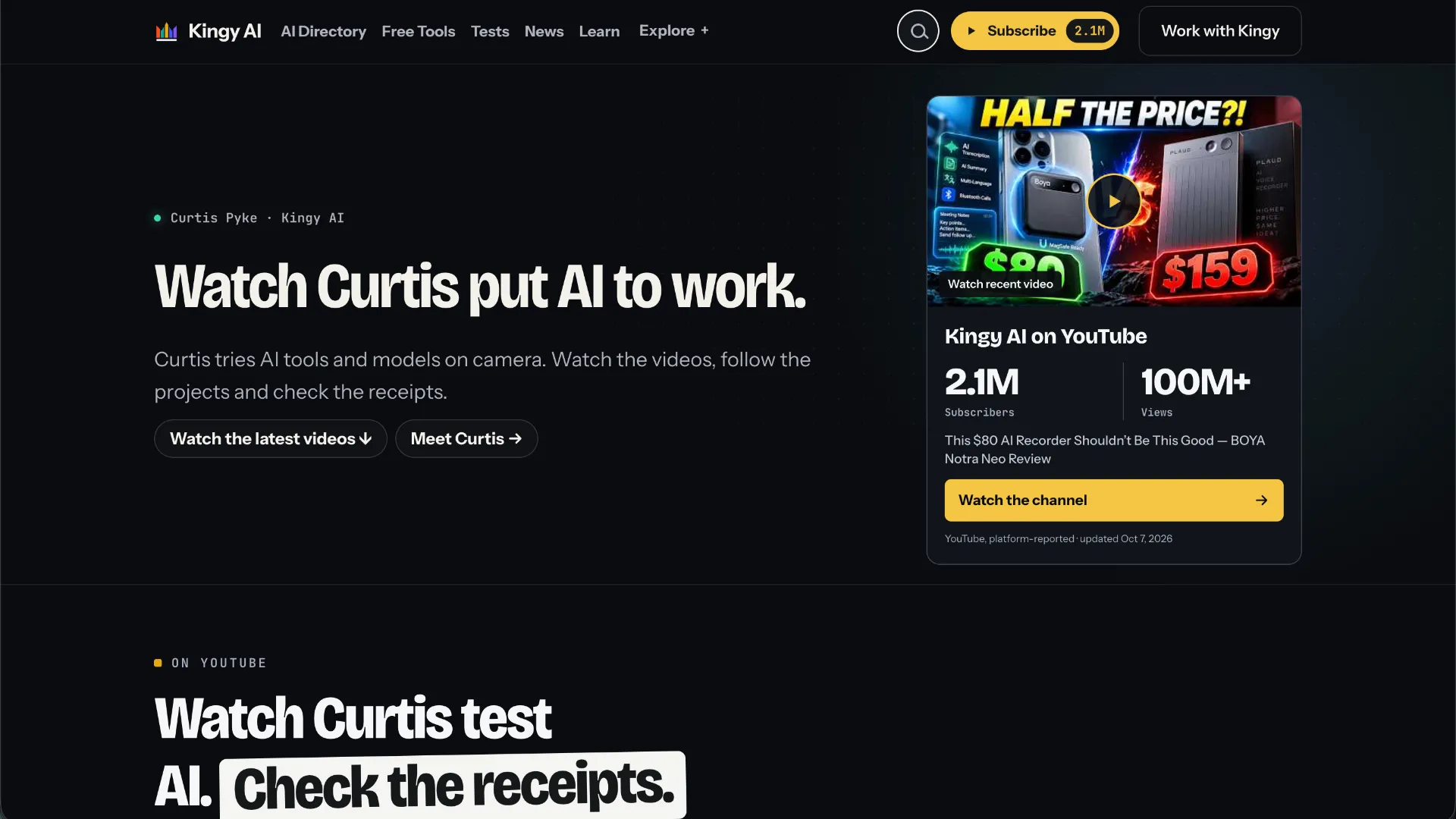
- Kingy AI has a substantial creator audience. Its website reported approximately 2.1 million YouTube subscribers, more than 100 million channel views, and over 1,300 videos in October 2026.
- Most informational resources are accessible for free. Some tools have technical requirements, and third-party AI products featured on the website may require separate paid subscriptions or API credits.
- Its most distinctive feature is evidence-based product coverage. Kingy attempts to distinguish official documentation, observed tests, commercial partnerships, and conclusions that remain uncertain.
What Is Kingy AI?
Kingy AI is an artificial intelligence publication, product discovery platform, and creator-led technology media business founded by Curtis Pyke. It helps users understand AI products, compare their capabilities, follow industry developments, and find practical ways to apply artificial intelligence.
Unlike AI applications that generate text, images, or videos directly, Kingy AI primarily helps people decide which AI tools to use, how those tools work, what they cost, and whether their advertised capabilities are supported by evidence.
The platform brings several resources together:
- A searchable directory of AI products and services.
- AI model information and pricing comparisons.
- Video reviews and product demonstrations.
- Free AI calculators, workflow planners, and creative utilities.
- Technology news and product launch coverage.
- Original experiments, benchmarks, and downloadable research.
- A newsletter covering important AI developments.
- YouTube sponsorship and distribution services for AI companies.
Kingy AI describes itself as a founder-led publication and creator platform rather than a neutral software marketplace. This distinction matters: the website publishes editorial content while also operating commercial partnerships with technology companies.
Its central proposition is straightforward: help users find useful AI products, understand how to use them, and inspect the evidence behind important claims.
Who Founded Kingy AI?
Kingy AI was founded by Curtis Pyke, who serves as its founder and editor.
According to the platform's official founder profile, Pyke focuses on artificial intelligence products, model capabilities, developer workflows, product launches, and creator-led technology distribution.
His work combines several activities that traditional technology publications often separate:
- Explaining new AI technologies through video demonstrations.
- Evaluating product capabilities and limitations.
- Reviewing documentation and pricing information.
- Publishing tutorials and practical workflows.
- Developing research resources and interactive tools.
- Working with AI companies on sponsored creator campaigns.
This creator-led structure is important to understanding Kingy AI. Its website is not simply an independent collection of articles; it is closely connected to the founder's broader video content and industry relationships.
How Popular Is Kingy AI?
As of October 2026, Kingy.ai displayed the following YouTube figures:
| Metric | Reported Figure |
|---|---|
| YouTube subscribers | 2.1 million |
| Total channel views | 100 million+ |
| Published videos | 1,300+ |
These are platform-reported audience figures presented on Kingy.ai, not an independently audited measurement of website traffic, revenue, or active users.
The large YouTube audience creates an important connection between video content and the website. Viewers can encounter an AI product in a demonstration, then visit Kingy.ai to examine supporting information, limitations, costs, and related resources.
What Can You Do on Kingy AI?
Kingy AI combines several different types of resources. The most useful starting point depends on whether someone wants to discover software, complete a task, compare models, or understand a recent technology announcement.
1. Discover AI Tools Through the Product Directory
The Kingy AI Tools Directory organizes products into searchable records.
In October 2026, the directory displayed 223 product records, although this inventory can change as products are added or updated.
Visitors can narrow results using categories and product attributes, including:
- Product category and intended audience.
- Free-plan availability.
- API access.
- Open-source or open-weight characteristics.
- Demonstration availability.
- Company and pricing information.
For example, someone researching AI image generators could use the directory to identify products offering free access and determine which provide developer APIs.
Individual product records may include company information, pricing notes, supported features, relevant limitations, and links to recorded changes.
Why this matters: AI products frequently change their pricing, feature availability, model access, and usage limits. A structured product record can be more useful than an undated list of recommendations, provided its information remains current.
However, users should still verify important purchasing details on the product provider's official website.
2. Read AI Reviews and Examine Test Results
One of Kingy AI's more distinctive features is its Reviews and Tests Library.
Rather than presenting every article as an independent hands-on review, the platform distinguishes between different evidence categories.
As of October 2026, the library displayed 36 entries, including:
| Evidence Type | Entries | What It Represents |
|---|---|---|
| Original tests | 4 | Kingy-run experiments with documented methods and results |
| Video reviews and demonstrations | 31 | Recorded workflows and product demonstrations |
| Source analysis | 1 | Evaluations based primarily on documented third-party or official sources |
These categories are important because watching a product demonstration is not equivalent to conducting a controlled benchmark.
For example, a video might demonstrate that an AI application can generate a presentation from a prompt. That observation does not automatically establish that the product performs reliably across different industries, languages, document sizes, or user accounts.
Kingy attempts to preserve this distinction by identifying what was demonstrated, what evidence supports the results, and what remains unverified.
3. Use Free AI Tools and Calculators
Kingy AI also provides a collection of interactive resources through its Free Tools section.
Notable examples include:
| Tool | Primary Purpose |
|---|---|
| AI Model Picker | Help users identify suitable AI models or setups |
| Workflow Planner | Develop AI workflow suggestions based on goals, skills, and budget |
| AI Cost Calculator | Estimate model API expenses using token counts and pricing assumptions |
| AI Subscription Planner | Compare subscription-related spending |
| Local AI | Explore which AI models may fit specific hardware configurations |
| AI Camera Simulator | Plan camera movements and prepare video-generation prompts |
| AI Video Studio | Organize scripts, shots, prompts, production plans, and budgets |
| Voice Script Doctor | Prepare narration scripts and delivery guidance |
| AI Fix Finder | Find documented AI workflow problems and corrections |
| Document to Audio | Prepare audio from supported documents |
These tools address practical questions that ordinary AI news articles often leave unanswered.
For example, knowing that a model supports a long context window does not explain what a particular workload will cost. A token calculator can help estimate that expense before implementation.
Similarly, an AI video prompt generator may help creators structure scenes and camera movements, even though the final output still depends on the selected video model.
Important limitation: A calculator is only as accurate as its pricing inputs and assumptions. Some browser-based tools may also have model-download, memory, hardware, or browser compatibility requirements.
4. Compare AI Models and Developer Workflows
Kingy AI maintains model-related resources covering access methods, costs, lifecycle information, and technical limitations.
These resources can help developers investigate questions such as:
- Which model is appropriate for a coding task?
- Does a model provide API access?
- Can an open-weight model run locally?
- What hardware memory might be required?
- How do input and output token costs compare?
- Has a model or API endpoint changed or been discontinued?
This type of research is particularly useful because model quality alone does not determine deployment suitability.
A less expensive model with reliable structured output may be preferable to a more capable model that exceeds a project's latency or budget requirements.
Kingy's model information and calculators can support preliminary decisions, but production deployments still require direct testing against representative workloads.
5. Follow AI News, Launches, and Product Changes
Kingy AI publishes news about artificial intelligence products, companies, models, and developer infrastructure.
It also maintains an AI Change Tracker covering developments such as pricing changes, model availability, API behavior, and operational deadlines.
This is more useful than treating every technology announcement as an isolated article.
For example, a developer may initially discover a coding model through a launch announcement. Several months later, the more important question could be whether its API parameters, authentication requirements, or pricing have changed.
A maintained change record can connect the original launch with subsequent technical developments.
Nevertheless, readers should distinguish between the date an event occurred, the date Kingy verified it, and the date the original provider updated its documentation.
6. Explore Original AI Research and Datasets
Kingy AI publishes research resources covering AI pricing, distribution, referrals, and selected industry developments.
Its Research Library includes projects such as:
- OpenAI and Anthropic API Price Index: Historical pricing observations with supporting records.
- AI Model Price Stability: Research into changes in publicly posted model prices.
- State of AI Distribution: A bounded dataset examining selected products and their distribution evidence.
- AI Referral Index: Analysis of published estimates concerning traffic referrals from AI assistants.
- AI Prediction Ledger: Records of public AI forecasts and related outcomes.
Some research releases provide CSV downloads, data dictionaries, external repositories, version identifiers, and digital object identifiers.
For example, the historical pricing research includes dated observations rather than pretending that every archived value represents a live API price.
This distinction is especially relevant for researchers, journalists, analysts, and developers who need traceable information.
A major limitation remains: a carefully documented dataset is not necessarily a comprehensive dataset. A study covering selected companies or models should not be interpreted as a complete picture of the AI market.
7. Watch AI Demonstrations and Subscribe to Updates
Kingy AI's YouTube content is closely integrated with its website.
Videos can introduce an AI product, demonstrate a workflow, or explore its practical limitations. Related website pages may preserve supporting details that are harder to communicate in a short video.
The platform also operates The Kingy Brief, a newsletter focused on AI developments, original testing, and practical applications.
This combination supports different learning preferences:
- Video viewers can watch technology in action.
- Researchers can examine written evidence.
- Developers can inspect technical details.
- Busy professionals can follow selected updates through the newsletter.
How Does Kingy AI Work?
Kingy AI does not require visitors to begin with the name of a particular AI product.
Its website emphasizes task-based discovery, allowing users to start with an objective and then explore relevant tools and evidence.
A practical workflow looks like this:
Step 1: Identify the task.
Start with a specific goal, such as creating an AI video, selecting an AI coding setup, building a small application, or estimating API costs.
Step 2: Explore relevant tools.
Use the task navigation or AI directory to identify products that match the required capabilities and budget.
Step 3: Inspect supporting information.
Review product records, available video demonstrations, pricing notes, documented changes, and original tests where available.
Step 4: Check whether the evidence applies to the intended workload.
A positive review may rely on a different product version, subscription tier, device, or testing environment.
Step 5: Try suitable candidates.
Evaluate promising tools using a representative task before committing to a subscription or production integration.
Step 6: Verify current commercial and technical details.
Check official documentation for current prices, usage rights, regional restrictions, API availability, and relevant service limits.
This workflow turns AI product discovery into a more structured decision process.
Example: Using Kingy AI to Choose an AI Video Generator
Consider a creator who wants to generate short product advertisements using artificial intelligence.
A generic search for the best AI video generator may produce dozens of promotional rankings. Kingy AI provides additional ways to narrow the decision.
First, define the requirements.
A useful project brief might include:
- Video length: 15 seconds.
- Format: Vertical 9:16.
- Input: Existing product images.
- Output: Three advertising variations.
- Budget: $30 for experimentation.
- Priorities: Product consistency, realistic motion, and commercial usage rights.
Next, investigate candidate tools.
Use Kingy's video-related resources to explore prompt examples, camera movements, available demonstrations, and estimated generation costs.
Then, estimate the actual workload.
If each completed advertisement requires multiple attempts, the effective cost is higher than the advertised price of a single generation.
For example, a hypothetical service charging $0.60 per generation would cost $9 for 15 attempts, excluding additional editing or subscription charges.
That is an illustrative calculation, not a quoted price for any product listed on Kingy AI.
Finally, conduct a controlled comparison.
Use the same source image, target duration, aspect ratio, and evaluation criteria for each candidate.
Compare the final results on subject consistency, motion quality, generation failures, editing effort, and actual cost per acceptable output.
This process produces a more meaningful purchasing decision than selecting whichever product has the most impressive promotional video.
What Makes Kingy AI Different From Other AI Tool Directories?
Most AI directories focus on helping users discover products. Kingy AI combines discovery with demonstrations, research, utility tools, and creator-led distribution.
| Feature | Typical AI Directory | Kingy AI |
|---|---|---|
| Product discovery | Core function | Core function |
| Category filters | Common | Available |
| Pricing information | Often available | Available in product records |
| Creator video demonstrations | Varies | Central part of the platform |
| Original experiments | Varies | Dedicated evidence library |
| Free calculators and workflow tools | Varies | Dedicated tool collection |
| Research datasets | Not universal | Selected downloadable research |
| Product change monitoring | Varies | Dedicated change-tracking resources |
| Sponsored content | Varies | Explicit creator-distribution business |
The distinction is not that Kingy has every available AI product or provides definitive rankings. Its particular strength is the connection between product information and supporting evidence.
A visitor can move from discovering a product to examining a demonstration, understanding a technical limitation, or consulting a related research record.
That interconnected structure can be more valuable than a directory containing thousands of minimally described listings.
How Reliable Are Kingy AI Reviews?
Kingy AI publishes an Editorial Standards policy describing how product claims, testing, sponsorships, and corrections should be handled.
The stated approach emphasizes four principles:
- Source identification: Explain where important information originated.
- Testing transparency: Distinguish observed results from product marketing claims.
- Visible limitations: Identify what a test does not establish.
- Commercial disclosure: Label relevant sponsorships, supplied access, and other material relationships.
These policies provide useful signals of editorial accountability, but they do not independently prove the accuracy of every article.
Understanding the Difference Between a Review and a Benchmark
A particularly important distinction concerns experimental scope.
In September 2026, Kingy published a small comparison involving DeepSeek V4.1 Flash, GPT-6 Astra, and Claude Fable 5.1.
The comparison reported four tasks repeated twice per model, producing eight trials for each candidate. Recorded results included passing trials and measured API costs.
However, the platform explicitly warned that this small sample could not establish a universal reliability ranking.
That qualification is essential.
Eight successful attempts may demonstrate that a model handled those particular tasks under those conditions. They do not establish performance across thousands of prompts, production environments, or unrelated use cases.
When reviewing Kingy test results, readers should look for:
- The exact model or product version.
- The tasks and prompts used.
- Sample size and repeated attempts.
- The scoring criteria.
- Access method and hardware conditions.
- Recorded failures and incomplete attempts.
- Test date and subsequent product changes.
- Any commercial relationship relevant to the evaluation.
The strongest reviews are those that make these details inspectable rather than simply announcing a winner.
Is Kingy AI Free to Use?
Kingy AI provides free access to its public articles, product directory, published reviews, research pages, and a collection of tools.
However, it is important to distinguish between accessing Kingy.ai and using the third-party AI products that Kingy covers.
| Activity | Cost Consideration |
|---|---|
| Reading Kingy AI articles | Publicly accessible |
| Browsing the AI directory | Publicly accessible |
| Reading published tests | Publicly accessible |
| Accessing free utility tools | Tool-specific requirements may apply |
| Downloading available research datasets | Depends on the publication and its reuse terms |
| Using third-party AI services | Provider pricing and usage limits apply |
| Commissioning promotional services | Commercial terms are individually scoped |
There is no reason to assume that a third-party product is free simply because it appears in Kingy's directory.
Similarly, a free prompt-planning utility does not necessarily include free access to an external image or video generation API.
Users should verify the specific tool's limitations before assuming it provides unlimited processing or production capabilities.
How Does Kingy AI Make Money?
Kingy AI publicly offers commercial services to AI companies, particularly through YouTube sponsorships and creator-led product distribution.
Its Media Kit describes several possible arrangements:
- Dedicated product videos: Sponsored demonstrations or explanations focused on a specific AI application.
- Launch distribution packages: Video campaigns accompanied by selected website, launch, or discovery assets.
- Category-focused campaigns: Multi-asset promotional programs designed to explain an emerging technology category.
The company reviews potential partnerships before confirming deliverables, schedules, rights, and pricing.
Kingy does not publish a universal sponsorship rate card in its media kit. Any third-party estimate of its advertising revenue should therefore be treated as an estimate rather than verified company income.
Its commercial model is significant because it can connect an AI company's promotional campaign with an existing audience and supporting editorial resources.
At the same time, sponsorship creates a potential conflict of interest. Visitors should examine each article or video for disclosure rather than assuming all recommendations are commercially independent.
Is Kingy AI Legitimate and Trustworthy?
Kingy AI is an identifiable operating publication with a named founder, publicly accessible content, documented commercial offerings, and published editorial policies.
Its website provides founder information, editorial standards, methodology resources, review disclosures, and a corrections process.
These are positive transparency indicators, particularly compared with anonymous AI websites that provide no information about authorship or testing.
Nevertheless, legitimacy and reliability are different questions.
A legitimate publication can still contain outdated information, incomplete testing, sponsored material, or editorial judgments with which readers disagree.
For high-stakes decisions, several precautions remain appropriate:
- Confirm current pricing and technical specifications with the original provider.
- Read sponsorship disclosures before interpreting a recommendation.
- Check whether testing was conducted on the same product tier being considered.
- Look for sample sizes, limitations, and documented failures.
- Use primary technical documentation when evaluating security or enterprise compliance.
- Avoid treating a single review as a substitute for direct testing.
Kingy AI's published transparency policies are useful, but they should complement rather than replace independent evaluation.
Who Should Use Kingy AI?
Beginners Exploring Artificial Intelligence
People unfamiliar with the AI software market can use Kingy's task-based navigation, tutorials, and demonstrations to understand what different categories of AI tools actually do.
Content Creators and Marketers
Video production resources, script utilities, creative workflows, and product demonstrations can help creators evaluate practical AI-assisted production methods.
Developers and Technical Teams
Model records, pricing information, local AI resources, and selected coding workflow analysis can support initial technical research and procurement decisions.
Startup Founders
Founders can use product research, workflow tools, launch resources, and distribution-focused material to understand a competitive technology market.
AI Researchers and Analysts
Versioned datasets, original experiments, and documented methodology provide starting points for further investigation.
Kingy AI is less suitable as the sole authority for security-critical deployment decisions, comprehensive market statistics, regulated procurement, or guaranteed product performance.
Advantages and Limitations of Kingy AI
Advantages
- Multiple discovery methods: Users can start with a task, product, model, or industry development.
- Strong video integration: Demonstrations provide context that written specifications may not convey.
- Evidence organization: Tests and source-based analyses are labeled separately.
- Practical utilities: Calculators and workflow tools help translate general information into concrete decisions.
- Research transparency: Selected studies provide downloadable data and methodological explanations.
- Named editorial accountability: The founder and editorial policies are publicly identified.
Limitations
- Not an exhaustive database: Its catalog cannot be assumed to include every AI product or model.
- Mixed evidence quality: Recorded demonstrations, experiments, and source analyses support different types of conclusions.
- Commercial relationships: Sponsored content requires careful disclosure review.
- Rapidly changing information: Pricing, feature availability, and model access can become outdated.
- Different tool requirements: Some utilities depend on supported browsers, hardware, or external services.
- No guaranteed product outcomes: A successful demonstration does not establish reliability for every user or workload.
The overall value depends on matching the resource to the question. A directory record may be sufficient for initial discovery, while an expensive enterprise deployment requires considerably stronger evidence.
Frequently Asked Questions About Kingy AI
Is Kingy AI an AI chatbot?
No. Kingy AI is primarily an AI information, research, review, and discovery platform. It offers interactive utilities, but it should not be confused with a general-purpose chatbot service such as ChatGPT or Claude.
Who owns Kingy AI?
Kingy AI publicly identifies Curtis Pyke as its founder and editor. He is responsible for the publication's editorial direction and standards.
Does Kingy AI create its own AI models?
Kingy primarily evaluates, explains, and organizes information about AI technologies. Its website also provides original utilities and research resources. It should not be mistaken for a foundation-model provider.
Can Kingy AI help find free AI tools?
Yes. Its directory includes a free-plan filter, while its Free Tools section provides a separate collection of Kingy utilities. Product-specific restrictions and usage limits should still be verified.
Does Kingy AI publish sponsored reviews?
Yes. Its published video library includes content labeled as sponsored or involving supplied product access. Commercial disclosures should be checked on each relevant review.
Are Kingy AI benchmarks independent?
Kingy publishes original tests and describes editorial standards intended to protect independent conclusions. However, independence and methodological strength must be assessed for each individual study, including its disclosures, sample size, and testing conditions.
Is Kingy AI the same as Kingy.wiki?
No. Kingy.ai focuses on artificial intelligence, while Kingy.wiki is a related gaming guide and planning-tools project associated with Curtis Pyke.
What is the official Kingy AI website?
The official website is kingy.ai. Its major sections include the AI directory, free tools, reviews and tests, news, model resources, and research.
Conclusion
Kingy AI is best understood as a creator-led AI discovery and evidence platform rather than a single AI application. Founded by Curtis Pyke, it connects AI product information, YouTube demonstrations, free utilities, industry reporting, and selected original research in one ecosystem.
Its strongest differentiator is the effort to connect product claims with identifiable sources, real demonstrations, documented tests, and explicit limitations. That makes Kingy potentially useful for people trying to understand not only what AI products promise, but what available evidence actually demonstrates.
The platform is not a substitute for official documentation or independent testing, especially when pricing, security, performance, or commercial rights matter. Its most effective use is as a starting point for discovering options and identifying the questions that need verification.
To explore Kingy AI, visit its AI Tools Directory, try the Free Tools, or examine the Reviews and Tests Library before selecting your next AI product.
Continue Reading
More articles connected to the same themes, protocols, and tools.



Referenced Tools
Browse entries that are adjacent to the topics covered in this article.