On This Page8 sections
Key Takeaways
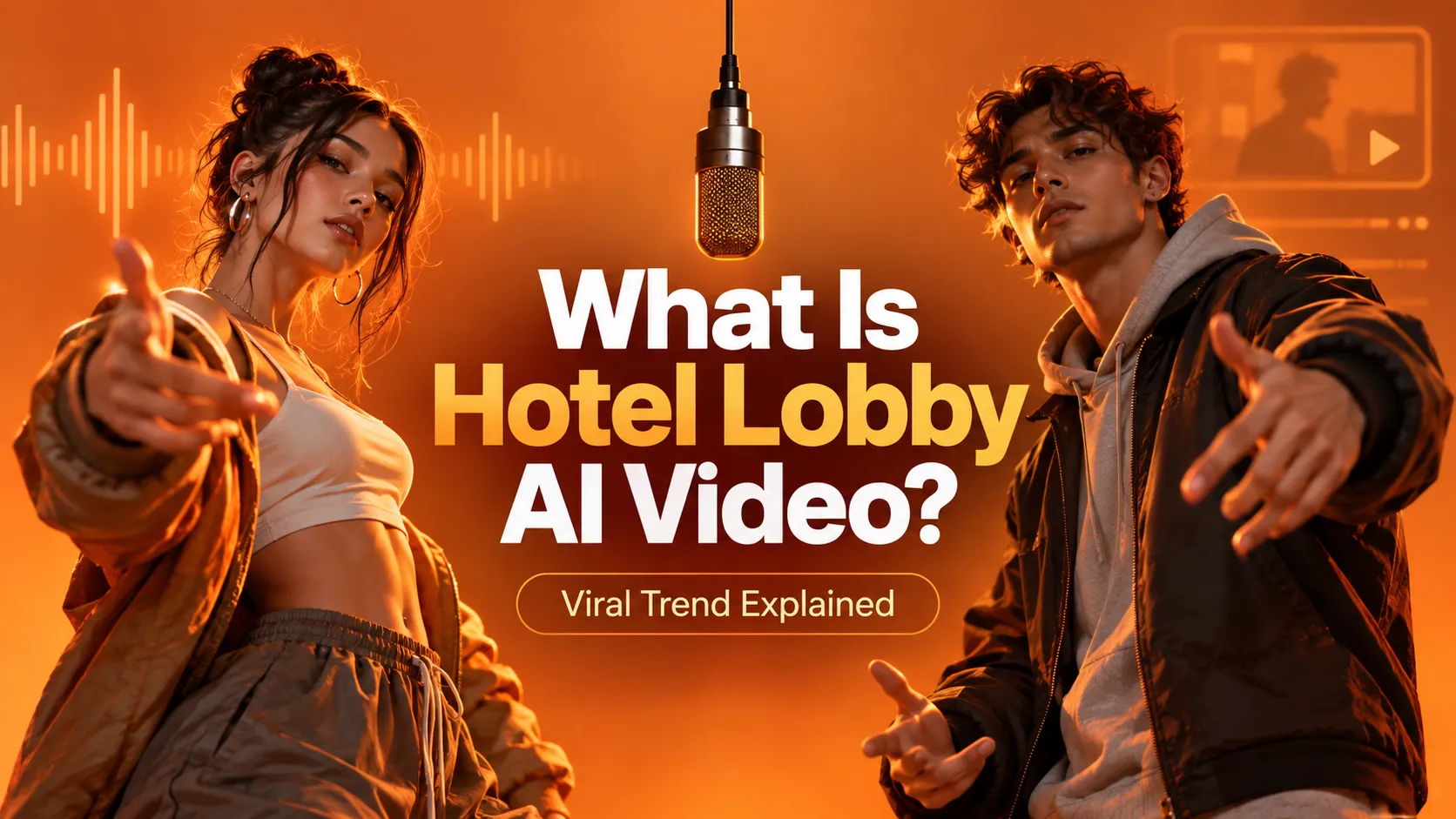
- Hotel Lobby AI video is a viral 2026 AI-video trend that recreates the visual setup of Quavo and Takeoff's 2022
HOTEL LOBBY (Unc & Phew)A COLORS SHOW performance: two performers, a saturated orange set, and one microphone hanging between them. - The phrase does not usually mean an AI-generated video of a hotel lobby. In current social-media usage, it refers to AI remixes of the Quavo and Takeoff performance.
- Creators typically provide one or two reference images, then use image-to-video, video-to-video, character replacement, motion transfer, or a preset template to make the subjects perform in the recognizable scene.
- The format spread rapidly on TikTok and X in September 2026, with remixes featuring friends, couples, pets, fictional characters, athletes, celebrities, and other unexpected pairings. Know Your Meme
- Good results depend less on a long prompt than on clean reference images, stable subject assignment, controlled framing, and consistent motion.
- The safest publishing workflow is to use images and likenesses you have permission to animate and add music through a platform's licensed audio library rather than redistributing copyrighted audio inside the generated file.
What Is the Hotel Lobby AI Video?
A Hotel Lobby AI video is an AI-generated or AI-transformed short video that places new people, animals, or fictional characters into a scene inspired by Quavo and Takeoff's performance of HOTEL LOBBY (Unc & Phew) for A COLORS SHOW.
The original song was released on May 20, 2022, while the widely referenced COLORS performance was published in June 2022. The performance is visually distinctive: Quavo and Takeoff stand against a monochromatic orange background and trade lines around a single microphone suspended from above. [Apple Music - Web Player](https://music.apple.com/us/album/hotel-lobby-unc-phew-single/1624591067
In 2026, AI creators began treating that composition as a reusable video format. Instead of Quavo and Takeoff, a generated version might show two cats, a couple, TV characters, football players, historical figures, or two photos supplied by the creator.
That is why searches for hotel lobby AI, hotel lobby AI video, hotel lobby AI trend, Migos AI trend, and hotel lobby AI generator are usually describing the same basic phenomenon.
Why Is It Called Hotel Lobby AI?
The name comes from the song title, not the location shown in the video.
This is an important distinction because the original COLORS performance does not resemble a conventional hotel lobby. Its signature look is a minimalist orange studio with two performers and a hanging microphone.
In other words:
- Hotel Lobby = the Quavo and Takeoff song.
- Hotel Lobby performance = the recognizable orange COLORS performance.
- Hotel Lobby AI video = an AI remake that replaces or reinterprets the performers while preserving enough of that staging and movement to make the reference instantly recognizable.
This naming explains why someone searching for the trend may be confused when results show rappers, cats, celebrities, or cartoon characters instead of hotels.
Where Did the Hotel Lobby AI Trend Come From?
Quavo and Takeoff released HOTEL LOBBY (Unc & Phew) in May 2022. The performance most closely associated with the later AI trend was published by COLORS in June 2022. Apple Music - Web Player
The AI remix format became prominent in mid-to-late September 2026. Know Your Meme documents an early viral example posted on September 16, 2026, replacing Quavo and Takeoff with characters from Suits. It also records subsequent versions featuring cats and other pairings as the meme spread across TikTok and X. Know Your Meme
By early October 2026, Hotel Lobby AI was being included in weekly meme roundups, confirming that the format had moved beyond isolated experiments into a recognizable social-video meme. Know Your Meme
The important point is that this was not driven by one official Hotel Lobby AI app. It became a format that multiple creators and tools could reproduce.
What Does a Hotel Lobby AI Video Look Like?
Most successful versions preserve several visual cues from the source performance:
- Two subjects positioned on opposite sides of the frame.
- A flat orange or orange-red background.
- A single microphone hanging from above.
- Medium or full-body framing.
- Alternating performance gestures between the left and right subjects.
- Head movement, hand gestures, body rhythm, and reaction shots timed like a rap duet.
- A relatively stable camera rather than aggressive cinematic movement.
- The Hotel Lobby song or a similar rap track added during editing or on the social platform.
The exact output varies by generator. Some tools create a fresh scene from two images, while others use a reference clip or motion template to guide pose, timing, and camera behavior.
How Does Hotel Lobby AI Work?
There is no single technical method behind every Hotel Lobby AI video. Most workflows use one or more of the following techniques.
1. Character-reference image generation
The creator provides one photo for the left performer and another for the right performer. A video model uses those images as identity references while generating a new sequence.
The model must preserve:
- facial identity,
- hairstyle,
- clothing cues,
- approximate body proportions,
- left-versus-right placement,
- and temporal consistency across frames.
This is more difficult than generating a single AI image because the model has to keep both identities stable while they move.
2. Image-to-video generation
A generator creates an initial frame or scene containing both subjects, then animates it.
The prompt or preset describes:
- who stands on the left,
- who stands on the right,
- the shared hanging microphone,
- the orange studio,
- hand and head movements,
- timing,
- and camera stability.
Image-to-video works well when the goal is to recreate the idea of the scene rather than copy the original performance precisely.
3. Video-to-video transformation
Some versions use a reference performance as a motion guide. The model preserves the broad movement, pacing, composition, or pose changes while rendering different characters.
This can produce stronger motion fidelity because the AI does not need to invent the full choreography from text alone.
However, video-to-video also creates more copyright and likeness considerations if the workflow directly incorporates copyrighted footage or a recognizable person's image.
4. Motion transfer or performance transfer
More advanced systems separate appearance from motion. One input supplies character identity, while another supplies the movement.
Conceptually, the pipeline looks like this:
Reference person A + Reference person B
            ↓
Identity / character conditioning
            ↓
Performance or motion reference
            ↓
Scene and camera constraints
            ↓
Temporal video generation
            ↓
Face / hand consistency pass
            ↓
Audio, captions and final edit
The strongest Hotel Lobby AI generators hide most of this complexity behind a preset.
Why Did the Hotel Lobby AI Trend Go Viral?
The trend is unusually well suited to generative video.
The scene is recognizable within one second
The orange background, hanging microphone, and two-person composition create a strong visual signature. A viewer does not need to watch a full clip to understand the reference.
It has a simple substitution mechanic
Memes spread faster when audiences can immediately imagine new variants.
The Hotel Lobby format asks a simple question:
What if these two characters performed Hotel Lobby together?
That makes almost any duo usable:
- best friends,
- couples,
- parents,
- pets,
- sports rivals,
- movie characters,
- game characters,
- historical figures,
- or intentionally absurd combinations.
The original camera setup is AI-friendly
Generative video often struggles with rapidly changing environments, complex cuts, crowds, and multiple interacting objects.
Hotel Lobby is comparatively constrained:
- simple background,
- fixed visual palette,
- mostly stable camera,
- two main subjects,
- one central prop,
- repetitive rhythmic movement.
Those constraints reduce the number of things the model must keep consistent from frame to frame.
It combines recognition with surprise
The viewer recognizes the staging but does not know who will appear in it. That combination creates an immediate hook and encourages remixes.
How to Make a Hotel Lobby AI Video
A reliable workflow can be completed with a dedicated template generator or a general AI video model.
Step 1: Choose two strong reference images
Use one subject per image whenever possible.
Best results usually come from photos with:
- a clearly visible face,
- good lighting,
- minimal motion blur,
- no sunglasses covering the eyes,
- no hands covering the face,
- no additional people,
- and enough resolution to preserve facial details.
Waist-up or full-body images can help when clothing and body appearance matter. A close headshot may preserve the face well but force the model to invent the rest of the outfit.
Step 2: Keep the two roles explicit
Assign each person to a fixed side.
For a general video model, a prompt can use language such as:
Two performers in a minimalist warm-orange studio share one vintage microphone hanging from the ceiling. SUBJECT A remains on the left and SUBJECT B remains on the right. They alternate energetic rap-performance gestures, head movement and natural hand motion. Locked front-facing camera, medium full-body framing, consistent facial identity, consistent clothing, no camera cuts, no extra people.Explicit left/right instructions reduce the chance that the model swaps faces or merges clothing.
Step 3: Generate a short clip first
Start with approximately 5 to 10 seconds.
Longer clips increase the probability of:
- face drift,
- hand deformation,
- clothing changes,
- position swapping,
- extra limbs,
- background instability,
- and lip-sync errors.
Once a stable short clip works, extend the idea through multiple edited shots rather than assuming one long generation will remain perfect.
Step 4: Add audio separately when possible
For social publishing, it is often cleaner to generate the visual performance first and then add the relevant sound inside TikTok, Instagram, YouTube, CapCut, or another editor where audio licensing options are clearer.
This also gives better control over:
- beat alignment,
- caption timing,
- clip duration,
- volume,
- and platform-specific sound availability.
Step 5: Export for the target platform
For TikTok, Reels, and Shorts, 9:16 vertical video is the safest default.
Keep important faces and the microphone away from extreme top and bottom edges because platform UI elements can cover the frame.
Best Prompt Structure for Hotel Lobby AI
A strong prompt should describe composition, identity, motion, camera, and negatives in that order.
A practical structure is:
Scene: minimalist monochromatic orange performance studio.
Characters: SUBJECT A on the left, SUBJECT B on the right.
Prop: one vintage microphone suspended from the ceiling between them.
Action: alternating rap-performance gestures, rhythmic head movement, natural hand motion, reacting to each other.
Camera: locked front camera, medium-wide framing, no cuts, no zoom.
Consistency: preserve facial identity, hairstyle and clothing throughout.
Avoid: extra people, face swapping, fused bodies, duplicate arms, changing outfits, moving microphone, background changes.
A dedicated Hotel Lobby preset may not require a prompt at all, but these principles still explain what the preset is controlling behind the scenes.
Common Problems and How to Fix Them
The two faces swap positions
Cause: The model treats both people as a loose group rather than independent identities.
Fix: Use separate reference images and explicitly define SUBJECT A = left and SUBJECT B = right.
The faces look correct at first and drift later
Cause: Temporal identity consistency weakens as the sequence becomes longer or motion becomes more complex.
Fix: Shorten the generation, reduce exaggerated movement, or use a model with stronger character-reference support.
Hands become distorted
Cause: Fast gestures, hand overlap, microphone interaction, and occlusion are difficult for video models.
Fix: Ask for moderate, rhythmic gestures rather than extreme hand motion. Generate several variations and choose the most stable result.
The microphone moves or duplicates
Cause: The model interprets the microphone as part of the performers' motion.
Fix: Describe it as a single stationary microphone suspended from the ceiling and request a locked camera.
Clothes keep changing
Cause: Weak visual reference coverage or too much full-body movement.
Fix: Use clearer source images that show the intended outfit and add consistency instructions.
The result looks like a generic rap video
Cause: The prompt captures the genre but not the distinctive composition.
Fix: Emphasize the minimalist monochromatic orange studio, two-person left/right staging, one hanging microphone, and locked front-facing camera.
Do You Need a Specific Hotel Lobby AI App?
No.
The trend is not tied to one universal official generator. Multiple services now offer dedicated Hotel Lobby templates, while general AI video systems can recreate a similar format with reference images and motion guidance.
Current Hotel Lobby-focused tools commonly advertise workflows in which users upload two photos and generate a short duet-style clip, while general AI video products can achieve comparable results with more manual prompting and editing. Hotel Lobby AI
The choice depends on the goal:
- Dedicated template: fastest and easiest.
- General image-to-video tool: more creative freedom.
- Video-to-video workflow: strongest motion resemblance, but requires more care around source footage and rights.
- Manual editor plus AI: best control over captions, timing, music, and final polish.
Is Hotel Lobby AI the Same as Face Swap?
Not exactly.
Traditional face swap replaces a face while keeping most of the original footage unchanged.
A modern Hotel Lobby AI workflow may instead generate:
- a new body,
- new clothing,
- new background pixels,
- new gestures,
- new lighting,
- and sometimes an entirely new performance.
This is closer to reference-conditioned generative video than a basic face swap.
Some lightweight templates may still use face-replacement techniques, so the underlying method depends on the tool.
Is Hotel Lobby AI the Same as the Migos AI Trend?
Usually, yes.
Quavo and Takeoff were members of Migos, so users often refer to the meme using search terms such as:
- Migos AI video
- Migos Hotel Lobby AI
- Quavo Takeoff AI trend
- Hotel Lobby Migos trend
- Hotel Lobby AI filter
The more precise description is the Quavo and Takeoff Hotel Lobby AI trend, because the specific performance features those two artists.
Copyright, Likeness and Disclosure Considerations
AI video makes remixing easy, but creators should separate three different rights issues.
Music rights
The original HOTEL LOBBY (Unc & Phew) recording is copyrighted. A safer social workflow is to use audio offered through the platform's licensed music system rather than packaging an unauthorized copy of the song into a downloadable video.
Performance footage
Directly using or transforming copyrighted source footage can raise different issues from merely creating a new video inspired by the composition.
A fully generated orange-studio duet with original motion is not technically identical to transforming the original performance frame by frame.
Likeness rights
Animating real people without permission can create privacy, publicity-right, impersonation, or platform-policy issues, especially when the result appears realistic.
For commercial use, advertising, or potentially misleading content, consent becomes particularly important.
Creators should also consider labeling realistic synthetic media when a platform requires it or when viewers could reasonably mistake the content for authentic footage.
What Makes a High-Quality Hotel Lobby AI Video?
The best examples prioritize consistency over complexity.
A strong generation usually has:
- two clearly recognizable subjects,
- stable left/right placement,
- one microphone,
- clean facial details,
- believable hand movement,
- consistent clothing,
- limited camera movement,
- accurate beat timing,
- and a short duration.
Trying to add dramatic camera moves, outfit changes, crowds, multiple props, and complex choreography often makes the output less convincing.
For this trend, the visual simplicity is not a limitation. It is the reason the format works.
Hotel Lobby AI vs. a Generic AI Music Video
| Feature | Hotel Lobby AI | Generic AI Music Video |
|---|---|---|
| Core idea | Recreate a recognizable two-person performance format | Create any music-video concept |
| Subjects | Usually two | One or many |
| Background | Usually orange/minimalist | Any environment |
| Camera | Often locked or simple | Highly variable |
| Motion | Alternating duet gestures | Any choreography |
| Prompt difficulty | Low with a preset | Medium to high |
| Meme recognition | Very high | Depends on concept |
| Best use | Fast social remix | Original music-video production |
The Hotel Lobby format wins on recognizability and repeatability, while a generic AI music video offers more creative freedom.
Frequently Asked Questions
Is Hotel Lobby AI actually about hotels?
No. The name refers to the Quavo and Takeoff song HOTEL LOBBY (Unc & Phew), not a hotel-lobby scene.
When did the Hotel Lobby AI trend become popular?
The original song and COLORS performance date to 2022, while the AI remix trend became widely visible in September 2026. Know Your Meme
What do you need to make one?
Usually two clear reference photos are enough for a dedicated template. More advanced workflows may also use a motion reference, text prompt, character model, or video-to-video input.
Can pets or fictional characters be used?
Yes. The meme works because the two performers can be replaced with almost any recognizable pair. Viral examples have included animals and fictional characters. Know Your Meme
Why does the trend use two photos?
Two separate images make it easier to preserve each performer's identity and assign one to the left side and one to the right side.
What aspect ratio should be used?
Use 9:16 for TikTok, Instagram Reels, and YouTube Shorts unless a specific platform or template requires another format.
Is there one official Hotel Lobby AI generator?
No. There are multiple dedicated generators and general AI video tools capable of making versions of the trend. The phrase describes the meme format more than one specific product. Hotel Lobby AI
Conclusion
The Hotel Lobby AI video trend is a 2026 generative-video remix of Quavo and Takeoff's iconic HOTEL LOBBY COLORS performance. Its orange background, hanging microphone, two-person staging, and rhythmic hand gestures make it unusually easy to recognize and unusually well matched to current AI video systems.
The most effective workflow is straightforward: choose two clean reference images, lock each subject to a side, keep the camera stable, generate a short clip, and add platform-cleared audio during editing. For higher-quality results, focus on identity consistency and motion control rather than adding more visual complexity.
For creators exploring the trend, the best next step is to produce a 5–10 second test with two clear photos before spending time on longer generations. That small test quickly reveals whether the chosen model can preserve faces, hands, clothing, and left/right placement well enough for a polished final video.
Continue Reading
More articles connected to the same themes, protocols, and tools.

Referenced Tools
Browse entries that are adjacent to the topics covered in this article.