
On This Page8 sections
Key Takeaways
- Dramagic is an enterprise AIGC production platform from BytePlus for short dramas and cinematic video workflows, not a standalone text-to-video model.
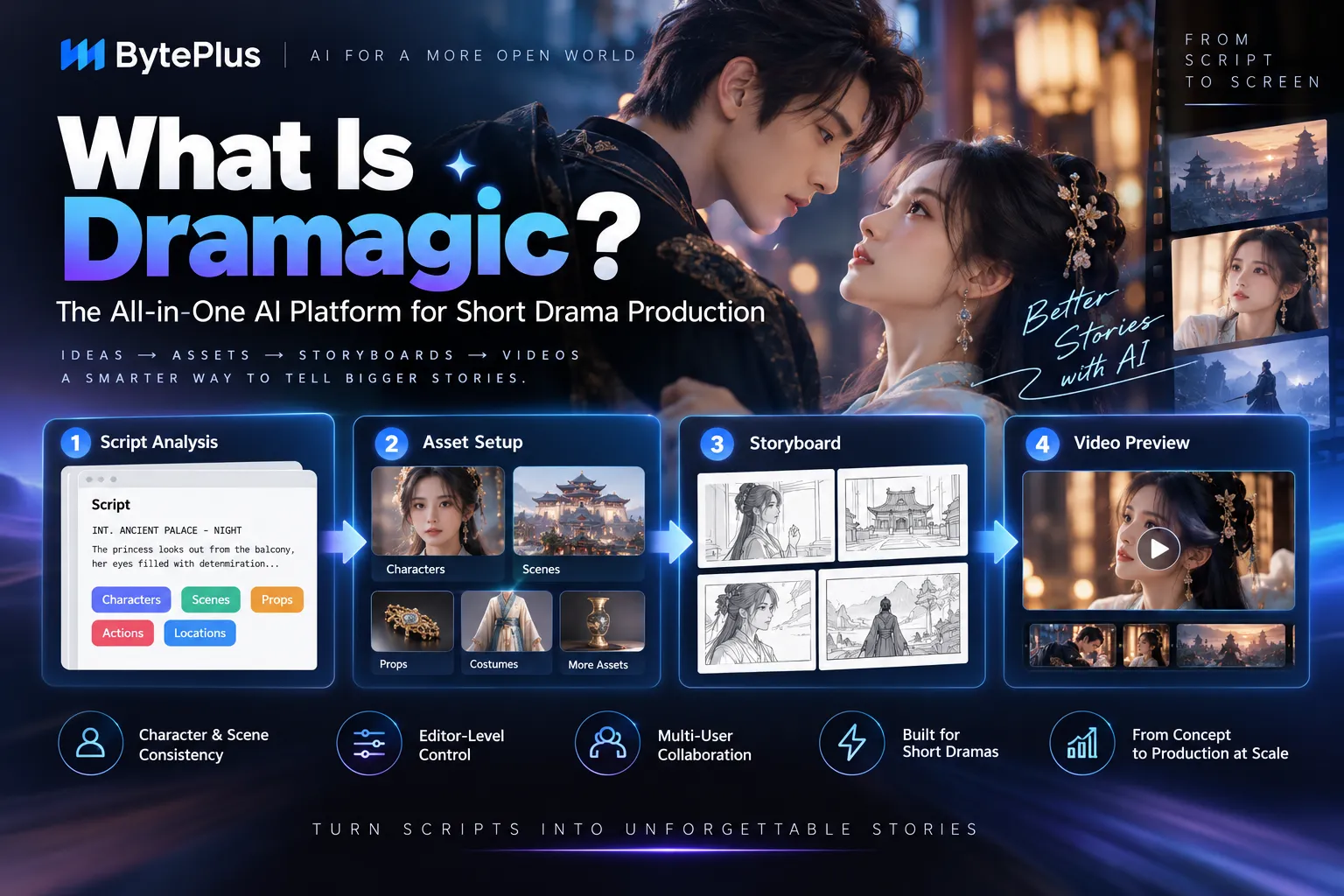
- Its core workflow is Script Analysis → Asset Setup → Storyboard → Video Preview, bringing pre-production and AI generation into one connected system.
- BytePlus highlights character and scene consistency, editor-level control, and multi-user collaboration as core differentiators.
- As of September 21, 2026, Dramagic is in beta and access is requested through BytePlus rather than a normal public self-service signup flow.
- Dramagic should be understood as a production workflow layer. A model such as Seedance generates or edits individual video outputs; Dramagic is designed to organize a much larger process around scripts, reusable assets, shots, review, and team production.
- Public information is still limited. BytePlus has not publicly documented a complete Dramagic feature matrix, global self-service price list, supported export formats, or every model used inside the platform.
What Is Dramagic?
Dramagic is BytePlus’s enterprise-grade, all-in-one AI-generated content platform for short-drama and cinematic production. BytePlus positions it as a system that connects the steps between receiving a script and reviewing a video result, rather than forcing production teams to jump between separate script tools, image generators, video generators, spreadsheets, and review systems.
The simplest way to understand Dramagic is:
A script becomes structured production assets; those assets feed storyboards; the storyboards feed video previews; the whole process stays connected for review and collaboration.
That distinction matters. Many AI video products start with a prompt and return a clip. Dramagic starts from the workflow problem faced by studios: a story may contain recurring characters, locations, wardrobe, props, shot requirements, continuity rules, and dozens or hundreds of scenes that need to remain visually coherent.
Dramagic is therefore closer to an AI-native production operating system for short-form narrative video than to a conventional one-shot video generator.
Who Makes Dramagic?
Dramagic is offered through BytePlus, ByteDance’s enterprise technology platform. It now appears in BytePlus’s AI and personalization product catalog alongside products such as Seedream, ModelArk, TRAE, and other AI services.
BytePlus publicly announced the current Dramagic beta as an enterprise AIGC platform for short dramas and video production. The company’s access page describes it as an all-in-one workflow for short dramas and cinematic production.
There are unrelated products and organizations using the Dramagic name, including an English drama academy. For the AI video product, the relevant official entry point is BytePlus, not similarly named dramagic.com or dramagic.net websites.
How Dramagic Works
BytePlus presents the workflow in four major stages.
1. Script Analysis
The first step is Script Analysis.
Instead of treating a screenplay as one long prompt, a production system needs to understand its structure. That normally means identifying production-relevant entities such as:
- characters
- scenes and locations
- props
- recurring visual details
- actions
- shot-level story information
- relationships between assets and scenes
BytePlus does not yet expose every internal Dramagic parsing detail publicly. However, its broader short-drama infrastructure shows the direction of the technology. BytePlus separately documents a short-drama script parsing operator that can turn multilingual scripts into structured character, prop, and scene tables, merge duplicate assets across episodes, and prepare data for text-to-image or text-to-video workflows.
That broader ecosystem documentation should not be read as a promise that Dramagic exposes the same operator or API directly. It does, however, illustrate why script parsing is important: AI filmmaking becomes easier to scale when a story is converted into structured production data before generation begins.
2. Asset Setup
The second stage is Asset Setup.
An AI drama rarely fails because a model cannot generate one attractive frame. The harder problem is making the twentieth shot still look like it belongs to the same production.
Asset setup provides a place to define and reuse the visual building blocks of a story. BytePlus specifically emphasizes built-in consistency for characters and scenes.
In practical terms, the production logic is straightforward:
- establish a character once
- establish important scenes once
- reuse those identities and visual references across shots
- reduce accidental visual drift
- review changes at the asset level rather than fixing every generated clip independently
This is especially important for microdrama and episodic content, where the same character may appear in dozens of clips generated at different times.
3. Storyboard
The third stage is Storyboard.
Storyboarding sits between a written script and expensive generation. It gives a production team a shot-level plan before committing to final video outputs.
BytePlus’s wider AI production stack provides useful technical context here as well. Its documented storyboard-generation workflow can associate shots with characters, scenes, props, visual settings, validation information, and change reports.
Again, that documentation describes BytePlus’s broader LAS capabilities rather than a guaranteed Dramagic API contract. But it demonstrates the underlying production principle: the storyboard becomes structured orchestration data, not merely a collection of pretty concept images.
For AI video production, this can improve:
- shot planning
- continuity
- prompt reuse
- asset tracking
- revision workflows
- quality review before video generation
4. Video Preview
The fourth public stage is Video Preview.
This wording is important. BytePlus currently describes the workflow as ending in video preview, rather than claiming that Dramagic automatically replaces every part of final editing, sound design, finishing, mastering, and distribution.
A preview-first workflow lets teams test whether:
- the character remains recognizable
- the scene is correct
- the shot communicates the intended story beat
- motion and framing work
- adjacent shots feel coherent
- a sequence is worth regenerating at higher quality
This can reduce one of the biggest costs in generative video: repeatedly generating expensive clips before the production plan is stable.
Why Character and Scene Consistency Matter
Consistency is one of the central problems Dramagic is designed to address.
Single-clip AI video generation has become increasingly capable, but serialized storytelling introduces a different challenge. A production may need the same face, hairstyle, costume, room, prop, lighting language, and visual identity to survive across many shots.
Without a structured system, teams often rely on:
- manually copying prompts
- repeatedly uploading reference images
- naming assets in spreadsheets
- tracking generations in folders
- manually checking whether continuity has drifted
Dramagic’s product positioning suggests that consistency is handled as a workflow-level concern rather than an afterthought at the individual prompt level. BytePlus explicitly lists built-in consistency for characters and scenes among the platform’s main benefits.
This is arguably more important for AI drama production than maximizing the visual quality of one isolated clip.
Dramagic vs. Seedance
Dramagic and Seedance are related to the same broader BytePlus AI ecosystem, but they solve different problems.
| Product | Primary role | Best way to think about it |
|---|---|---|
| Dramagic | End-to-end short-drama production workflow | Organizes script analysis, assets, storyboards, previews, review, consistency, and collaboration |
| Seedance | AI video generation model family | Generates or edits individual video outputs from text and multimodal references |
| Dreamina | Creative generation workspace | Gives creators a user-facing environment for working with models such as Seedance |
| CapCut | General video creation and editing platform | Editing, assembly, effects, templates, AI features, and publishing-oriented workflows |
BytePlus describes Seedance 2.5 as a video-generation model supporting native 30-second generation, multimodal references, and precision editing.
That makes the architectural distinction clear:
Seedance is a generation engine. Dramagic is a production workflow.
BytePlus has not publicly stated that every Dramagic generation is powered exclusively by Seedance 2.5, so it would be inaccurate to describe Dramagic simply as a Seedance wrapper.
Dramagic vs. a Normal AI Video Generator
A conventional AI video generator typically follows this pattern:
Prompt or reference
        ↓
Video generation
        ↓
Download clip
Dramagic is designed around a larger production graph:
Script
  ↓
Script analysis
  ↓
Characters / scenes / production assets
  ↓
Storyboard and shot planning
  ↓
Video preview
  ↓
Review / revisions / collaboration
The difference becomes more important as project size increases.
For a six-second experimental clip, a standalone generator may be enough.
For a 50-episode vertical drama with recurring characters and multiple collaborators, the management problem can become as difficult as the generation problem. Dramagic is aimed at that second category.
Collaboration Is a Core Feature, Not an Extra
BytePlus explicitly highlights multi-user collaboration and the ability for teams to plan, review, and scale production.
This indicates that Dramagic is not being positioned only for solo prompt experimentation. It is designed for workflows where multiple roles may interact with the same project.
Typical teams could include:
- producers
- script teams
- directors
- storyboard artists
- AI generation operators
- editors
- reviewers
- localization teams
- project managers
The value of collaboration is not simply simultaneous editing. In an AI production environment, the more important requirement is a shared source of truth for which character, scene, shot, or version is approved.
Who Is Dramagic For?
Dramagic is most relevant to teams producing narrative video repeatedly or at scale.
Short-drama studios
This is the clearest target market. Episodic vertical dramas require high output volume while preserving character and narrative continuity.
AI film and video production teams
Studios already using multiple image and video models can benefit from a structured layer that manages assets and storyboards instead of treating every generation as an isolated task.
Agencies and branded-content teams
Campaigns often require many related assets, revisions, reviewers, and platform variations. A structured production workflow can be more valuable than simply generating clips faster.
Distributed production teams
Multi-user collaboration becomes important when writers, generation operators, editors, and reviewers are working from different locations.
High-volume content operations
BytePlus already works with short-drama businesses operating at industrial scale. One BytePlus case study describes Light-Hub Power producing more than 10,000 minutes of AI short drama per month using a broader AI-driven production pipeline. That case study is not specifically a Dramagic benchmark, but it shows the scale of workflow problem BytePlus is targeting.
Is Dramagic Available Now?
Yes, but it is currently in beta.
As of September 21, 2026, BytePlus is inviting interested users to request access through its Dramagic contact form.
The public access flow asks for business information and project details, which reinforces its enterprise positioning.
This is different from a consumer AI tool where anyone can immediately create an account, buy a small monthly plan, and start generating.
How Much Does Dramagic Cost?
BytePlus has not published a standard global self-service Dramagic price table on the public beta access page as of September 21, 2026.
There are partner offerings that package Dramagic access differently. For example, Lebara Play Studio in Nigeria offers Dramagic-powered creator access through credit bundles and subscriptions.
Those prices should not be treated as BytePlus’s universal Dramagic pricing. They are a partner-specific commercial offer.
For enterprise buyers, the practical assumption should be that pricing may depend on factors such as generation volume, resolution, model usage, storage, collaboration requirements, support, and contract terms until BytePlus publishes a standardized pricing model.
What Is Confirmed — and What Is Still Unknown?
Because Dramagic is newly public, it is useful to separate confirmed information from assumptions.
Confirmed by BytePlus
- enterprise-grade AIGC platform
- designed for short dramas and cinematic/video production
- script analysis
- asset setup
- storyboard workflow
- video preview
- built-in character and scene consistency
- editor-level control
- multi-user collaboration
- beta availability through request access
Not yet clearly documented publicly
- complete list of models available inside Dramagic
- whether users can switch between multiple video-generation models
- exact maximum episode or project length
- precise supported export formats
- public API availability
- exact storage and project limits
- full collaboration permission model
- global pricing
- SLA details for beta users
- final-mastering and distribution capabilities
This distinction matters because early social posts can easily turn reasonable assumptions into supposed product facts.
The Bigger Idea Behind Dramagic
The most important part of Dramagic is not another AI generation button.
It represents a shift from model-centric AI video to workflow-centric AI production.
The first wave of generative video competition focused on questions such as:
- Which model looks most realistic?
- Which model follows prompts best?
- Which model produces the longest clip?
- Which model supports the highest resolution?
Those questions still matter. But professional production introduces a second layer:
- How are 100 shots organized?
- Which version of a character is approved?
- How does a scene remain consistent across episodes?
- How are revisions tracked?
- How do multiple people review the same project?
- How are reusable assets carried from script to storyboard to generated video?
Dramagic is designed around these operational questions.
That makes it potentially more significant than a single model upgrade. A generation model can be replaced as better models arrive. A strong workflow layer can remain valuable because it organizes the entire production process around those models.
Common Misunderstandings About Dramagic
Dramagic is not just another text-to-video model
Its public positioning is an enterprise production platform. Treating it as a model misses the asset, storyboard, consistency, review, and collaboration layers.
Dramagic is not the same product as Seedance
Seedance is a video-generation model family. Dramagic is a broader production system.
Dramagic is not currently a fully open consumer service
The current BytePlus release is beta and access is requested.
Public partner pricing is not universal pricing
A third-party or regional partner may sell credits for Dramagic access, but those plans should not automatically be presented as BytePlus global pricing.
Do not assume every BytePlus short-drama capability is exposed inside Dramagic
BytePlus has extensive separate documentation for script parsing, storyboard generation, Seedance video generation, short-drama delivery, localization, and other services. These provide useful technical context, but only features explicitly documented for Dramagic should be described as confirmed Dramagic functionality.
Why Dramagic Matters
AI video quality is improving rapidly, but high-quality individual clips alone do not create a scalable studio.
The production bottleneck is increasingly shifting toward orchestration:
- maintaining identity across shots
- turning scripts into structured plans
- managing reusable assets
- controlling revisions
- coordinating teams
- reviewing large numbers of generations
- deciding which outputs should move forward
Dramagic is BytePlus’s attempt to turn those fragmented production steps into one connected system.
If it succeeds, its main competitive advantage may not be that it generates a prettier single clip. It may be that a studio can move from one script to many coherent shots with fewer manual handoffs.
Conclusion
Dramagic is an enterprise AI production platform from BytePlus built specifically around short dramas and cinematic workflows. Its core pipeline connects script analysis, asset setup, storyboarding, and video preview while emphasizing character and scene consistency, editor-level control, and team collaboration.
The key idea is simple: Dramagic is not trying to be only another video model. It is trying to become the workflow layer that turns AI video models into a repeatable production pipeline.
As of September 21, 2026, the product remains in beta, so important details such as standardized global pricing, the complete internal model stack, APIs, limits, and export options are still not fully public. Teams evaluating Dramagic should therefore focus first on the confirmed workflow capabilities and request beta access directly from BytePlus for project-specific details.
Continue Reading
More articles connected to the same themes, protocols, and tools.
Referenced Tools
Browse entries that are adjacent to the topics covered in this article.