On This Page8 sections
Key Takeaways
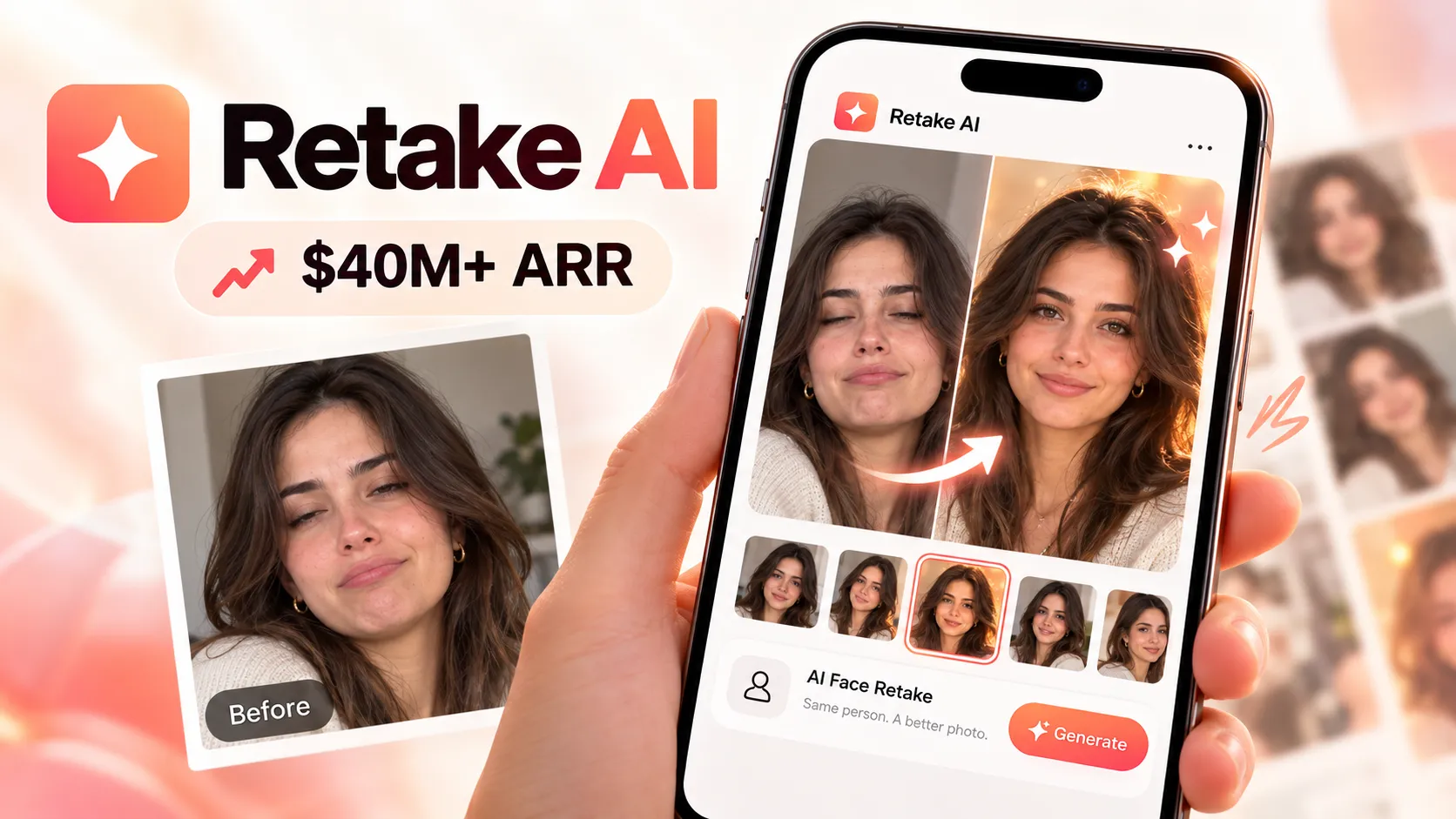
- Retake AI is a personalized AI face editor that generates alternative versions of existing photographs while attempting to preserve the subject's recognizable identity.
- Codeway publicly reported $40M+ in annual recurring revenue (ARR) and 35M+ downloads for Retake. These figures are company disclosures, not independently audited financial results.
- Third-party estimates support a substantial business: AlphaMoat estimated approximately $2.8 million in app-store in-app purchase revenue and 815,465 downloads during September 2026.
- Retake uses proprietary AI technology. Codeway says its own image generation model powers the product, distinguishing it from applications built entirely around third-party image APIs.
- The app is free to download but monetizes through subscriptions. The US App Store lists multiple weekly subscription options ranging from $4.99 to $14.99, alongside an annual option.
- Its competitive advantage is identity preservation rather than generic beauty enhancement. Subscription costs, inconsistent results, and facial-data privacy remain important considerations.
What Is Retake AI?
Retake AI is an AI-powered photo editing application designed to solve a common photography problem: the composition, clothing, background, and lighting of a photograph look excellent, but the person in the picture dislikes their facial expression.
Traditional photo editing applications typically address this problem through skin smoothing, facial reshaping, lighting adjustments, and beauty filters. Retake approaches it differently.
Instead of modifying individual features with conventional editing controls, Retake uses a personalized AI face profile to generate alternative versions of a photograph. The objective is to make the subject look more flattering without losing the facial characteristics that make them recognizable.
This positioning makes Retake particularly relevant for:
- Selfies with awkward facial expressions.
- Vacation photographs that cannot be retaken.
- Candid portraits captured at imperfect moments.
- Social media profile pictures.
- Event photography where the pose and composition are already satisfactory.
- Group photographs where one person's expression detracts from an otherwise excellent image.
Retake is developed within Codeway, a consumer technology company headquartered in Istanbul with operations in Barcelona. The application is distributed through Apple's App Store and Google Play.
Its App Store legal seller is DEEP FLOW SOFTWARE SERVICES - FZCO, while Codeway identifies Retake as a product within its consumer AI portfolio.
The central product proposition is straightforward: make an existing photograph look like the best version of the original subject rather than generating an entirely different person.
How Does Retake AI Work?
Retake uses a personalized image generation workflow. According to its official mobile application description, users begin by uploading 12 favorite photographs to establish an individual AI face profile.
The official Retake website describes a process involving photo selection, AI profile selection, and generating shareable results.
Step 1: Create a Personal AI Face Profile
The application asks users to provide several reference photographs showing their appearance.
These images help the system represent distinguishing facial features, including proportions, structure, and other characteristics associated with the same person.
Using multiple images is important because a single photograph provides incomplete information. Lighting, camera angle, expression, makeup, and focal length can all change how someone appears.
A collection of representative photographs gives an identity-conditioned image model more information about the subject.
Step 2: Upload a Photograph to Improve
After creating a profile, users select an existing photograph that contains an unsatisfactory expression or appearance.
The target image provides the original scene, pose, framing, and visual context.
For example, a user may upload a wedding photograph where the clothing, background, and overall composition are excellent, but the subject was blinking when the camera shutter activated.
Step 3: Select the AI Profile
Retake supports multiple profiles, allowing users to choose which saved profile should be applied to the selected photograph.
This is different from a standard global beauty filter because the system attempts to incorporate the appearance of a particular individual.
Step 4: Generate Multiple Alternatives
Retake generates alternative versions of the selected image.
Instead of manually adjusting facial details, users can compare candidate results and select the one that appears most natural.
The official website also advertises like/dislike feedback for generated alternatives.
Step 5: Review and Save the Result
The final step is selecting a preferred image and saving it for personal use or sharing.
Important limitation: AI-generated expressions are synthetic reconstructions. They may appear realistic without representing the exact expression that existed when the original photograph was taken.
For personal social media content, that distinction may be acceptable. For documentary, journalistic, forensic, or evidentiary photography, authenticity requirements are substantially different.
Retake AI Features: What Makes the App Different?
Retake's product experience emphasizes automated facial reconstruction rather than a complicated collection of manual editing tools.
| Feature | Description | Primary Benefit |
|---|---|---|
| Personalized Face Model | Uses uploaded reference photographs to represent a particular subject | Improves the likelihood of recognizable identity |
| AI Photo Retakes | Generates alternative versions of an existing photograph | Reduces the need to repeat the original photo session |
| Multiple Generated Results | Provides candidate images for comparison | Lets users choose the most appealing result |
| Identity Preservation | Attempts to retain distinctive facial characteristics | Avoids replacing the subject with a generic-looking face |
| Multiple Profiles | Supports selection among different saved AI profiles | Provides flexibility across supported editing scenarios |
| Like/Dislike Feedback | Allows preference feedback on generated candidates | Simplifies the result-selection process |
| Mobile Editing | Designed around smartphone photography | Makes editing accessible without professional software |
Identity Preservation Is the Core Feature
Many AI photography applications produce attractive portraits. Fewer consistently maintain the identity of a specific subject while significantly changing an expression.
This distinction is particularly important because small facial changes can make a generated person look unfamiliar.
An image model might generate beautiful eyes, smoother skin, and a more symmetrical smile, yet alter the nose, jawline, or mouth proportions enough that the resulting person no longer resembles the original subject.
Retake attempts to solve that problem through personalization.
Why Multiple Results Matter
Facial attractiveness and naturalness are subjective.
A generated expression that appeals to one user may look artificial to another. Offering multiple candidates gives the user control over the final selection without requiring advanced photo editing skills.
The result-selection process is an important part of the product experience, not merely an additional feature.
Retake AI Revenue: Did It Really Reach $40 Million ARR?
Yes, Codeway has publicly claimed that Retake reached more than $40 million in annual recurring revenue.
In a Codeway growth recruitment announcement, the company stated that Retake had surpassed 35 million downloads and $40 million ARR in approximately two years.
Retake product lead Marco Greselin also disclosed the $40 million milestone in a professional LinkedIn post.
The private-company intelligence platform Caplight records these Retake milestones as of April 25, 2026.
Understanding the $40 Million Figure
Annual recurring revenue is a measure of recurring subscription revenue expressed on an annualized basis.
A $40 million ARR run rate corresponds to approximately:
| Metric | Calculation | Value |
|---|---|---|
| Annualized recurring revenue | Company-reported milestone | $40M+ |
| Monthly recurring revenue equivalent | $40M / 12 | About $3.33M |
| Daily annualized equivalent | $40M / 365 | About $109,589 |
These are mathematical equivalents of the reported ARR, not separate verified revenue disclosures.
Several distinctions are essential:
- ARR is not historical annual revenue. A business can achieve a particular annualized run rate without collecting that amount over the preceding year.
- ARR is not profit. Marketing expenses, app-store commissions, model inference, research, support, refunds, and infrastructure all affect profitability.
- ARR does not establish subscriber count. Calculating paying users requires reliable information about subscriber mix, average realized pricing, churn, and billing periods.
- ARR is not independently audited financial evidence. Retake's publicly available milestone comes from company statements.
The reported figure nevertheless indicates that Retake has become a commercially significant product within consumer AI photography.
Independent Revenue and Download Estimates for 2026
Third-party mobile analytics provide additional context beyond company announcements.
According to AlphaMoat's September 2026 Retake profile, the application generated an estimated $2.8 million in app-store in-app purchase revenue and received approximately 815,465 downloads in the reporting window.
AlphaMoat's published download trend includes:
| Period | Estimated Downloads | Interpretation |
|---|---|---|
| July 2026 | Approximately 1.5M | High acquisition volume |
| August 2026 | Approximately 1.6M | Continued substantial acquisition |
| September 2026 | 815,465 | Approximately 48% lower month over month |
The September estimate also identifies the United States as Retake's largest download market, accounting for approximately 15% of downloads.
Why Do Download and Revenue Trends Differ?
New downloads are an acquisition metric. Subscription revenue can include payments from users who installed the application months earlier.
Consequently, declining downloads do not automatically imply declining subscription revenue.
Possible explanations include:
- Existing subscribers continuing to renew.
- Changes in paid advertising budgets.
- Seasonal changes in photography-related demand.
- Shifts in acquisition channels or geographic targeting.
- Differences in third-party measurement methodology.
None of these explanations can be confirmed without access to Retake's internal financial and acquisition data.
AlphaMoat's figures are modeled estimates, not company accounting records. They cover the app-store purchases included in its methodology and should not be treated as an exact substitute for reported ARR.
Does Retake Really Have 150 Million Downloads?
A separate download claim requires careful interpretation.
Codeway's October 2026 product event page describes an identity-focused image product associated with more than 150 million downloads.
However, the Codeway corporate website attributes 150M+ downloads to Wishlabs, the broader AI creativity business that includes Retake and other products.
The Wishlabs website also presents 150 million downloads as a portfolio-level figure.
Therefore, the clearly attributable Retake-specific milestone remains the previously disclosed 35M+ downloads. The entire Wishlabs download total should not automatically be assigned to Retake alone.
Who Owns Retake AI? The Codeway Connection
Retake is part of Codeway, a consumer application company founded in Istanbul in 2020.
Its official company website currently reports the following group-level figures:
| Codeway Metric | Public Company Figure |
|---|---|
| Worldwide users | 600M+ |
| Applications | 60+ |
| Team members | 400+ |
| External investment | $0, according to Codeway |
| Main operating cities | Istanbul and Barcelona |
Codeway develops and operates applications across AI creativity, education, productivity, wellness, entertainment, and other consumer categories.
Its portfolio includes products such as Cleanup and Learna alongside Retake.
Was Retake Really Built by Only Seven People?
Retake attracted attention after Marco Greselin described the core team responsible for the product.
The disclosed team consisted of:
- Five engineers.
- One designer.
- One product manager.
However, that statement explicitly referenced an additional AI research team.
Codeway also operates centralized infrastructure, data, marketing, recruitment, finance, legal, and operational functions.
The correct interpretation is that Retake operated with a small core product team supported by a substantially larger company.
It would be misleading to conclude that only seven people were responsible for all its AI research, advertising, infrastructure, customer support, and business operations.
This organizational structure helps explain how relatively small product teams can operate applications serving millions of users.
How Does Retake AI Make Money?
Retake follows a consumer subscription model.
The application is available for free installation, while paid subscriptions provide access to its commercial editing experience.
Unlike conventional professional photo editing software, its value proposition centers on quickly achieving a desired result rather than offering a large collection of tools.
Retake AI Pricing in 2026
The US Apple App Store lists several subscription variants.
| Plan | Publicly Listed Price | Notes |
|---|---|---|
| Retake Pro Weekly | $4.99–$14.99 | Multiple weekly purchase variants exist |
| Retake Pro Annual | $59.99 | Listed US annual option |
| Free Trial | Availability varies | Confirm eligibility and duration in the app |
These are publicly visible purchase options, not a guarantee that every user receives all plans. Actual prices depend on the country, account, offer, and checkout configuration.
Why Weekly Pricing Matters
A weekly subscription can produce a high annualized payment amount if a customer keeps renewing.
For example, a $9.99 weekly plan would cost approximately $519.48 across 52 weekly billing cycles.
That differs considerably from a listed $59.99 annual option. Eligibility, plan terms, and promotional conditions may also differ.
Short subscription cycles can be commercially attractive when users have urgent or occasional needs, but they create challenges around perceived value, churn, refunds, and customer trust.
Retake's business model demonstrates how strongly consumers may value improvements to personal photographs. It does not prove that high weekly prices are appropriate for every user or every competing application.
How to Cancel Retake AI
On iPhone:
- Open Settings.
- Select the Apple Account name.
- Open Subscriptions.
- Select Retake.
- Choose Cancel Subscription.
Apple documents this process in its official subscription cancellation guide.
On Android:
- Open Google Play.
- Go to Payments & subscriptions.
- Select Subscriptions.
- Choose Retake.
- Cancel the subscription.
Google provides additional instructions in its subscription management documentation.
Deleting the application does not automatically cancel the subscription. Users should verify the renewal status through the relevant payment platform.
Retake AI Reviews: What Do Real Users Say?
Retake has a significant presence on both major mobile application marketplaces.
As displayed in October 2026:
- Apple App Store, United States: Approximately 4.6/5 stars from 52,000 ratings.
- Google Play: Approximately 3.7/5 stars from more than 57,000 reviews.
Ratings change over time and can differ across geographic storefronts.
Positive User Feedback
A recurring positive theme in App Store reviews is the ability to produce flattering portraits without substantially changing the person's identity.
Some users report that Retake's results look more like their actual appearance than conventional beauty filters.
Others appreciate being able to improve an existing photograph without organizing another photography session.
These comments align with the product's central identity-preservation approach.
Negative User Feedback
Critical reviews highlight several recurring concerns:
- Weekly subscription costs that users consider expensive.
- Confusion about free-trial eligibility and billing.
- Occasional unnatural facial features or expressions.
- Inconsistent image-generation quality.
- Photo-loading or processing difficulties.
- Restrictions on how many photographs can be edited within a period.
These are individual customer reports, not independently measured product failure rates.
What the Reviews Reveal About Product-Market Fit
Retake appears to address a problem that some consumers consider genuinely valuable.
However, customer satisfaction depends on more than producing one impressive result.
Consistency, subscription transparency, reliability, and the ability to obtain satisfactory results repeatedly are equally important.
A product can generate considerable revenue while still receiving substantial criticism about pricing and recurring payments.
Retake AI Technology: Why Identity Preservation Is Difficult
Codeway describes Retake as using proprietary, internally developed image-generation technology.
The company emphasizes that maintaining personal identity is a central technical challenge.
At a product event scheduled for October 21, 2026, Retake product and engineering leaders plan to discuss why the team adapted its own image model rather than relying entirely on a general-purpose image-generation API.
As of October 19, 2026, that presentation has not yet taken place. Detailed claims about unpublished model architecture should therefore be treated cautiously.
Four Technical Problems Behind Natural AI Retakes
1. Identity preservation
The model must preserve facial structure, proportions, and distinctive characteristics across generated variations.
A generated face may look realistic while no longer resembling the correct person. That represents a failure for identity-focused editing.
2. Expression reconstruction
Changing a smile or eye expression affects multiple interacting facial structures.
Natural results require coherent changes to the mouth, cheeks, eyelids, surrounding muscles, and visible teeth.
3. Scene consistency
The newly generated face must remain visually consistent with the original photograph.
Lighting direction, shadows, head orientation, hairstyle, skin tone, and the transition between edited and unedited regions all influence realism.
4. Candidate quality and selection
Producing several images is not enough if most contain obvious artifacts.
A successful product must offer meaningful variation while controlling identity drift and visual errors.
What Technology Might Support These Capabilities?
Common approaches across the broader AI image-generation field include:
- Identity-conditioned image generation.
- Facial representation models.
- Generative image inpainting.
- Face-aware masking and region editing.
- Image-to-image generation.
- Candidate ranking and quality evaluation.
These are relevant technical concepts, not confirmed descriptions of Retake's exact internal architecture.
Codeway has not publicly disclosed sufficient information to establish Retake's complete training pipeline, model weights, inference architecture, or cost per generated image.
Why a Proprietary Model Could Matter
General-purpose image models are designed to support a broad range of tasks.
A specialized model can potentially optimize more directly for consistent identity, constrained facial editing, predictable latency, and a particular quality standard.
That specialization may improve differentiation, but it also requires dedicated research, engineering, infrastructure, and ongoing evaluation.
The presence of proprietary technology alone does not establish that a model outperforms every alternative. Reliable conclusions would require controlled, reproducible comparisons.
Retake AI vs. Remini, FaceApp, and Google Best Take
Retake competes with established photo enhancement and facial editing products, although their primary capabilities differ.
| Tool | Primary Strength | Main Difference | Recommended Use Case |
|---|---|---|---|
| Retake AI | Personalized facial regeneration | Focuses on creating alternate versions of the same person's face | Improving awkward selfies and candid expressions |
| Remini | Image enhancement and facial clarity | Concentrates on improving image quality and portrait details | Restoring blurry or low-quality portraits |
| FaceApp | Photorealistic filters and appearance editing | Offers broader facial transformations and retouching | Makeup, hairstyles, creative edits, and facial adjustments |
| Google Photos Best Take | Selecting expressions from similar photographs | Combines expressions captured in related frames | Fixing group photographs where someone blinked |
Retake AI vs. Remini
Remini is particularly relevant when the primary problem is insufficient image quality.
Its tools address sharpness, resolution, lighting, facial detail, and image restoration.
Retake instead focuses on changing the appearance or expression of an individual in a photograph using a personalized profile.
A blurry photograph and an awkward expression are two different problems, even though both may be described as needing AI photo enhancement.
Retake AI vs. FaceApp
FaceApp provides a broader collection of facial editing features, including retouching, filters, and creative appearance transformations.
Retake's differentiation lies in its narrower goal of making an existing photograph more flattering while maintaining personal identity.
Users seeking varied creative transformations may prefer a broader editor. Users mainly concerned about recognizable facial consistency may find Retake's workflow more directly relevant.
Retake AI vs. Google Best Take
Google Photos Best Take can combine facial expressions from a sequence of similar photographs on supported Pixel devices.
This is different from generating an alternative expression using a personalized AI model.
When several suitable frames already exist, Best Take may provide a result more closely connected to expressions actually captured by the camera.
Retake becomes more relevant when no suitable alternate photograph exists.
Retake AI Privacy and Security: What Should Users Know?
Personalized facial editing involves sensitive user-generated content.
Building a face profile raises legitimate questions about photo storage, model personalization, data retention, and deletion.
The Apple App Store privacy disclosures indicate that certain user-content categories may be used for tracking across other companies' applications or linked to a user's identity.
The Google Play data-safety disclosures state that the application may collect photographs and application activity data. The listing marks data as not encrypted and indicates that users can request deletion.
These declarations are supplied by the developer and are not independent security-audit findings.
They should not automatically be interpreted as proof of a specific vulnerability, but they are important factors when deciding whether to upload facial reference photographs.
Privacy Checklist Before Using Retake
- Review the current Retake privacy policy.
- Check whether uploaded images are retained after a generated result is produced.
- Determine whether deleting a face profile also deletes associated server-side data.
- Investigate whether user photographs can be used for broader model improvement or training.
- Avoid uploading sensitive photographs or identity documents.
- Obtain consent before editing identifiable third parties.
- Retain the original, unedited photographs.
Users should distinguish between deleting an application, deleting a local profile, and requesting deletion of data held by a service provider.
These actions may have different effects.
How Retake AI Acquires Users and Grows Revenue
Retake benefits from Codeway's experience distributing consumer subscription applications internationally.
A Codeway growth recruitment listing specifically identifies Meta, TikTok, Google, and creative testing as relevant acquisition responsibilities.
The Codeway company website also emphasizes shared growth and advertising capabilities.
Why Before-and-After Marketing Fits Retake
The product offers an outcome that can be communicated almost instantly through visual demonstration.
A short comparison between an awkward original photograph and an improved version makes the value proposition easy to understand.
This is especially compatible with visual advertising formats on short-form video and social platforms.
A plausible acquisition journey is:
- A potential user sees a before-and-after demonstration.
- The advertisement introduces the possibility of improving an existing photograph.
- The user installs the application.
- The onboarding process creates a personalized face profile.
- The user explores generated alternatives and encounters the applicable subscription offer.
- The business attempts to retain paying customers through continued use.
This describes a reasonable consumer-app funnel, not verified Retake conversion data.
Retake has not publicly disclosed reliable figures for customer acquisition cost, advertising budget, subscriber lifetime value, renewal rates, or advertising return on spend.
Its ARR should not be used to invent these missing metrics.
Why Codeway's Organizational Structure Matters
Codeway operates centralized research and growth capabilities across multiple applications.
A small Retake product team can therefore benefit from infrastructure, knowledge, and resources developed for other products.
This creates a different competitive position from an independent developer launching a new subscription application without an established acquisition operation.
What Retake AI Teaches the Consumer AI Market
Retake provides several useful lessons for companies building AI applications.
1. Specific Problems Can Be More Valuable Than Large Feature Lists
Retake does not need to compete by offering every possible photography tool.
Its primary use case is easy to explain and directly connected to an existing consumer frustration.
This clarity makes the product easier to demonstrate and evaluate.
2. Personalization Can Create Differentiation
Personal reference photographs introduce a meaningful distinction between generic output and identity-specific editing.
However, personalization only becomes valuable when it improves the actual user experience. More onboarding steps or expensive model customization are not advantages by themselves.
3. Result Quality Must Be Measured Repeatedly
A collection of impressive demonstration images cannot establish consistent performance.
A more useful evaluation considers identity preservation, realistic expressions, processing reliability, the percentage of usable results, and user satisfaction across diverse photographs.
4. Distribution Is a Separate Competitive Capability
Strong AI models do not automatically produce strong businesses.
Consumer application growth also depends on effective positioning, advertising creatives, conversion, pricing, and retention.
Retake combines specialized technology with an established mobile growth organization.
5. Subscription Revenue Does Not Eliminate Trust Risks
Weekly subscription plans can generate meaningful recurring revenue, but unclear billing expectations can damage user satisfaction.
Transparency around price, cancellation, usage restrictions, and personal-data handling is particularly important for consumer AI products.
Is Retake AI Worth Paying For?
Retake is most compelling when users have photographs they genuinely value but cannot easily retake.
It may be worth considering when:
- A portrait contains an awkward facial expression.
- An otherwise excellent photograph needs a more flattering face.
- Maintaining recognizable identity matters more than dramatic styling.
- The user expects to edit enough photographs to justify the subscription.
It is less compelling when basic exposure correction, skin retouching, or sharpening would solve the problem.
Users requiring strict photographic authenticity should also consider whether generative facial editing is appropriate.
Before Subscribing
- Confirm the price and exact billing interval.
- Review any free-trial terms and renewal date.
- Check whether editing limits apply.
- Prepare clear, representative reference images.
- Evaluate the results for identity consistency and visible artifacts.
- Understand the platform's cancellation process.
- Review privacy and data-deletion information.
The right purchase decision depends on the quality of results and the value of the particular photographs, not on the product's headline revenue milestone.
Frequently Asked Questions
Is Retake AI free?
Retake is free to download, but the application offers paid subscriptions. Some users may encounter promotional trials, depending on eligibility and current offers. Free installation should not be confused with unrestricted free generation.
How many photos does Retake AI need?
Its official mobile listing describes uploading 12 favorite photographs to create a personalized AI face model. Requirements may change between application versions or onboarding experiences.
Does Retake AI preserve the original face?
Preserving recognizable personal identity is a primary product objective. However, results can vary depending on reference quality, lighting, facial orientation, occlusion, and expression complexity. Perfect identity preservation is not guaranteed.
Can Retake AI edit group photographs?
Retake is positioned around selfies and candid photographs, while third-party descriptions also mention group-photo scenarios. Performance and the ability to edit multiple individuals separately depend on the supported workflow and image conditions. Editing other people's likenesses should involve appropriate consent.
Is Retake AI safe?
Security cannot be guaranteed from a public application listing alone. Users should examine the developer's current privacy policy and the Apple and Google Play data-safety declarations before uploading personal facial photographs.
Who developed Retake AI?
Retake belongs to Codeway's consumer AI product portfolio and is associated with its Wishlabs AI creativity vertical. DEEP FLOW SOFTWARE SERVICES - FZCO is identified as the legal app seller or developer entity in major app stores.
How much revenue does Retake AI generate?
Codeway publicly reported more than $40 million in ARR. AlphaMoat separately estimated approximately $2.8 million in app-store in-app purchase revenue for September 2026. These figures measure different things and should not be treated as interchangeable.
Is Retake AI available on Android and iPhone?
Yes. Retake has official listings on both the Apple App Store and Google Play. Its website also provides a demonstration experience, although that should not be confused with a complete desktop editing application.
Is Retake AI better than Remini?
The applications emphasize different tasks. Retake focuses on personalized facial regeneration and alternative expressions, while Remini emphasizes image enhancement, sharpness, and portrait quality. The better choice depends on the original photograph's problem.
Is Retake AI just another AI image-generation API wrapper?
Codeway says Retake uses proprietary, internally developed image-generation technology. Its public statements therefore distinguish the product from applications relying exclusively on third-party APIs. The complete internal architecture has not been publicly disclosed.
Conclusion
Retake AI demonstrates how a narrowly focused AI application can become a substantial consumer subscription business.
Its company-reported $40M+ ARR, 35M+ download milestone, personalized facial editing workflow, and proprietary model strategy make it a significant example of commercialization in consumer AI photography.
The product succeeds conceptually by addressing a clear emotional need: improving an important photograph while preserving the identity of the person in it.
However, recurring subscription costs, variable generated results, competitive alternatives, and facial-data privacy deserve equal attention.
For consumers, the most useful question is not how much revenue Retake generates, but whether its results justify the price and meet expectations for realism and identity consistency.
Explore the official Retake AI demo, compare its capabilities with Remini and FaceApp, and verify the live subscription terms before making a purchase.
Continue Reading
More articles connected to the same themes, protocols, and tools.

Referenced Tools
Browse entries that are adjacent to the topics covered in this article.