On This Page7 sections
Key Takeaways
- Search demand for “pics and prompts”, “AI photo prompts”, and “image to prompt” has grown rapidly as more people want ready-to-copy prompts instead of writing them from scratch.
- The core user intent is simple: find a visual style they like and immediately copy a working prompt for ChatGPT, Gemini, Midjourney, Flux, or similar tools.
- High-intent keywords cluster around specific styles (girls, couples, cinematic, Instagram, saree, Korean, etc.) and action phrases (“copy paste prompt”, “exact prompt”, “recreate this look”).
- Sites that combine images + exact prompts + clear categories capture both informational and commercial intent, creating strong SEO and product opportunities.
- The gap is not more generic prompt lists, but well-organized, style-specific, and frequently updated prompt galleries that solve the “I saw a good image but don’t know the prompt” problem.
What Is “Pics and Prompts” Demand?
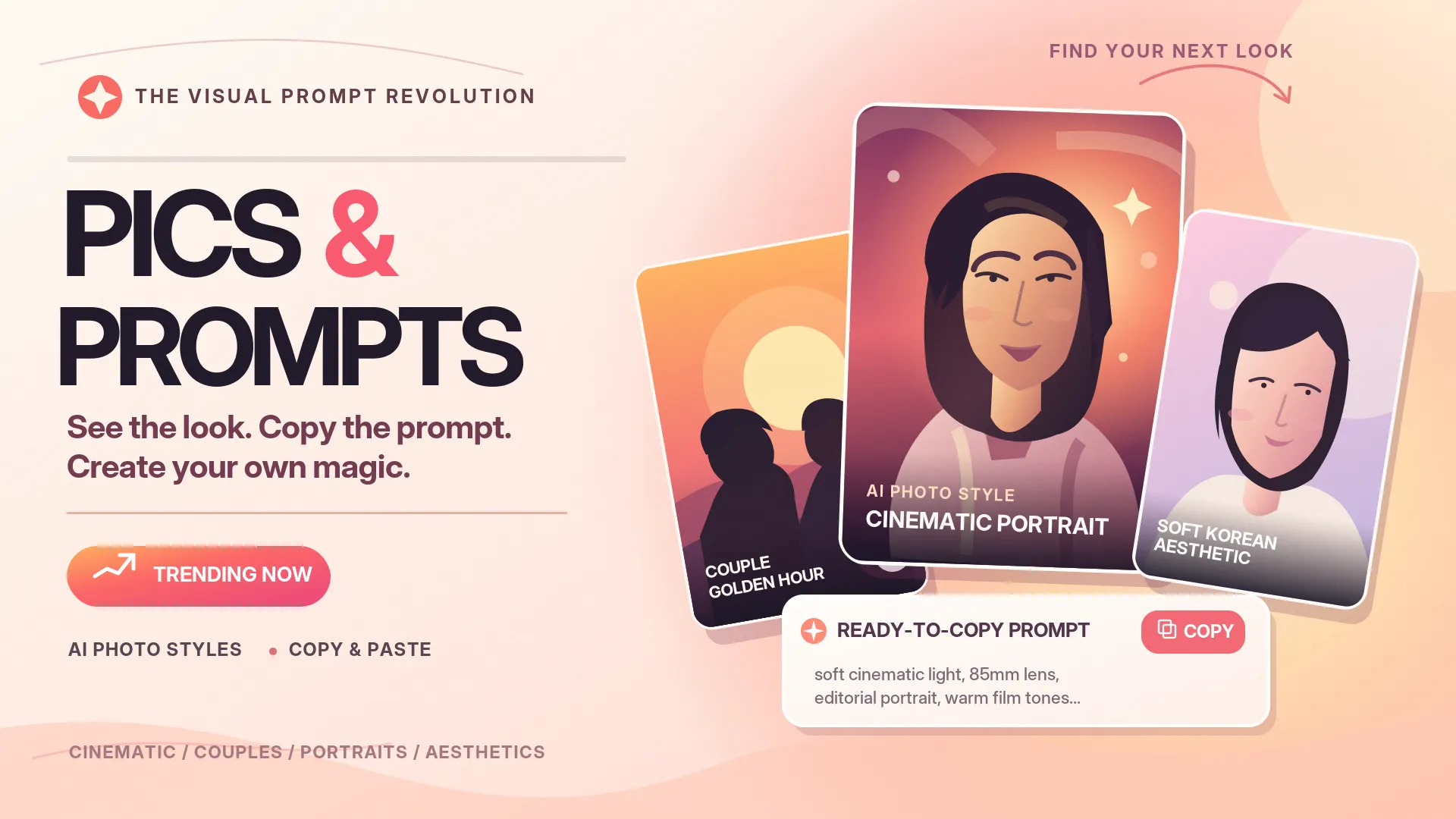
“Pics and prompts” refers to the growing search and product demand for galleries that pair AI-generated (or AI-edited) photos with the exact prompts used to create them.
Users typically arrive with one of three goals:
- They saw a photo style they like and want the exact prompt to recreate it.
- They want ready-to-copy prompts for popular themes (portraits, couples, cinematic looks, fashion, Instagram aesthetics).
- They want to upload their own photo and apply a proven style without writing a prompt themselves.
This demand sits at the intersection of three overlapping searches:
- Pics and prompts / picsandprompts
- AI photo prompts / AI photo editing prompts
- Image to prompt / prompt from image
Analysis of search behavior and content performance shows that pure prompt lists underperform compared with pages that show the resulting image next to a copyable prompt. Visual proof reduces uncertainty and increases both engagement and conversion.
Core Keywords and Search Intent
Primary Keywords
| Keyword | Intent | Notes |
|---|---|---|
| pics and prompts | Commercial / Informational | Brand-like query; users expect a gallery |
| picsandprompts | Navigational / Commercial | Often used as a product or site name |
| AI photo prompts | Informational / Commercial | Broad but high volume |
| AI photo editing prompts | Commercial | Stronger action intent |
| image to prompt | Tool intent | Users want reverse-engineering |
| copy paste AI prompts | Transactional | High conversion potential |
Long-Tail & Style-Specific Keywords
These convert better because they match specific visual desires:
- AI photo prompts for girls
- AI couple photo prompts
- cinematic AI portrait prompts
- Instagram AI photo prompts
- Korean style AI photo prompts
- saree AI photo prompts
- ChatGPT photo prompts
- Gemini photo prompts
- Midjourney portrait prompts
- exact prompt for this image
- recreate this AI photo
Why these matter: Most users do not search for “prompt engineering.” They search for the look they want (“Korean girl portrait prompt”, “cinematic couple photo prompt”) or the action they want to take (“copy this prompt”, “prompt for this style”).
Why This Demand Exists Now
Several factors are driving the growth:
- AI image tools became mainstream (ChatGPT, Gemini, Midjourney, Flux, Ideogram, etc.), but writing good prompts remains a skill barrier.
- Social media rewards strong visual styles. People see viral AI photos and want to replicate them quickly.
- Prompt fatigue is real. Many users have tried writing prompts and gotten inconsistent results, so they prefer proven ones.
- Image-to-prompt tools lowered the barrier further, but users still prefer curated, high-quality examples over raw AI descriptions.
Community feedback and content performance indicate that the highest-performing resources are those that:
- Show the actual output image
- Provide a clean, copyable prompt
- Organize content by style, gender, use case, or platform
- Update frequently with trending aesthetics
Content and Product Opportunities
High-Opportunity Content Types
- Style-specific galleries (e.g., “50 Korean AI Photo Prompts with Examples”)
- Platform-specific guides (ChatGPT vs Gemini vs Midjourney prompts for the same look)
- “Exact prompt” pages that pair one strong image with a detailed, optimized prompt
- Comparison pages: “Best AI Photo Prompts for Instagram in 2026”
- How-to content: “How to Recreate Any AI Photo Style Using Pics and Prompts”
Product / Tool Opportunities
- Curated prompt libraries with one-click copy
- Image upload + style application (user photo + selected prompt)
- Prompt extraction tools that also suggest improved versions
- Category filters by platform, gender, lighting style, or aesthetic
Sites that treat this as a content + utility hybrid (gallery + copy button + optional generation) tend to capture more intent than pure blogs or pure generators.
Common Pitfalls
- Publishing long lists of prompts without images (low engagement)
- Using vague or untested prompts that do not match the shown image
- Ignoring platform differences (a Midjourney prompt often fails or looks different in ChatGPT)
- Over-focusing on generic keywords instead of style-specific long-tail terms
- Failing to update content as new aesthetics and models emerge
Conclusion
The demand behind “pics and prompts” is clear and practical: people want visual inspiration paired with immediately usable prompts. Keywords that combine a specific style with an action (“copy”, “exact”, “recreate”, “for ChatGPT/Gemini”) consistently show stronger commercial intent than broad terms alone.
For content creators and product builders, the opportunity lies in building organized, image-rich, frequently updated prompt galleries that solve the core problem — “I like this look, give me the prompt.”
If you are creating content or a tool in this space, start with the highest-intent long-tail keywords listed above, pair every prompt with a clear example image, and structure pages around real user styles rather than generic “best prompts” lists.
Continue Reading
More articles connected to the same themes, protocols, and tools.
How to Create a SURVIVE MIN-Style Horror Game With AI: Complete Ren'Py Guide
GenOffice: The Open-Source AI Office Suite That Edits Your Files Directly (Not Just Chats About Them)
Google CrUX Vis: The Free Tool to Check Any Website's Real Core Web Vitals and Competitor Performance
Referenced Tools
Browse entries that are adjacent to the topics covered in this article.