On This Page8 sections
OpenAI plans to end Cursor's direct access to its models following Cursor's acquisition by SpaceX, with November 12, 2026 proposed as the shutoff date. The decision could change one of the AI coding market's most familiar arrangements: using GPT models inside a third-party, multi-model development environment.
The announcement does not mean Cursor is shutting down. It also does not yet answer every question about personal OpenAI API keys, enterprise contracts, existing Cursor plans, or exactly which model routes will stop working. What it does establish is that the commercial agreement supplying OpenAI models directly through Cursor is being wound down.
For developers who have built daily workflows around a particular GPT model inside Cursor, the distinction matters. This is not merely another model deprecation. It is a reminder that an AI IDE depends on contracts, model-provider policies, ownership changes, and infrastructure decisions that sit outside the editor itself.
The short version
- OpenAI says it notified SpaceX that it intends to wind down the contract that provides OpenAI models to Cursor.
- The company proposed November 12, 2026 as the date when Cursor's direct access would end.
- OpenAI tied the decision to Cursor's change of control after its acquisition by SpaceX and to concerns about trust and terms-of-service compliance.
- OpenAI says future models, including a model it calls Astra, will not be provided to Cursor under the arrangement.
- Cursor remains an operating AI development platform with its own models and access to other model families.
- The announcements do not clearly say whether users will still be able to connect personal OpenAI API keys after the direct integration ends.
- Developers should treat November 12 as a planning deadline, not assume that every OpenAI-related Cursor workflow will behave the same way afterward.
What Thibault Sottiaux said on X
Thibault Sottiaux, who works on Codex and ChatGPT at OpenAI, summarized the decision in a widely shared post on X. He said OpenAI could no longer continue providing its models through Cursor, described the issue in five words — “It boils down to trust” — and said the November date was intended to give developers time to plan.
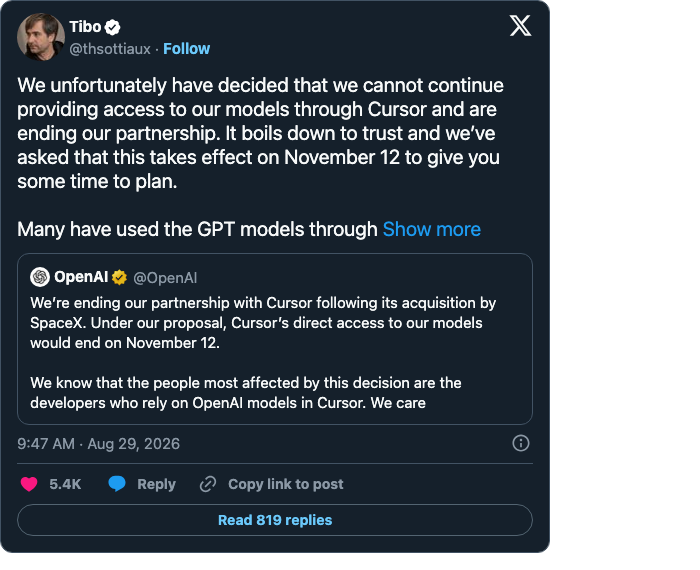
Screenshot of the original August 29, 2026 post and the quoted OpenAI announcement. Source: X.
The post matters because it frames the change from the perspective of the team responsible for OpenAI's developer products. It also acknowledges that many developers have used GPT models through Cursor for years and will need a transition path.
What OpenAI officially announced
In its formal announcement, OpenAI said it had notified SpaceX of its intention to end the custom contract supplying models to Cursor. It described November 12 as a “proposed shutoff date” and said this was the maximum notice allowed by the agreement.
OpenAI's explanation has three parts.
First, the Cursor acquisition created a change-of-control event. OpenAI says its contract includes a limited window in which it can cancel the agreement after such an event.
Second, OpenAI says large-scale integrations require custom contracts that govern safety and compliance. The company stated that it could not be confident SpaceX would use its technology within those terms, citing its own prior disputes with companies controlled by Elon Musk. Those are OpenAI's stated reasons; the announcement is not an independent adjudication of the underlying disputes.
Third, OpenAI connected the decision to future capability. It specifically referred to an upcoming model named Astra and argued that more capable models create a higher obligation to control how they are integrated and used. OpenAI said it plans to preserve current access for the contractual notice period while withholding future models from Cursor.
The tone of the announcement is unusually direct, but it also praises Cursor's product and team. OpenAI says it has worked with Cursor for nearly four years and wants to support developers through the transition.
How the SpaceX acquisition changed the relationship
This dispute did not appear without context. Cursor's relationship with SpaceX moved quickly from compute partnership to ownership.
| Date | Event |
|---|---|
| April 21, 2026 | Cursor announced a model-training partnership with SpaceX to gain more compute for its own coding models. |
| August 14, 2026 | Cursor announced that it had officially been acquired by SpaceX. |
| August 28, 2026 | OpenAI published its decision to wind down the model-supply agreement. |
| August 29, 2026 | Thibault Sottiaux summarized the decision and transition date on X. |
| November 12, 2026 | OpenAI's proposed date for ending Cursor's direct model access. |
Cursor said the acquisition would give it access to the “largest fleet of GPUs in the world,” helping the company train stronger models at lower operating cost. Its official acquisition announcement presented Grok 4.6 as an early example of what the combined organizations could build.
Official artwork published with Cursor's August 14 announcement that it had become part of SpaceX. Source: Cursor.
Strategically, that moves Cursor closer to a vertically integrated stack: SpaceX provides large-scale compute, the combined organization develops its own models, and Cursor supplies the developer-facing application and agent harness.
That vertical integration also changes Cursor's relationship with outside model providers. What once looked like a neutral editor buying access from several AI labs can now look like a major AI platform distributing a competitor's frontier models inside its own product.
What does “direct access” actually mean?
OpenAI's wording is precise enough to confirm a contract change but not detailed enough to answer every implementation question.
The clearest interpretation is that Cursor will lose the first-party commercial route through which it offers OpenAI models as built-in choices to its customers. If a Cursor plan currently includes GPT usage handled through Cursor's infrastructure, billing, or enterprise agreement, that is the access path most directly described by the announcement.
Several adjacent questions remain unanswered in the cited statements:
Personal API keys
Some AI coding tools let users bring their own provider key. Neither OpenAI's announcement nor Sottiaux's post explicitly says whether a personal OpenAI API key connected to Cursor will continue to work after November 12. A custom contract cancellation and a standard API account are different commercial relationships.
Developers should not assume either outcome. Cursor and OpenAI need to publish product-level guidance before the date.
Existing model versions
The announcement refers broadly to OpenAI models and separately says future models will not be provided. It does not include a model-by-model retirement table. The availability of individual GPT variants could therefore change before or on the proposed date.
Enterprise agreements
Large customers may have data-processing terms, security reviews, or procurement agreements connected to the Cursor integration. The public statements do not describe whether any enterprise-specific transition schedule will differ.
Cursor subscription changes
No pricing adjustment, refund policy, credit conversion, or replacement-model entitlement is specified in the announcements. Cursor's own customer communication will be the authoritative source for those details.
What is confirmed and what is not
| Confirmed by the announcements | Not yet confirmed |
|---|---|
| OpenAI intends to end the Cursor model-supply contract | Whether the November 12 date could change through negotiation |
| November 12 is the proposed direct-access shutoff date | Whether personal OpenAI API keys will remain usable in Cursor |
| The decision follows Cursor's acquisition by SpaceX | The exact list of affected GPT models and endpoints |
| OpenAI does not plan to provide future models to Cursor | How Cursor will change plans, credits, or pricing |
| Cursor remains part of SpaceX and continues developing its platform | Whether enterprise customers receive a different migration process |
This distinction should shape every headline and migration recommendation. “OpenAI plans to end direct model access in Cursor” is supported. “All GPT use in Cursor becomes impossible on November 12” is not yet supported by the available public details.
What this means for Cursor users
The editor is not disappearing
Cursor still has its editor, cloud agents, code-hosting direction, agent harness, model router, Composer models, and its new relationship with SpaceX. Projects, repositories, rules, and non-OpenAI model workflows are not described as ending.
The immediate risk is narrower: a developer may lose access to the exact model and integration path that makes a current workflow reliable.
Model behavior is part of the workflow
Changing from one coding model to another is not like swapping a font. Models differ in tool use, planning, code style, latency, context handling, instruction following, and how they behave inside a particular agent harness.
A workflow that succeeds with an OpenAI model in Cursor may need new prompts, permissions, review steps, or task boundaries when moved to another model. Teams should test representative work rather than rely on generic benchmark scores.
Provider concentration is now an operational risk
Cursor became popular partly because it made several leading models available inside one interface. This announcement shows the limit of that convenience: the editor can unify the user experience, but it does not control every provider contract.
Teams that standardize on one editor-model pair should now include provider availability in their continuity planning.
How developers should prepare before November 12
There is no need for a panic migration, but waiting until the final week would create avoidable risk.
1. Inventory actual OpenAI dependencies
List where OpenAI models are selected in Cursor: interactive chats, agent modes, background agents, code review, automations, team defaults, and any API-based scripts. Separate a general preference for GPT from a workflow that genuinely depends on its behavior.
2. Preserve portable instructions
Back up repository rules, AGENTS.md files, prompts, agent skills, MCP configurations, custom commands, and evaluation tasks in version-controlled formats where possible. These assets are more portable than conversation history tied to one product.
3. Build a small migration evaluation
Choose ten to twenty real tasks that represent your work: debugging, refactoring, test generation, repository navigation, frontend implementation, migrations, and review. Run the same tasks with the alternatives available to your team and compare correctness, review time, latency, and cost.
4. Test first-party OpenAI workflows separately
If continued access to OpenAI models is essential, evaluate OpenAI's own Codex CLI workflow rather than assuming another editor will reproduce the same integration. A first-party agent can differ substantially from the same model used through a third-party harness.
5. Test non-OpenAI options inside and outside Cursor
Cursor may continue offering its own models and models from other providers. Teams can also evaluate focused agents such as Claude Code, Gemini CLI, and model-flexible tools such as OpenCode. The best replacement depends on repository size, tool permissions, deployment environment, and review requirements.
6. Wait for explicit BYOK guidance
Do not purchase API credits or redesign authentication around an assumption. Confirm whether Cursor will support personal OpenAI keys after the contractual integration ends and whether OpenAI permits that use under its standard API terms.
7. Create a rollback point
Document current model selections, settings, extensions, and known-good workflows. If Cursor changes routing or defaults during the transition, teams should be able to identify what changed and revert local configuration safely.
A bigger shift in the AI IDE market
The decision is important beyond Cursor and OpenAI because it exposes a structural tension in AI development tools.
The first generation of AI IDEs competed by aggregating the best available models behind one interface. Users could choose a preferred model while keeping the same editor, context engine, and workflow.
The next phase is becoming more vertically integrated:
- OpenAI has Codex and can connect models, agent runtime, cloud tasks, and developer accounts directly.
- Anthropic has Claude Code as a first-party agent environment.
- Google has Gemini CLI and Gemini Code Assist.
- Cursor has Composer, Grok access, SpaceX compute, and its own agent platform.
- Open-source harnesses let developers bring models and infrastructure together on their own terms.
Vertical integration can improve performance, cost, product tuning, and accountability. It can also reduce portability. When the model provider, agent harness, cloud execution layer, and editor belong to different companies, every connection depends on commercial cooperation.
The Cursor–OpenAI split makes that dependency visible.
Frequently asked questions
Is OpenAI leaving Cursor?
OpenAI says it intends to end the custom agreement that gives Cursor direct access to its models. November 12, 2026 is the proposed shutoff date.
Will Cursor stop working on November 12?
No. The announcement concerns OpenAI model access, not the Cursor editor or platform as a whole. Cursor has its own models and other model integrations.
Will GPT models disappear from Cursor completely?
Built-in direct access is the clearest affected path. The public announcements do not yet explain whether personal OpenAI API keys will remain supported, so a complete ban on every possible GPT connection should not be assumed.
Why is OpenAI ending the partnership?
OpenAI says Cursor's acquisition by SpaceX activated a limited change-of-control cancellation window. It also says it lacks confidence that SpaceX would use future OpenAI technology within the required terms, based on prior contractual disputes involving Musk-controlled companies.
What happens to Cursor users with paid plans?
No public pricing, refund, or credit-conversion plan is included in the announcements cited here. Users should wait for Cursor's account-specific transition guidance.
What is Astra?
OpenAI's announcement names Astra as an upcoming model and says future models will not be provided to Cursor. It does not provide enough technical or release detail in that announcement to evaluate Astra itself.
What to watch next
The most important next update will be Cursor's detailed product response. Developers need answers about affected models, plan credits, enterprise arrangements, BYOK, model routing, and migration tools.
OpenAI may also publish implementation guidance as the proposed date approaches. Because the announcement describes a contractual notice process, the exact product behavior should be verified again before November 12 rather than treated as fixed months in advance.
For now, the practical conclusion is straightforward: Cursor is not ending, but the era of treating GPT access inside Cursor as permanent is ending. Teams have enough notice to test alternatives carefully, preserve portable configuration, and decide whether they value a multi-model editor, a first-party OpenAI agent, or a more provider-neutral coding harness.
Continue Reading
More articles connected to the same themes, protocols, and tools.
Referenced Tools
Browse entries that are adjacent to the topics covered in this article.