On This Page8 sections
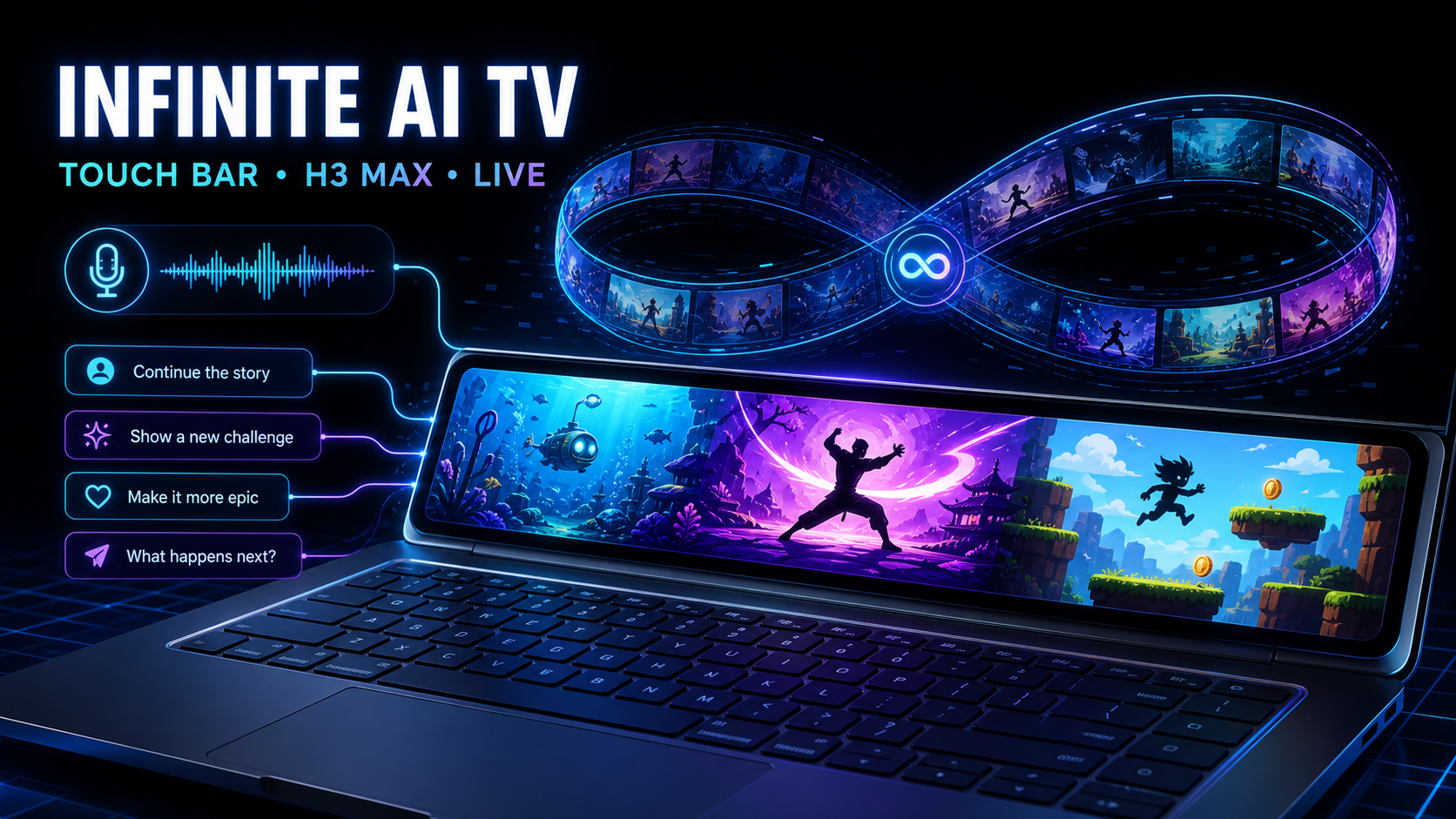
What looks like a novelty demo—a never-ending cartoon squeezed into a MacBook Pro Touch Bar—is really a preview of a new kind of media system. Hero TV generates a show clip by clip, lets viewers influence the next scene, and can play the result in the narrow display above the keyboard on Touch Bar-equipped Macs.
The important part is not the unusual screen. It is the timing: a video model can now finish the next clip before the audience finishes watching the current one. Once generation becomes faster than playback, AI video stops behaving like a file-export tool and starts behaving like a live medium.
Quick answer: Hero TV is an interactive, continuously generated AI channel from Hero Run. A director component decides the next story beat, a video model renders it with sound, and audience instructions can steer what happens next. The Touch Bar client turns that loop into a tiny installable television, while systems such as Pieter Levels' Infinite Slop demonstrate the same faster-than-playback idea in a conventional livestream.
What the viral Touch Bar demo is showing
The demo shared by @thestreamingdev presents a deliberately absurd crossover-style channel in the Touch Bar. The viewer can tap the strip to affect a character and speak a new scene request, which the system uses to influence a later clip.
It is easy to read this as a pre-rendered animation or a playlist of short videos. Hero TV is designed differently. According to the official Hero TV page, the creator selects characters, a premise, and a visual style. A director then writes each new beat, a video model turns that beat into a clip with sound, and the audience can steer the show while it is running.
The result is not one finished episode. It is a sequence assembled while people watch:
Current clip plays
        ↓
Director proposes the next story beat
        ↓
Video model generates the next clip
        ↓
The clip joins the stream
        ↓
Audience steers what should happen next
        ↺
Hero TV can start every clip from the same set image or use the last frame of the previous clip. The second option is especially important because it gives the generator a visual bridge between segments, although it does not guarantee perfect continuity.
What Hero TV actually is
Hero TV, also described as Infinite TV, is a product from Hero Run. Its tagline is concise: “Television that never ends.”
The current product combines several pieces that used to be separate experiments:
| Layer | What it does |
|---|---|
| Show configuration | Defines the title, characters, premise, visual style, clip length, and aspect ratio |
| AI director | Chooses or writes the next narrative beat |
| Video generation | Produces the next audiovisual clip |
| Continuity | Reuses the set or previous clip's final frame as the next starting point |
| Audience steering | Accepts paid instructions that influence upcoming clips |
| Playback | Streams generated clips as an ongoing channel |
| Touch Bar client | Displays compatible stations in the MacBook Pro Touch Bar and provides a steer box |
Hero Run supports both widescreen 16:9 stations and an ultra-wide 21:9 Touch Bar strip format. It also provides an API for opening a channel, so the television interface is only one client for the underlying generation loop.
The project should not be confused with a conventional streaming service. There is no fixed season, episode file, or canonical ending waiting on a server. The program is being composed and rendered in small pieces.
Why H3 Max made infinite AI video practical
Infinite generation has existed as an idea for years. The obstacle was latency.
If a 15-second video takes several minutes to render, a live channel must either pause after every clip or build a large buffer in advance. Neither feels truly interactive. A viewer instruction cannot affect the near future if the next several minutes are already rendered.
fal's H3 Max changes that operating model. The company describes H3 Max as a post-trained version of the open-weights MiniMax H3 model, co-optimized with its inference stack for speed, prompt adherence, and visual quality. In its August 27, 2026 announcement, fal reports that H3 Max can generate a five-second 768p clip in under three seconds.
Pieter Levels reported a similar result at a longer duration: a 15-second clip generated in about nine seconds, compared with roughly two to five minutes for earlier workflows. Those figures are vendor and creator reports rather than a benchmark we independently reproduced, but the ratio is the point:
Generate Clip 1
        ↓
Play Clip 1 ───────────── 15 seconds
        └─ Generate Clip 2 ── about 9 seconds
                                ↓
Play Clip 2
        └─ Generate Clip 3
                                ↓
                         Repeat continuously
The generator has approximately six seconds of headroom in this example. That margin can absorb prompt assembly, queueing, storage, and delivery overhead. If the full pipeline stays inside the playback window, the viewer sees a continuous stream.
The original MiniMax H3 and H3 Max serve different needs. fal's model overview says the original H3 supports 2K output, five-to-15-second clips, native stereo audio, and richer reference or editing workflows. H3 Max prioritizes speed at 768p. For a live channel, latency can matter more than maximum resolution.
How Infinite Slop fits into the story
Hero TV is part of a fast-moving cluster of projects rather than an isolated Touch Bar trick.
On August 29, 2026, Pieter Levels launched Infinite Slop, an interactive AI-generated livestream in which chat messages influence the next video. Levels credited Marc Antoine and an earlier stream by Rehan Sheikh for the idea, and said fal sponsored the expensive inference workload.
The relationship is best understood as a product lineage, not as one project simply renaming another:
| Project or contributor | Contribution to the emerging format |
|---|---|
| Rehan Sheikh and early stream experiments | Demonstrated that faster generation could support an ongoing video stream |
| Pieter Levels / Infinite Slop | Turned the idea into a public interactive channel with chat-driven continuity |
| fal / H3 Max | Supplied a faster-than-playback video model and sponsored Infinite Slop's inference |
| Hero Run / Hero TV | Packaged the loop as configurable channels, creator economics, an API, and a Touch Bar client |
Infinite Slop emphasizes a shared chat and a public stream. Hero TV emphasizes opening and monetizing configurable stations. The Touch Bar is a memorable distribution surface, but both projects use the same core loop:
Audience
   ↓
AI director or prompt queue
   ↓
Video model
   ↓
Live stream
   ↓
Audience reacts and steers again
This is a more meaningful change than ordinary text-to-video. The prompt is no longer just an instruction that produces video.mp4; it becomes an input to a running system.
How the MacBook Touch Bar version works
Hero Run offers a small client named HeroTVBar for MacBook Pro models that have a Touch Bar. Compatible stations play inside the strip, while a normal window provides the steering input.
The official page currently shows this installation command:
curl -fsSL https://herorunai.com/downloads/HeroTVBar -o ~/HeroTVBar
chmod +x ~/HeroTVBar
~/HeroTVBar
Because that command downloads and runs an executable, users should inspect the downloaded file and trust its source before launching it. The client also requires a Mac with the discontinued Touch Bar hardware; it is not a general replacement for a browser-based stream.
Voice steering adds another short pipeline:
Spoken request
      ↓
Speech-to-text
      ↓
Director turns the request into the next beat
      ↓
Video model renders the beat
      ↓
The generated clip enters the channel
A command such as “a robot enters the room” does not directly manipulate a game engine. It influences the prompt or story plan for a future generated segment. That distinction explains both the magic and the limitations: the model may interpret the request creatively, and the change is not necessarily immediate or deterministic.
Why this is closer to a game than traditional television
Traditional television is authored before playback. Livestreams are performed during playback. Infinite AI TV introduces a third structure: the audience and a model jointly author the program while the system renders it.
That creates product categories that sit between television, games, and social platforms:
- AI cartoon channels: children or families suggest the next harmless story beat.
- Persistent anime-style worlds: characters and visual rules stay fixed while plots continue indefinitely.
- Audience-controlled story streams: a chat collectively decides what happens next.
- Personalized television: each viewer receives a different show generated around selected characters and themes.
- AI game TV: viewers issue high-level commands while the model renders the outcome as video rather than simulation.
- Persistent NPC worlds: characters continue interacting even when no single player is in control.
The boundary is still clear today. A game engine maintains explicit state, physics, rules, and player control. A generated video stream primarily maintains the appearance of continuity. But as memory, world models, and low-latency generation improve, the two forms can move closer together.
The hard problems are cost, continuity, and control
Faster generation does not make infinite television free or reliable.
Inference cost
Levels said fal sponsored Infinite Slop because continuous video generation would otherwise be expensive. Unlike an uploaded video, which can be cached and replayed for many viewers, a personalized or audience-steered stream may require new inference every few seconds.
Hero TV's current model is “watch free, steer paid, creators earn.” Paid steering and tips fund upcoming clips, and creators can receive what remains after generation costs. It is an attempt to connect the audience action that creates cost with the payment that covers it.
Story and visual continuity
Passing the previous final frame into the next request helps preserve composition, but it does not create a perfect world state. Characters can change appearance, objects can disappear, voices can drift, and the plot can contradict itself. A production system needs memory outside the video model: character sheets, scene state, forbidden changes, summaries, and continuity checks.
Latency spikes
An average render time below the clip duration is not enough. Queue delays or a slow generation can still empty the playback buffer. Practical systems need prefetching, fallback clips, adaptive durations, retry logic, and monitoring.
Safety and intellectual property
Audience prompts can request unsafe material or copyrighted characters, while generated outputs can imitate recognizable visual styles. A public channel therefore needs prompt moderation, output review, age controls, rights management, and a clear policy for creator-owned characters and reference media.
These are not side issues. They determine whether infinite AI TV remains a viral demo or becomes a durable platform.
The real shift: AI video is becoming a runtime
The Touch Bar makes the concept easy to share, but the deeper change is architectural.
The old workflow was a batch job:
Prompt → wait → finished video fileThe new workflow is a feedback system:
Audience → director → generator → stream → audienceWhen generation remains faster than consumption, AI video can operate continuously. The model is no longer only creating content; it is running the content experience.
Hero TV is an early and playful implementation. Its tiny screen is not the market. The market is software that can maintain a world, generate its next moments on demand, accept live direction, and keep going without a predetermined ending.
Frequently asked questions
Is Hero TV playing pre-generated episodes?
No. Hero TV is designed to generate a show clip by clip. Some buffering is still necessary, and creators can provide a starting image or set, but the channel is not simply looping a completed episode library.
Does Hero TV definitely use H3 Max for every clip?
Hero Run's public TV page describes a video-model pipeline but does not promise that every station always uses one fixed backend. H3 Max is the clearest example of the faster-than-playback capability enabling this category, while Hero Run's broader platform routes across multiple model providers.
Can any Mac run the Touch Bar client?
The strip experience requires a MacBook Pro with physical Touch Bar hardware. Other viewers can still use web-based infinite video experiences, but a normal display cannot reproduce the built-in Touch Bar interface without a separate client.
Is this a game?
Not in the conventional sense. The viewer steers generated narrative video rather than controlling a deterministic simulation frame by frame. It is better described as interactive generative media, positioned between a livestream, an animated show, and a game.
Why is faster-than-playback generation so important?
It allows the next segment to be produced while the current segment is playing. That overlap removes the visible wait between generations and gives audience instructions a chance to affect the near future of a continuous stream.
Continue Reading
More articles connected to the same themes, protocols, and tools.

What Is Qwant? The Complete 2026 Guide to France’s Private Search Engine, AI Answers, and Staan
Cursor vs Windsurf (Devin Desktop) vs Claude Code: The Definitive 2026 AI Coding Tools Showdown

Cloudflare Cost Guard Skill: How to Prevent D1, Workers, and Durable Objects Bill Shock
Referenced Tools
Browse entries that are adjacent to the topics covered in this article.