On This Page8 sections
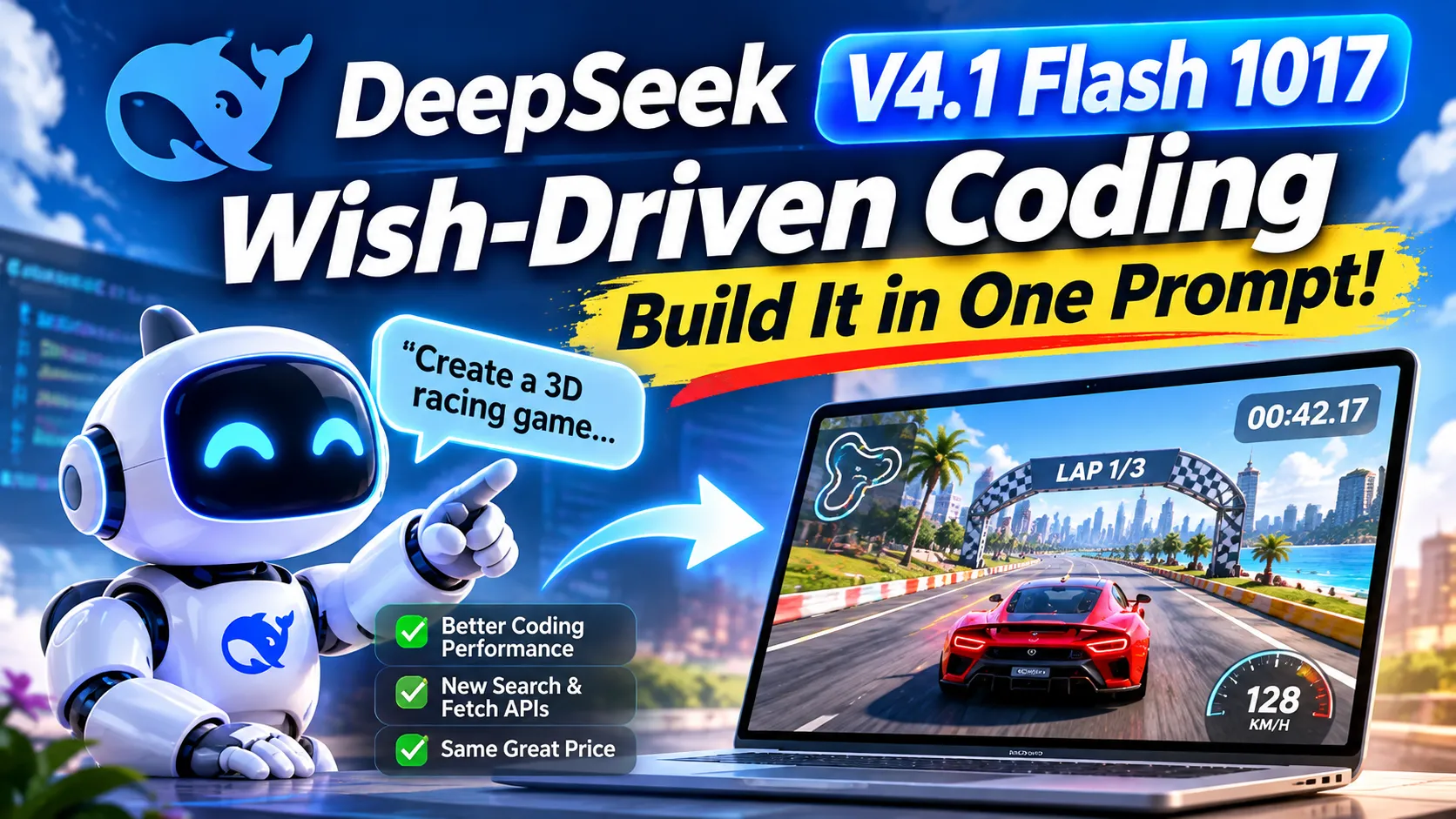
Updated October 17, 2026. DeepSeek has released DeepSeek-V4.1-Flash-1017, an upgrade focused on coding agents, end-to-end project creation, and lower task costs. Its headline promise is wish-driven programming: describe the software or game you want, then let an agent build and refine it. The release also introduces public Search and Fetch APIs.
Key Takeaways
- Released October 17, 2026: DeepSeek-V4.1-Flash-1017 is now served through the DeepSeek website, app, and API. Existing API users continue to select
deepseek-flash. - Coding results improved: DeepSeek reports Terminal-Bench 4.0 rising from 31.2 to 42.3, ProgramBench from 20.3 to 29.1, and DeepSWE v1.1 from 74.2 to 77.0. These are publisher-reported evaluations, not independent guarantees.
- Full-project workflows are the focus: Official demonstrations include a browser racing game, a Godot portal-style recreation, a 3D Forbidden City, and a historical 3D environment.
- Pricing is unchanged: Off-peak rates start at $0.15 per million uncached input tokens and $0.60 per million output tokens; peak rates are double.
- Web research is now an API feature: Search and Fetch each cost $0.75 per 1,000 successful calls, independently of model-token charges.
- The agent environment matters: DeepSeek recommends Harness v0.2.1-rc.1 or later. A good model alone cannot execute commands, inspect files, or verify a build without appropriate tools and permissions.
What Is DeepSeek V4.1 Flash 1017?
DeepSeek-V4.1-Flash-1017 is the October 17 update to the DeepSeek V4.1 Flash model family first released on September 10, 2026. DeepSeek describes the checkpoint as a minor version update with meaningful gains in reasoning, coding, agentic tasks, and visual benchmarks. It is not a separate paid subscription tier, and the API model identifier has not changed.
The key distinction is between generating source code and completing a development task. A chat model can suggest an implementation; a coding agent with a terminal, filesystem access, and testing tools can create files, run a build, detect failures, modify the implementation, and report what passed. This second workflow is the intended context for the phrase wish-driven programming.
DeepSeek attributes improvements in building projects from scratch to self-feedback reinforcement learning. The announcement does not provide enough detail to conclude that every generated project is production-ready or that the model autonomously performs reliable quality assurance. The official October 17 announcement is explicit that the showcase projects were made inside DeepSeek Harness, with limited prompts, references, and interaction rounds.
What Changed in the October 17 Update?
| Area | September V4.1 Flash | October 1017 update |
|---|---|---|
| API identifier | deepseek-flash | Still deepseek-flash |
| Coding and agent tasks | Existing V4.1 capabilities | Higher official benchmark scores |
| Task efficiency | Previous task times and output lengths | DeepSeek reports shorter runs and responses |
| Project generation | Code assistance and tool use | Stronger from-scratch games and 3D projects |
| Agent integrations | Supported third-party coding tools | Specifically optimized for DeepSeek Harness, CodeBuddy, and WorkBuddy |
| Search and Fetch | Not generally available as standalone public endpoints | Public Search and Fetch APIs launched |
| Model weights | Earlier V4.1 Flash weights | Updated MIT-licensed checkpoint published |
The upgrade is best understood as a better model-plus-agent workflow, rather than a new visual game engine or a one-click hosting platform. It improves the model's ability to participate in complex tasks; rendering, physics, dependency installation, and deployment still depend on the development stack.
DeepSeek V4.1 Flash 1017 Benchmarks: How Much Better Is It?
DeepSeek's official model card reports the following results. The change column is in percentage points or benchmark score points, not relative percentage growth.
| Benchmark | V4.1 Flash | V4.1 Flash 1017 | Change |
|---|---|---|---|
| Humanity's Last Exam, without tools | 36.8 | 42.6 | +5.8 |
| Terminal-Bench 4.0 | 31.2 | 42.3 | +11.1 |
| DeepSWE v1.1 | 74.2 | 77.0 | +2.8 |
| ProgramBench | 20.3 | 29.1 | +8.8 |
| NL2Repo-Bench | 65.4 | 68.2 | +2.8 |
| Automation-Bench v1.0.6 | 54.8 | 60.5 | +5.7 |
| Apex Bench v1.1 | 64.6 | 72.1 | +7.5 |
The most relevant gains for developers are Terminal-Bench and ProgramBench. Terminal-Bench probes a model's capacity to carry out tasks in a command-line environment. ProgramBench focuses more directly on program-construction capability. Higher scores on both are encouraging for a tool-using developer agent.
DeepSWE measures software-engineering performance under a specified evaluation environment. DeepSeek reports 77.0, compared with 73.0 for GPT-5.6 Sol and 74.0 for Opus 5 in its published comparison table. The relationship reverses on some other tests: ProgramBench is 29.1 for DeepSeek versus 37.0 for Opus 5, and Terminal-Bench is 42.3 versus 51.8. There is no defensible conclusion that one model wins every category.
Evaluation caveats matter: DeepSeek says it used a Claude Code harness for Terminal-Bench 4.0 and Mini-SWE-V2 for DeepSWE v1.1. Harness design, allowed tools, reasoning settings, time limits, and task selection can affect outcomes. The HLE model-card table also includes a separate text-only subset score, which should not be confused with the full benchmark number. Until more independently replicated tests are available, these numbers should be treated as official results.
Can DeepSeek V4.1 Flash 1017 Really Build a Game From a Prompt?
The official release presents four examples of end-to-end development:
- 3D Forbidden City: architectural modeling and interactive scene presentation.
- Browser racing game: a playable-looking web game involving a track and vehicles.
- Godot portal-style game: a recreation inspired by Portal 2, demonstrating work inside a full game engine.
- Valley of Ages: a 3D experience depicting the transition from prehistoric to modern settings.
These demonstrations support the claim that DeepSeek can generate substantial interactive prototypes in an agent-equipped environment. They do not establish consistent one-shot success rates, mobile performance, accurate vehicle dynamics, completed accessibility features, or production-ready security. Nor does an impressive screenshot prove that a game has robust input handling or error-free gameplay.
For browser games, a practical stack is Three.js or React Three Fiber for rendering, a physics library when simulation is required, and Vite for the development workflow. For larger scenes, Godot offers a conventional editor, engine runtime, physics tools, and asset pipeline. The important choice is not which framework sounds more advanced; it is which framework fits the type of interactions the game requires.
Why the Coding Harness Matters More Than a Clever Prompt
A harness is the environment that lets an AI model interact with tools. DeepSeek Harness can expose file editing, shell execution, web search, planning, and other agent capabilities. Its developer documentation describes how to configure a model, choose a workspace, and grant approvals for tool actions.
A typical successful development loop looks like this:
- Specify the outcome: define the game or app, supported devices, and completion criteria.
- Generate a project skeleton: create files, dependencies, and an executable entry point.
- Run real checks: install dependencies and execute build, type-check, or test commands.
- Inspect failures: read compiler errors, runtime logs, and browser console messages.
- Revise and rerun: fix concrete issues rather than repeatedly rewriting everything.
- Review the deliverable: verify gameplay, accessibility, security, and performance before publishing.
The October model is optimized for DeepSeek Harness, Tencent CodeBuddy, and WorkBuddy, but the model can also be integrated with compatible coding agents. The model alone does not grant the authority to browse the internet or modify a repository. Permissions and tools are configured by the host environment.
How to Use DeepSeek V4.1 Flash 1017 With DeepSeek Harness
For the agent-based experience behind the official demos, start with the current Harness release and a DeepSeek API key.
Step 1: Launch the Harness Web UI. Install a compatible Node.js runtime, then run:
npx @deepseek-ai/dsh webStep 2: Configure the API key. Open the Web UI, navigate to its model settings, and add your DeepSeek API key. Avoid placing credentials in source files or committing them to a public repository.
Step 3: Choose a workspace. Select a dedicated local directory rather than granting access to an entire home folder. Review requested shell commands and file changes, especially before deleting files or installing unfamiliar packages.
Step 4: Submit a task with measurable acceptance criteria. The prompt below is deliberately more precise than a vague request to build a racing game:
Build an original 3D racing prototype using Vite, TypeScript, and Three.js.
Requirements:
- A drivable car with acceleration, braking, steering, and reset controls.
- Desktop keyboard input plus visible touch controls for mobile.
- A closed track, lap timer, checkpoint detection, and restart button.
- Responsive rendering with a capped device-pixel ratio.
- Original placeholder assets; no copyrighted car logos or game textures.
- npm scripts for dev, build, and type-check.
Acceptance criteria:
- The production build completes without errors.
- The car stays controllable on a desktop browser and a phone-sized viewport.
- The lap counter advances only when checkpoints are crossed in order.
- Report any untested features and known limitations.
Step 5: Verify the output. A sensible acceptance pass includes npm run build, a real browser playthrough, checks for WebGL console errors, a phone-size touch test, and a check that a second lap cannot be triggered by crossing the finish line repeatedly. If the agent cannot run a browser, that is an unverified acceptance criterion, not a passed test.
Calling DeepSeek V4.1 Flash 1017 Through the API
Existing integrations can keep using deepseek-flash. The OpenAI-compatible API base URL is https://api.deepseek.com, according to DeepSeek's getting-started guide.
curl https://api.deepseek.com/chat/completions \
  -H "Authorization: Bearer ${DEEPSEEK_API_KEY}" \
  -H "Content-Type: application/json" \
  -d '{
    "model": "deepseek-flash",
    "messages": [
      {
        "role": "user",
        "content": "Plan a Three.js racing prototype. Include architecture, milestones, tests, and performance risks."
      }
    ],
    "stream": false
  }'
This example returns a model response, not a finished game. To create and validate project files automatically, connect the model to a coding agent that has explicitly granted file and command tools. DeepSeek supports additional response and reasoning settings; consult the official API documentation rather than assuming that every OpenAI-compatible parameter works identically.
DeepSeek V4.1 Flash 1017 API Pricing Explained
DeepSeek retained the existing V4.1 Flash rates. Prices below are in US dollars per 1 million tokens, as listed on the official pricing page.
| Usage | Off-peak | Peak |
|---|---|---|
| Input, cache hit | $0.003 | $0.006 |
| Input, cache miss | $0.15 | $0.30 |
| Output | $0.60 | $1.20 |
Peak periods are 01:00–04:00 UTC and 06:00–10:00 UTC, Monday through Friday, excluding Chinese public holidays. All other hours, including weekends, are off-peak. This matters for automated code generation because agent sessions often repeat long system instructions, repository summaries, and tool traces.
For example, a task consuming 200,000 uncached input tokens and 50,000 output tokens costs approximately $0.06 off-peak or $0.12 at peak rates. This illustration excludes other services and assumes no extra charges from search, hosting, or external tools. Real agent runs may contain many API calls, with varying proportions of cache hits and misses.
A low per-token price is only one side of cost efficiency. Compare total cost per accepted task, not the cost of a single response. Retries, overly broad prompts, repeated repository scans, and failed builds can erase apparent savings. Cache-friendly prompts, focused diffs, and deterministic acceptance tests are more useful than arbitrary caps on answer length.
The service currently lists a 1-million-token context window and a maximum 384,000-token output capacity for deepseek-flash. Those are service limits, not a recommendation to fill the entire context on every request.
New DeepSeek Search and Fetch APIs: Endpoints, Pricing, and Example
The October release also opened two read-only web tools. Search finds pages relevant to a query and returns structured metadata; Fetch retrieves an individual page and returns its extractable content as Markdown. Both are documented in DeepSeek's Search and Fetch API guide.
| Feature | Search API | Fetch API |
|---|---|---|
| Endpoint | POST /v1/tools/search | POST /v1/tools/fetch |
| Primary input | Search query | Page URL |
| Output | Ranked result records | Page title and Markdown content |
| Price | $0.75/1,000 successful calls | $0.75/1,000 successful calls |
| Account limit | 5 requests/second | 5 requests/second, plus per-domain limits |
A Search request can return 1–50 results and supports query operators such as site:, after:, and lang:. The optional need_content flag requests page content where available. Search results include URLs and metadata; they are not a substitute for a verified SEO search-volume database.
curl https://api.deepseek.com/v1/tools/search \
  -H "Authorization: Bearer ${DEEPSEEK_API_KEY}" \
  -H "Content-Type: application/json" \
  -d '{
    "query": "Three.js car physics tutorial site:github.com",
    "count": 5,
    "need_content": false
  }'
A successful nonempty Search response is billed once regardless of whether it returns five or fifty results. Fetch calls are billed separately. For example, 1,000 successful searches plus 1,000 successful fetches cost $1.50 in request charges, before any language-model tokens. Empty Search responses, failed requests, and timeouts are not billed under the published policy.
Billing deadline: DeepSeek says server-side Search/Fetch requests made through DeepSeek Harness, Claude Code, and Codex when using the DeepSeek API are temporarily free. Published charging begins at 00:00 Beijing time on November 1, 2026 (16:00 UTC on October 31). Explicitly calling the public endpoints should be budgeted at the documented rates.
For production research agents, add source URL retention, publication-date checks, domain deduplication, exponential backoff for HTTP 429/5xx errors, and prompt-injection safeguards for fetched pages. A webpage is external evidence, not an instruction source entitled to override the agent's task.
Open Weights, Architecture, and Local Deployment
DeepSeek published the 1017 checkpoint on Hugging Face, with model weights and repository content under the MIT license. The model supports text and image understanding, but visual input is not the same thing as native image or 3D asset generation. The 3D demonstrations involve writing software to construct and render scenes.
The V4.1 Flash family uses an asymmetric mixture-of-experts design. In its September architecture announcement, DeepSeek described separate input and output activation footprints, with approximately 8B active parameters on input and 16B on output. Those active counts should not be mistaken for the total checkpoint size or a promise of laptop-grade memory use.
Local operators should inspect the actual 1017 weight files, supported inference runtimes, precision requirements, and prompt encoding before budgeting hardware. The model card recommends official encoding utilities and references deepseek-recipe for production-oriented prompt formatting. Its lack of a Jinja chat template is an integration detail worth checking; a generic serving stack may not reproduce the hosted API's behavior without the correct tokenizer and message format.
For most individual developers, the hosted API is simpler than allocating multi-GPU infrastructure to a very large checkpoint. Open weights provide deployment flexibility, not zero-cost inference.
Practical Limitations and Common Mistakes
- Treating demos as success-rate evidence: Four compelling examples do not measure reliability across hundreds of random prompts. Test multiple seeds and tasks before making business decisions.
- Skipping executable verification: A generated project that looks complete may have dependency failures, broken controls, missing assets, or incorrect gameplay logic. Run and inspect it.
- Confusing model and agent: A direct chat-completions response cannot edit a repository without an external tool loop.
- Ignoring browser performance: Complex meshes, dynamic shadows, physics steps, and unconstrained pixel ratios can make 3D demos unusable on mobile. Measure frame times rather than relying on screenshots.
- Using copyrighted demo assets: A proof of concept inspired by an existing game is not a license to ship its characters, textures, logos, or levels commercially.
- Granting unlimited shell access: Use isolated workspaces, review commands, and protect environment secrets. Treat fetched content and repositories as potentially untrusted.
- Assuming cheap tokens mean cheap projects: Include retries, test tooling, web-search requests, storage, and human review in the total cost.
- Claiming independent benchmark validation: The published 1017 scores are predominantly DeepSeek's own results. A fair evaluation needs identical environments, explicit criteria, and reproducible logs.
A useful internal evaluation suite contains at least three task types: a greenfield browser game, a bug fix inside an existing repository, and a small research-and-implementation task using Search/Fetch. For each run, log whether the project builds, whether acceptance tests pass, elapsed time, total billed tokens, tool calls, and manual repairs. This provides a more decision-relevant picture than aggregate leaderboards alone.
Frequently Asked Questions
When was DeepSeek V4.1 Flash 1017 released? October 17, 2026. It updates the September 10 V4.1 Flash model.
What API model name should developers use? Use deepseek-flash. The October model is served behind that identifier, so existing integrations do not need a model-name migration.
Is DeepSeek V4.1 Flash 1017 free? The official chat interface may be accessible separately, but API token usage is metered. DeepSeek publishes peak/off-peak prices. Search and Fetch are also metered APIs, subject to the temporary server-side agent-tool promotion described above.
Can the model make a complete 3D game in one prompt? It can generate substantial prototypes using an appropriately equipped coding harness. One-prompt reliability, playability, polish, and production readiness are not guaranteed by the official demonstrations.
Does the model generate 3D models or images directly? The announced examples rely on code-based scene construction and game-development tools. Its visual-understanding capability should not be confused with a specialized image-generation or 3D-mesh-generation endpoint.
Does it work with Codex or Claude Code? DeepSeek documents integrations with compatible agent frameworks and says its own API's server-side Search/Fetch tools are used by DeepSeek Harness, Claude Code, and Codex. Configuration and compatibility depend on the host tool's current capabilities.
Is the new model open source? DeepSeek provides MIT-licensed model weights. Review the model repository's license and third-party software or asset licenses independently before commercial deployment.
Are the Search and Fetch APIs a Google Trends or keyword-volume replacement? No. They retrieve web search results and page content; they do not supply verified search volumes, keyword difficulty, or site analytics.
Conclusion
DeepSeek V4.1 Flash 1017 is a meaningful coding-agent update, not a magic one-click game factory. Official results show strong improvements in terminal tasks and program construction, while practical value depends on the agent harness, repeatable testing, and the amount of human correction required. The new Search and Fetch APIs also make research-backed coding workflows easier to build at predictable request prices.
Developers evaluating the release should start with the official model card, review the current pricing, and run the same small, measurable project through their preferred coding agent. Publish the build results, failure cases, elapsed time, and total cost—those are the metrics that reveal whether wish-driven programming delivers on its promise.
Continue Reading
More articles connected to the same themes, protocols, and tools.


Referenced Tools
Browse entries that are adjacent to the topics covered in this article.