On This Page8 sections
Key Takeaways
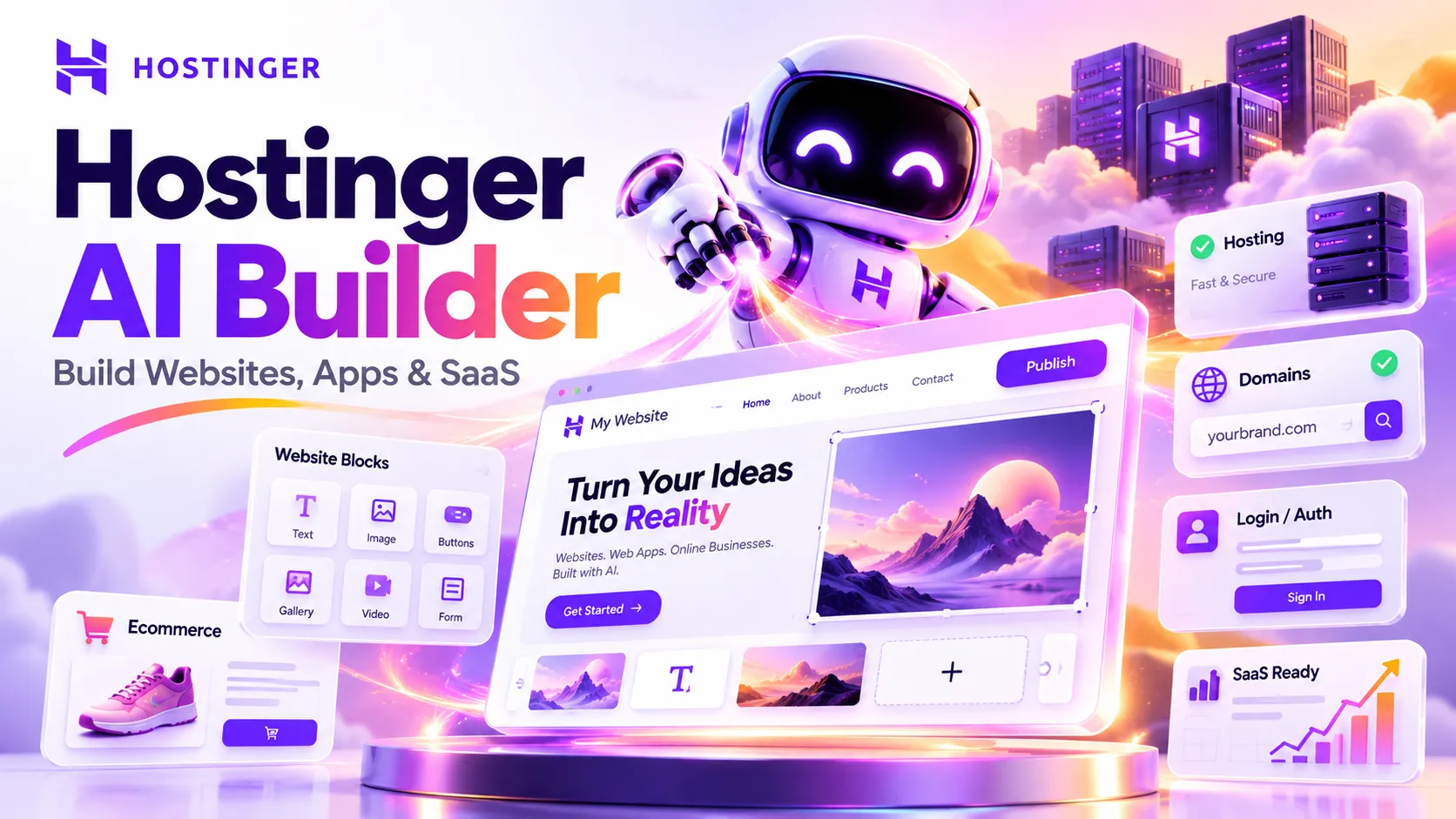
- Hostinger AI Builder is an AI-powered platform for creating, publishing, and managing websites and web applications through natural-language prompts and visual editing.
- On August 18, 2026, Hostinger unified its former Horizons product and traditional Website Builder into a single AI Builder platform.
- Unlike basic AI website generators, AI Builder integrates hosting, authentication, databases, ecommerce, subscriptions, SEO tools, and email marketing into one environment.
- Users can choose between Agentic mode, which builds applications conversationally, and Manual mode, which emphasizes visual editing and direct design control.
- Major 2026 improvements include server-side rendering for newly created websites, website generation from existing URLs and HTML files, and expanded integrations.
- The most important limitation concerns data portability: source code can be exported, but records stored in Hostinger's integrated backend cannot currently be exported directly.
- AI Builder is particularly suitable for entrepreneurs, small businesses, and creators who want to launch web products without assembling a separate development and hosting stack.
What Is Hostinger AI Builder?
Hostinger AI Builder is an AI website and application development platform from Hostinger, the web hosting company known for domain registration, WordPress hosting, and virtual private servers.
The platform allows users to describe an idea in ordinary language and generate a functioning website or web application. It combines AI-assisted design and development with managed infrastructure for publishing and operating the resulting project.
For example, a small business could request a booking website with customer accounts, an appointment calendar, and payment integration. A software entrepreneur could instead describe a subscription-based productivity dashboard or interactive online tool.
AI Builder attempts to create the necessary pages, interfaces, and application logic, with integrated services available for features such as user authentication and persistent data storage.
This positions Hostinger beyond the traditional website builder market and into the expanding category of AI app builders and vibe coding platforms.
The distinction matters because generating a visually convincing homepage is relatively straightforward. Creating a functional application also requires persistent data, access control, deployment infrastructure, and ongoing maintenance.
Hostinger's strategy is to package more of those components into a single service.
Hostinger Horizons vs. Hostinger AI Builder: What Changed?
Hostinger Horizons was originally introduced as a conversational AI tool for generating websites and web applications. Hostinger Website Builder, meanwhile, focused on templates and visual drag-and-drop editing.
On August 18, 2026, Hostinger announced that these experiences would be unified under the Hostinger AI Builder name.
The consolidation was more than a branding change. It combined two different approaches to website creation while expanding the infrastructure available to AI-generated projects.
According to Hostinger's official launch announcement, fewer than 4% of projects created on the platform a year earlier fell outside traditional website categories. By August 2026, nearly one in five projects involved categories such as SaaS applications, internal business tools, or educational platforms.
These are company-reported platform figures, not independently verified market-share statistics. Nevertheless, they help explain the product's direction: customers increasingly expect AI to create working software rather than static marketing pages.
The updated platform combines:
- Conversational website and application generation.
- Manual visual editing for layouts and content.
- Integrated databases, authentication, and file storage.
- Ecommerce and payment integrations.
- AI-powered features within published applications.
- Hosting, domains, and publishing workflows.
- SEO tools and connections to marketing services.
Existing Horizons projects were not automatically discontinued by the rebranding. However, capabilities can vary between older projects and newly created projects, particularly when backend infrastructure differs.
How Hostinger AI Builder Works: Agentic Mode vs. Manual Mode
One of the platform's defining features is its support for two different creation workflows.
| Feature | Agentic Mode | Manual Mode |
|---|---|---|
| Primary workflow | Build through AI conversation | Build through visual editing |
| Best suited for | Web apps, SaaS, custom tools | Business websites, portfolios, landing pages |
| Application logic | AI can generate functional logic | More limited application-building flexibility |
| Databases and authentication | Integrated backend support | More limited advanced integrations |
| Design control | Prompts, content editing, and code editing | Drag-and-drop and visual controls |
| Code export | Available with paid plans | Requires switching to Agentic mode |
| Learning curve | Requires describing requirements clearly | Familiar to traditional website-builder users |
Agentic mode is designed around the principle of delegating development tasks to AI. Users describe functionality, inspect the generated result, and request improvements through subsequent prompts.
For example, a request to add user accounts can initiate the creation of registration interfaces, authentication flows, and supporting data structures.
Manual mode is better suited to users who want direct control over page composition without repeatedly prompting an AI model.
Neither mode is universally superior. A restaurant brochure website may be easier to manage visually, while a customer portal with account-specific information benefits from Agentic mode.
The ability to choose between these approaches reduces the need to select an entirely different product as a project becomes more sophisticated.
Core Features: What Can You Build With Hostinger AI Builder?
1. Websites From Prompts, Screenshots, PDFs, and URLs
AI Builder accepts several types of project input beyond ordinary text descriptions.
Users can start with a written requirement, an uploaded screenshot, a PDF containing relevant information, or a reference website URL.
This is particularly useful for redesigning an existing business website or converting a design reference into an editable starting point.
In August 2026, Hostinger introduced a workflow for generating editable web pages from publicly accessible URLs. Rather than manually rebuilding an existing page, users can provide the address and request a new version.
The result should be treated as a starting point, not a guaranteed pixel-perfect reproduction. Designs, content, trademarks, and proprietary assets must still be used with appropriate permissions.
In October 2026, Hostinger added HTML file uploads as another starting point. Users can attach existing HTML and describe how the generated website should preserve or transform its structure.
2. Integrated Backend and User Authentication
Traditional AI website generators often produce frontend interfaces that still require external databases and authentication systems.
Hostinger AI Builder includes an integrated backend for Agentic projects, supporting persistent data, account management, file uploads, and application-related notifications.
Supported authentication options include email-and-password login, one-time passcodes, and third-party sign-in providers such as Google and Apple.
Hostinger's backend documentation lists up to 5 GB of data storage per project and up to 500 automated emails per day per project, subject to applicable platform limits.
This makes it possible to create practical applications such as customer dashboards, member portals, basic CRM systems, or online directories with user accounts.
However, integrated infrastructure does not eliminate the need to verify authorization rules, database permissions, and protection of sensitive information.
3. Ecommerce and Subscription Monetization
Hostinger has increasingly connected AI Builder with its ecommerce infrastructure.
Users can create online stores, product pages, and paid digital services without separately assembling every component of a traditional ecommerce stack.
Supported monetization scenarios include:
- Selling physical products through an online storefront.
- Offering digital downloads and paid services.
- Creating subscription-based products.
- Adding payment integrations such as Stripe.
- Managing customers, orders, and applicable store functionality.
In May 2026, Hostinger announced subscriptions for Horizons projects, including recurring billing options, Stripe integration, subscriber self-service, and test payments.
These features are particularly relevant to creators building small SaaS products or paid member applications.
Payment processing remains dependent on the relevant payment provider. Supported countries, transaction fees, compliance requirements, and account eligibility should be checked independently.
4. AI Features Inside Published Applications
Hostinger AI Builder can also help integrate AI functionality into the applications it generates.
Potential use cases include customer-support chatbots, smart search interfaces, content-assistance tools, and AI-powered workflows.
The main advantage is reduced configuration complexity: users can describe the desired AI behavior instead of manually integrating every model endpoint and billing component.
However, AI functionality introduces operational considerations beyond the cost of initially creating the application.
Developers should distinguish between credits consumed while building or editing the project and usage associated with AI features accessed by end users.
A public-facing AI application can generate recurring operating costs as its audience grows. Rate limits, abuse prevention, and usage monitoring remain essential.
5. Hosting, Domains, and Publishing
AI Builder integrates with Hostinger's existing hosting ecosystem.
Users can publish projects, connect custom domains, configure supported integrations, and manage website-related services from the Hostinger environment.
This simplifies deployment for users who do not want to configure their own cloud server, reverse proxy, SSL certificates, or application hosting pipeline.
The platform also provides a preview environment that separates unpublished changes from the live website.
For businesses already accepting orders or storing user information, this separation reduces the risk of accidentally exposing unfinished changes.
Nevertheless, publishing should still follow an explicit testing process, particularly when modifying authentication, payment flows, or production data.
What's New in Hostinger AI Builder in 2026?
Several updates throughout 2026 materially changed the platform's capabilities.
| Date | Update | Why it matters |
|---|---|---|
| May 2026 | Subscription monetization | Enables recurring-revenue products |
| August 2026 | Website generation from URLs | Simplifies redesigning existing sites |
| August 18, 2026 | Horizons and Website Builder unified | Combines conversational and visual creation |
| September 21, 2026 | Server-side rendering for new websites | Improves access to initial content for crawlers |
| October 2026 | Guided publishing improvements | Helps users progress from drafts to launch |
| October 6, 2026 | HTML file input | Allows existing HTML to guide site generation |
The server-side rendering update deserves particular attention because it addresses an important weakness of some AI-generated websites.
Hostinger stated in its September 2026 product update that newly created AI Builder websites from September 21 onward use server-side rendering.
New websites also receive page titles, descriptions, a robots.txt file, and a sitemap covering supported dynamically generated pages, including blog and product pages.
These improvements make the platform more practical for SEO-oriented websites, although they do not guarantee indexing or search rankings.
Existing projects created before the rollout should not automatically be assumed to have the same rendering behavior.
Hostinger AI Builder SEO: Is It Good for Google Search?
Search engine visibility is a critical consideration for businesses relying on organic traffic.
A website that renders meaningful content only after client-side JavaScript executes may create additional complications for crawlers and social preview systems.
Server-side rendering addresses part of this challenge by delivering meaningful HTML content before the browser completes client-side execution.
For eligible new AI Builder websites, the September 2026 SSR rollout provides a stronger technical starting point.
Other supported SEO-related capabilities include metadata configuration, sitemap generation, robots directives, and analytics integrations.
However, the presence of automated SEO features is not equivalent to a fully optimized website.
A thorough launch audit should still verify:
- Rendering: Important page content and internal navigation should be accessible in the initial HTML response.
- Indexing: Valuable public pages should use appropriate indexing directives and appear in the sitemap.
- Canonical URLs: Similar or duplicated routes should have consistent canonical handling.
- Structured data: Relevant Schema.org markup should describe real page content accurately.
- Internal linking: Important pages should be reachable through ordinary links, not only interactive controls.
- Performance: Images, JavaScript bundles, layout stability, and mobile responsiveness should be examined.
- Search Console: Google Search Console should be used to identify indexing problems and monitor search performance.
For dynamically generated directories or content-heavy applications, developers should additionally verify pagination, redirects, error responses, and how the platform handles large numbers of public URLs.
SSR is a technical advantage, but content quality, originality, relevance, and link architecture remain decisive factors in search performance.
How to Build a Web App With Hostinger AI Builder
A structured approach generally produces better results than requesting a complete business application in one vague sentence.
Step 1: Define the minimum viable product.
Identify the primary audience, essential functionality, required data, and actions users need to complete. Avoid adding every possible feature before validating the core workflow.
Step 2: Start a project in Agentic mode.
Open Hostinger AI Builder and describe the project. Use a reference image, document, or existing website when it can clarify the desired design.
Step 3: Provide a detailed initial prompt.
For example, a small subscription-based productivity application could begin with:
Create a responsive web application for freelancers to manage projects and tasks.

Target audience: Independent professionals and small teams.

Core features:
- Public landing page explaining the product.
- User registration and login.
- Private dashboard for each account.
- Create, edit, complete, and delete tasks.
- Project categories and due dates.
- Persistent storage for user-created data.
- Subscription pricing page with a free tier and paid tier.
- Mobile-friendly navigation and accessible forms.

Design requirements:
- Clean typography and generous spacing.
- Simple navigation and clear call-to-action buttons.
- Responsive layouts for mobile and desktop.

Technical requirements:
- Use the supported integrated backend.
- Keep each user's private data isolated.
- Validate user input and handle errors clearly.
- Use descriptive page titles and semantic HTML.
- Do not activate live payment processing until testing is complete.

Build the core application first. Explain any integrations that require external accounts or additional configuration.
This prompt separates visual preferences from application behavior and technical requirements.
Step 4: Test the generated application.
Check registration, sign-in, permissions, data persistence, and responsive layouts. Verify that records belonging to one account cannot be accessed by another.
Step 5: Add integrations incrementally.
Connect payment providers, analytics, or marketing services only after the main application works reliably.
Step 6: Review SEO and deployment settings.
Configure the domain, inspect page metadata, verify public pages, and test the published project from a separate browser session.
Step 7: Publish and monitor actual usage.
Track application errors, conversion events, AI credit consumption, and support requests. Use the results to prioritize subsequent improvements.
This approach also reduces unnecessary AI iterations, since each change can be evaluated against a clearly defined requirement.
Hostinger AI Builder Pricing in 2026
Hostinger offers AI Builder through hosting-related plans with different capabilities and AI credit allowances.
As displayed on the official pricing page in October 2026, promotional offers included the following examples:
| Plan | Advertised introductory price | Advertised renewal rate |
|---|---|---|
| Premium | $2.99/month | $10.99/month |
| Unlimited | $3.99/month | $16.99/month |
| Cloud Startup | $7.99/month | $25.99/month |
These examples reflect advertised 48-month promotional commitments rather than ordinary month-to-month billing. Plans are charged upfront, and prices, included credits, taxes, and promotional conditions can vary by location or checkout offer.
The advertised 48-month upfront totals for these examples were $143.52, $191.52, and $383.52 respectively.
Buyers should examine three distinct cost components:
- Hosting subscription: The recurring expense for maintaining the website or application.
- AI development credits: The allowance used for generating or modifying projects through AI prompts. Some advertised credits are promotional one-time gifts rather than recurring monthly allowances.
- Application operating costs: Potential charges related to AI-powered functionality, payment processing, and other external services.
Credit usage depends on the complexity of AI operations. A minor text adjustment may consume fewer resources than generating a complex application feature.
The lowest introductory price is therefore not necessarily the lowest long-term cost for a frequently modified application.
For commercial projects, total cost should be evaluated over at least the first renewal cycle, not solely the initial promotional period.
Hostinger AI Builder vs. Lovable, Bolt, and Replit
Hostinger AI Builder competes with several platforms that convert natural-language requirements into working software.
| Platform | Primary strength | Best-fit use case | Main consideration |
|---|---|---|---|
| Hostinger AI Builder | Integrated website creation, hosting, backend, and business tools | Small businesses and streamlined SaaS launches | Integrated backend portability |
| Lovable | Conversational full-stack application development | Product prototypes and custom web apps | External integrations and architecture choices |
| Bolt | Rapid AI-assisted web application development | Browser-based prototyping and iteration | Deployment and application architecture decisions |
| Replit | Cloud development environment with AI-assisted workflows | Developers who want a fuller programming environment | Greater development flexibility also brings technical responsibility |
The central difference is not simply which platform produces an interface fastest.
Hostinger emphasizes the complete business lifecycle: generating a website, connecting its infrastructure, publishing it, accepting payments, and supporting marketing activity.
Lovable, Bolt, and Replit are also designed to accelerate software development, but they offer different balances between code-level control, development environments, integrations, and deployment workflows.
For nontechnical founders launching relatively standard business applications, Hostinger's integrated approach can reduce setup complexity.
For applications requiring unusual backend architectures, custom infrastructure, extensive automated testing, or strict data portability, a more developer-oriented workflow may be preferable.
There is no independently verified benchmark in the cited product documentation establishing that one platform consistently generates more reliable applications or better-performing websites than the others.
A meaningful comparison should test the same functional specification across platforms, including authentication, data handling, deployment, SEO, and maintenance.
Important Limitations and Risks
Hostinger AI Builder makes application creation more accessible, but several constraints are particularly important for serious projects.
1. Exporting source code does not mean exporting all application data.
According to Hostinger's code export documentation, Agentic projects can be exported as React and Vite-based Node.js projects.
However, the exported archive does not include records stored in the integrated backend.
Hostinger's backend documentation states that there is currently no direct tool to export that integrated data, including existing user records and other stored information.
This creates a meaningful migration risk for applications that accumulate valuable customer data.
2. Exported projects cannot simply be imported back for continued AI editing.
Once source code is exported and modified independently, the edited version cannot currently be reimported into AI Builder to resume the same prompting workflow.
A development team considering an eventual migration should plan for a more traditional maintenance process after export.
3. Native mobile application generation is not supported.
AI Builder can generate mobile-responsive websites and web applications, but it does not directly create native applications for distribution through the Apple App Store or Google Play.
4. Infrastructure customization is limited.
The managed environment automates several hosting operations but restricts certain low-level configurations and traditional hosting tools.
Applications requiring specialized background workers, custom cron infrastructure, unusual networking behavior, or precise server-level tuning may need a separate hosting architecture.
5. AI-generated applications still require security review.
Generated login interfaces and payment flows should not be assumed secure merely because they work in a demonstration.
Before collecting sensitive customer information, developers should evaluate server-side authorization, secrets management, webhook verification, input validation, abuse prevention, privacy obligations, and recovery procedures.
6. Platform availability and data retention matter.
Hostinger states that integrated project data can be permanently deleted when relevant hosting services are canceled or expire without renewal.
For business-critical systems, a tested data retention and migration strategy should be established before significant customer information accumulates.
These constraints do not make the platform unsuitable for production use. They define the circumstances in which convenience must be balanced against long-term control.
Who Should Use Hostinger AI Builder?
Good candidates include:
- Entrepreneurs validating SaaS or micro-SaaS ideas without building an infrastructure stack first.
- Small businesses creating websites, stores, appointment portals, or customer dashboards.
- Freelancers developing simple client websites and interactive prototypes.
- Content creators launching subscription products, digital tools, or paid communities.
- Nontechnical users who value integrated hosting and visual editing over infrastructure flexibility.
Projects that may require alternatives include:
- Applications requiring independently managed databases with unrestricted export and migration procedures.
- Systems involving highly sensitive or regulated information without sufficient compliance validation.
- Software requiring complex background processing or specialized deployment environments.
- Native iOS or Android applications.
- Large applications whose architecture must integrate tightly with an existing enterprise engineering workflow.
For these use cases, conventional development frameworks and independently managed infrastructure may provide more predictable control.
Frequently Asked Questions
Is Hostinger Horizons still available?
Hostinger Horizons was incorporated into the unified AI Builder platform in August 2026. Users searching for Horizons should now evaluate Hostinger AI Builder and its Agentic mode.
Can Hostinger AI Builder create a real SaaS product?
Yes. It supports components needed for SaaS applications, including authentication, persistent data, interfaces, and subscription monetization. Production suitability depends on security, performance, application requirements, and operational constraints.
Can AI Builder websites rank on Google?
Yes, AI Builder websites can be indexed by search engines. The September 2026 server-side rendering update improved the technical foundation for new sites, but rankings depend on many additional factors, and indexing is not guaranteed.
Can developers download the generated source code?
Yes. Paid Agentic projects support source code export. However, integrated backend records are not included, and exported modifications cannot simply be imported back into the AI Builder editing workflow.
Does Hostinger AI Builder support Stripe?
Stripe integration is supported for applicable payment and subscription use cases. Actual payment processing requires the appropriate payment provider configuration and eligibility.
Is Hostinger AI Builder free?
Hostinger offers ways to begin exploring AI Builder, while hosting, publishing, AI usage, and advanced capabilities depend on applicable plan conditions. Users should review the current pricing page rather than assume unlimited free application development.
Is Hostinger AI Builder better than WordPress?
The tools solve overlapping but different problems. WordPress provides a mature content management ecosystem and extensive plugin flexibility, while AI Builder emphasizes conversational creation and integrated application development. Content-heavy publishing operations may favor WordPress, whereas a small interactive web application may be faster to prototype with AI Builder.
Conclusion
Hostinger AI Builder represents a significant expansion of what a traditional website hosting company can offer.
By combining the former Horizons experience with visual editing, managed infrastructure, ecommerce, and AI-assisted workflows, Hostinger is moving from website hosting toward a more integrated platform for creating and operating online businesses.
Its most compelling advantage is convenience. A nontechnical creator can move from a product idea to a working web application without independently configuring every service normally required for deployment.
The 2026 additions of server-side rendering, richer project inputs, subscriptions, and integrated backend capabilities make AI Builder more useful than a simple AI landing-page generator.
However, its integrated data export limitations, managed infrastructure restrictions, and AI-related operating costs deserve careful consideration before committing a business-critical application to the platform.
For entrepreneurs, creators, and small businesses, the practical next step is to explore Hostinger AI Builder, create a narrowly scoped prototype, and validate its functionality, security, SEO behavior, and long-term operating costs before expanding it into a production product.
Continue Reading
More articles connected to the same themes, protocols, and tools.


Referenced Tools
Browse entries that are adjacent to the topics covered in this article.