On This Page8 sections
Key Takeaways
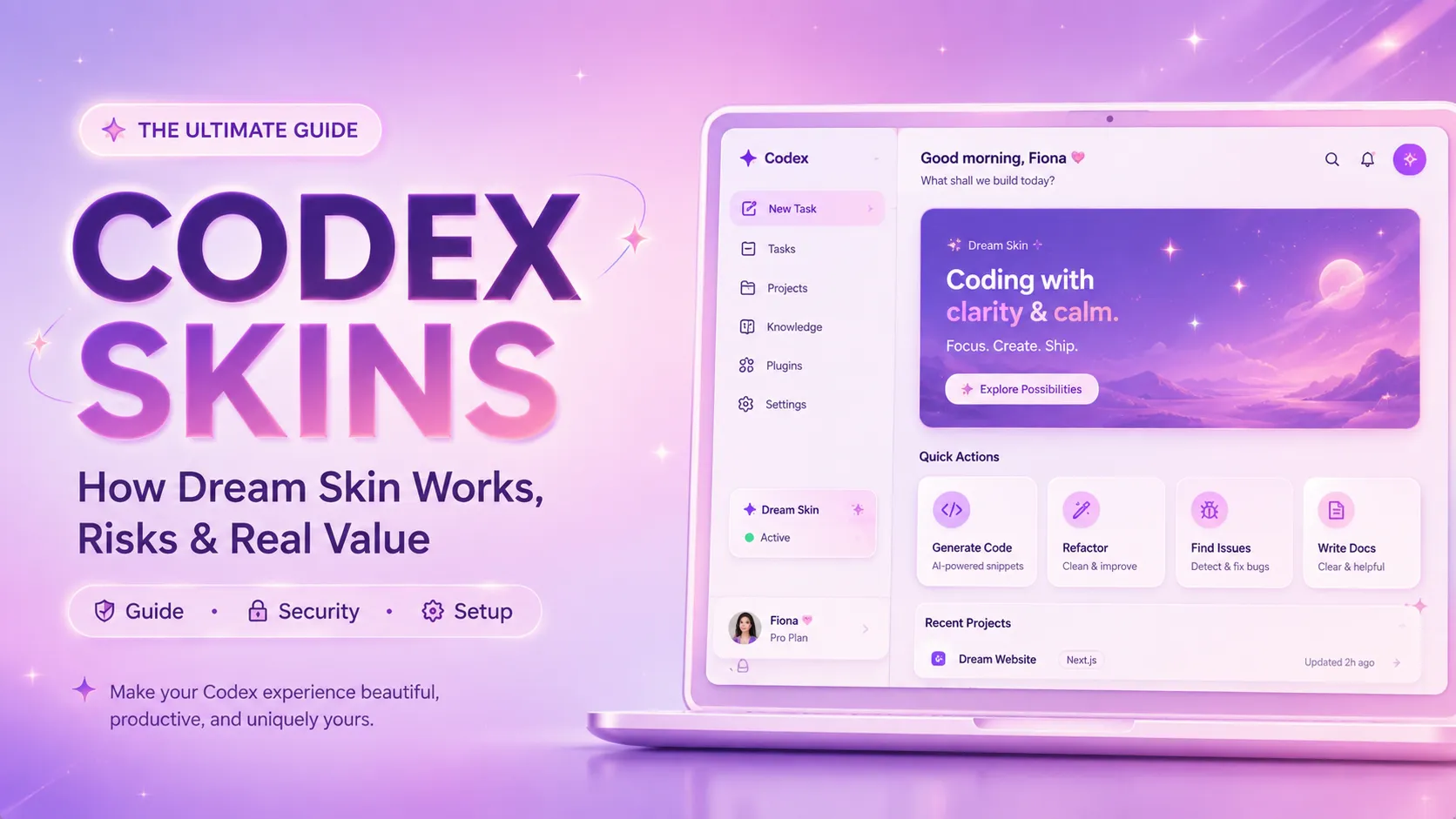
Codex skins usually refer to third-party customization projects such as Codex Dream Skin. These tools connect to the Codex desktop application through the local Chrome DevTools Protocol, then inject CSS, background assets, and limited JavaScript to change how the interface looks.
A Codex skin is not an official OpenAI feature. It does not improve model intelligence, increase usage limits, accelerate responses, or unlock additional Codex capabilities.
The most important points are:
- Codex skins primarily modify the visual interface.
- They may avoid modifying official application binaries while still creating scripts, configuration files, logs, and shortcuts.
- The Chrome DevTools Protocol provides powerful access to the application renderer and introduces local security risks.
- A Codex update can break a skin when page structure, routes, or internal selectors change.
- Personal testing environments are more appropriate than production development machines.
- The stronger business opportunity is a secure theme manager, not a basic paid installation service.
What Is a Codex Skin?
A Codex skin is a third-party interface customization layer for the Codex desktop application. It can replace background images, adjust panel transparency, change sidebar styling, and add blur, shadow, border, or color effects to the input area and conversation interface.
One widely discussed implementation is Codex Dream Skin. It allows the default Codex workspace to be transformed into anime-inspired, cyberpunk, pixel-art, minimalist, dark-glass, branded, or other visual styles.
A typical Codex skin can modify:
- The home-screen background
- Conversation-page backgrounds
- Sidebar transparency
- Input-box styling
- Card opacity and borders
- Text contrast in light and dark modes
- Blur and glass effects
- Workspace-specific visual themes
A Codex skin does not normally change:
- The underlying Codex model
- Reasoning quality
- Token or usage limits
- Execution permissions
- API pricing
- Response speed
- Code-generation capability
Codex skins should therefore be understood as interface personalization tools, not Codex performance extensions.
Is Codex Dream Skin an Official OpenAI Feature?
No. Codex Dream Skin is a third-party open-source project and is not an official OpenAI theme system.
This distinction matters because third-party skins do not receive official compatibility guarantees. OpenAI can update the Codex desktop application at any time, changing its page structure, startup behavior, security settings, component hierarchy, or internal styling.
Users should expect that:
- A skin may stop working after a Codex update.
- Buttons or text may become difficult to see.
- Injection scripts may require frequent maintenance.
- OpenAI could restrict remote debugging parameters.
- An official theme system could eventually replace unofficial injection methods.
A third-party Codex skin is better treated as an experimental customization project than as a permanent part of the Codex platform.
How Does Codex Dream Skin Work?
Codex Dream Skin does more than place an image over the application window. It connects to Codex's Chromium-based rendering environment and dynamically modifies the interface while the application is running.
The general process is:
- Confirm that the official Codex desktop application is installed.
- Restart Codex with remote debugging enabled.
- Bind the debugging service to the local loopback interface.
- Retrieve the list of active Codex renderer pages.
- Connect to the selected page through a WebSocket endpoint.
- Inject CSS and limited JavaScript through the Chrome DevTools Protocol.
- Watch for page refreshes, navigation changes, and renderer reloads.
- Reapply the theme when the Codex interface changes.
Remote debugging may be enabled with parameters similar to:
--remote-debugging-address=127.0.0.1
--remote-debugging-port=9341
The injector can then inspect a local endpoint such as:
http://127.0.0.1:9341/json/listAfter identifying the correct Codex renderer, the tool uses the Chrome DevTools Protocol to evaluate style or interface-modification code inside that page.
The advantage is that the project may avoid directly patching the official Codex application package. The disadvantage is that it depends heavily on undocumented internal implementation details.
Does a Codex Skin Modify the Official Application?
Most Codex skin implementations do not directly modify the official application binary, application signature, or protected installation directory.
However, not modifying the official binary does not mean nothing on the system is changed.
An installer may still create or modify:
- Codex user configuration files
- Skin state files
- Local launch scripts
- Log files
- Desktop shortcuts
- Start-menu shortcuts
- macOS LaunchAgent files
- Windows PowerShell launchers
Windows users should pay particular attention to changes under the Codex user configuration directory. An installer may back up and then modify a file such as:
~/.codex/config.tomlOn macOS, theme resources may be stored under a path such as:
~/.codex/codex-dream-skin-studioApplication state and logs may also be stored under:
~/Library/Application Support/CodexDreamSkinStudioThe more accurate description is:
Codex Dream Skin may avoid changing the official application binary while still creating configuration files, scripts, logs, state data, and shortcuts in the user's account.
Is Codex Dream Skin Safe?
The main security concern is not the background image. It is the level of access provided by the debugging and injection mechanism.
The Chrome DevTools Protocol can inspect page structure, execute JavaScript, read renderer state, modify displayed content, and automate interactions. A tool that connects to Codex through CDP has significantly more power than a traditional CSS-only theme.
What Security Measures Can Reduce the Risk?
A more careful implementation should:
- Listen only on
127.0.0.1 - Verify the identity of the official Codex application
- Check application signatures or package metadata
- Connect only to expected Codex renderer pages
- Reject remote network interfaces
- Avoid modifying official application binaries
- Provide verification and restoration scripts
- Record the process ID and executable path
- Use predictable local storage locations
These protections reduce accidental exposure, but they do not eliminate local threats.
Why Is CDP Potentially Dangerous?
A loopback address normally prevents direct access from other computers on the internet or local network. However, other programs already running on the same computer may still be able to connect to the debugging port.
While Codex is running with remote debugging enabled, a malicious local process could potentially:
- Inspect Codex page content
- Execute JavaScript in the renderer
- Observe interface changes
- Alter displayed information
- Simulate interactions
- Read some renderer-level application state
This does not mean that the original open-source project is necessarily malicious. It means that the underlying mechanism has a broad capability boundary.
Users must evaluate more than the theme image. They must also trust:
- The installation script
- The injector source code
- The update mechanism
- The download source
- Third-party forks
- Prepackaged installers
Which Codex Skin Installation Methods Are the Riskiest?
The following installation methods should be avoided:
- Downloading an unverified archive from a file-sharing service
- Purchasing a closed-source customized version
- Running repackaged PowerShell or shell scripts
- Installing a version that asks users to disable system security features
- Granting administrator privileges without a clear reason
- Running theme packages containing unknown executables
- Using scripts that upload cookies, API keys, or project content
- Leaving the debugging port active permanently
Particular caution is necessary with products marketed as a cracked version, permanently compatible version, or version that works without the official Codex application. These claims often indicate that the package has moved far beyond a simple theme implementation.
The safer approach is to obtain the project from its original repository, inspect the scripts, and test it in an isolated environment.
How Can a Codex Skin Be Installed More Safely?
Users should perform basic checks before copying an installation command into a terminal.
A safer workflow includes:
- Confirm the repository and maintainer identity.
- Review recent commits for unexplained binaries or large files.
- Check which directories the installer writes to.
- Look for downloads of additional remote executables.
- Back up the Codex user configuration.
- Close all active Codex processes.
- Test on a secondary account, virtual machine, or non-sensitive computer.
- Confirm that the debugging port is bound only to the local interface.
- Run the restore or uninstall process when the skin is not needed.
On macOS or Linux, the Codex configuration can be backed up with:
cp ~/.codex/config.toml ~/.codex/config.toml.backupWindows users should inspect:
%USERPROFILE%\.codex\config.tomlAfter installation, compare the modified configuration with the backup. Confirm that no unknown API endpoints, proxy servers, model providers, or authentication settings were added.
How Can the CDP Port Be Checked?
A safer setup should bind the debugging service to 127.0.0.1, not 0.0.0.0.
On macOS or Linux, check the listening process with:
lsof -nP -iTCP:9341 -sTCP:LISTENOn Windows PowerShell, use:
Get-NetTCPConnection -LocalPort 9341The expected local address is:
127.0.0.1A result such as the following is more concerning:
0.0.0.0That address can indicate that the service is listening on every network interface. Codex and the skin process should be stopped immediately while the launch configuration is reviewed.
Can a Codex Skin Read Source Code or API Keys?
A legitimate visual theme does not need access to project files, environment variables, API keys, or authentication tokens.
However, because CDP can execute JavaScript, the actual behavior depends on the injector code being run.
Security review should look for:
fetchcalls or other network requests- External WebSocket connections
- File-upload code
- Clipboard access
- Keyboard event monitoring
- Scanning of
localStorageor IndexedDB - Environment-variable access
- API-key search patterns
- Unknown analytics or telemetry domains
- Dynamically downloaded and executed code
If the injector only manipulates DOM elements, CSS variables, and local image resources, the risk is more limited. If it sends data externally or loads remote commands dynamically, it should not be used.
Why Can Codex Skins Break After an Update?
Runtime injection commonly depends on specific DOM structures, CSS class names, routes, and component hierarchies.
A skin may need to identify:
- The left navigation container
- The conversation list
- The input-box wrapper
- The home-page welcome section
- The primary content background
- Toolbar buttons
When Codex changes its React components, generated class names, page routes, or renderer structure, an older selector may no longer locate the correct element.
Common failures include:
- The background disappearing
- Text becoming unreadable
- The input box becoming excessively transparent
- Clickable controls being covered
- Broken scroll behavior
- Interface flickering
- Duplicate style injection
- Increased CPU usage
- Repeated application restarts
A reliable skin manager should use resilient element detection and stop safely when injection fails instead of retrying indefinitely.
Do Codex Skins Affect Performance?
Simple CSS changes and a static background image should have a limited performance impact. Complex themes can increase GPU utilization, memory usage, and rendering cost.
Potentially expensive designs include:
- Uncompressed high-resolution images
- Animated 4K or 8K backgrounds
- Continuously playing video backgrounds
- Large areas of real-time blur
- High-frequency DOM scanning
- Repeated insertion of identical styles
- Excessive shadows and filters
- Infinite route-change detection loops
Recommended optimization practices include:
- Use WebP or AVIF for background images.
- Keep individual background assets close to or below 1 MB when practical.
- Avoid long, high-resolution video loops.
- Limit the area affected by
backdrop-filter. - Use fixed CSS variables instead of continuous calculations.
- Inject the theme only once per renderer state.
- Give observers explicit stopping conditions.
A high-resolution display does not require an original 8K asset. For most desktop windows, an optimized image around 2560 pixels wide is sufficient.
How Are Codex Skins Different From VS Code Themes?
The main difference is the availability of an official extension and theming API.
| Category | Third-Party Codex Skin | Official VS Code Theme |
|---|---|---|
| Official theme API | Usually unavailable | Available |
| Implementation | CDP and runtime injection | Official extension system |
| Stability | Depends on internal UI structure | Relatively stable |
| Permission scope | Potentially broad | Managed by the extension platform |
| Update compatibility | Frequently affected | Guided by compatibility rules |
| Installation | Scripts or local tools | Extension marketplace |
| Recovery | Depends on installer quality | Extension can be disabled |
| Security review | Depends on the project | More mature platform controls |
This is why a Codex skin is more accurately described as an interface injection tool than a conventional editor theme.
Why Did Codex Skins Become Popular So Quickly?
The popularity of Codex skins is driven less by technical complexity and more by immediate visual impact.
The Result Is Easy to Understand
A single before-and-after screenshot can communicate the value of the project. This is more accessible than explaining an agent framework, MCP server, or code-model benchmark.
Using Codex to Customize Codex Is Highly Shareable
Users can ask Codex to read the installation instructions, execute the setup commands, and verify the result. The idea of using an AI coding agent to modify its own interface creates a strong social-media narrative.
AI Coding Tools Are Becoming Long-Term Workspaces
Developers increasingly spend extended periods inside Codex, Cursor, Claude Code, and similar environments. As these tools become persistent workspaces, personalization, emotional appeal, and visual identity become more important.
Customization Services Create a Monetization Story
Some users have started offering theme design, image adaptation, and installation services. Even when the technical barrier is low, the idea of earning money by selling Codex skins is naturally attention-grabbing.
Is a Paid Codex Skin Customization Service Worth It?
The value depends on what the service includes.
A service that only changes one background image and runs a public script has limited long-term value. As tutorials become more accessible, more users will be able to perform the same task independently.
A more reasonable paid service should include:
- Original visual design
- Adaptation for multiple screen sizes
- Separate light-mode and dark-mode tuning
- Text and input readability adjustments
- Configuration backup before installation
- Post-installation security checks
- Compatibility maintenance after Codex updates
- One-click restoration
- Clear licensing for included assets
A seller who cannot provide source code, a restoration process, or a list of modified files should not be trusted on a machine containing sensitive projects.
What Copyright Risks Do Codex Skins Create?
An open-source software license does not automatically grant commercial rights to images used inside a theme.
Common copyright and licensing risks include:
- Anime characters
- Game characters
- Celebrity likenesses
- Photographic works
- Brand logos and trademarks
- Unlicensed fonts
- AI-generated imitations of protected intellectual property
Commercial themes should use:
- Original illustrations
- Properly licensed commercial assets
- Images explicitly approved for commercial use
- Owned brand materials
- Abstract designs without protected characters
Product names should also avoid implying official OpenAI approval. A safer description is “a third-party theme tool compatible with Codex,” combined with a clear statement that the product is not affiliated with OpenAI.
Where Is the Real Business Opportunity?
Basic skin installation has a low technical barrier and is likely to become a price-competitive service. The more defensible opportunity is a secure, visual, cross-platform theme management product.
Visual Theme Editor
A graphical editor could allow users to:
- Drag and drop a background image
- Automatically crop and compress assets
- Extract dominant colors
- Adjust opacity
- Configure blur intensity
- Check text contrast
- Preview light and dark modes
- Install and restore a theme with one click
Declarative Theme Format
A safer theme package should not allow arbitrary JavaScript. It should contain only images, approved properties, and CSS variables.
For example:
{
  "name": "Midnight Glass",
  "background": "background.webp",
  "overlayOpacity": 0.38,
  "blur": 12,
  "panelOpacity": 0.82,
  "accentColor": "#8b7cff"
}
The theme manager would convert these values into restricted CSS. This approach reduces the attack surface of downloadable themes.
Theme Marketplace
A marketplace could provide:
- Free and paid themes
- Creator profiles
- User ratings
- Version-compatibility status
- Automated security scanning
- Signed theme packages
- Original-content declarations
- Revenue sharing for creators
Enterprise Environment Identification
The strongest enterprise use case may not be decorative backgrounds. It may be reducing operational mistakes through clear environment indicators.
For example:
- Production workspaces could use a red border.
- Staging environments could use a yellow theme.
- Development environments could use a blue theme.
- Different client projects could use different brand colors.
- Sensitive repositories could display persistent warnings.
These features can reduce accidental actions and provide more practical value than decorative customization alone.
Cross-Platform AI Coding Tool Support
A product that supports only Codex faces significant platform risk. A more sustainable theme manager could expand to:
- Cursor
- Windsurf
- Claude Code
- Visual Studio Code
- Gemini CLI
- OpenCode
- Other AI IDEs and agent workspaces
The broader product category could be positioned as an AI Coding Workspace Theme Manager rather than a Codex-only skin utility.
How Can Common Codex Skin Problems Be Fixed?
The Skin Does Not Appear After Codex Starts
Possible causes include:
- Codex was launched through the normal shortcut instead of the skin launcher.
- The debugging port was not enabled.
- The injector could not locate the correct renderer.
- A Codex update changed the expected selectors.
- The theme asset path is invalid.
Check the skin logs, the listening port, and the injector process before reinstalling anything.
Codex Shows a Blank Screen or Buttons Cannot Be Clicked
This usually means that CSS rules are too broad or that a background layer is covering interactive elements.
Recommended recovery steps include:
- Disable the active theme.
- Run the restoration script.
- Remove cached custom CSS.
- Restore the configuration backup.
- Restart Codex through the official launcher.
Text Is Difficult to Read
A background overlay is usually more reliable than changing text colors individually.
A safer CSS pattern is:
.codex-theme-background::after {
  content: "";
  position: absolute;
  inset: 0;
  background: rgba(0, 0, 0, 0.38);
  pointer-events: none;
}
The pointer-events: none property is essential because it prevents the overlay from blocking buttons and input elements.
The Interface Flickers After a Codex Update
This usually indicates that the injector can no longer find an old target element and is repeatedly attempting to insert the theme.
Automatic injection should be paused until a compatible version is available. Increasing the retry frequency will usually make the problem worse.
Codex Still Runs in Debugging Mode After Uninstallation
Confirm that:
- Skin launch scripts have been removed.
- LaunchAgent entries or scheduled tasks have been disabled.
- Desktop shortcuts point to the official application again.
- The Codex configuration has been restored.
- The debugging port is no longer listening.
Who Should Use a Codex Skin?
Codex skins are most suitable for:
- Developers using personal computers
- Users who enjoy desktop customization
- People comfortable reviewing shell, JavaScript, or PowerShell files
- Non-sensitive test projects
- Early adopters who accept compatibility problems
- Theme-tool developers and visual designers
They are less appropriate for:
- Enterprise production machines
- Computers containing many cloud credentials
- Devices handling confidential commercial code
- Financial, healthcare, or highly regulated environments
- Systems that frequently run untrusted software
- Users unable to inspect installation scripts
- Workflows that require uninterrupted Codex stability
Could OpenAI Add Official Codex Themes?
As the Codex desktop application develops into a long-term agent workspace, official appearance settings would be a logical addition.
A mature official system could include:
- Light and dark modes
- Accent-color selection
- Official theme variables
- High-contrast accessibility modes
- Font-size controls
- Display and readability settings
- A restricted theme extension API
If an official theming system becomes available, CDP-based skin tools may shift toward:
- Theme design marketplaces
- Theme generators
- Cross-tool synchronization
- Team branding
- Environment identification
The most valuable long-term asset is therefore unlikely to be the injection script itself. It is more likely to be the creator ecosystem, theme library, compatibility infrastructure, and cross-platform configuration layer.
Conclusion
Codex Dream Skin demonstrates that AI coding tools are evolving from purely functional software into personal workspaces where developers spend substantial amounts of time. Users increasingly care not only about model capability and execution speed, but also about appearance, identity, comfort, and emotional value.
However, current Codex skins remain unofficial runtime-injection tools. They may avoid changing official binaries, but they still rely on a powerful local debugging interface and may create configuration files, launch scripts, logs, and persistent injector processes.
Users should follow several basic rules:
- Use only a trusted original repository.
- Review the code and back up configuration files before installation.
- Avoid repackaged third-party installers.
- Confirm that the debugging port is bound only to the local interface.
- Disable CDP and run the restoration process when the skin is not in use.
- Avoid installing unaudited versions on production development machines.
For developers and entrepreneurs, the stronger opportunity is not another one-time installation service. It is a declarative, secure, reversible, and cross-platform AI coding workspace theme manager.
A practical first version could focus on visual theme creation, automatic color extraction, compatibility checks, asset optimization, and one-click restoration. It could later expand to Cursor, Claude Code, Windsurf, Visual Studio Code, Gemini CLI, and other AI development environments.
Continue Reading
More articles connected to the same themes, protocols, and tools.

The X Subscription (X Pass) Explained: Pricing, Grok, Cursor, Hidden Costs, and Whether It's Worth Switching in 2026

Cloudflare Workers KV Instant Explained: 177× Faster Reads, Pricing, Limits, and Setup

Herdr GUI Is Now Roamgate: The Complete Guide to Managing AI Coding Agents from Your Browser
Referenced Tools
Browse entries that are adjacent to the topics covered in this article.