

Emergent
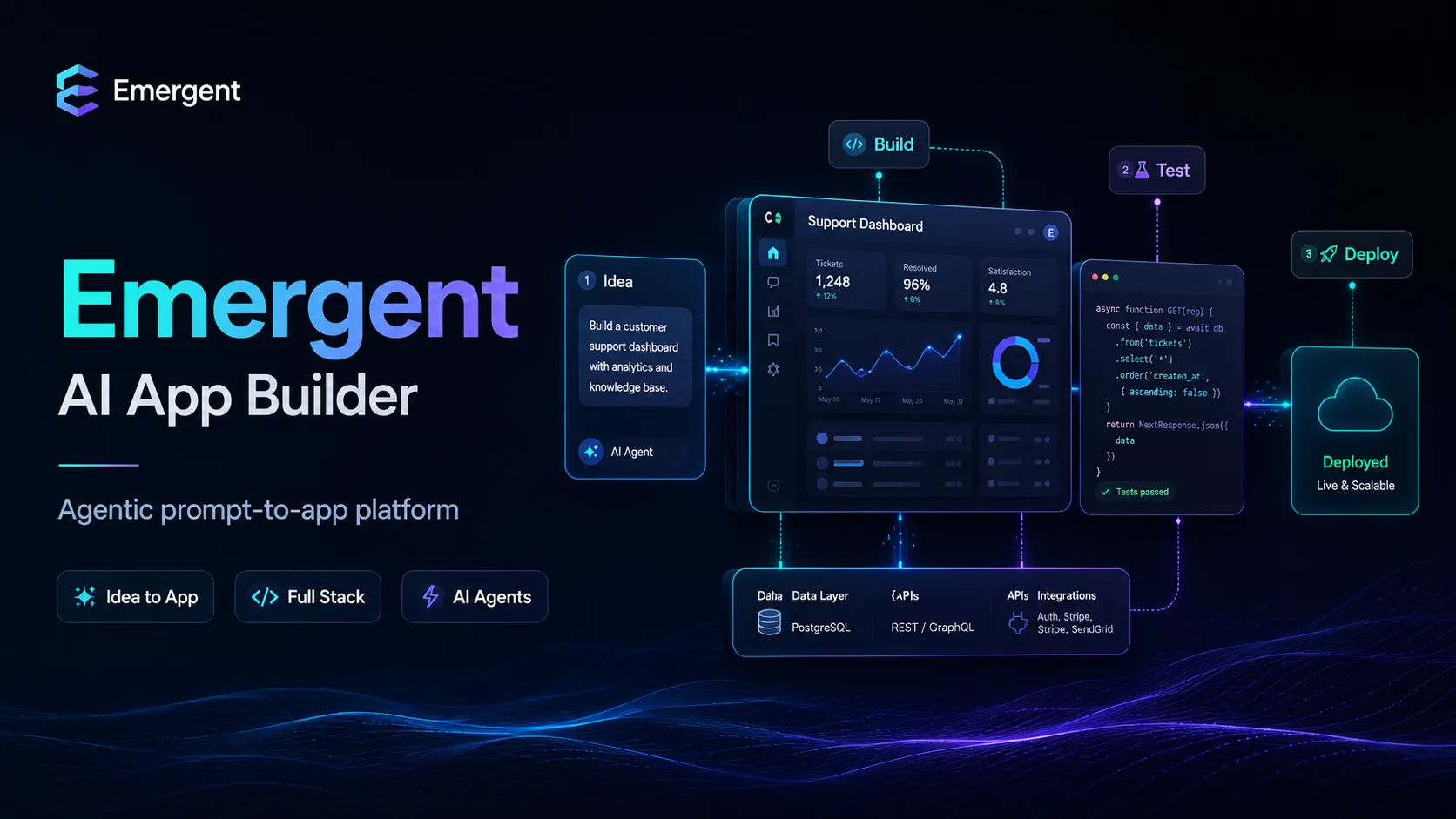
Emergent is a browser-based agentic app builder that turns natural-language requirements into deployable full-stack web and mobile applications.
Information checked: Jul 16, 2026 ·View sources
Tool details
- Type
- App builders
- Platforms
- Web
- Free plan
- Yes
- Open source
- No
- Bring your own key
- No
- Local models
- No
Overview
Best for
- Founders validating SaaS or marketplace ideas
- Product managers turning specifications into working prototypes
- Small teams building internal tools and operational dashboards
- Agencies producing client MVPs with exportable code
- Builders who want hosting and deployment in the same workflow
Strengths
- Covers more of the application lifecycle than editor-only coding assistants.
- Generates code that can be synchronized with GitHub and taken outside the platform.
- Supports both web and mobile application projects from one conversational workflow.
- Offers a usable free tier for evaluating the build experience.
- Provides stronger governance options for larger organizations.
Limitations & trade-offs
- Developers seeking a local-first desktop IDE
- Teams that require self-hosted open-source tooling by default
- Projects that must use a fixed hand-designed architecture from the first commit
- Highly regulated workloads without an enterprise security and data review
- Users who only need inline completion inside an existing editor
- Credit-based usage needs monitoring during long or highly iterative builds.
- The primary workflow is cloud- and browser-based rather than local-first.
- Production applications still require human review for architecture, security, and edge cases.
- Advanced context, agent controls, and compute are concentrated in the Pro tier.
- Public materials do not document local model execution or coding-model BYOK support.
Get started
Pricing & usage limits
Official pricingFree tier · From $20
Free$0 / month
10 monthly credits with core web and mobile building capabilities.
Standard$20 / month
$17/month when billed annually; includes 100 credits, private hosting, GitHub integration, and extra-credit purchases.
Pro$200 / month
$167/month when billed annually; includes 750 credits, 1M context, advanced reasoning controls, custom agents, and priority support.
BusinessCustom
Adds RBAC, SSO, shared workspaces, and real-time co-editing.
EnterpriseCustom
Adds audit logs, usage controls, VPC deployment, self-hosted database support, analytics, and priority SLA.
Pricing checked: Jul 16, 2026 · Subscription, usage limits, and model costs may be billed separately.
Features & details
Agentic Development
- Natural-language full-stack app generation
- Coordinated planning, coding, testing, and debugging
- Web and mobile application workflows
- Long-context and advanced reasoning modes
Project Lifecycle
- Browser-based build workspace
- Live application preview and iterative changes
- Managed hosting and deployment
- GitHub integration and code ownership
Data and Integrations
- Generated backend logic, schemas, and APIs
- Third-party service integrations
- Supabase, Stripe, OpenAI, and other documented connectors
- Universal Key access to multiple AI model providers
Teams and Governance
- Shared workspaces and pooled usage
- Role-based access control and SSO
- Audit logs and user-level credit limits
- VPC deployment and self-hosted database options
Why Choose Emergent?
Emergent is most differentiated when a project needs more than generated interface code. The platform is designed to carry a requirement through architecture, implementation, validation, and deployment inside the same conversation. That makes it closer to an agentic product-development workspace than an autocomplete tool or a visual page builder.
The practical appeal is reduced handoff overhead. A founder can describe the user roles, workflows, data entities, integrations, and launch constraints without first assembling a separate editor, backend service, database, preview environment, and hosting pipeline. Technical users can then move the generated project into GitHub and continue with conventional engineering practices.
This approach is useful for speed, but it does not remove the need for product judgment. The quality of the result still depends on clear requirements, realistic scope, representative test data, and explicit acceptance criteria. Emergent works best when the conversation is treated as a living specification rather than a sequence of vague design requests.
Core Workflow
A reliable Emergent project should begin with a compact product brief covering the target user, primary job to be done, critical screens, data model, permissions, integrations, and definition of done. Asking for the entire product in one loosely written prompt can produce a visually complete result while leaving important business rules underspecified.
After the first build, review the application by workflow rather than by page. Test account creation, empty states, invalid inputs, permission boundaries, failure recovery, and the transitions between frontend actions and stored data. Corrections should describe the observed behavior, the expected behavior, and the acceptance test. This gives the agent a more stable target than instructions such as “make it work better.”
GitHub should be connected before the project becomes business-critical. Treat major generated milestones as reviewable checkpoints, keep secrets outside the repository, and use external CI or security checks when the application handles payments, personal data, or privileged operations. The browser workspace can remain the fast iteration surface while the repository becomes the durable engineering record.
Use Cases
Emergent is well suited to MVPs where the main uncertainty is whether users want a workflow, not whether a novel infrastructure design is technically possible. Examples include subscription tools, client portals, directories, booking systems, lightweight marketplaces, data dashboards, and operational applications built around forms, roles, records, and third-party APIs.
Internal tools are another natural fit because teams can encode a process that currently lives across spreadsheets, email, and manual approvals. The strongest candidates have clear inputs, repeatable decisions, and measurable outputs. Processes dominated by exceptions, undocumented institutional knowledge, or high-risk approvals need more human-led design before automation.
Agencies can use Emergent to shorten the path from discovery to an interactive client build, provided ownership and maintenance are addressed early. A sensible delivery model is to use the platform for implementation speed, then hand over a synchronized repository, environment documentation, integration credentials, and a clear boundary between platform-managed and customer-managed infrastructure.
Comparison to Alternatives
Compared with Lovable and Base44, Emergent emphasizes an end-to-end agentic build process and a broad application lifecycle. The relevant decision is not which interface looks simpler, but how much backend behavior, debugging, deployment, and ongoing code control the project requires.
Bolt.new and Replit Agent are closer substitutes for technically involved builders who want an integrated cloud environment. Those products may feel more familiar when the user expects to inspect runtime details frequently. Emergent is more compelling when the preferred interaction is a product conversation that delegates a larger portion of implementation to coordinated agents.
v0 is a strong comparison when frontend quality and the React or Vercel workflow dominate the decision. Emergent is the more direct match when the deliverable includes backend logic, persistent data, integrations, and deployment rather than reusable interface components alone.
No prompt-to-app platform should be selected only from a polished demo. A fair evaluation uses the same small but realistic specification across candidates, then compares correction cycles, repository quality, integration reliability, deployment behavior, and the amount of manual engineering required after the first successful preview.
Best Configuration
Keep the initial architecture conventional. Standard authentication, explicit roles, simple relational or document entities, and well-documented APIs are easier for agents and humans to maintain than clever abstractions. Put stable project rules into persistent instructions: naming conventions, preferred component patterns, validation rules, accessibility expectations, and files or modules that should not be changed casually.
Separate product prompts from operational secrets. API keys, production credentials, payment secrets, and private datasets should be added through the platform's supported secret-management flow rather than pasted into ordinary conversation or committed to source control. Use sandbox accounts for payment, email, and messaging integrations until failure paths have been tested.
For larger projects, divide work into vertical slices that can be demonstrated end to end. A complete “invite user” flow is a better unit than separately requesting all screens, then all APIs, then all database tables. Vertical slices expose integration problems earlier and make rollback or repository review more manageable.
Migration Notes
Code ownership and GitHub synchronization reduce lock-in, but a repository export is not the same as a complete migration plan. Before moving away from Emergent-managed hosting, inventory the runtime, database, file storage, scheduled jobs, environment variables, domains, authentication providers, and external webhooks. Confirm which resources are portable and which must be recreated.
Review generated code for assumptions tied to platform URLs, managed services, or deployment conventions. Replace those dependencies deliberately, reproduce the build and test process in an independent environment, and run data migrations against a copy before changing production traffic.
Teams importing an existing codebase should establish protected areas and a narrow first task. Start with a contained feature or bug, verify that the agent respects the project's conventions, and only then expand its editing scope. This is safer than asking the platform to modernize architecture and ship new functionality in the same initial pass.
Model support & data privacy
Supported models
- GPT-5.6 Sol
- GPT-5.6 Terra
- Claude Fable 5
- Claude Opus 4.6
- Google Gemini
Privacy & data handling
Emergent is a hosted service. Its enterprise pages advertise audit logs, VPC deployment, and self-hosted database support, but public materials reviewed do not describe local-only model execution. Teams handling sensitive code or regulated data should review the current privacy policy, data-processing terms, and enterprise deployment boundaries before adoption.
Guides, reviews & fixes
Product updates
EmergentTool news
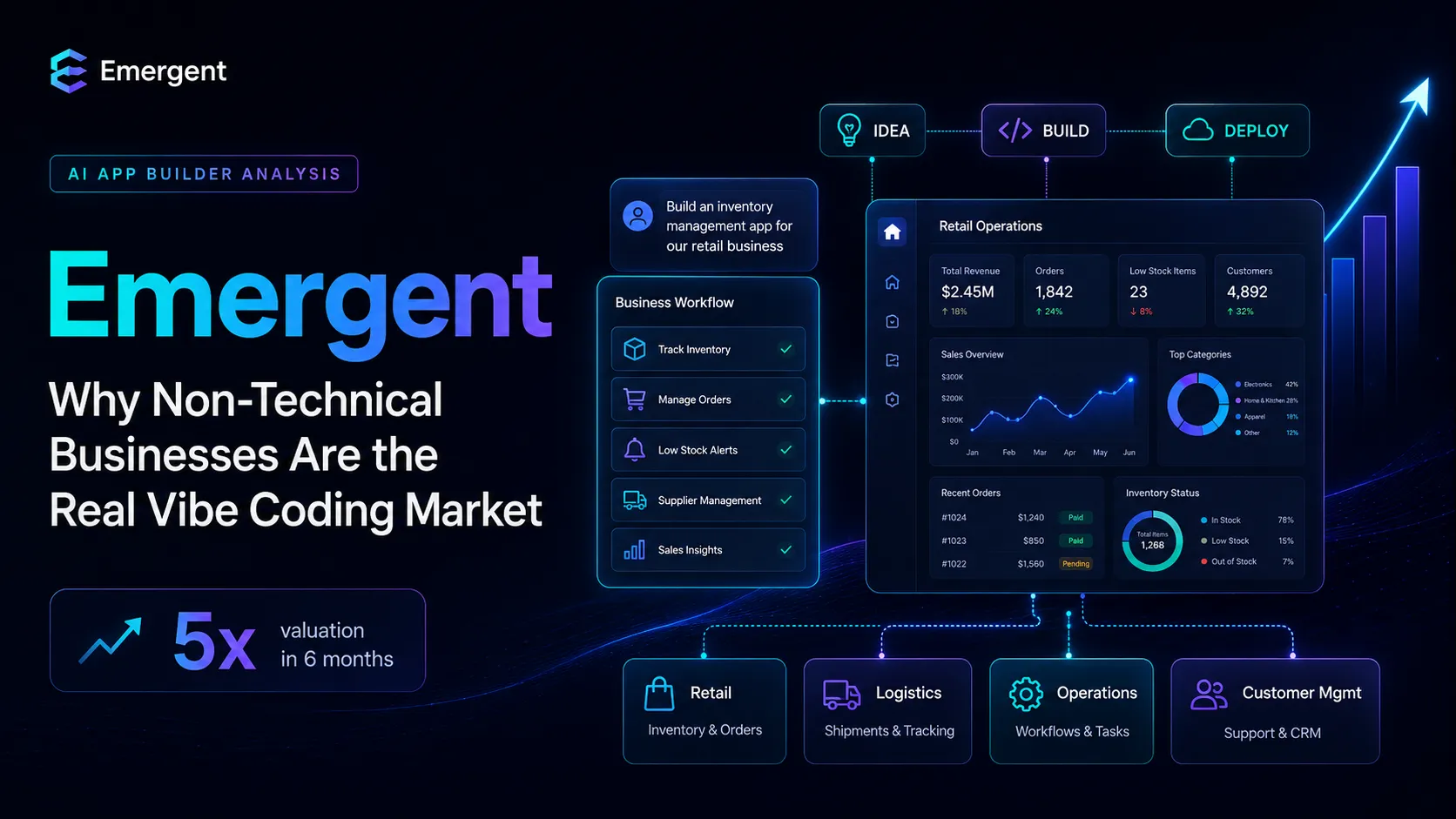
Emergent’s Valuation Jumped 5x in Six Months: Why Non-Technical Businesses Are the Real Vibe Coding MarketHow Emergent reached a $1.5B valuation and why non-technical businesses may become the largest market for vibe coding platforms.
Alternatives
 LovableLovable is a full-stack AI web app builder positioned between no-code prototyping tools and developer-first AI coding environments.
 Bolt.newBolt.new is a browser-native AI web app builder for quickly turning product ideas into editable, runnable, and deployable JavaScript applications.
 Replit AIReplit AI is an all-in-one browser-based AI software creation platform that combines prompt-to-app generation, a cloud IDE, built-in infrastructure, publishing, and collaboration.
 Base44Base44 is a no-code AI app builder for creating functional web apps, websites, internal tools, and portals from natural-language prompts with built-in backend services.
 v0v0 is Vercel’s AI app builder for creating, refining, integrating, and deploying modern web applications from prompts, design inputs, and repository context.
 CreateCreate is an AI-first prompt-to-app builder, now also branded as Anything, for turning natural-language ideas into working web apps, mobile apps, internal tools, dashboards, and AI-powered workflows.
Sources & verification
Verification dates record when this directory checked the information. Product release dates appear separately above.
Official websiteOfficial pricingOfficial documentationFirst app guideGitHub integration documentationUniversal Key documentationEnterprise offeringGPT-5.6 availability announcementPrivacy policy
Directory revision history
Verified current plans, product workflow, GitHub support, model references, and enterprise controls against official pages.
Emergent announced GPT-5.6 Sol and Terra availability for all users.