
On This Page8 sections
Key Takeaways
- Chuttamalle AI Video became a breakout search term in early October 2026 after an unauthorized AI-manipulated video based on the popular Chuttamalle sequence from Devara: Part 1 spread online.
- The trend combines several different search intents: people looking for news about the controversy, users trying to understand AI deepfakes, and creators searching for Chuttamalle-style AI video templates, face swaps, dance videos, and photo-to-video effects.
- The underlying song was already enormously popular before the AI controversy. Chuttamalle was released in 2024 for Devara: Part 1, composed by Anirudh Ravichander, sung by Shilpa Rao, and written by Ramajogayya Sastry.
- The viral incident should not be confused with legitimate AI video creation. The controversy involved non-consensual manipulation of a real person's appearance, while legitimate AI templates can be built around users' own or properly authorized photos.
- The larger product opportunity is not a single Chuttamalle generator. It is the rapidly growing category of viral AI video templates, where trending dances, visual effects, memes, songs, and cinematic formats become reusable photo-to-video experiences.
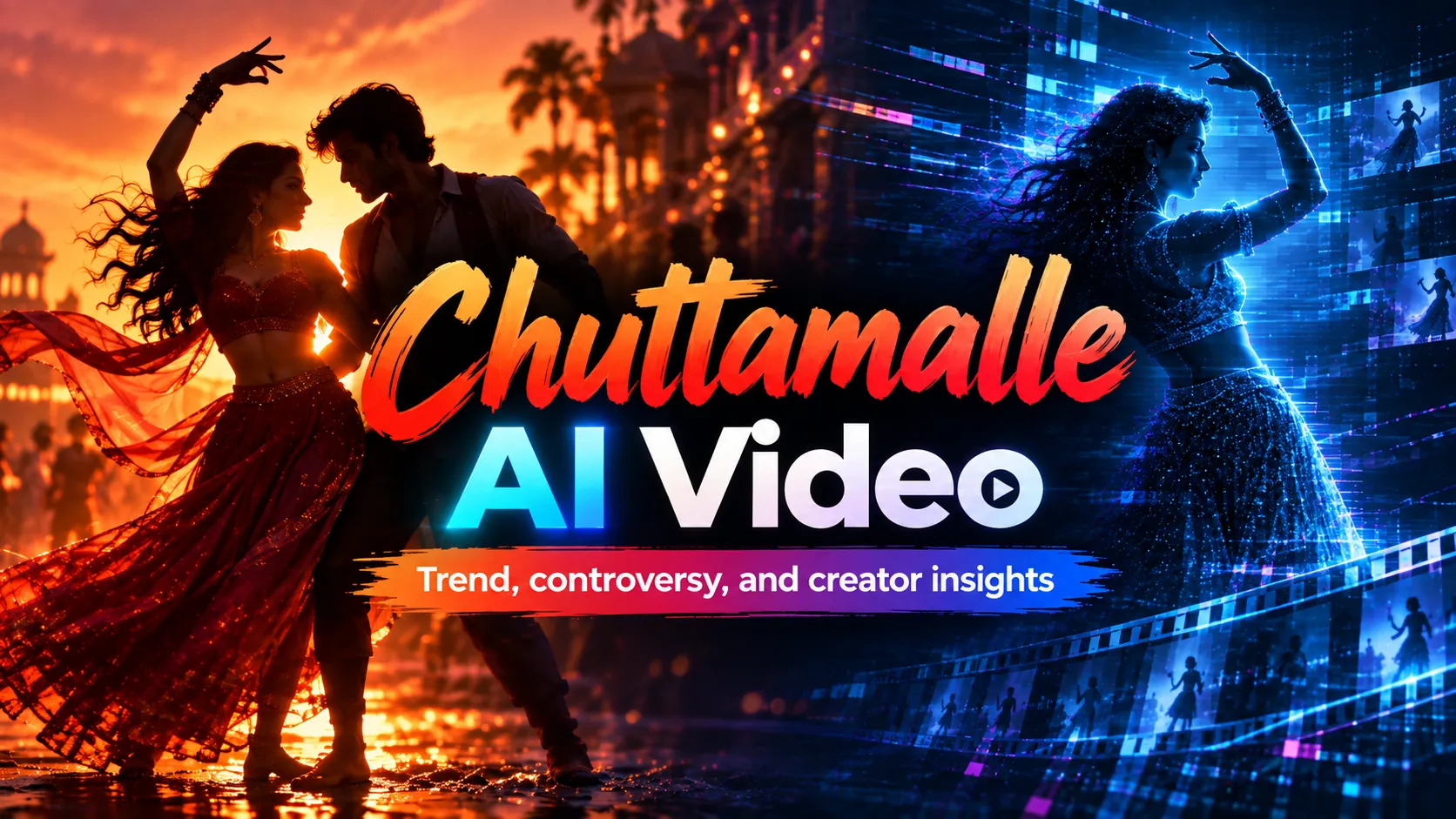
What Is the Chuttamalle AI Video?
The phrase Chuttamalle AI Video currently refers to two related but very different things.
The first is the controversy that pushed the keyword into mainstream search. In early October 2026, an unauthorized AI-altered video based on footage associated with Chuttamalle circulated online and falsely depicted actor Janhvi Kapoor in degrading sexually explicit imagery that was not part of the original production. Jr NTR publicly condemned the manipulation on October 3, while Kapoor addressed the incident on October 5 and described the non-consensual use of AI as a serious violation.
The second meaning is much broader and commercially more important: users searching for ways to create Chuttamalle-inspired AI videos using their own photos.
That creator-focused intent can include:
- Chuttamalle AI video generators
- AI dance templates
- Couple photo-to-video effects
- Cinematic Indian music-video templates
- AI face replacement using authorized images
- Chuttamalle-style edits for Reels and short-form video
These two intents should not be treated as interchangeable. One concerns an abusive deepfake incident; the other concerns a legitimate generative-video format.
What Is Chuttamalle?
Chuttamalle is a Telugu-language song from the 2024 film Devara: Part 1. It was released on August 5, 2024 and features music by Anirudh Ravichander, vocals by Shilpa Rao, and lyrics by Ramajogayya Sastry.
The song became especially recognizable because of its romantic visual style, choreography, tropical scenery, costumes, and the pairing of Jr NTR and Janhvi Kapoor.
Those characteristics also make it unusually suitable for AI remix culture. A recognizable visual sequence can be transformed into a reusable template much more easily than an abstract song with no distinctive visual identity.
That explains why the search opportunity extends beyond people interested in the original movie.
Creators increasingly search for experiences such as:
- Put me in this music video
- Turn my photo into this dance
- Make a couple version of this scene
- Generate a cinematic Indian dance video
- Create this viral effect from one photo
This is the same behavioral shift that has fueled many viral AI photo-to-video effects.
Why Did Chuttamalle AI Video Suddenly Go Viral?
The keyword did not grow simply because a new AI generator was released.
It emerged from the collision of three powerful distribution mechanisms.
1. A Famous Existing Song
Chuttamalle already had a large audience and recognizable visual identity. That meant millions of people understood the reference immediately when the AI controversy appeared.
2. A High-Profile AI Deepfake Controversy
On October 3, 2026, Jr NTR publicly condemned the manipulated video and called for action against people creating and circulating it. Other figures in the Indian film industry subsequently spoke out, including Chiranjeevi and Vijay Deverakonda.
By October 5, Janhvi Kapoor had also publicly responded, moving the story beyond social-media speculation into a major discussion about consent, AI manipulation, and digital abuse.
3. Search Users Started Connecting the Trend With AI Creation
Once a video trend becomes associated with AI, search behavior usually broadens rapidly.
Users move from informational queries such as:
chuttamalle ai video
and:
what happened to chuttamalle ai video
toward creator-intent queries such as:
chuttamalle ai video generator
chuttamalle ai template
chuttamalle ai dance
chuttamalle photo to video
chuttamalle face swap
This transition matters because creator intent is far more durable and commercially useful than controversy-driven traffic.
Chuttamalle AI Video vs. Deepfake: The Important Difference
AI-generated video is not inherently a deepfake.
The distinction depends largely on whose identity is being represented, whether the output is deceptive, and whether appropriate consent exists.
| Type | Example | Risk Level |
|---|---|---|
| AI video effect | Animate your own portrait | Low |
| AI dance template | Generate yourself performing a fictional dance | Low |
| Authorized face replacement | Replace a character with your own face | Moderate |
| Couple template | Generate two consenting users from uploaded photos | Moderate |
| Celebrity impersonation | Make a real celebrity appear to perform something they never did | High |
| Non-consensual sexual deepfake | Fabricate intimate or sexual content involving a real person | Extremely high |
A legitimate Chuttamalle-inspired product should therefore focus on user-owned or explicitly authorized images, rather than providing unrestricted celebrity manipulation.
How a Legitimate Chuttamalle-Style AI Video Generator Could Work
A modern implementation does not need to copy or modify the controversial video.
The safer approach is to treat Chuttamalle as inspiration for a broader cinematic romantic dance template.
A typical workflow looks like this:
User photo or authorized couple photos
        ↓
Identity and safety checks
        ↓
Pose / appearance conditioning
        ↓
Predefined cinematic dance template
        ↓
Image-to-video generation
        ↓
Motion consistency and face stabilization
        ↓
Safety review
        ↓
AI-generated disclosure
        ↓
Download or social sharing
The user supplies the identity, while the generative system creates new motion and scenery rather than editing a real actor's body into compromising footage.
Face Swap vs. Person Swap vs. Image-to-Video
These terms are often grouped together, but they describe different technologies.
Face Swap
Face swapping typically preserves the original video's body, motion, camera movement, lighting, and scene while replacing facial identity.
Advantages:
- Fast generation
- Stable choreography
- Predictable output
Limitations:
- Can look unnatural at extreme head angles
- Lighting inconsistencies may expose the swap
- Creates greater identity and consent risks
- Reliance on copyrighted source footage can create additional complications
Person Replacement
Person replacement attempts to change more than the face. Clothing, body appearance, hair, proportions, and sometimes pose can also change.
This can produce more convincing personalization, but temporal consistency becomes substantially harder.
Image-to-Video
Image-to-video starts from a still image and synthesizes the motion itself.
For a long-term AI product, this is often the most flexible approach because the generated sequence does not have to be a direct alteration of an existing music video.
A Chuttamalle-inspired template could instead describe characteristics such as:
- tropical cinematic scenery
- romantic choreography
- flowing wardrobe motion
- sweeping camera movement
- warm film lighting
- Indian music-video aesthetics
That makes the concept reusable across many trends.
Why Viral AI Video Templates Are Becoming a Product Category
Traditional text-to-video systems ask users to describe everything manually.
That flexibility is powerful, but it creates friction.
A casual user rarely wants to design camera movement, choreography, framing, pacing, lighting, and motion prompts from scratch.
Templates remove that problem.
Instead of asking:
Describe the video you want to generate.
A template product can ask:
Upload a photo and create this trend.
That difference dramatically lowers the skill required to generate a shareable result.
The product model resembles CapCut templates, but generative AI expands what can be customized.
Traditional template:
Your media + predefined edit
Generative AI template:
Your identity + predefined concept + newly generated video
That is why trends such as Chuttamalle may matter beyond their immediate search volume.
The Search Intent Behind Chuttamalle AI Video
The keyword currently combines several audiences.
News Intent
Users want to understand:
- Why Chuttamalle AI is trending
- What happened to Janhvi Kapoor
- Why Jr NTR responded
- Whether the circulating video was genuine
Navigational Intent
Some users are searching for the controversial clip itself.
Responsible websites should avoid redistributing non-consensual intimate synthetic content. Reporting the incident does not require embedding or linking to the abusive material.
Creator Intent
This is the most valuable long-term category.
Users may be searching for:
- Chuttamalle AI video generator
- Chuttamalle AI video template
- Chuttamalle dance generator
- Chuttamalle photo animation
- Chuttamalle couple AI video
- Indian dance AI generator
- Telugu song AI video template
Educational Intent
Another audience wants to understand how generative video, face swapping, deepfakes, and synthetic-media detection work.
A comprehensive page can satisfy both educational and creator intent without distributing harmful content.
Why Creators Should Avoid Celebrity Deepfakes
The ability to technically produce a video does not automatically make the use legitimate.
Celebrity deepfakes introduce several overlapping risks:
- Consent: the depicted person may never have agreed to the fabricated action.
- Deception: realistic AI output may be interpreted as authentic footage.
- Harassment: sexualized or humiliating synthetic media can cause direct harm.
- Personality rights: commercial use of someone's identity may trigger legal claims depending on jurisdiction.
- Copyright: source music videos, film footage, choreography, and recordings may have separate rights holders.
- Platform enforcement: social platforms and advertising networks increasingly restrict abusive synthetic content.
Google Ads, for example, prohibits advertising destinations that promote the creation or distribution of sexually explicit synthetic content, including deepfake pornography services or instructions for making it.
India's 2026 Synthetic Media Rules Matter for This Trend
The Chuttamalle controversy is also significant because it is unfolding after India strengthened its rules around synthetic media.
India's 2026 amendments to the Information Technology rules define certain realistic AI-generated or AI-altered audio-visual material as synthetically generated information. The framework also addresses labeling and technical provenance for synthetic media and specifically identifies categories including non-consensual intimate imagery and deceptive impersonation as serious concerns.
The amendments came into force in February 2026.
For AI video platforms operating in or serving India, this creates a strong incentive to design safety into the generation pipeline rather than treating moderation as an afterthought.
Safety Features an AI Video Generator Should Have
A responsible viral-template platform should implement safeguards at multiple stages.
Before Generation
- Detect obviously sexual or prohibited uploads.
- Require users to confirm that they own or have permission to use uploaded identities.
- Restrict unsupported celebrity or public-figure impersonation scenarios where appropriate.
- Block prompts requesting non-consensual intimate content.
During Generation
- Apply prompt and output moderation.
- Detect attempts to bypass safety filters through indirect wording.
- Prevent templates from being repurposed for explicit or degrading outputs.
After Generation
- Add an AI-generated disclosure where appropriate.
- Preserve provenance metadata where technically possible.
- Provide a reporting mechanism for identity misuse.
- Maintain an abuse-removal process.
The best safety architecture is not a single NSFW classifier. It is a layered system covering input, generation, output, distribution, and reporting.
How Creators Can Make a Chuttamalle-Inspired Video Safely
Creators interested in the aesthetic rather than the controversy can use a straightforward rule:
Use yourself or people who have clearly agreed to participate.
A safe creative workflow could include:
- Upload an original photo that the user owns or is authorized to use.
- Select a romantic or cinematic Indian dance template.
- Generate completely new footage rather than modifying intimate footage of a real person.
- Review the result for identity errors or unintended sexualization.
- Label realistic AI-generated footage when appropriate.
- Use licensed music or audio that the publishing platform permits.
This preserves the creative appeal of the trend without reproducing the abuse that originally pushed the phrase into the news cycle.
Common Mistakes With Viral AI Video Trends
Chasing Only the Exact Viral Keyword
A phrase can spike dramatically and disappear weeks later.
Products should connect individual trends to evergreen categories such as:
- AI dance generator
- photo-to-video generator
- couple AI video
- cinematic AI video templates
- Bollywood AI video
- Telugu AI video templates
Building Around Copyrighted Footage
Using a fixed copy of an original music video may simplify generation, but it can create copyright and distribution constraints.
Generating new footage inspired by a broader visual concept is typically more scalable.
Allowing Arbitrary Celebrity Uploads
An unrestricted upload celebrity → generate anything workflow creates predictable abuse problems.
Identity-sensitive moderation should be designed before such features are released.
Ignoring Audio Rights
Video generation rights and music rights are separate issues.
Even when the visuals are entirely AI-generated, distributing them with a commercial song may still depend on the platform, territory, license, and intended use.
Treating NSFW Detection as Complete Protection
A classifier may catch obvious nudity while missing humiliation, deceptive impersonation, suggestive manipulation, or non-consensual context.
Safety decisions need context as well as pixels.
What the Chuttamalle Trend Reveals About the Future of AI Video
The deeper opportunity is not Chuttamalle itself.
The trend demonstrates how quickly culture can become an AI generation interface.
A viral song, meme, dance, camera move, transformation, movie aesthetic, or social-media challenge can become a one-click generative template.
The emerging pattern looks like this:
Viral cultural moment
        ↓
Search demand
        ↓
AI template
        ↓
Upload photo
        ↓
Generate personalized version
        ↓
Share on social media
        ↓
More searches and remixes
This creates a powerful feedback loop.
The winners in this category may not necessarily be the companies with the strongest base video model. They may be the products that identify trends fastest, package them into safe templates, produce consistent results, and remove most prompting complexity.
FAQ
Is the viral Chuttamalle AI video real?
No. The controversial material reported in October 2026 was AI-manipulated rather than authentic footage from the original Chuttamalle production. Multiple actors publicly condemned its creation and circulation.
Why is Chuttamalle AI Video trending?
The phrase surged after an unauthorized AI-altered video became the subject of widespread criticism and media coverage. Search demand subsequently expanded into questions about deepfakes and Chuttamalle-style AI generators.
Is Chuttamalle an AI-generated song?
No. Chuttamalle is a conventional commercially released song from Devara: Part 1, composed by Anirudh Ravichander and performed by Shilpa Rao.
Can AI create a Chuttamalle-style dance video from a photo?
Modern image-to-video systems can generate dance-like movement and cinematic sequences from still images. Results depend on the model, source photo quality, duration, motion complexity, and identity-consistency system used.
Is using AI face swap illegal?
Face swapping itself is a technology rather than a single legal category. Legality depends on factors such as jurisdiction, consent, deception, privacy, sexual content, copyright, commercial use, and the identity involved. Non-consensual intimate deepfakes present particularly serious legal and ethical risks.
What is the safest way to create this type of AI video?
Use your own photos or images from people who have clearly authorized their use, generate new footage rather than deceptive intimate representations of real people, avoid unauthorized celebrity impersonation, and clearly disclose realistic synthetic media where required.
Conclusion
Chuttamalle AI Video is more than a temporary entertainment keyword. Its sudden rise illustrates both sides of modern generative video: AI can turn cultural moments into highly personalized creative experiences, but the same technology can also be weaponized for non-consensual impersonation and harassment.
For creators, the useful opportunity is not reproducing the controversial deepfake. It is building or using consent-based Chuttamalle-inspired AI dance templates that transform authorized photos into entirely new videos.
For AI product builders, the bigger lesson is even more important. Viral AI video is increasingly becoming a template business: identify a recognizable trend, reduce generation to a simple upload-and-create workflow, build strong identity and safety protections, and then repeat the process as new cultural moments emerge.
The sustainable opportunity is not one Chuttamalle generator—it is a continuously updated library of safe, high-quality viral AI video templates.
Continue Reading
More articles connected to the same themes, protocols, and tools.

Referenced Tools
Browse entries that are adjacent to the topics covered in this article.