
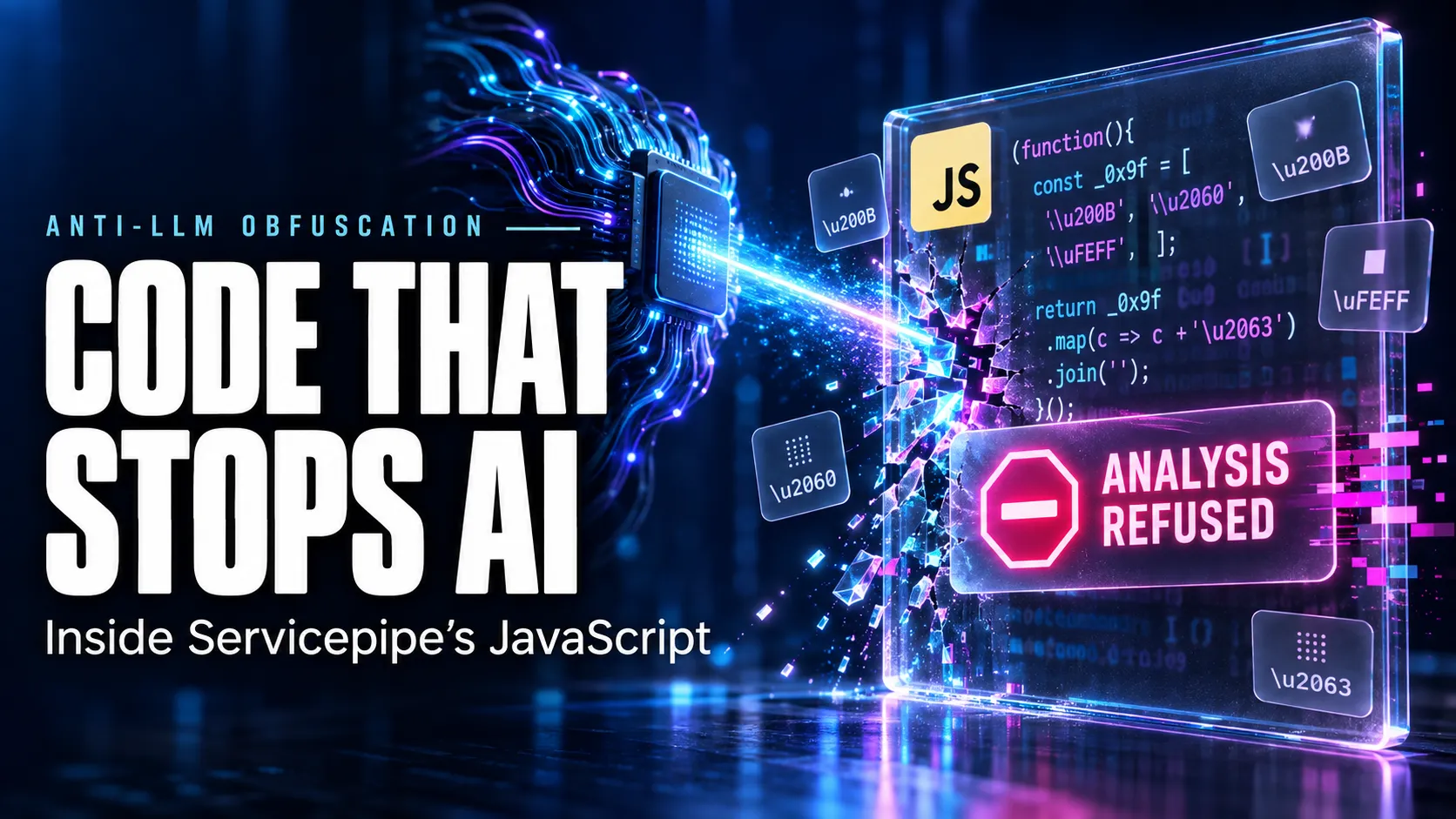
On This Page8 sections
Key Takeaways
- Anti-LLM obfuscation targets AI-assisted analysis. Its objectives can include refusal, incorrect interpretation, higher analysis costs, or instruction manipulation.
- Servicepipe explicitly documents its use. The company’s Digital Fraud Protection integration guide identifies anti-LLM techniques in its JavaScript library.
- Reported model refusals are case evidence, not a universal benchmark. A response from another model does not automatically establish correct analysis.
- Hidden Unicode deserves inspection, but detection requires context. Some otherwise suspicious characters also have legitimate uses.
- Protect the analysis environment. Inspect unknown code as data, preserve the original, and enforce tool permissions independently of model output.
Updated October 31, 2026.
What Is Anti-LLM Obfuscation?
Anti-LLM obfuscation is the deliberate modification of code or accompanying text to make analysis by large language models less reliable or more expensive.
Traditional JavaScript obfuscation complicates the program’s representation through techniques such as renamed identifiers, encoded strings, and transformed control flow. Anti-LLM techniques additionally target how an AI system interprets the material it reads.
Servicepipe’s July 10, 2026 publication describes four broad approaches:
| Approach | Intended interference |
|---|---|
| Misleading code structures | Encourage an incorrect explanation of functionality |
| Threat-like content | Trigger safety-related refusal |
| Excessive false relationships | Increase context and reasoning demands |
| Hidden instructions | Redirect the analysis or induce a false result |
These are the vendor’s descriptions of its strategy, not independently measured success rates.
An important consequence follows: analysis can fail even when the JavaScript remains executable and the model produces a fluent answer. Refusal is merely the most visible failure mode.
What the Servicepipe Evidence Actually Establishes
The strongest evidence combines a vendor statement with an external research report. Each establishes something different.
The vendor confirms use of the technique. Servicepipe’s Digital Fraud Protection integration documentation explicitly states that its JavaScript library uses anti-LLM obfuscation and warns that AI-generated reverse-engineering explanations may be misleading. The same guide uses the fp.servicepipe.tech domain, directly connecting that domain family to the documented product. Its July 14 technical blog page also identifies countermeasures against LLMs and AI agents as practices used by the company.
The researcher reports a concrete encounter. On October 28, 2026, veritas published Why Is This Fingerprinting Script Creating Bioweapons?. Following a crawl of 10,000 websites, the investigation reached a script hosted on servicepipe.tech. The report describes hazardous-looking identifiers, concealed instructions, and an environment-gated Node.js branch. Its browser-side analysis identified familiar device, browser, and WebGL signals.
The author reported these model outcomes:
| Configuration, using the author’s labels | Reported outcome |
|---|---|
| Astra | Refused the analysis request |
| Astra with Daybreak Blue | Also refused |
| GLM-5.3 | Complied with the request |
This establishes a reported difference in behavior. It does not establish repeatable refusal rates, comparative accuracy, or that misleading identifiers alone caused the refusals. Compliance also does not independently validate the resulting explanation.
Together, the sources support a narrow but meaningful conclusion: a vendor documents this strategy, and an external researcher reports encountering behavior consistent with it. They do not provide a controlled evaluation of every mechanism in the sampled file.
Refusal, Misinterpretation, and Prompt Injection Are Different Problems
A useful technical assessment separates three outcomes that are often grouped together.
| Outcome | What happens | What would demonstrate it |
|---|---|---|
| Refusal | The system declines the legitimate analysis task | Recorded responses under documented conditions |
| Misinterpretation | The system explains the program incorrectly | Comparison with verified behavior or a reference analysis |
| Instruction hijacking | The system follows directions embedded in the material | A measurable deviation from the authorized task |
A suspicious function name can influence interpretation without containing an instruction. Conversely, a comment directing an agent to change its task can attempt prompt injection without affecting JavaScript execution.
Text inside a program can be inert for the runtime and active as input to an AI reader. That distinction explains why ordinary malware analysis and prompt-injection analysis need separate questions.
The OWASP prompt-injection guidance covers instructions concealed in external content and encoded representations. However, the presence of such content establishes an attempted mechanism; successful manipulation still requires observable evidence.
How Hidden Unicode Changes Code Review
A text editor’s visual presentation is not a complete representation of the underlying character sequence. Two snippets can look similar while containing different code points.
The Unicode Tags block occupies U+E0000 through U+E007F. Its printable tag characters correspond to ASCII characters. For example, U+E0041 corresponds to the ASCII letter A when interpreted through that mapping.
There is a legitimate complication: Unicode uses tag characters in certain emoji sequences. A tag-character match is an inspection finding, not proof of malicious intent. The Unicode specification documents both the block and its current emoji-related use.
AWS’s research on Unicode character smuggling explains why concealed character sequences matter for LLM applications. The security question is whether those sequences survive ingestion and influence the model, not simply whether a human sees them.
For reviewers, three practical distinctions matter:
- Visual inspection versus character inspection: rendering alone cannot establish what text a tool receives.
- Character detection versus intent analysis: an unusual sequence still needs surrounding context.
- Decoding versus execution: extracting a representation for inspection does not require running the surrounding JavaScript.
A scan limited to the Tags block also cannot cover arbitrary Unicode offset encodings, other invisible characters, or instructions written in ordinary visible text.
A Read-Only Unicode Inspection Example
The following Python 3 command inspects a local UTF-8 file without importing or executing it. Replace suspect.js with the file to examine.
It limits input to 5 MiB, calculates a SHA-256 fingerprint, and reports the first 100 matches in the Unicode Tags range. Printable tag characters receive an ASCII equivalent; other positions receive null.
python3 - suspect.js <<'PY'
import hashlib
import json
import sys
from pathlib import Path

limit = 5 * 1024 * 1024
with Path(sys.argv[1]).open('rb') as handle:
    raw = handle.read(limit + 1)

if len(raw) > limit:
    raise SystemExit('Input exceeds the 5 MiB inspection limit.')

text = raw.decode('utf-8', errors='strict')
findings = []

for index, char in enumerate(text):
    code = ord(char)
    if 0xE0000 <= code <= 0xE007F:
        findings.append({
            'index': index,
            'codePoint': f'U+{code:05X}',
            'asciiEquivalent': (
                chr(code - 0xE0000)
                if 0xE0020 <= code <= 0xE007E
                else None
            ),
        })
        if len(findings) == 100:
            break

print(json.dumps({
    'sha256': hashlib.sha256(raw).hexdigest(),
    'matchesShown': len(findings),
    'findings': findings,
}, ensure_ascii=True, indent=2))
PY
Interpret the output precisely:
indexis a zero-based Unicode code-point position, not a byte offset or JavaScript UTF-16 index.matchesShownis capped at 100; it is not necessarily the file’s total match count.- An empty list means this particular range was absent, not that the file is safe.
- Invalid UTF-8 produces an error instead of silently replacing bytes.
- The SHA-256 value identifies the inspected bytes; it does not certify their trustworthiness.
This is a narrow inspection utility, not a malware detector or a general prompt-injection classifier. Any decoded text remains untrusted evidence.
How to Investigate Suspicious JavaScript
A useful investigation preserves the ability to distinguish what the file contains, what can execute, and what an AI system inferred.
1. Preserve the original bytes.
Record the retrieval location, timestamp, file size, and cryptographic hash. Analyze a working copy. A URL alone cannot identify an exact sample if its contents later change.
2. Build a representation inventory.
Locate unusual Unicode, long encoded strings, comments, identifiers, and dynamically constructed code. Record the transformation used to inspect each encoded value. Avoid silently replacing the original with a cleaned version.
3. Examine structure before assigning intent.
Use a trusted JavaScript parser to inspect syntax and call relationships. Follow values into operations such as network requests, storage access, dynamic evaluation, or process creation. A name is a clue; the implementation determines behavior.
4. Treat reachability as a finding that needs support.
A conditional branch is not automatically dead code. Identify its conditions and the environments in which they can hold. If reachability remains unresolved, state that uncertainty explicitly.
5. Keep runtime claims separate from textual findings.
Finding a command string does not prove execution. Finding an instruction addressed to an AI does not prove the model obeyed it. Preserve these distinctions in the report.
6. Use an appropriate execution boundary when dynamic analysis is necessary.
Do not use eval(), module imports, or a local Node.js process merely to reveal a script’s behavior. Node’s official node:vm documentation explicitly says the module is not a security mechanism for untrusted code. A separate JavaScript context does not provide the required isolation.
What Changes When the Reader Is an AI Coding Agent?
An agent may turn an interpretation into a file edit, command, or network request. That creates a second question beyond whether its explanation is correct: what operations can its interpretation authorize?
OWASP’s Secure Coding with AI guidance identifies repository documentation, issues, review comments, error output, and connected tools as possible sources of indirect instructions. It also treats agent rules files as security-sensitive configuration.
Practical controls should match those entry points:
| Entry point | Useful control |
|---|---|
| Third-party code or documentation | Start with scoped, read-only access |
| Error messages and tool output | Preserve provenance and treat embedded instructions as untrusted |
| Agent configuration changes | Require explicit review of the configuration diff |
| Proposed shell or network operations | Validate the target and arguments outside the model |
| Generated patches | Review the complete diff, including unrelated files |
The OWASP AI Agent Security guidance recommends narrowly scoped tools and authorization enforced by the execution component. For sensitive operations, approval must apply to the actual action being executed. A model-generated statement that an operation is authorized is insufficient.
Prompt wording remains useful for expressing intent, but it cannot replace these controls. OWASP also cautions that delimiters, screening, and structured prompts do not themselves enforce an instruction–data boundary.
How to Evaluate Anti-LLM Claims Properly
A meaningful evaluation should measure several outcomes separately. The following is a proposed assessment framework, not a description of published Servicepipe benchmark results.
| Measurement | Question it answers |
|---|---|
| Legitimate-task refusal rate | How often does analysis stop unnecessarily? |
| Behavioral accuracy | Does the explanation match verified program behavior? |
| Unsupported-claim rate | Does the model invent functionality or intent? |
| Instruction-following deviation | Does embedded text change the authorized task? |
| Tool-policy violations | Does the agent attempt an unauthorized operation? |
| Analysis cost | How do time, tokens, retries, and tool calls change? |
| False-positive rate | How often is benign material incorrectly flagged? |
Use harmless fixtures with known behavior, fixed sample hashes, recorded prompts, and repeatable configurations. Include ordinary source code, conventionally obfuscated code, and matched variants containing review distractions.
To isolate a suspected mechanism, change one feature at a time and verify that executable behavior remains equivalent. Otherwise, an apparent effect from identifier naming could actually come from a changed task, altered code, or different context length.
A suitable reference answer should identify concrete behavior: inputs, outputs, side effects, and reachable operations. Agreement between two models is useful supporting evidence, but it is not a substitute for that reference.
A successful defense should preserve authorized analysis while preventing unauthorized actions. Measuring only refusals rewards systems that avoid useful work. Measuring only completion rewards systems that confidently produce incorrect results.
What Website Owners Should Ask Vendors
For a customer integrating a protected SDK, resistance to analysis can create an operational tradeoff: the same techniques that inconvenience hostile reverse engineering may also complicate authorized security review.
Useful questions include:
- Can the vendor provide an auditable build or a documented review process?
- Which environments are supported, and does the distributed file contain code for other runtimes?
- What client data is collected, and where is it transmitted?
- How are sample versions and significant behavior changes identified?
- Can customers distinguish deliberate analysis interference from unexpected code changes?
These are procurement and engineering questions, not evidence that a particular SDK is malicious.
Servicepipe itself acknowledges that universal resistance to AI analysis is unavailable and recommends server-side validation for critical business processes. Obfuscation should not carry the responsibility for payment integrity, authorization, or other server-enforced decisions.
Frequently Asked Questions
Is anti-LLM obfuscation the same as prompt injection?
No. Prompt injection is one possible mechanism. Misleading names, context inflation, and refusal-inducing material can interfere with analysis without successfully issuing a new instruction.
Does a model refusal prove that code is dangerous?
No. It records the system’s response to the request and supplied material. Determining program behavior requires separate evidence.
Does removing invisible Unicode solve the problem?
No. Instructions can be fully visible or encoded in other ways. Blanket removal can also damage legitimate text. Preserve the original and use context-specific inspection rules.
Can a scanner certify that a file is free of prompt injection?
A narrow scanner cannot support that conclusion. Report its exact coverage and findings, rather than converting a lack of matches into a general safety verdict.
Does a vendor warning prove an AI account will be suspended?
No. Servicepipe’s integration guide includes an account-blocking warning, but that is a vendor statement—not an independently verified outcome or a policy statement from the AI services concerned.
Conclusion
Anti-LLM obfuscation makes the reliability of the analysis process part of the security problem. The Servicepipe case provides evidence of documented vendor adoption and reported model interference, while leaving effectiveness, repeatability, and causal attribution open to further testing.
The practical response is to make reviews more inspectable: preserve exact samples, distinguish text from behavior, evaluate accuracy separately from refusal, and enforce agent permissions outside the model.
Start with one third-party script in the review pipeline: record its hash, inspect unusual characters, document reachable behavior, and verify that reading it cannot authorize unrelated tool actions.
Continue Reading
More articles connected to the same themes, protocols, and tools.


Referenced Tools
Browse entries that are adjacent to the topics covered in this article.