
 CodeRabbitCodeRabbit focuses on reviewing code rather than generating entire features. It adds automated, context-aware feedback to pull requests and increasingly brings the same review loop into IDE and CLI workflows.
Qodo
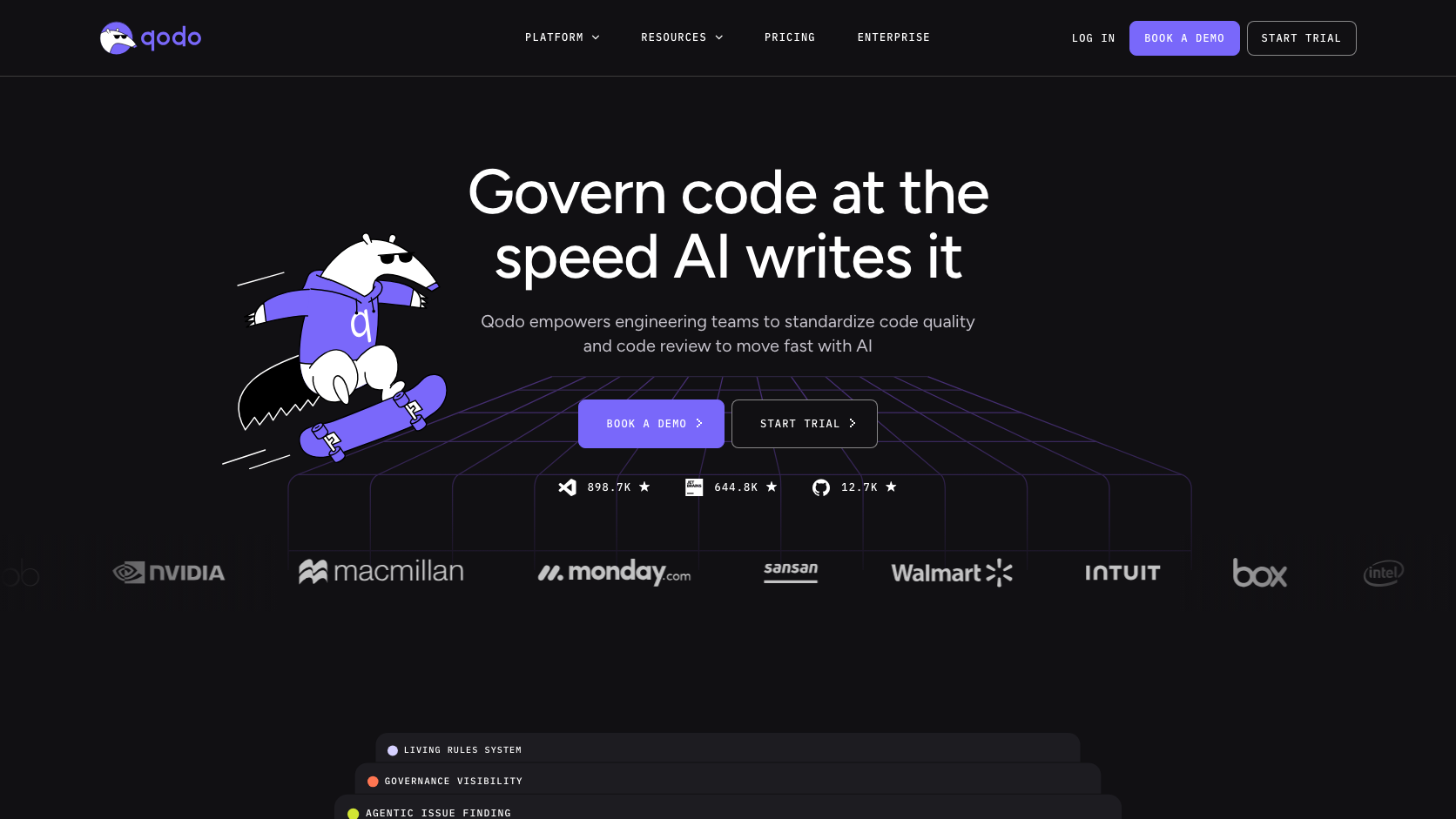
Qodo is an agentic code-quality platform that connects code generation, testing, and review. Its strongest positioning is enterprise-grade review with multiple specialized agents and organization context.
Information checked: Aug 29, 2026 ·View sources
Tool details
- Type
- Review & testing
- Platforms
- VS Code, JetBrains IDEs, CLI, GitHub, GitLab
- Free plan
- Yes
- Open source
- No
- Bring your own key
- No
- Local models
- No
Overview
Best for
- Organizations standardizing AI-assisted code quality.
- Teams that need testing and review in one platform.
- Large codebases that benefit from cross-repository context and policy.
Strengths
- Covers review and testing rather than only generation.
- Multi-agent architecture can separate review concerns.
- IDE, CLI, and Git integrations support shift-left workflows.
- Enterprise context and governance are central features.
Limitations & trade-offs
- Small projects needing only a lightweight PR bot.
- Users seeking an open-source local reviewer.
- Teams that only want an autonomous coding agent.
- Broad platform scope can require a larger rollout effort.
- Managed analysis requires careful source-code privacy review.
- Teams may need tuning to prevent duplicate or low-value comments.
- Exact value depends on integration with existing CI and review policy.
Get started
Pricing & usage limits
Free tier available
Developer accessFree tier
Entry access for individual development workflows.
TeamsPlan-dependent
Collaboration, policy, and higher-capacity workflows.
EnterpriseCustom
Governance, deployment, security, and support requirements.
Pricing checked: Aug 29, 2026 · Subscription, usage limits, and model costs may be billed separately.
Features & details
Agentic Review
- Multiple specialized review agents
- Pull-request analysis
- Suggested fixes
- Policy-aware review
Quality Workflow
- Test generation and improvement
- IDE assistance
- CLI automation
- Code-quality checks across the SDLC
Enterprise Context
- Repository and cross-repository context
- Organization rules
- Governance controls
- Git provider integrations
Qodo Review 2026
Qodo is an AI code-quality and review platform with multi-agent pull-request analysis, IDE and CLI assistance, repository and cross-repository context, testing workflows, governance, and enterprise controls.
What Is Qodo?
Qodo is an agentic code-quality platform that connects code generation, testing, and review. Its strongest positioning is enterprise-grade review with multiple specialized agents and organization context.
Qodo combines multi-agent review, testing assistance, cross-repository context, and governance instead of treating review as a single prompt over a diff.
Core Features
Agentic Review
- Multiple specialized review agents
- Pull-request analysis
- Suggested fixes
- Policy-aware review
Quality Workflow
- Test generation and improvement
- IDE assistance
- CLI automation
- Code-quality checks across the SDLC
Enterprise Context
- Repository and cross-repository context
- Organization rules
- Governance controls
- Git provider integrations
How It Fits an Agentic Development Workflow
Qodo is most useful when its permissions, repository scope, model access, and review checkpoints are configured before the first large task. Start with a bounded project, verify the generated changes or analysis, and only then expand access. This matters because agentic tools can move faster than a conventional assistant and can also amplify a bad assumption.
For teams, the practical evaluation should cover setup time, context quality, task completion rate, review burden, model or infrastructure cost, security controls, and how easily a human can interrupt or redirect work.
Best Use Cases
- Organizations standardizing AI-assisted code quality.
- Teams that need testing and review in one platform.
- Large codebases that benefit from cross-repository context and policy.
Pricing
- Developer access: Free tier. Entry access for individual development workflows.
- Teams: Plan-dependent. Collaboration, policy, and higher-capacity workflows.
- Enterprise: Custom. Governance, deployment, security, and support requirements.
Pricing and limits can change quickly. The figures or plan descriptions above were checked against official information on 2026-08-29; verify the official site before purchasing.
Privacy, Security, and Deployment
Qodo may process source, diffs, tests, and organization context. Review data retention, model use, role-based access, provider integrations, auditability, and enterprise deployment options.
Any coding agent or developer tool with repository, terminal, browser, or secret access should be introduced with least-privilege credentials, protected branches, mandatory review, isolated test environments, and clear log-retention rules.
Limitations
- Broad platform scope can require a larger rollout effort.
- Managed analysis requires careful source-code privacy review.
- Teams may need tuning to prevent duplicate or low-value comments.
- Exact value depends on integration with existing CI and review policy.
Alternatives
- CodeRabbit
- GitHub Copilot
- Bito
- Tabnine
- Sourcery
The best alternative depends on whether the priority is an AI-native editor, a terminal harness, autonomous cloud execution, code review, mobile control, or a shared orchestration layer.
Verdict
A required entry for the code-review category because it connects multi-agent analysis, testing, context, and governance across the development lifecycle.
Official Sources
Model support & data privacy
Supported models
- Qodo managed models
Privacy & data handling
Qodo may process source, diffs, tests, and organization context. Review data retention, model use, role-based access, provider integrations, auditability, and enterprise deployment options.
Guides, reviews & fixes
No published guides yet. Start with the official documentation above.
Product updates
No verified product updates listed yet. Follow this tool to see new relevant content in Saved.
See the content timelineAlternatives
CodeRabbitCodeRabbit focuses on reviewing code rather than generating entire features. It adds automated, context-aware feedback to pull requests and increasingly brings the same review loop into IDE and CLI workflows. GitHub CopilotGitHub Copilot is a mainstream AI code assistant and developer workflow layer for teams that want AI support inside existing editors, GitHub repositories, pull requests, and terminal workflows.
 TabnineTabnine is an enterprise-focused AI coding assistant and agentic platform for organizations that need private, governed, deploy-anywhere AI development workflows.
Sources & verification
Verification dates record when this directory checked the information. Product release dates appear separately above.
Directory revision history
Created a complete English draft profile from current official sources; kept unpublished for editorial review.