
 QodoQodo is an agentic code-quality platform that connects code generation, testing, and review. Its strongest positioning is enterprise-grade review with multiple specialized agents and organization context.
CodeRabbit
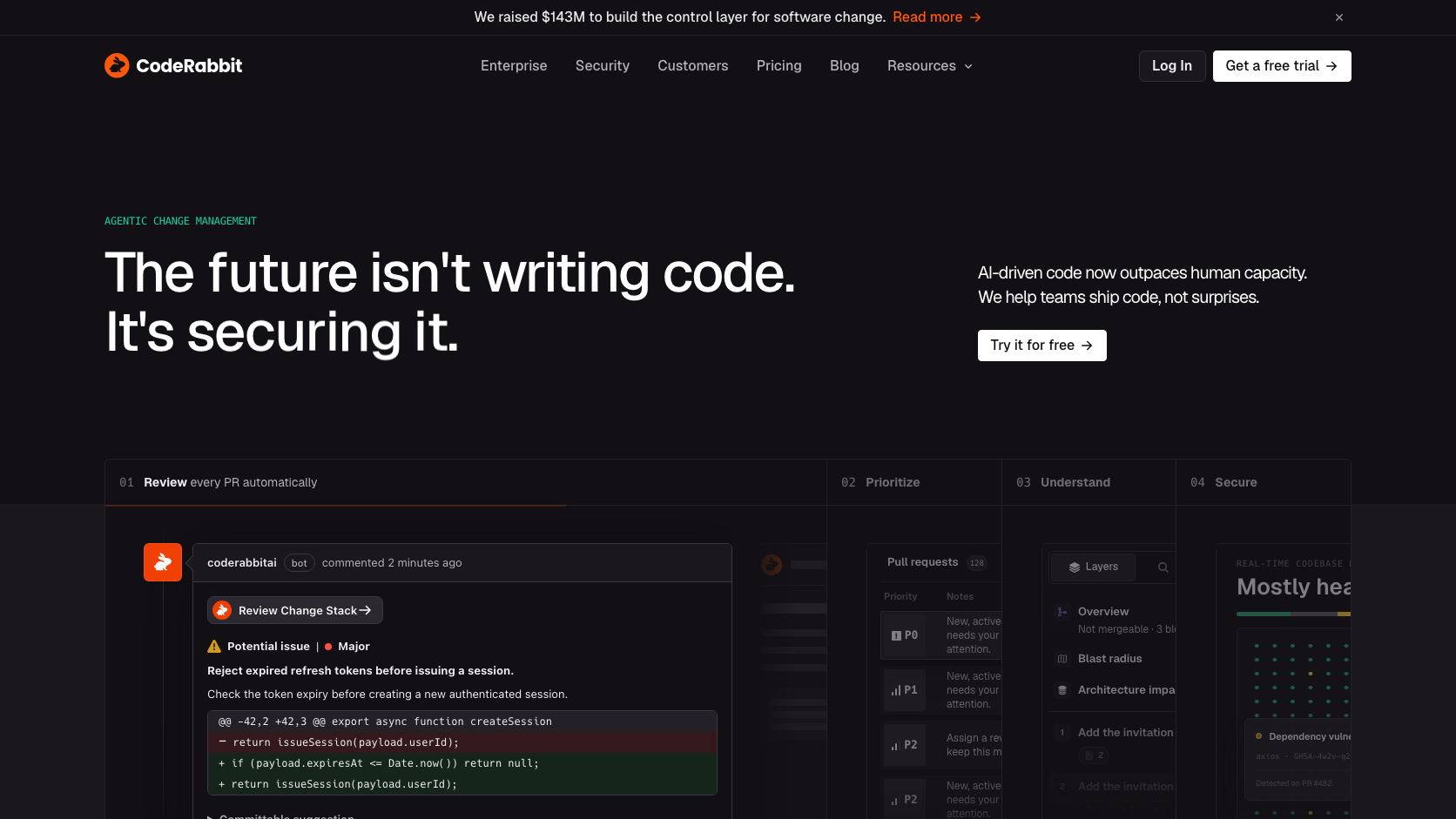
CodeRabbit focuses on reviewing code rather than generating entire features. It adds automated, context-aware feedback to pull requests and increasingly brings the same review loop into IDE and CLI workflows.
Information checked: Aug 29, 2026 ·View sources
Tool details
- Type
- Review & testing
- Platforms
- GitHub, GitLab, IDE, CLI
- Free plan
- Yes
- Open source
- No
- Bring your own key
- No
- Local models
- No
Overview
Best for
- Teams with substantial pull-request review volume.
- Repositories that need consistent first-pass review.
- Developers who want review feedback before and after opening a PR.
Strengths
- Purpose-built for code review rather than generic chat.
- Fits directly into pull-request workflows.
- IDE and CLI options can catch issues before a PR is opened.
- Repository context improves relevance over isolated diff review.
Limitations & trade-offs
- Solo projects with very few pull requests.
- Organizations that cannot send code to a managed reviewer.
- Teams seeking a full autonomous feature-building agent.
- Automated comments still require human judgment.
- Noisy configuration can create review fatigue.
- Private code is processed by a managed service unless an enterprise option changes the deployment model.
- Paid value depends on pull-request volume and team workflow.
Get started
Pricing & usage limits
Free tier available
Free tier$0
Entry access for evaluating automated reviews.
Team plansPlan-dependent
Paid collaboration, higher limits, and organization capabilities.
EnterpriseCustom
Security, governance, and support for larger organizations.
Pricing checked: Aug 29, 2026 · Subscription, usage limits, and model costs may be billed separately.
Features & details
Pull Request Review
- Line-by-line review comments
- Pull-request summaries
- Suggested fixes
- Incremental review as code changes
Repository Context
- Repository-aware feedback
- Project instructions
- Issue and risk detection
- Learning from developer feedback
Developer Surfaces
- Git provider integration
- IDE review workflow
- CLI checks
- Team and enterprise controls
CodeRabbit Review 2026
CodeRabbit is an AI code-review platform for pull requests, IDE feedback, and command-line checks, producing repository-aware review comments, summaries, issue detection, and suggested fixes.
What Is CodeRabbit?
CodeRabbit focuses on reviewing code rather than generating entire features. It adds automated, context-aware feedback to pull requests and increasingly brings the same review loop into IDE and CLI workflows.
Its product is built around repeatable review quality, repository learning, and pull-request collaboration rather than a general-purpose coding chat.
Core Features
Pull Request Review
- Line-by-line review comments
- Pull-request summaries
- Suggested fixes
- Incremental review as code changes
Repository Context
- Repository-aware feedback
- Project instructions
- Issue and risk detection
- Learning from developer feedback
Developer Surfaces
- Git provider integration
- IDE review workflow
- CLI checks
- Team and enterprise controls
How It Fits an Agentic Development Workflow
CodeRabbit is most useful when its permissions, repository scope, model access, and review checkpoints are configured before the first large task. Start with a bounded project, verify the generated changes or analysis, and only then expand access. This matters because agentic tools can move faster than a conventional assistant and can also amplify a bad assumption.
For teams, the practical evaluation should cover setup time, context quality, task completion rate, review burden, model or infrastructure cost, security controls, and how easily a human can interrupt or redirect work.
Best Use Cases
- Teams with substantial pull-request review volume.
- Repositories that need consistent first-pass review.
- Developers who want review feedback before and after opening a PR.
Pricing
- Free tier: $0. Entry access for evaluating automated reviews.
- Team plans: Plan-dependent. Paid collaboration, higher limits, and organization capabilities.
- Enterprise: Custom. Security, governance, and support for larger organizations.
Pricing and limits can change quickly. The figures or plan descriptions above were checked against official information on 2026-08-29; verify the official site before purchasing.
Privacy, Security, and Deployment
Review requires access to repository code and pull-request metadata. Evaluate retention, training policy, tenant isolation, permissions, secret scanning, and enterprise deployment terms.
Any coding agent or developer tool with repository, terminal, browser, or secret access should be introduced with least-privilege credentials, protected branches, mandatory review, isolated test environments, and clear log-retention rules.
Limitations
- Automated comments still require human judgment.
- Noisy configuration can create review fatigue.
- Private code is processed by a managed service unless an enterprise option changes the deployment model.
- Paid value depends on pull-request volume and team workflow.
Alternatives
- Qodo
- GitHub Copilot
- Bito
- Sourcery
- Graphite
The best alternative depends on whether the priority is an AI-native editor, a terminal harness, autonomous cloud execution, code review, mobile control, or a shared orchestration layer.
Verdict
A core AI code-review product that deserves a dedicated entry because it addresses a different stage of the development lifecycle than coding agents.
Official Sources
Model support & data privacy
Supported models
- CodeRabbit managed models
Privacy & data handling
Review requires access to repository code and pull-request metadata. Evaluate retention, training policy, tenant isolation, permissions, secret scanning, and enterprise deployment terms.
Guides, reviews & fixes
No published guides yet. Start with the official documentation above.
Product updates
No verified product updates listed yet. Follow this tool to see new relevant content in Saved.
See the content timelineAlternatives
QodoQodo is an agentic code-quality platform that connects code generation, testing, and review. Its strongest positioning is enterprise-grade review with multiple specialized agents and organization context. GitHub CopilotGitHub Copilot is a mainstream AI code assistant and developer workflow layer for teams that want AI support inside existing editors, GitHub repositories, pull requests, and terminal workflows.
Sources & verification
Verification dates record when this directory checked the information. Product release dates appear separately above.
Directory revision history
Created a complete English draft profile from current official sources; kept unpublished for editorial review.