On This Page8 sections
Key Takeaways
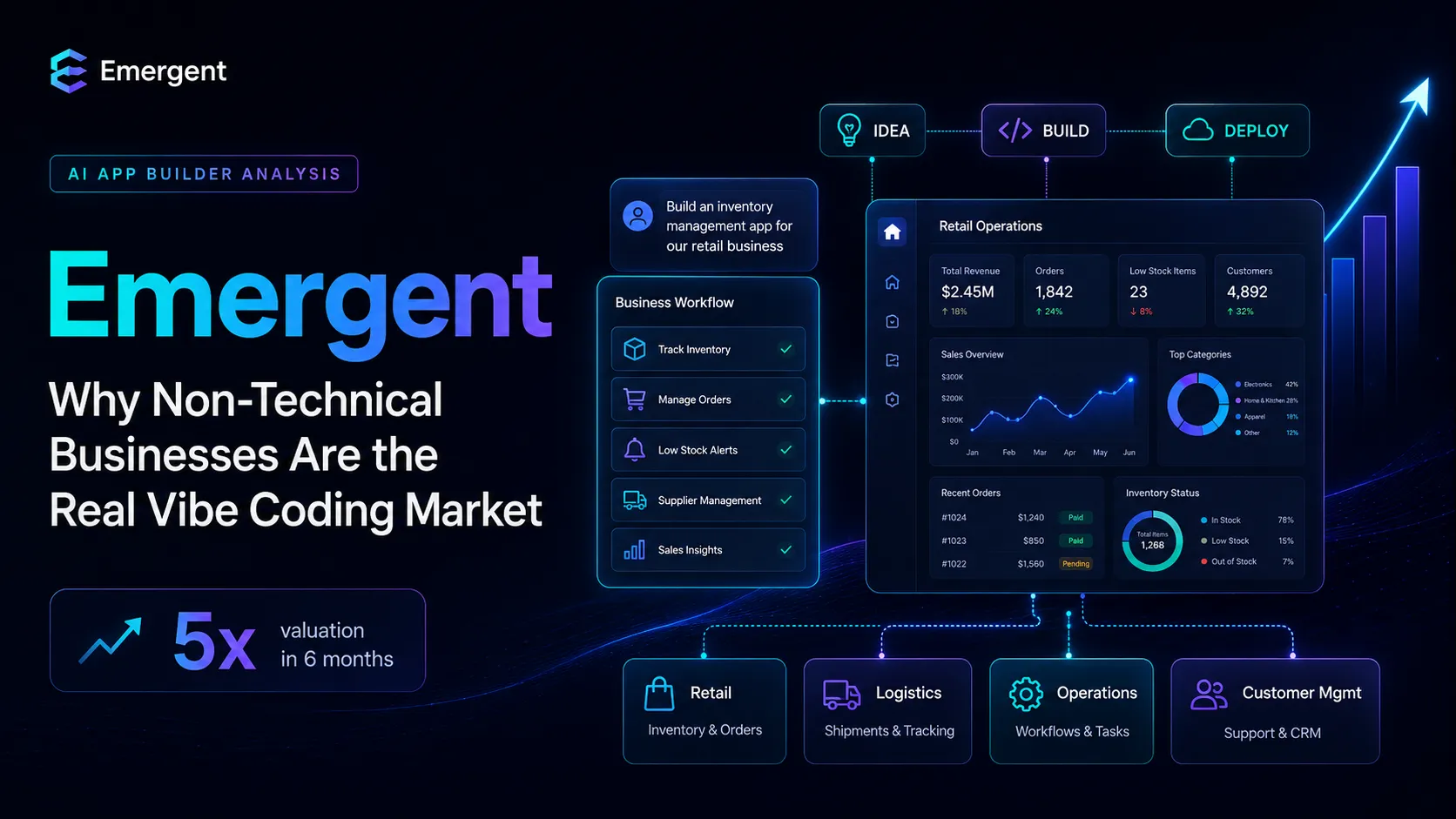
As of July 16, 2026, Emergent had increased its valuation from approximately $300 million to $1.5 billion in about six months. Its growth is not primarily driven by helping professional developers write code faster. Emergent allows founders, operators, and traditional businesses to generate, deploy, and run custom software through natural-language instructions. The company says roughly 70% of its users have no programming experience, showing that non-technical businesses are becoming a core market for vibe coding.
Why Did Emergent’s Valuation Increase Fivefold in Six Months?
Emergent’s valuation increased because rapid revenue growth, user expansion, and a differentiated market position attracted substantial investor demand. The company raised a $70 million Series B at an estimated $300 million valuation in January 2026, followed by a $130 million Series C at a $1.5 billion post-money valuation in July 2026.
During the same period, Emergent’s reported annualized revenue run rate increased from approximately $50 million to $120 million. The valuation grew faster than revenue, indicating that investors are pricing in the possibility that agentic app-building platforms could capture spending currently allocated to outsourced development, low-code platforms, vertical SaaS, and internal software teams.
| Metric | January 2026 | July 2026 | Change |
|---|---|---|---|
| Valuation | About $300 million | $1.5 billion | 5x |
| Latest funding round | $70 million Series B | $130 million Series C | Larger round |
| Annualized revenue run rate | About $50 million | About $120 million | About 2.4x |
| User base | About 5 million | About 11 million | More than doubled |
| Applications created | Several million | More than 12 million | Rapid expansion |
Emergent’s valuation is based on a broader question than how much an AI coding assistant is worth. Investors are evaluating how valuable it could be to control the software-production entry point for millions of businesses that do not have dedicated engineering teams.
What Kind of AI Coding Company Is Emergent?
Emergent is an agentic prompt-to-app platform designed primarily for users who understand business problems but may not know how to build software. A user describes an application in natural language, and coordinated AI agents handle planning, interface creation, frontend development, backend logic, databases, testing, debugging, and deployment.
Emergent starts from a business requirement rather than an existing codebase. Tools such as Cursor and GitHub Copilot assume that users understand repositories, frameworks, code review, and software architecture. Emergent assumes that users may only know the workflow, users, data, and outcome they need.
Emergent CEO Mukund Jha has described the central idea as enabling the people closest to a business problem to build the software that solves it. This positioning expands software creation beyond engineering teams to product managers, operations specialists, founders, consultants, and small-business owners.
Why Are Non-Technical Businesses the Largest Vibe Coding Opportunity?
Non-technical businesses have an enormous volume of software needs that standard SaaS products cannot fully address. Retailers, logistics companies, manufacturers, schools, repair businesses, travel operators, and professional-service firms all need inventory systems, scheduling tools, quotation workflows, approval processes, customer portals, and reporting dashboards.
Most of these requirements are too specific for standard SaaS but too small to justify a full internal development team. Businesses have traditionally chosen between adapting their processes to generic software, paying for expensive custom development, or continuing to rely on spreadsheets, messaging applications, email, and manual coordination.
Vibe coding introduces another option: business users can describe their existing workflow and generate software that follows it. This is more valuable than generating a generic landing page because it directly replaces repetitive operational work and fragmented internal systems.
Business customers also have stronger retention potential than casual creators. A user may generate a personal website once and leave, but a company that moves customers, inventory, payments, employee permissions, and approval processes into an application creates recurring demand for hosting, databases, AI agents, integrations, maintenance, and new features.
Emergent says approximately 70% of its users have no programming background and that more than half of its customers are building software connected to real business activity. These figures suggest that non-technical users are not merely experimenting with the platform; they are becoming central to its growth and revenue model.
How Do Non-Technical Users Differ From Professional Developers?
Non-technical users want a completed business outcome, while professional developers usually want greater control and higher engineering productivity. Both groups may use AI-generated code, but their expectations for interaction, visibility, testing, and ownership are significantly different.
| Dimension | Professional Developer Tools | Non-Technical Business Platforms |
|---|---|---|
| Starting point | Code, repository, or issue | Business goal, workflow, or spreadsheet |
| Main interaction | Editing code and reviewing diffs | Conversation, requirements, and acceptance tests |
| Primary concern | Architecture, performance, maintainability | Whether the software solves the business problem |
| Typical output | Code changes | A running business application |
| Representative products | Cursor, Claude Code | Emergent, Lovable, Replit Agent |
| Pricing basis | Seats and model usage | Building, deployment, databases, and application usage |
Non-technical businesses also require capabilities that coding assistants rarely prioritize, including access control, data import, approvals, payment processing, messaging, audit logs, team collaboration, and dependable deployment. A vibe coding product becomes an enterprise platform only when it can support these operational requirements.
What Do Emergent’s Growth Numbers Reveal?
Emergent’s reported growth indicates that prompt-to-app software has moved beyond experimental demonstrations into meaningful paid usage. The company says users have created more than 12 million applications, its user base has reached approximately 11 million, and its annualized revenue run rate has reached about $120 million.
The most important indicator is not total registrations but the behavior of high-frequency customers. Emergent has previously said that approximately 65% to 70% of monthly realized revenue came from users who continued building over several weeks or months. These users were primarily startups and small or midsize businesses, with some spending more than $300 per month.
This pattern shows that vibe coding revenue does not have to depend entirely on low-cost subscriptions. Once an application becomes part of daily operations, customers continue consuming agent tasks, model inference, databases, deployment resources, traffic, and third-party integrations.
Emergent’s reported ARR should be interpreted as an annualized revenue run rate rather than fully contracted recurring revenue. It is calculated from recent monthly revenue and may include subscriptions, credit purchases, computing consumption, deployment, and enterprise usage. Long-term retention and gross margins therefore remain important metrics to verify.
Which Use Cases Are Best Suited to Emergent?
Emergent is best suited to clearly defined business workflows that create measurable value but do not justify a large engineering organization. Strong examples include customer portals, inventory management, logistics coordination, appointment systems, supplier workflows, internal approvals, and operational dashboards.
A representative case is Autoverse Mobility, an automotive-parts distribution company. The business used Emergent to build connected applications for drivers, warehouse staff, supplier pickups, administrators, and employee attendance. Work that was expected to require nine or ten months of internal development was reportedly completed in approximately two and a half months.
The significance of this example is not that AI generated several attractive screens. The applications became part of the company’s operating workflow. The strongest proof of value for vibe coding is repeated employee usage, not the successful generation of a first prototype.
High-value use cases include:
- Logistics and warehousing: Routing, barcode scanning, delivery confirmation, photographs, and exception tracking.
- Retail and distribution: Inventory alerts, store replenishment, dealer quotations, and order tracking.
- Professional services: Customer portals, appointments, contracts, project updates, and invoicing.
- Education and training: Enrollment, timetables, assignments, attendance, and parent communication.
- Repair and local services: Work orders, technician scheduling, parts, quotations, and customer follow-up.
- Cross-border commerce: Leads, quotations, order processing, logistics, and multilingual customer management.
How Does Emergent Compare With Cursor, Lovable, and Replit Agent?
Emergent competes most directly with platforms that generate complete applications from natural-language instructions. Cursor is an AI-native code editor, Lovable emphasizes rapid web-product creation, and Replit Agent combines an AI agent with a cloud development environment and integrated deployment.
| Product | Primary users | Starting point | Main advantage | Main limitation |
|---|---|---|---|---|
| Emergent | Non-technical businesses, founders, and product teams | Business requirements | Agentic workflow from planning to deployment | Cloud dependence and continued need for human review |
| Cursor | Professional developers | Existing codebase | Strong code understanding and developer control | Does not deliver a complete business workflow by default |
| Lovable | Founders, designers, and product users | Web product description | Fast UI creation and strong SaaS prototyping | Complex backend logic requires careful validation |
| Replit Agent | Developers and non-technical builders | Application goal | Mature cloud IDE, runtime, and deployment | More complex product and engineering interface |
| Bolt.new | Builders comfortable with project structure | Prompt and code | Rapid browser-based full-stack feedback | Long-term maintenance of complex projects can be difficult |
Emergent is most appropriate when users want to delegate technical implementation to agents while still receiving a complete business application. Cursor is better suited to established engineering teams, Lovable works well for design-focused web products, and Replit Agent provides greater visibility into the cloud development environment.
Why Is Vibe Coding Becoming a Software-Production Platform?
Vibe coding is evolving from helping people write code into helping organizations continuously produce and operate software. Code generation is only the first stage. Enterprise value comes from understanding requirements, managing data, integrating services, testing behavior, controlling permissions, deploying applications, and maintaining them over time.
AI-assisted software development has progressed through four stages:
- Code completion: AI generates functions, tests, and repetitive code.
- Repository agents: AI understands a codebase and completes multi-file tasks.
- Prompt-to-app platforms: AI creates complete applications from natural-language requirements.
- Continuous operations: AI builds, monitors, maintains, and operates business software.
Emergent is attempting to move toward the fourth stage. Its long-term value will not be determined by how quickly it generates an initial application, but by whether that application remains reliable, editable, secure, and useful in daily operations.
Why Is Emergent’s Business Model Attractive?
Emergent can generate revenue from subscriptions, build credits, model usage, deployment, databases, enterprise governance, and high-value integrations. This creates more expansion opportunities than a coding assistant that primarily charges for developer seats.
A typical business customer may progress through several spending stages:
- Purchasing a subscription and initial building credits.
- Increasing agent usage and advanced reasoning consumption.
- Deploying a production application with hosting requirements.
- Connecting payments, email, messaging, and external APIs.
- Adding team seats, permissions, reporting, and audit controls.
- Purchasing SSO, VPC deployment, and enterprise support.
This model also creates cost pressure. Complex applications require repeated model calls, code execution, browser testing, sandbox environments, and debugging cycles. Emergent must continuously improve model routing, caching, task decomposition, and automated validation to protect gross margins.
What Is Emergent’s Defensible Advantage?
Emergent’s primary advantage is not exclusive access to a foundation model. Its defensibility depends on learning how non-technical users describe requirements, how agents translate those requirements into systems, how applications fail, and how deployed products are repaired and improved.
Sustainable advantages can come from five areas:
- Requirement translation: Turning ambiguous business language into data models, permissions, and acceptance criteria.
- Agent orchestration: Coordinating planning, coding, testing, debugging, and deployment across multiple steps.
- Application feedback: Learning from the behavior and failure patterns of large numbers of deployed applications.
- Enterprise governance: Supporting GitHub, RBAC, SSO, audit logs, VPC environments, and controlled data access.
- Distribution and brand: Becoming the default platform that non-technical users consider when they need custom software.
Foundation-model providers remain a major competitive threat. OpenAI, Anthropic, and Google can add code execution, browser control, databases, and deployment to their own products. Emergent must therefore deliver more reliable workflows, better business context, and lower completion costs than a general-purpose model interface.
What Are the Main Risks Facing Emergent and Vibe Coding?
The largest risk is that software-generation capabilities are improving faster than software-verification capabilities. Non-technical users can generate applications quickly, but they may not recognize authorization failures, data corruption, concurrency problems, payment errors, or dangerous edge cases.
The main risks include:
- Revenue quality: Annualized revenue run rate is not the same as contracted recurring revenue.
- Gross margins: Agentic building and testing consume significant model and computing resources.
- Security responsibility: Non-technical users may move prototypes into production without adequate review.
- Shadow IT: Departments may create unmanaged applications with fragmented data and permissions.
- Platform dependence: Hosted databases, deployment systems, and proprietary workflows can complicate migration.
- Competitive convergence: Model providers and cloud platforms can reproduce basic prompt-to-app capabilities.
- Complexity limits: High-scale, heavily regulated, or specialized systems still require experienced engineers.
Businesses should treat AI agents as part of the software-production team rather than as a replacement for code review, security testing, and operational approval. The closer an application is to payments, finance, healthcare, or sensitive customer information, the more rigorous its human governance must be.
What Can Entrepreneurs Learn From Emergent?
The strongest opportunity is not necessarily to copy Emergent as a general-purpose platform. A more defensible strategy is to let industry specialists generate software for a specific vertical using predefined data models, workflows, integrations, and compliance rules.
Promising vertical opportunities include:
| Market | Applications That Can Be Generated | Local or Industry Advantage |
|---|---|---|
| Cross-border ecommerce | Leads, support, inventory, orders, and logistics | Marketplace APIs, languages, taxes, and payments |
| International trade | Quotations, follow-ups, documents, and customer portals | Trade workflows, terminology, and email data |
| Repair services | Work orders, estimates, technician scheduling, and parts | Local provider networks and service standards |
| Travel operations | Itineraries, reservations, vehicles, guides, and settlements | Local inventory, languages, and suppliers |
| Manufacturing | Quality control, production records, equipment, and supplier workflows | Factory processes, hardware, and ERP integration |
| Education businesses | Enrollment, scheduling, assignments, attendance, and renewals | Local payments, messaging, and compliance |
A vertical vibe coding product should provide more than an empty prompt box. It should include industry-specific entities, permissions, reports, automations, and integrations. Business customers pay for software that already understands their industry, not simply for AI that can generate code.
How Should Businesses Adopt Emergent-Like Platforms Safely?
Businesses should begin with low-risk, internally used, clearly defined workflows. The strongest pilot projects are processes that currently depend on spreadsheets, forms, email, and manual synchronization rather than payments or mission-critical infrastructure.
A practical adoption process includes:
- Choose a specific workflow: Select a process with defined inputs, steps, and measurable outputs.
- Limit sensitive data: Begin with test or anonymized information.
- Connect a code repository: Use GitHub for version history, review, and migration readiness.
- Define acceptance criteria: Specify permissions, error behavior, empty states, and recovery requirements.
- Conduct human testing: Business users validate workflows while engineers review security and architecture.
- Roll out gradually: Start with internal users before expanding to customers or critical operations.
- Maintain an exit plan: Document databases, environment variables, integrations, domains, and deployment dependencies.
A successfully running application should not automatically be considered production-ready. A safer standard is whether the application remains controlled under invalid inputs, authorization conflicts, service outages, and data-recovery scenarios.
Will Non-Technical Businesses Replace Professional Development Teams?
Non-technical users will not replace professional engineers, but they will change the boundary of engineering work. Business teams will directly create more prototypes, internal tools, and lightweight applications, while engineers focus on platform architecture, security, data governance, complex integrations, and high-risk systems.
The emerging software-production model has three layers:
- Business users define requirements and acceptance criteria.
- AI agents implement and iterate on most of the application.
- Professional engineers govern the platform and review critical systems.
The future is not that everyone becomes a programmer. It is that more people become software owners, workflow designers, and AI-agent managers. The most valuable skills will shift from memorizing syntax toward process design, systems judgment, testing, and risk management.
Conclusion
Emergent’s increase from a roughly $300 million valuation to $1.5 billion shows that investors increasingly view vibe coding as a change in how businesses produce software, rather than a temporary code-generation trend. Its reported user mix, application volume, and revenue run rate indicate strong demand from organizations that have historically lacked access to custom software.
The most important lesson is that the largest vibe coding market may not be improving productivity for existing developers. It may be enabling millions of founders, operators, and industry specialists to create software directly. The winning platforms will not merely generate code. They will understand business workflows, operate applications reliably, provide governance, and support continuous improvement after deployment.
Continue Reading
More articles connected to the same themes, protocols, and tools.
OpenCode 2.0 Is Here: Code Mode, Background Agents, and a Major Rebuild of the Open-Source Coding Agent
Gemini 4 Argon vs Claude Opus 5.5: Which AI Actually Wins at Coding, Agents, and Price in 2026?
Cloudflare Artifacts Explained: Pricing, Architecture, and the Future of Git for AI Agents
Referenced Tools
Browse entries that are adjacent to the topics covered in this article.