
 LangGraphLangGraph is an open-source, low-level agent orchestration framework for developers building stateful, controllable, long-running AI agents and workflows.
CrewAI
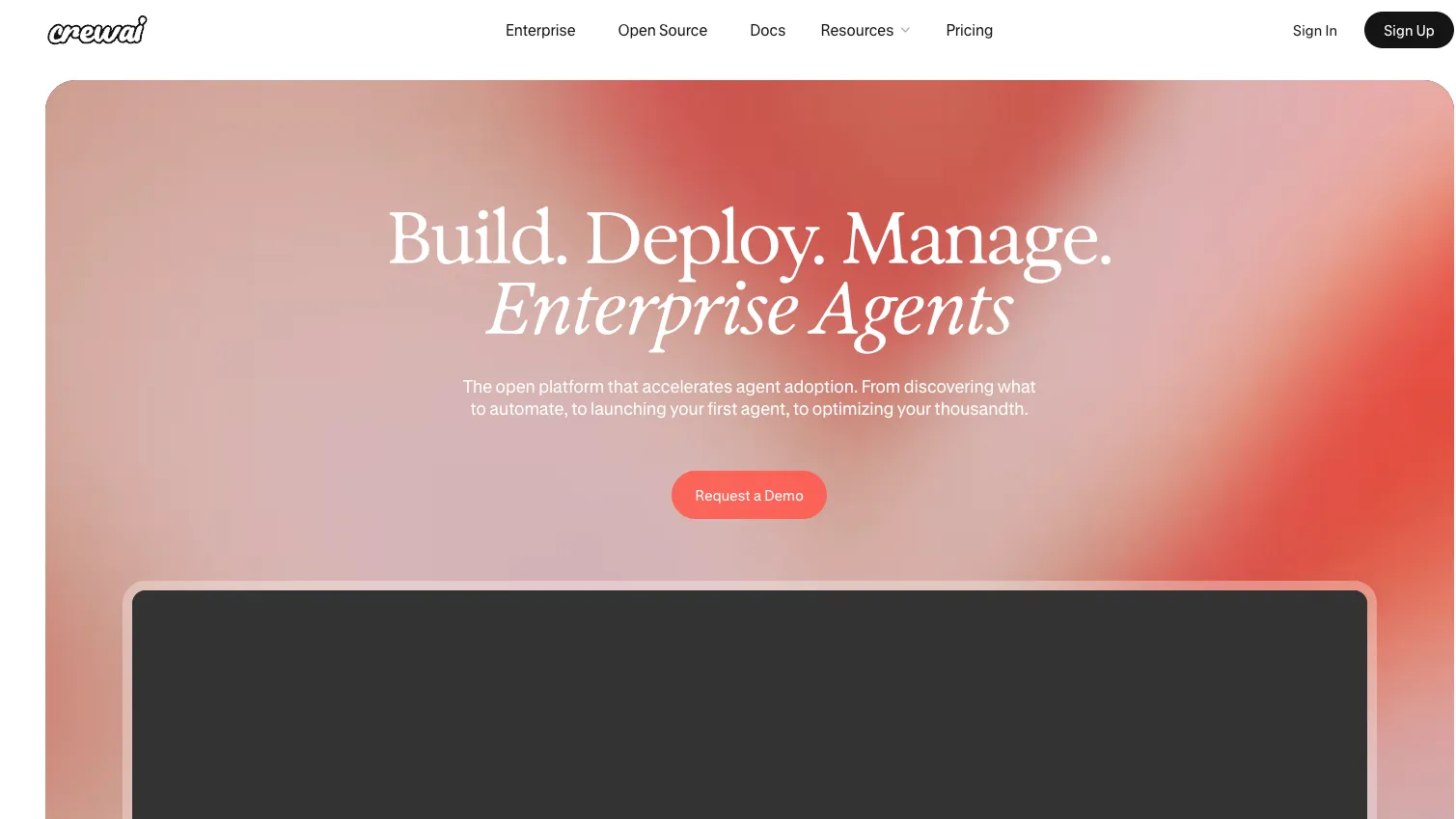
CrewAI is an open-source multi-agent framework and enterprise agent platform for teams building role-based agent crews, event-driven flows, and production AI automations.
Information checked: Jul 8, 2026 ·View sources
Tool details
- Type
- Developer workflows
- Platforms
- Python, CLI, Web, CrewAI AMP, Docker, Cloud, Private infrastructure, Local development, MCP servers, OpenAI-compatible endpoints
- Free plan
- Yes
- Open source
- Yes
- Bring your own key
- Yes
- Local models
- Yes
Overview
Best for
- Multi-agent workflow automation
- Role-based agent teams
- Research, analysis, and report-generation crews
- Agentic business process automation
- AI workflows that need tools, apps, memory, and knowledge
- Teams that want both open-source local development and an enterprise control plane
Strengths
- Clear role-based abstraction makes multi-agent workflows easier to design.
- Open-source core framework with an active Python ecosystem.
- Supports both autonomous Crews and more deterministic Flows.
- Strong MCP, tool, memory, knowledge, and enterprise automation direction.
- Enterprise platform adds deployment, observability, governance, and team controls.
Limitations & trade-offs
- Developers looking for an AI code editor like Cursor or Windsurf
- Teams that want a terminal-first coding agent
- GitHub issue-to-PR automation workflows
- Simple RAG applications that do not need agent collaboration
- Frontend teams that require a TypeScript-first agent framework
- Production systems without time for sandboxing, evaluation, and governance
- Not an AI-native code editor, IDE extension, or GitHub issue-to-PR coding agent.
- Python-first framework; TypeScript-first teams may prefer other agent stacks.
- Role/backstory patterns can feel artificial for deterministic backend workflows.
- Production quality still requires evaluation, sandboxing, observability, and security review.
- Enterprise pricing is custom rather than transparent self-serve paid tiers.
Get started
Pricing & usage limits
Official pricingFree tier available
CrewAI OSSFree
MIT-licensed open-source Python framework for building agents, tasks, crews, flows, tools, memory, and knowledge workflows.
Free$0 / month
Cloud entry plan with visual editor, AI copilot, GitHub integration, and 50 workflow executions per month.
EnterpriseCustom / contract
Adds CrewAI or private infrastructure, on-site support and training, and 50 hours of development per month.
Pricing checked: Jul 8, 2026 · Subscription, usage limits, and model costs may be billed separately.
Features & details
Agents and Crews
- Role-based agents with goals and backstories
- Tasks, delegation, planning, and reasoning
- Sequential, hierarchical, and hybrid processes
- Memory, knowledge, structured outputs, and guardrails
Flows and Orchestration
- Event-driven workflows with start, listen, and router steps
- State persistence and long-running execution support
- Checkpointing, replay, and resume patterns
- Crews and Flows can be combined in one automation
Tools and Integrations
- Built-in and custom tools
- MCP server support
- Apps, Skills, and Knowledge sources
- Code execution and sandbox integrations such as E2B and Daytona
Enterprise Platform
- Crew Studio visual builder
- Automations, triggers, and deployments
- Traces, observability, and OpenTelemetry export
- RBAC, SSO, secret management, PII trace redaction, and human-in-the-loop controls
Why Choose CrewAI?
CrewAI is most useful when the application needs more than one assistant-style model call. Its core design treats agents like specialized team members: each one has a role, goal, context, and tools, then the system coordinates those agents toward a larger outcome.
That makes CrewAI different from AI coding assistants. A coding assistant helps a developer write or edit source code. CrewAI helps developers build the agentic application itself: the workflow where agents research, decide, call tools, pass work to each other, and produce an output.
The strongest reason to choose CrewAI is its approachable abstraction. Developers can explain an agent crew to business users without forcing them to understand graphs, queues, chains, or state machines first. That makes it especially useful for operations, research, analysis, support, marketing, and internal automation workflows where the work already feels like a team process.
Core Workflow
A typical CrewAI project starts by defining the job to be done, then deciding which agent roles are needed. Instead of writing one long prompt, the developer breaks the work into responsibilities: for example, a researcher gathers evidence, an analyst compares options, a writer drafts the output, and a reviewer checks quality.
The next step is deciding how much freedom the agents should have. Some workflows benefit from autonomous collaboration, where agents can reason, delegate, and iterate. Other workflows need tighter control, where the developer uses event-driven flow logic to decide exactly when each step runs and what state is carried forward.
The practical skill is knowing when to use a crew and when to use a flow. Crews are better when role-based collaboration is the central idea. Flows are better when the path must be predictable, resumable, and easier to audit. Production systems often combine both: deterministic flow control around an agent crew that performs one bounded piece of work.
Use Cases That Fit CrewAI
CrewAI fits tasks where multiple reasoning steps and tool calls need to be coordinated. Examples include market research, competitive analysis, lead enrichment, customer support triage, report generation, document review, CRM automation, data collection, internal operations assistants, and agentic workflows that connect to SaaS tools.
It is also a strong prototyping framework for teams exploring agent design. The role-based model makes it easy to test whether a problem benefits from division of labor. If a single assistant prompt is too brittle, a crew can make the workflow easier to reason about and improve.
It is less compelling when the problem is mostly retrieval, search, or deterministic backend orchestration. If the hard part is indexing documents, LlamaIndex or Haystack may be more direct. If the hard part is state-machine control, retries, and durable execution, LangGraph or Microsoft Agent Framework may deserve a closer look.
Comparison to Alternatives
Compared with LangGraph, CrewAI is usually easier to explain and faster to prototype for role-based agent teams. LangGraph is usually stronger when the workflow needs explicit graph state, complex branching, durable checkpoints, and precise control over every transition.
Compared with AutoGen, CrewAI has a more productized and enterprise-oriented direction in 2026. AutoGen remains important historically for multi-agent conversations, but Microsoft has moved new agent investment toward Microsoft Agent Framework. CrewAI is the more natural choice when a team wants a currently active open-source framework with a commercial control plane.
Compared with Semantic Kernel, CrewAI is more crew-and-task oriented. Semantic Kernel is more natural for Microsoft-centered application integration, plugin calls, and existing .NET services. CrewAI is often easier when the mental model is a team of agents completing a business task.
Compared with LlamaIndex, CrewAI is less focused on indexing and retrieval quality. LlamaIndex is often better when the application lives or dies on private-data context. CrewAI is better when the value comes from agent collaboration, tool use, and workflow automation.
Best Configuration
The best CrewAI setup starts small. Use fewer agents than the workflow diagram suggests, then add roles only when a specific failure case justifies them. Too many agents can increase cost, latency, and ambiguity without improving the result.
For production use, define tool access carefully. An agent that can search the web is very different from an agent that can write to a CRM, execute code, update a spreadsheet, or send messages. Sensitive actions should be bounded by approval steps, scoped credentials, and clear audit trails.
For model strategy, avoid assuming every agent needs the strongest model. A cheaper or local model may be enough for classification, formatting, or extraction, while a stronger hosted model can be reserved for planning, synthesis, and quality review.
For enterprise use, pair CrewAI OSS development with a deployment and observability plan early. Agent runs are harder to debug than ordinary functions because they depend on model behavior, tool outputs, prompts, memory, and external systems. Traces, logs, replay, and evaluation datasets should be part of the architecture, not a late add-on.
Migration Notes
Migrating from a simple prompt script to CrewAI is usually straightforward: identify the repeated steps in the prompt, turn them into tasks, assign each task to an agent, then test whether the agent split improves reliability. The goal is not to make the system look more agentic; the goal is to make the work easier to monitor and improve.
Migrating from LangChain often means deciding whether CrewAI should own the full workflow or only the multi-agent layer. Some teams keep existing retrieval, API wrappers, or observability tools and use CrewAI mainly for role-based task coordination.
Migrating from LangGraph requires a different decision. If the current LangGraph workflow depends heavily on explicit state transitions, conditional routing, and checkpoints, CrewAI may feel less precise unless the workflow is redesigned around Flows. If the current graph mostly simulates a team of agents, CrewAI may be easier to maintain.
Migrating from AutoGen should begin with agent inventory. List each agent role, tool, message pattern, approval step, and termination condition. Then rebuild the smallest working crew before porting every conversation pattern. Multi-agent systems often hide complexity in conversation flow, so direct rewrites can miss important behavior.
Tradeoffs in Practice
CrewAI's main advantage is that its abstractions are intuitive. Roles, tasks, crews, and flows are easy to discuss with both developers and business stakeholders. That is valuable when the project needs buy-in from operations, sales, support, or domain experts.
The tradeoff is that intuitive abstractions can hide engineering complexity. A crew that looks simple may still involve multiple model calls, external tools, memory, retries, and non-deterministic decisions. Production teams need evaluation, cost monitoring, sandboxing, and rollback plans.
The practical verdict is that CrewAI is a strong choice for agentic automation where collaboration is the right mental model. It should not be listed as a coding tool, but it belongs in a developer workflow directory because it helps engineers build, deploy, and govern the agent workflows that sit behind AI products.
Model support & data privacy
Supported models
- OpenAI
- Anthropic
- Google Gemini
- Azure OpenAI
- AWS Bedrock
- Snowflake Cortex
- Ollama
- LM Studio
- llama.cpp
- Mistral
- Groq
- Together AI
Privacy & data handling
CrewAI OSS runs in the developer's own environment, so privacy depends on the configured LLM provider, tools, MCP servers, storage, telemetry settings, and deployment architecture. CrewAI documentation states that anonymous telemetry does not collect prompts, task descriptions, agent backstories, goals, API responses, secrets, or environment variables by default, but teams with strict privacy requirements should review telemetry settings, provider terms, trace retention, and enterprise controls before production use.
Guides, reviews & fixes
No published guides yet. Start with the official documentation above.
Product updates
No verified product updates listed yet. Follow this tool to see new relevant content in Saved.
See the content timelineAlternatives
LangGraphLangGraph is an open-source, low-level agent orchestration framework for developers building stateful, controllable, long-running AI agents and workflows. AutoGenAutoGen is Microsoft’s open-source multi-agent AI framework for conversational agents, tool use, code execution, and agent collaboration, now primarily relevant for existing projects and migration planning.
 Microsoft Agent FrameworkAn open-source Microsoft framework for building provider-flexible AI agents and controlled multi-agent workflows across Python and .NET.
 Semantic KernelSemantic Kernel is Microsoft’s open-source AI application orchestration SDK for connecting LLMs, plugins, memory, vector stores, and existing code into agentic workflows.
 LlamaIndexLlamaIndex is a developer framework and managed document-agent platform for building context-aware LLM applications over private, structured, and unstructured data.
 LangChainLangChain is a developer framework and agent engineering ecosystem for building, debugging, evaluating, and deploying LLM-powered applications.
Sources & verification
Verification dates record when this directory checked the information. Product release dates appear separately above.
Official websiteCrewAI pricingCrewAI open sourceCrewAI documentationCrewAI documentation indexCrewAI GitHub repositoryCrewAI licenseCrewAI privacy policyCrewAI MCP documentationCrewAI enterprise features
Directory revision history
Created directory entry using official CrewAI website, pricing page, open-source page, documentation index, GitHub repository, license, privacy policy, and enterprise documentation.