
 LangChainLangChain is a developer framework and agent engineering ecosystem for building, debugging, evaluating, and deploying LLM-powered applications.
LlamaIndex
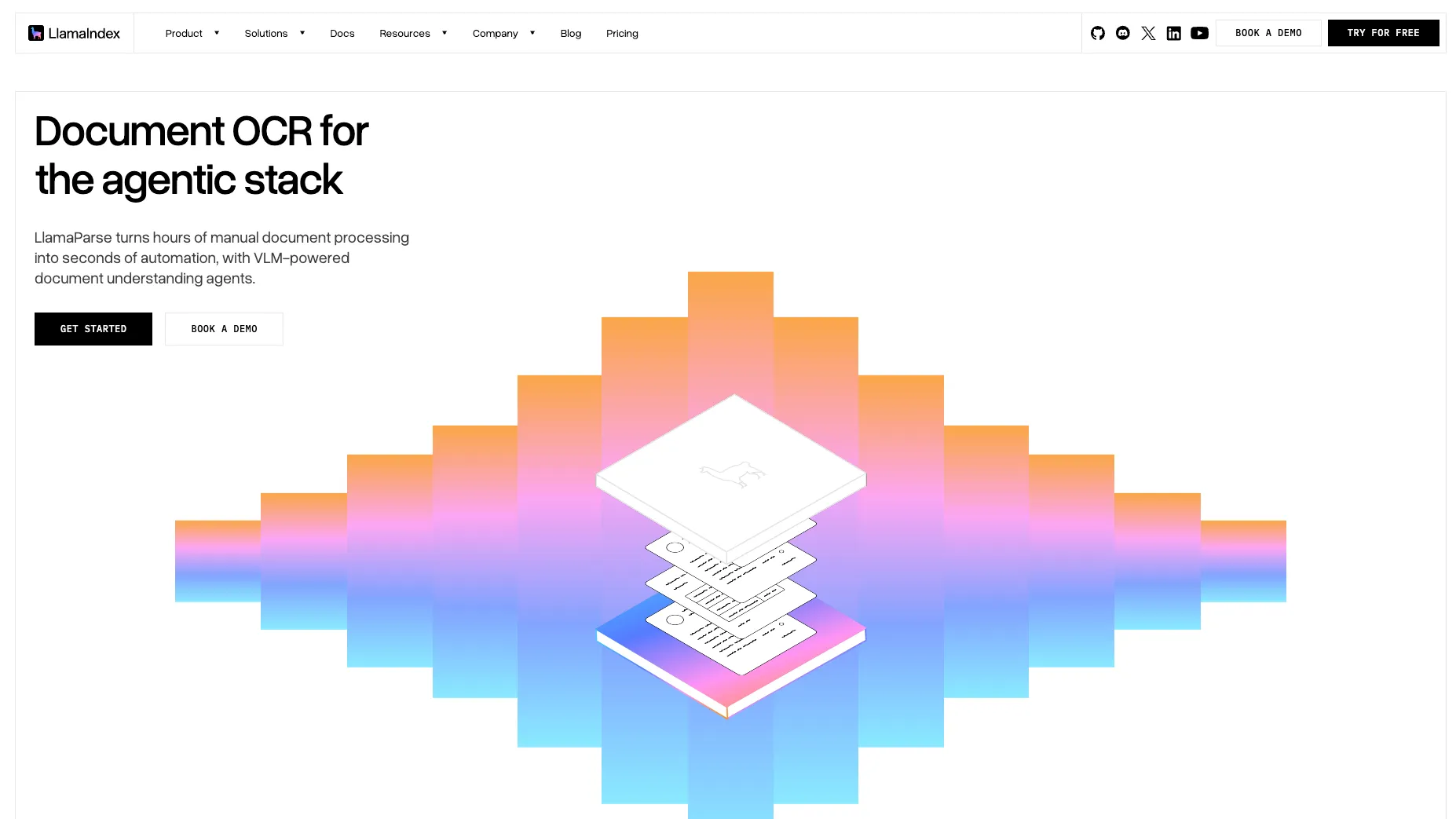
LlamaIndex is a developer framework and managed document-agent platform for building context-aware LLM applications over private, structured, and unstructured data.
Information checked: Jul 8, 2026 ·View sources
Tool details
- Type
- Developer workflows
- Platforms
- Python, TypeScript, Node.js, Web, LlamaCloud, Self-hosted applications, Cloud applications, Local development
- Free plan
- Yes
- Open source
- Yes
- Bring your own key
- Yes
- Local models
- Yes
Overview
Best for
- RAG applications over private data
- AI agents that need retrieval tools
- Document Q&A and knowledge assistants
- Structured data extraction from unstructured documents
- Enterprise search and support copilots
- Teams building custom LLM infrastructure instead of using a turnkey chatbot
Strengths
- Strong fit for RAG, document intelligence, and data-connected LLM applications.
- Open-source core framework with Python and TypeScript support.
- Flexible provider ecosystem for hosted and local models.
- LlamaParse adds managed document parsing for complex PDFs, tables, charts, and scans.
- Good choice when developers need control over retrieval pipelines instead of a black-box chatbot.
Limitations & trade-offs
- Developers looking for an AI-native code editor like Cursor or Windsurf
- Teams that want an autonomous GitHub issue-to-PR coding agent
- Non-technical users who want a no-code chatbot builder
- Simple prompt wrappers with no retrieval or data orchestration needs
- Projects that require a fully managed end-user app with minimal engineering work
- Not an AI code editor, IDE extension, or issue-to-PR coding agent.
- Production RAG quality still requires careful chunking, evaluation, observability, and data governance.
- The framework ecosystem can feel broad and fast-moving for new teams.
- Managed LlamaParse costs depend on credit usage and document complexity.
- Enterprise security posture depends on the chosen model providers, vector stores, and deployment architecture.
Get started
Pricing & usage limits
Official pricingFree tier · From $50
LlamaIndex OSSFree
MIT-licensed open-source framework for building RAG, agents, workflows, and context-augmented LLM applications.
LlamaParse Free$0 / month
Includes 10K monthly credits, 1 user, and basic support for document parsing and extraction.
LlamaParse Starter$50 / month
Includes 40K credits, pay-as-you-go usage up to 400K credits, 5 users, and basic support.
LlamaParse Pro$500 / month
Includes 400K credits, pay-as-you-go usage up to 4M credits, 10 users, and Slack support.
EnterpriseCustom
Volume credit discounts, higher rate limits, enterprise SSO, dedicated account management, and SaaS or hybrid deployment options.
Pricing checked: Jul 8, 2026 · Subscription, usage limits, and model costs may be billed separately.
Features & details
RAG and Context Engineering
- Data connectors for APIs, files, SQL, docs, and web sources
- Indexes, retrievers, query engines, and chat engines
- Advanced retrieval, reranking, routing, and response synthesis
- Vector store and embedding provider integrations
Agent and Workflow Development
- LLM-powered agents with tool use
- Event-driven workflows for multi-step AI apps
- Human-in-the-loop and stateful orchestration patterns
- Production microservice deployment patterns
Framework and SDKs
- Python SDK
- TypeScript SDK
- Modular integration packages
- Open-source MIT license
LlamaParse and LlamaCloud
- Agentic OCR for complex documents
- Structured extraction with confidence scores and citations
- Parsing, extraction, splitting, classification, and indexing APIs
- Support for PDFs, Office files, spreadsheets, images, and many document formats
Why Choose LlamaIndex?
LlamaIndex is most useful when the hard part of the AI application is not the chat UI, but the connection between the model and the data it needs to reason over. It gives developers a structured way to ingest sources, shape them into retrievable context, and expose that context through query, chat, agent, and workflow patterns.
That makes LlamaIndex different from AI coding assistants. A coding assistant helps write code inside an editor. LlamaIndex helps developers build the data and retrieval layer that makes an AI product useful after the code is written. It is closer to application infrastructure for RAG, document intelligence, and context-aware agents.
The strongest reason to choose it is control. Teams can start with high-level abstractions, then move down into custom retrievers, routing, ranking, tools, indexes, and workflow logic as requirements become more specific. That matters in production because retrieval quality, latency, cost, and traceability often decide whether an AI app is trusted.
Core Workflow
A typical LlamaIndex project starts with the question: what should the model know that it does not already know? From there, the developer identifies the source data, loads it into a document representation, splits it into useful units, attaches metadata, creates embeddings or other indexes, and designs the retrieval path that will serve relevant context at inference time.
After that first pipeline works, the project usually becomes an iteration loop. Developers test real queries, inspect failure cases, adjust chunking and metadata, add reranking, introduce routing across multiple sources, and evaluate whether the final answer is grounded enough for the target use case.
For agentic applications, the same workflow expands into tools and steps. Retrieval may become one tool among many, alongside API calls, structured extraction, database lookups, or workflow actions. The important design decision is deciding when the model should retrieve, when it should call a tool, and when the system should constrain or validate the result.
Use Cases That Fit LlamaIndex
LlamaIndex fits applications where private or domain-specific context is central to the product. Examples include enterprise knowledge assistants, customer support copilots, research agents, document Q&A, contract review helpers, financial analysis workflows, technical documentation search, and internal data assistants.
It is especially relevant when the source material is messy. Many AI prototypes work on clean markdown files but fail when asked to process scanned PDFs, tables, slide decks, long reports, mixed document sets, or structured data living beside unstructured files. LlamaIndex gives developers a path from raw content to retrieval-ready context, while LlamaParse can reduce the custom work needed for difficult document formats.
It is less compelling for simple chat wrappers that do not need retrieval, for teams that only want code autocomplete, or for non-technical users looking for a visual chatbot builder. The framework assumes developers are willing to design, test, and operate the retrieval layer.
Comparison to Alternatives
Compared with LangChain, LlamaIndex is often chosen when the project is centered on data ingestion, retrieval, indexing, and RAG quality. LangChain has a broader orchestration ecosystem and many agent/tool abstractions, while LlamaIndex is usually more focused on turning private data into useful model context.
Compared with LangGraph, the distinction is orchestration versus context. LangGraph is strong when the team needs explicit state machines and graph-based agent flows. LlamaIndex is often stronger when the application depends on complex documents, knowledge retrieval, and custom data access patterns. Some teams may use them together rather than treat them as mutually exclusive.
Compared with Haystack, LlamaIndex tends to appeal to developers who want a flexible framework for modern LLM retrieval patterns, agents, and rapid experimentation. Haystack remains a credible option for production search and RAG pipelines, especially for teams that prefer its pipeline architecture and ecosystem.
Compared with CrewAI or AutoGen, LlamaIndex is less about role-playing agents and more about grounding agents in data. If the product needs multi-agent coordination, those frameworks may be attractive. If the product fails without accurate retrieval and document understanding, LlamaIndex is usually the more direct starting point.
Best Configuration
The best configuration is usually modular rather than monolithic. Start with the smallest retrieval path that can answer real user questions, then add complexity only where evaluation shows a measurable failure. Many teams over-engineer early with multiple retrievers, routers, agents, and tools before they have proven that the base corpus and chunking strategy work.
For document-heavy use cases, treat parsing as a first-class system component. Poor extraction from PDFs or tables will make the retrieval layer look worse than it is. Use clean document pipelines, preserve useful metadata, keep source citations, and test against the kinds of files users actually upload.
For model selection, separate the embedding model, retrieval strategy, reranker, and answer-generation model. Each part affects quality and cost differently. A local or cheaper model may be enough for indexing or classification, while a stronger hosted model may be reserved for final synthesis or difficult agent steps.
For privacy-sensitive projects, decide early whether data can leave the environment. If not, configure local models, local embeddings, local vector storage, or a private deployment path before building too much application logic around hosted defaults.
Migration Notes
Migrating from a custom RAG stack to LlamaIndex is usually easiest when the existing system has clean boundaries between loaders, chunkers, embeddings, vector stores, retrieval logic, and answer generation. If those pieces are tangled together, migrate one layer at a time rather than rewriting the whole application.
From LangChain, the main migration question is whether LlamaIndex should replace the data layer only or the broader application orchestration. Many teams can begin by moving ingestion and retrieval into LlamaIndex while keeping existing app code, observability, or agent orchestration elsewhere.
From a basic vector-search prototype, the biggest change is evaluation discipline. LlamaIndex makes it easier to add advanced retrieval techniques, but those techniques should be justified by real failure cases. Build a test set of representative questions, expected sources, and unacceptable answers before changing the architecture.
Tradeoffs in Practice
LlamaIndex gives developers flexibility, but flexibility creates responsibility. The framework will not automatically decide the right chunk size, metadata strategy, storage backend, retrieval method, or hallucination policy for every domain. Production quality comes from measuring these choices against real data.
The managed LlamaParse side can save significant engineering time for document-heavy workflows, but teams should model credit usage carefully. A small number of complex documents can be more expensive than a large number of simple text files, especially when using more advanced parsing tiers.
The practical verdict is that LlamaIndex is best treated as the retrieval and context layer of an AI application. It is not the whole product, and it is not a replacement for evaluation, security review, or UX design. Used well, it helps teams move from demo-grade chatbots to systems that can answer with useful, source-grounded context.
Model support & data privacy
Supported models
- OpenAI
- Anthropic
- Mistral
- DeepSeek
- Hugging Face
- Ollama
- Gemini
Privacy & data handling
LlamaIndex OSS can run in the developer's own environment, but data handling depends on the configured LLM, embedding provider, vector store, and deployment. By default, some examples use hosted providers such as OpenAI; teams can configure local models, local embeddings, and local storage where needed. LlamaParse states that user data is kept private, not used for model training, and cached for 48 hours unless do_not_cache is used, but production teams should still review provider terms, retention settings, and sensitive-document handling.
Guides, reviews & fixes
No published guides yet. Start with the official documentation above.
Product updates
No verified product updates listed yet. Follow this tool to see new relevant content in Saved.
See the content timelineAlternatives
LangChainLangChain is a developer framework and agent engineering ecosystem for building, debugging, evaluating, and deploying LLM-powered applications. LangGraphLangGraph is an open-source, low-level agent orchestration framework for developers building stateful, controllable, long-running AI agents and workflows.
 HaystackHaystack is an open-source AI orchestration framework and enterprise platform for teams building production RAG, agents, multimodal search, and context-engineered LLM applications.
 Semantic KernelSemantic Kernel is Microsoft’s open-source AI application orchestration SDK for connecting LLMs, plugins, memory, vector stores, and existing code into agentic workflows.
 CrewAICrewAI is an open-source multi-agent framework and enterprise agent platform for teams building role-based agent crews, event-driven flows, and production AI automations.
 AutoGenAutoGen is Microsoft’s open-source multi-agent AI framework for conversational agents, tool use, code execution, and agent collaboration, now primarily relevant for existing projects and migration planning.
Sources & verification
Verification dates record when this directory checked the information. Product release dates appear separately above.
Official websiteLlamaIndex framework pageDeveloper documentationGitHub repositoryPricingLlamaCloud / LlamaParsePrivacy and security documentationUsing LLMs documentationLlamaParse FAQ
Directory revision history
Created directory entry using official LlamaIndex website, framework documentation, GitHub repository, LlamaParse pricing, LlamaCloud materials, and privacy documentation.