 LlamaIndexLlamaIndex is a developer framework and managed document-agent platform for building context-aware LLM applications over private, structured, and unstructured data.
Haystack
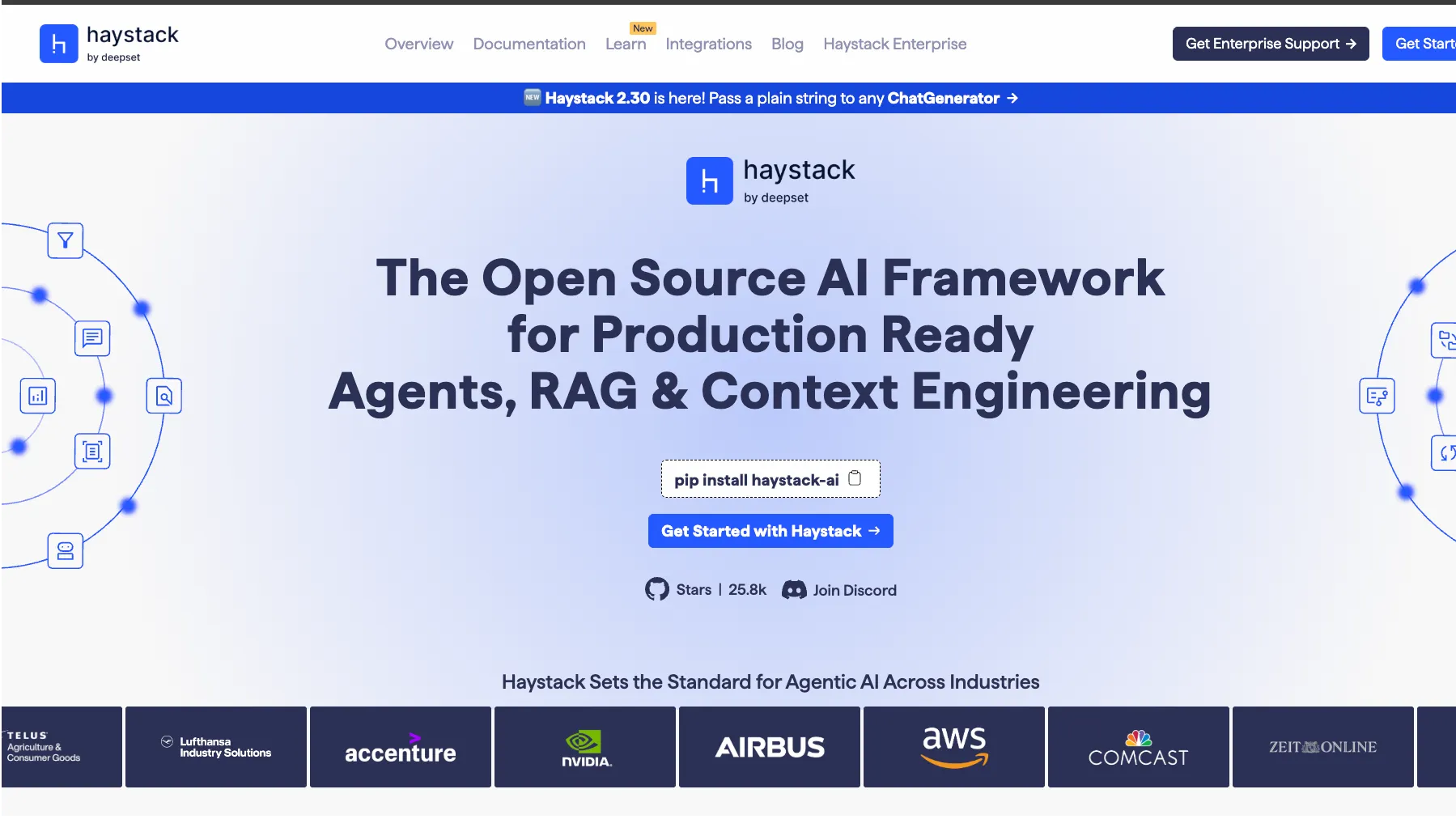
Haystack is an open-source AI orchestration framework and enterprise platform for teams building production RAG, agents, multimodal search, and context-engineered LLM applications.
Information checked: Jul 8, 2026 ·View sources
Tool details
- Type
- Developer workflows
- Platforms
- Python, pip, Docker, Kubernetes, Web, Cloud, Self-hosted, On-premises, Local development
- Free plan
- Yes
- Open source
- Yes
- Bring your own key
- Yes
- Local models
- Yes
Overview
Best for
- Production RAG applications
- Semantic search systems
- Context-engineered AI agents
- Multimodal retrieval workflows
- Question answering over private documents
- Teams that need explicit control over retrieval, routing, ranking, and generation
- Enterprise teams that want open-source portability with optional managed governance
Strengths
- Strong fit for production RAG, semantic search, and context-engineered AI systems.
- Open-source Apache 2.0 framework with a mature Python ecosystem.
- Model- and vendor-agnostic architecture reduces lock-in.
- Explicit pipeline design makes retrieval, routing, generation, and evaluation easier to inspect.
- Enterprise platform adds visual building, deployment, observability, and governance on top of the OSS framework.
Limitations & trade-offs
- Developers looking for an AI-native code editor like Cursor or Windsurf
- Teams that want a terminal-first coding agent
- Non-technical users who need a no-code chatbot builder
- Simple prompt wrappers with no retrieval or orchestration requirements
- Frontend-heavy teams that need a TypeScript-first LLM framework
- Not an AI code editor, IDE extension, or autonomous coding agent.
- Python-first framework; teams wanting a first-class TypeScript framework may prefer other options.
- Production quality still depends on retrieval design, evaluation, data governance, and infrastructure choices.
- Commercial enterprise pricing is custom rather than fully self-serve.
- The pipeline model can feel more structured than lightweight prompt-wrapper libraries.
Get started
Pricing & usage limits
Official pricingFree tier available
Haystack Open SourceFree
Apache 2.0-licensed Python framework installable with pip for local, cloud, or self-hosted AI application development.
Studio$0 / month
Free deepset platform plan for individual prototyping with 1 workspace, 1 user, 100 pipeline hours, 50 files, and 2 development pipelines.
Haystack Enterprise StarterCustom / contract
Enterprise support layer for teams using Haystack OSS, with engineering access, templates, deployment guides, and flexible pricing.
EnterpriseCustom / contract
Production platform plan with unlimited workspaces and users, custom resources, high-availability pipelines, cloud or custom deployment, and dedicated support.
Pricing checked: Jul 8, 2026 · Subscription, usage limits, and model costs may be billed separately.
Features & details
Pipeline Architecture
- Composable components and pipelines
- Retrievers, rankers, routers, generators, and converters
- Branching, looping, and conditional routing
- Serializable pipelines for deployment and versioning
RAG and Search
- Dense, sparse, and hybrid retrieval patterns
- Document Stores and vector database integrations
- Question answering and semantic search
- Evaluation and experiment workflows
Agents and Tools
- Tool-calling agents
- Memory and multi-step workflows
- MCP support through Hayhooks and platform tooling
- Custom components for APIs and internal systems
Enterprise Platform
- Visual Pipeline Builder with YAML and Python export
- Prompt Explorer, Playground, and prototype sharing
- Run history, traces, logs, and groundedness observability
- RBAC, SSO, audit logs, guardrails, and cloud or self-hosted deployment
Why Choose Haystack?
Haystack is most useful when the application needs a transparent pipeline for turning raw data, tools, and model calls into a reliable AI system. Its main idea is that production AI should be built from explicit components rather than hidden agent loops. Developers can see how information is loaded, converted, retrieved, ranked, routed, generated, evaluated, and deployed.
That makes Haystack different from AI coding assistants. A coding assistant helps a developer work inside an editor. Haystack helps a team build the AI application layer itself, especially when retrieval quality, model flexibility, deployment portability, and observability matter.
The strongest reason to choose Haystack is architectural control. Teams can begin with a simple pipeline and later add hybrid retrieval, custom components, branch logic, loops, tool calling, evaluation, monitoring, and deployment automation without abandoning the same conceptual model.
Core Workflow
A typical Haystack project starts by defining the pipeline boundary. The team decides which data enters the system, which transformations are needed, which retrieval strategy should be used, which model should generate the answer, and where validation or evaluation should happen.
The first production risk is usually not the LLM itself. It is whether the right context reaches the model in the right shape. Haystack's component model encourages developers to treat each step as testable infrastructure: conversion, cleaning, splitting, embedding, retrieval, ranking, prompting, generation, and output parsing.
As the project matures, the pipeline often becomes more conditional. Some queries may use keyword search, others vector search, others a hybrid path. Some user requests may require a tool call, while others only need retrieval and generation. Haystack works well when these routes need to be explicit, inspectable, and replaceable.
Use Cases That Fit Haystack
Haystack fits products where search, retrieval, and context quality are central to the user experience. Examples include enterprise knowledge assistants, technical support copilots, document Q&A, legal or compliance search, research assistants, internal semantic search, multimodal retrieval, and AI agents that need access to controlled tools and data.
It is also a strong option when teams expect provider choices to change. A prototype may start with one hosted model and one vector database, but production requirements may later demand a different model, a different document store, a private deployment, or a local inference path. Haystack's value is that these choices are meant to be swappable rather than hard-coded into the application design.
It is less compelling for teams that only need a simple chat wrapper, a frontend-only AI demo, or editor autocomplete. The framework is aimed at developers who are ready to own the retrieval and orchestration layer.
Comparison to Alternatives
Compared with LlamaIndex, Haystack is usually more pipeline-centered. LlamaIndex is often attractive when the primary task is building rich indexes and document-connected query layers. Haystack is attractive when the team wants explicit orchestration across retrieval, routing, generation, tools, evaluation, and deployment.
Compared with LangChain, Haystack tends to feel more structured and less sprawling. LangChain has a very broad ecosystem and is commonly used for many kinds of LLM applications. Haystack is often a better fit when a team wants a clearer pipeline model for production RAG, semantic search, and context-engineered systems.
Compared with LangGraph, the difference is graph-native agent state versus pipeline-native AI orchestration. LangGraph can be a strong choice for complex state machines and long-running agent flows. Haystack is a strong choice when the application still revolves around retrieval, ranking, model calls, and inspectable data flow.
Compared with CrewAI or AutoGen, Haystack is less focused on role-based multi-agent collaboration and more focused on grounding agents in the right context. If the product depends on accurate retrieval and controlled tool access, Haystack is often the more practical starting point.
Best Configuration
A good Haystack setup starts small. Build a minimal pipeline that answers real user questions, then add complexity only when a measurable failure justifies it. Many weak RAG systems fail because teams add agents, routers, and multiple models before they have tested basic parsing, metadata, retrieval, and ranking quality.
For private-data applications, choose the document store, embedding model, LLM provider, and observability stack as part of the same architecture decision. These layers affect privacy, latency, cost, and answer quality together. A strong configuration makes it easy to replace any one part without changing the whole application.
For enterprise use, treat evaluation and traces as early requirements rather than afterthoughts. The practical question is not whether the pipeline can answer one demo query. The question is whether the team can explain why it answered that way, which context it used, which component failed, and what changed between versions.
Migration Notes
Migrating from a custom RAG script to Haystack is usually easiest if the current system can be separated into ingestion, retrieval, generation, and evaluation stages. Start by recreating the existing behavior as a simple Haystack pipeline before adding new components.
From LangChain, the migration decision should focus on boundaries. Some teams may only move retrieval and RAG pipelines into Haystack while keeping other application logic elsewhere. Others may replace a broader orchestration layer if they want a more explicit pipeline architecture.
From LlamaIndex, migration is usually driven by the desire for different orchestration semantics rather than a simple feature gap. If the existing system depends heavily on LlamaIndex-specific indexes or query engines, migrate one workflow at a time and compare answers, latency, source grounding, and operational complexity before switching the entire stack.
Tradeoffs in Practice
Haystack's main tradeoff is that explicit architecture creates more design decisions. Developers need to think about components, document stores, retrievers, prompt construction, model providers, evaluation, and deployment. That structure is valuable in production, but it can feel heavy for a quick demo.
The Python-first ecosystem is another practical consideration. For backend AI teams, this is often an advantage. For teams building primarily in TypeScript, Haystack may still work well as a Python service, but it may not feel as native as a JavaScript-first framework.
The best way to evaluate Haystack is with a real retrieval problem, not a generic chatbot test. Use representative documents, realistic user questions, expected source citations, and failure cases. If the team values transparency, provider flexibility, and production control, Haystack is likely to fit the workflow well.
Model support & data privacy
Supported models
- OpenAI
- Anthropic
- Mistral
- Cohere
- Hugging Face
- Azure OpenAI
- Amazon Bedrock
- Google Gemini
- Meta Llama
- NVIDIA
- Together AI
- Ollama
- Groq
- DeepSeek
- Qwen
- OpenRouter
Privacy & data handling
Haystack OSS runs in the developer's own environment, but privacy depends on the configured LLM provider, embedding provider, document store, observability stack, and deployment. Haystack collects anonymous component usage telemetry by default and documents an opt-out environment variable. The enterprise platform adds RBAC, SSO, logs, auditability, guardrails, and cloud or self-hosted deployment options, but teams should still review provider routing and sensitive-data handling before production use.
Guides, reviews & fixes
No published guides yet. Start with the official documentation above.
Product updates
No verified product updates listed yet. Follow this tool to see new relevant content in Saved.
See the content timelineAlternatives
LlamaIndexLlamaIndex is a developer framework and managed document-agent platform for building context-aware LLM applications over private, structured, and unstructured data. LangChainLangChain is a developer framework and agent engineering ecosystem for building, debugging, evaluating, and deploying LLM-powered applications.
 LangGraphLangGraph is an open-source, low-level agent orchestration framework for developers building stateful, controllable, long-running AI agents and workflows.
 Semantic KernelSemantic Kernel is Microsoft’s open-source AI application orchestration SDK for connecting LLMs, plugins, memory, vector stores, and existing code into agentic workflows.
 AutoGenAutoGen is Microsoft’s open-source multi-agent AI framework for conversational agents, tool use, code execution, and agent collaboration, now primarily relevant for existing projects and migration planning.
 CrewAICrewAI is an open-source multi-agent framework and enterprise agent platform for teams building role-based agent crews, event-driven flows, and production AI automations.
Sources & verification
Verification dates record when this directory checked the information. Product release dates appear separately above.
Official websiteHaystack documentationHaystack GitHub repositoryHaystack licensedeepset pricingHaystack Enterprise PlatformHaystack Enterprise Platform documentationHaystack Enterprise StarterHaystack telemetry documentation
Directory revision history
Created directory entry using the official Haystack website, documentation, GitHub repository, license, deepset pricing, enterprise platform materials, and telemetry documentation.