
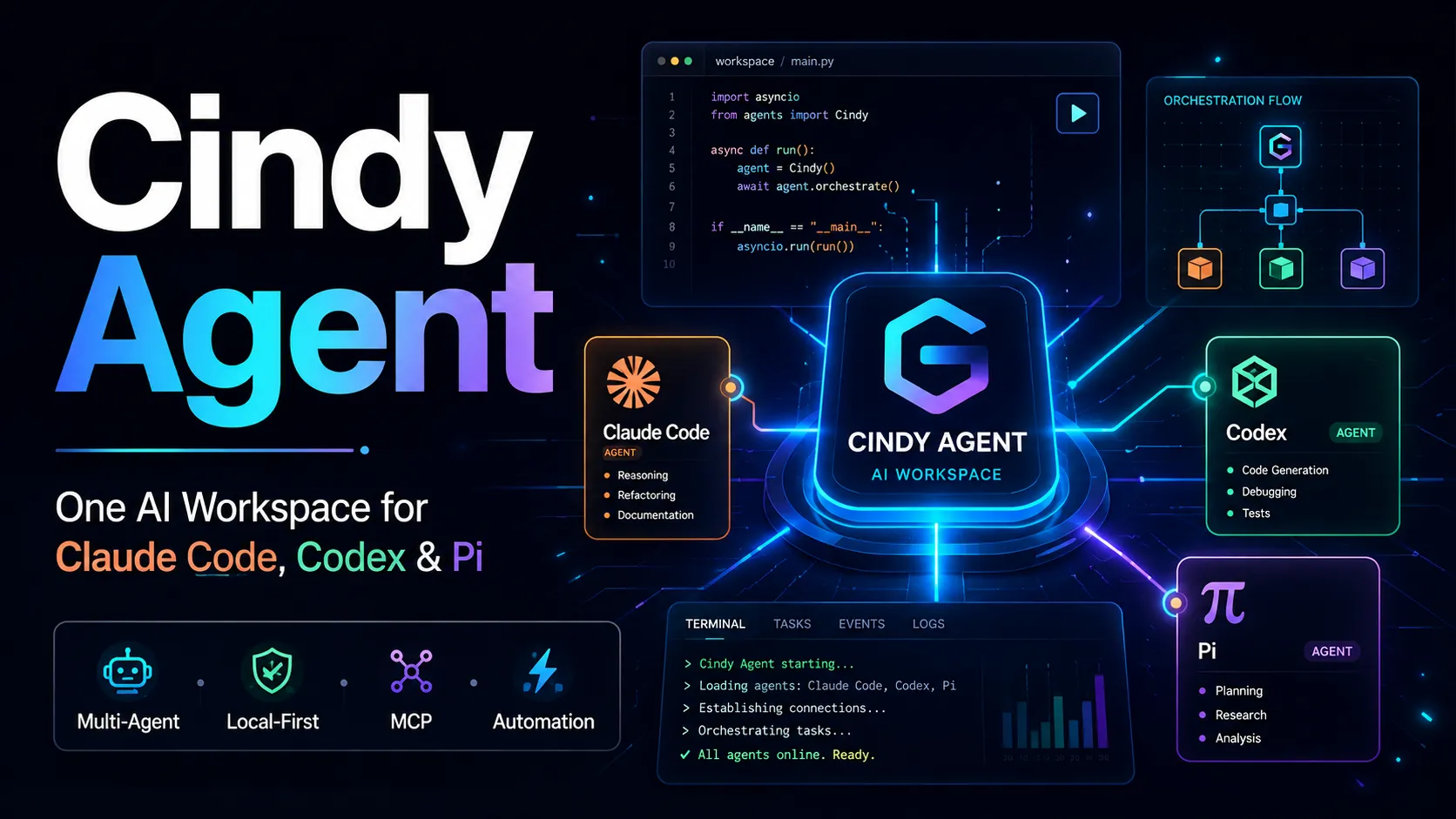

Cindy Agent
Cindy sits above individual coding harnesses. It provides one persistent workspace in which developers can use Claude Code, Codex, Pi, and other models without rebuilding project context each time.
Information checked: Aug 29, 2026 ·View sources
Tool details
- Type
- Developer workflows
- Platforms
- macOS, Windows, Linux, Android, iOS
- Free plan
- Yes
- Open source
- Yes
- Bring your own key
- Yes
- Local models
- Yes
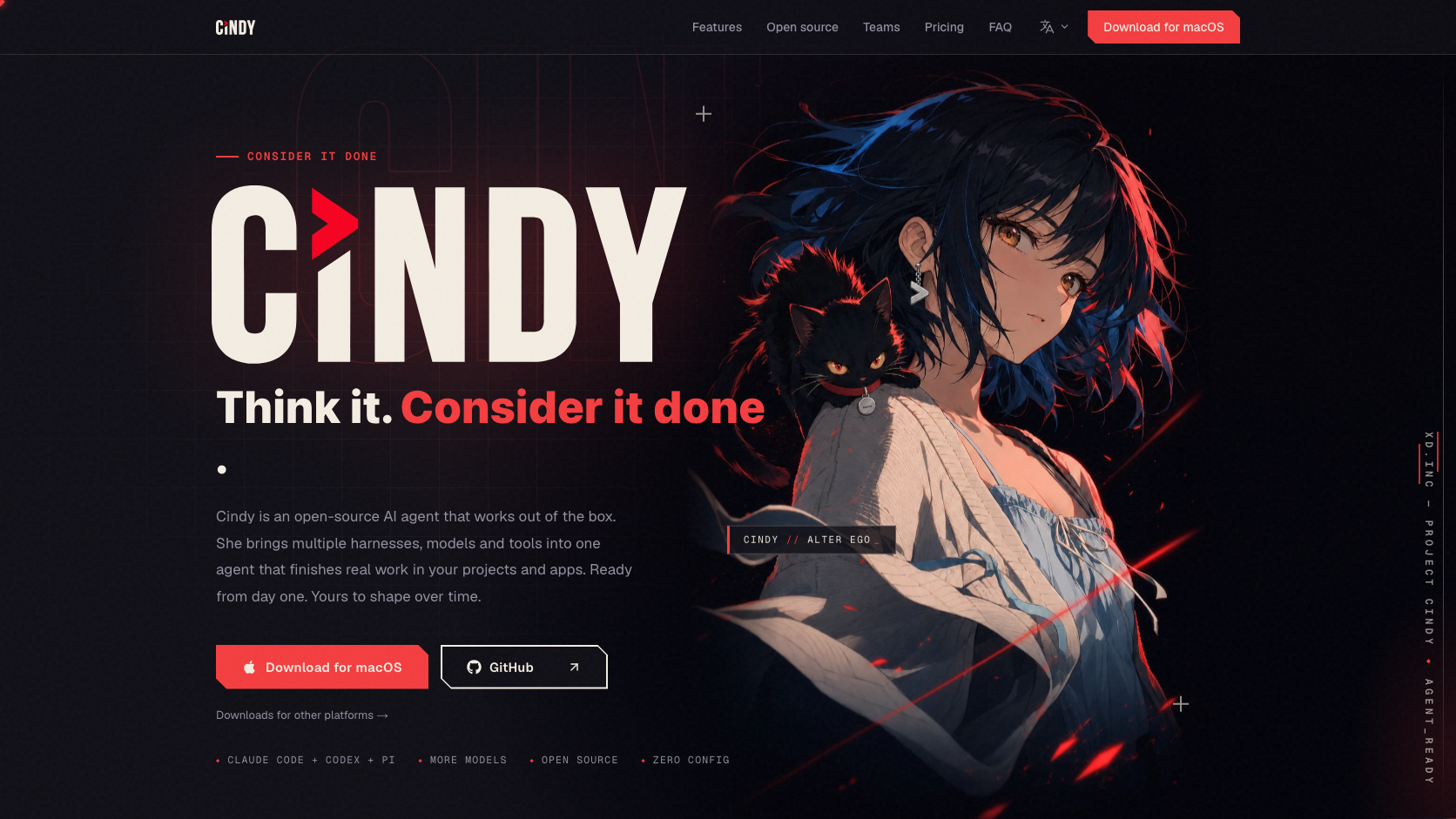
Overview
Best for
- Developers who actively use Claude Code, Codex, and Pi.
- Teams comparing models without losing task state.
- Users who want an open agent command center with local options.
Strengths
- Avoids locking a project into one coding harness.
- Preserves memory, skills, and tools across model changes.
- Open-source licensing supports inspection and customization.
- Desktop, mobile, and collaboration surfaces broaden access.
Limitations & trade-offs
- Developers committed to one simple CLI agent.
- Teams that want a fully managed enterprise control plane today.
- Users who do not need cross-harness continuity.
- Another control layer adds operational complexity.
- Underlying agent subscriptions and API costs still apply.
- Rapid development can produce changing workflows and compatibility.
- Teams must govern permissions across several harnesses and tools.
Get started
Pricing & usage limits
Free tier available
Open-source edition$0
Core software is open source; model usage and optional services may add cost.
Team and EnterpriseWaitlist / custom
Organization features are offered separately as they become available.
Pricing checked: Aug 29, 2026 · Subscription, usage limits, and model costs may be billed separately.
Features & details
Multi-Harness Workspace
- Claude Code, Codex, and Pi support
- Switch harnesses during a task
- Persistent project workspace
- Shared task history and context
Memory and Tools
- Persistent memory
- Reusable skills
- MCP tools
- Local model support
Access and Collaboration
- Desktop applications
- Mobile access
- Remote control workflows
- Slack and Feishu integrations
Cindy Agent Review 2026
Cindy is an open-source agent workspace that runs Claude Code, Codex, and Pi while preserving project workspaces, memory, skills, tools, and context when users switch harnesses or models.
What Is Cindy Agent?
Cindy sits above individual coding harnesses. It provides one persistent workspace in which developers can use Claude Code, Codex, Pi, and other models without rebuilding project context each time.
The workspace, memory, skills, and tools remain attached to the task even when the underlying harness or model changes.
Core Features
Multi-Harness Workspace
- Claude Code, Codex, and Pi support
- Switch harnesses during a task
- Persistent project workspace
- Shared task history and context
Memory and Tools
- Persistent memory
- Reusable skills
- MCP tools
- Local model support
Access and Collaboration
- Desktop applications
- Mobile access
- Remote control workflows
- Slack and Feishu integrations
How It Fits an Agentic Development Workflow
Cindy Agent is most useful when its permissions, repository scope, model access, and review checkpoints are configured before the first large task. Start with a bounded project, verify the generated changes or analysis, and only then expand access. This matters because agentic tools can move faster than a conventional assistant and can also amplify a bad assumption.
For teams, the practical evaluation should cover setup time, context quality, task completion rate, review burden, model or infrastructure cost, security controls, and how easily a human can interrupt or redirect work.
Best Use Cases
- Developers who actively use Claude Code, Codex, and Pi.
- Teams comparing models without losing task state.
- Users who want an open agent command center with local options.
Pricing
- Open-source edition: $0. Core software is open source; model usage and optional services may add cost.
- Team and Enterprise: Waitlist / custom. Organization features are offered separately as they become available.
Pricing and limits can change quickly. The figures or plan descriptions above were checked against official information on 2026-08-29; verify the official site before purchasing.
Privacy, Security, and Deployment
Cindy is open source, but data handling depends on enabled harnesses, model providers, MCP servers, remote-control services, and local storage. Audit each layer before connecting confidential repositories.
Any coding agent or developer tool with repository, terminal, browser, or secret access should be introduced with least-privilege credentials, protected branches, mandatory review, isolated test environments, and clear log-retention rules.
Limitations
- Another control layer adds operational complexity.
- Underlying agent subscriptions and API costs still apply.
- Rapid development can produce changing workflows and compatibility.
- Teams must govern permissions across several harnesses and tools.
Alternatives
- Berd
- Conductor
- Warp
- Superset
- Orca
The best alternative depends on whether the priority is an AI-native editor, a terminal harness, autonomous cloud execution, code review, mobile control, or a shared orchestration layer.
Verdict
A distinctive agent-workspace product that solves harness switching and shared context rather than competing only on code generation.
Official Sources
Model support & data privacy
Supported models
- Claude Code
- Codex
- Pi
- Local models
- Additional provider models
Privacy & data handling
Cindy is open source, but data handling depends on enabled harnesses, model providers, MCP servers, remote-control services, and local storage. Audit each layer before connecting confidential repositories.
Guides, reviews & fixes
Product updates
No verified product updates listed yet. Follow this tool to see new relevant content in Saved.
See the content timelineAlternatives
 BerdBerd is a desktop command center for agent work. Built by Block and backed by Goose, it gathers project context, conversations, files, skills, tools, models, and subagents into one interface.
 ConductorA standalone macOS orchestration layer for coordinating multiple coding-agent runtimes across isolated workspaces, testing environments, and pull request workflows.
 WarpWarp is a terminal-first agentic development environment that combines an AI-native coding workspace with local and cloud agent orchestration.
 SupersetA desktop code editor and control plane for running many coding agents in parallel.
 OrcaOrca is a standalone, local-first agent IDE for coordinating multiple CLI coding agents across isolated git worktrees.
Sources & verification
Verification dates record when this directory checked the information. Product release dates appear separately above.
Directory revision history
Created a complete English draft profile from current official sources; kept unpublished for editorial review.