On This Page8 sections
Key Takeaways
- The "Thanks Tibo" replies were a joke, not evidence that OpenAI reset Grok Bot. Grok Bot reset its own usage limits, while users sarcastically credited OpenAI's Tibo because he had become associated with aggressive quota resets around Codex and other agent products.
- The meme only works because AI coding-agent usage limits now matter almost as much as model quality. Developers care about how many long-running tasks, tool calls, and agent sessions they can complete before hitting a cap.
- Resetting limits has become a competitive growth tactic. A temporary quota refill can immediately increase engagement, reduce frustration, and make a product feel more generous without permanently changing its pricing model.
- The episode shows a broader shift from model wars to agent-economics wars. Codex, Claude Code, Grok Bot, and similar products increasingly compete on effective usable work per subscription, not just benchmark scores.
- A reset does not mean a model was retrained, user data was wiped, or product bugs were fixed. In this context, "reset" means restoring the user's usage allowance.
What Happened With the Grok Bot Reset?
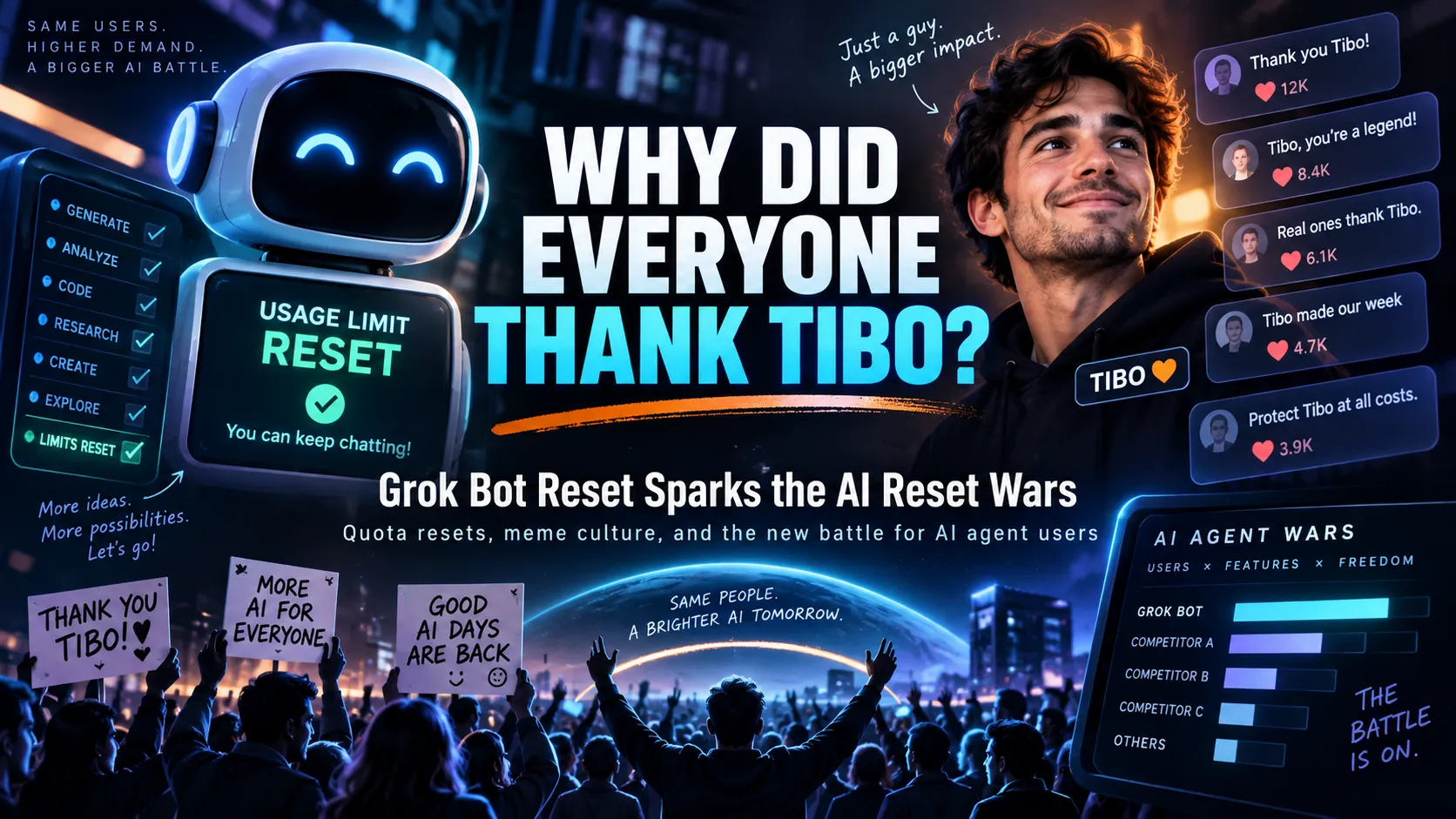
A short post from Felipe Fraga helped turn a routine quota reset into one of the more revealing AI developer memes of 2026.
Grok Bot announced that usage limits had been reset for users. Instead of simply thanking Grok or xAI, Felipe posted:
"Thanks Tibo 🙏"
That line makes little sense if read literally. Tibo is associated with OpenAI, not Grok Bot. He did not operate Grok's quota system.
The joke depends on recent history.
OpenAI had repeatedly used usage-limit resets as a way to reward users, soften rollout friction, and encourage heavier use of Codex and related agent products. Tibo became one of the most visible faces of that behavior. Community members began treating him almost like the industry's unofficial "reset button."
Once competing products also began restoring user allowances, the meme evolved:
Claude resets limits? Thank Tibo.
Grok Bot resets limits? Thank Tibo.
The implication is deliberately absurd: OpenAI's competitive pressure has become so strong that even rival companies are supposedly being forced to give users more usage.
That is why the reaction was positive rather than confused. The community was not actually assigning technical responsibility to Tibo. It was using him as a symbol for a broader quota war across AI coding agents.
First, What Does "Reset" Mean Here?
The wording can be misleading.
A Grok Bot usage reset does not mean:
- the Grok model was rebuilt;
- user conversations were deleted;
- the agent's memory was wiped;
- the product was rolled back;
- the underlying model weights were reset;
- every technical issue was fixed.
It means the user's metered allowance was restored.
For an agent product, that allowance can govern how much work the service is willing to perform under a subscription before requiring the user to wait, upgrade, or buy more capacity.
This distinction matters because coding agents consume resources differently from ordinary chatbots. A single task may involve repeated reasoning cycles, repository searches, file edits, command execution, test runs, web access, and retries. One visible prompt can trigger a large amount of invisible compute.
As a result, the practical question for developers is increasingly not just:
"Which model is smartest?"
It is also:
"How much useful work can this subscription complete before it stops me?"
That is the economic context behind the reset meme.
How Tibo Became the "Reset Guy"
The meme did not appear from nowhere.
OpenAI had increasingly turned usage resets into a public-facing product gesture. Instead of treating quotas as invisible billing infrastructure, reset announcements became community events.
The pattern looked roughly like this:
- A model or agent product receives a major rollout or capacity expansion.
- Some users hit limits quickly or wait for access.
- OpenAI restores or banks additional usage.
- Tibo publicly communicates the reset in a casual, developer-friendly style.
- Users celebrate because they can immediately return to coding.
- Competitors make their own quota or capacity moves.
- The community credits Tibo for those too.
At one point, the framing around OpenAI's behavior was jokingly summarized as "The Reset Company."
That phrase mattered because it converted a normally frustrating concept — rate limits — into a brand meme.
Instead of users discussing quotas only when angry, they began anticipating resets as rewards.
The result is a surprisingly effective form of developer marketing.
Why Did People Thank Tibo for a Grok Bot Reset?
There are four layers to the joke.
1. It Is Deliberate Sarcasm
The most direct interpretation is sarcasm.
When someone writes "Thanks Tibo" under a Grok Bot quota reset, the humor comes from thanking the wrong company.
The community understands that Grok controls Grok Bot's own usage system. The attribution is intentionally false.
2. Tibo Became a Symbol Rather Than a Literal Actor
Internet memes often detach a person from their original role.
In this case, "Tibo" started to mean something closer to:
the person who makes AI coding limits disappear.
That symbolic meaning became strong enough that users could apply it to Claude or Grok without needing to explain the joke.
A particularly telling variation was the idea that Elon Musk was effectively "Grok's Tibo" — as if every AI company now needed its own quota-reset personality.
3. Users Believe Competition Is Forcing Better Deals
The joke also contains a real market observation.
When one major coding-agent provider becomes more generous, competitors have to consider the user-experience impact.
Developers compare subscriptions constantly. If one product offers noticeably more effective work per month, that difference spreads quickly through X, Reddit, Discord, and developer communities.
So "Thanks Tibo" can also be read as:
"Thanks for making the market more competitive."
That is why the meme feels plausible even though the literal claim is false.
4. Developers Were Genuinely Happy to Get More Capacity
The final layer is simple: people wanted more usage.
Agent users often run into limits during long coding sessions. A surprise reset can restore hours of productive work immediately.
That makes a quota refill more emotionally valuable than many traditional product announcements.
A new benchmark score is abstract.
A reset means:
the agent works again right now.
The Real Story: AI Competition Is Moving From Benchmarks to Usable Work
For several years, AI competition was dominated by model-level comparisons:
- benchmark scores;
- context-window size;
- coding accuracy;
- latency;
- multimodal capability;
- API price per token.
Those metrics still matter. But autonomous and semi-autonomous agents introduce a second layer of competition: how much work the provider allows the model to perform for a given subscription.
This changes the purchase decision.
A developer choosing between Grok Bot, Codex, Claude Code, or another coding agent may care about at least five dimensions:
| Dimension | Why It Matters |
|---|---|
| Model capability | Determines whether the agent can solve hard tasks correctly |
| Agent harness | Determines how well it searches, edits, tests, retries, and uses tools |
| Speed | Determines how quickly interactive work gets completed |
| Usage allowance | Determines how long the user can keep working before hitting limits |
| Price | Determines the effective cost per completed task |
The important metric is no longer simply tokens per dollar.
For agent products, a more useful mental model is:
effective value = successful useful work / subscription cost
That is difficult to measure precisely because different tasks consume radically different amounts of compute. But it describes how real users evaluate these products.
A cheaper agent that repeatedly fails may be worse value.
A brilliant agent with an extremely restrictive cap may also be worse value.
The winner can be the product that delivers the most completed useful work before the user encounters friction.
Why Usage Resets Are Such a Powerful Growth Mechanism
A usage reset looks like a small operational decision. In practice, it can affect several product metrics at once.
Immediate Reactivation
Users who hit a limit become inactive by force.
Resetting the allowance instantly turns those blocked users back into active users.
There is no onboarding step, discount code, or new feature to learn.
The product simply becomes usable again.
Higher Experimentation
Developers behave differently when compute feels scarce.
With a tight quota, users tend to save capacity for high-confidence tasks.
With a fresh allowance, they are more willing to try:
- larger refactors;
- parallel agent tasks;
- code reviews;
- repository-wide migrations;
- test generation;
- exploratory research;
- repeated iterations.
That can expose more of the product's capabilities.
Positive Community Sentiment
Rate limits normally create negative posts.
A surprise reset reverses the emotional direction.
Instead of:
"I hit the limit again."
the conversation becomes:
"My usage is back."
This is unusually valuable because the cost of the gesture is mostly compute, while the resulting distribution happens organically through developer communities.
Competitive Pressure
Quota changes are also highly visible.
If users publicly compare how quickly they hit limits on competing services, each provider has an incentive to improve efficiency, increase capacity, or rethink pricing.
That is one reason the "reset wars" framing resonates. It captures a real competitive dynamic underneath the joke.
Grok Bot's Reset Was Not Necessarily Just Copying OpenAI
It would be too simplistic to conclude that Grok Bot reset limits only because OpenAI had done it.
Grok Bot's team had also been discussing efficiency improvements to its agent system, including areas such as routing, caching, context handling, and token efficiency.
Those optimizations matter because agent capacity is not determined only by the size of a user's quota.
It is also determined by how efficiently the product spends that quota.
Consider two agents with the same nominal compute budget.
Agent A repeatedly rereads large files, sends oversized contexts, and performs unnecessary tool calls.
Agent B caches relevant state, routes tasks more intelligently, trims context, and avoids redundant work.
Agent B can deliver more useful work without increasing the nominal limit.
This creates an important distinction:
higher limits and better efficiency can produce similar user-visible outcomes.
The strongest agent products will likely pursue both.
Why Agent Harness Efficiency Matters More Than Most Users Realize
The model is only one part of a coding agent.
Around the model is a harness that determines:
- when to call tools;
- which files to inspect;
- how much context to send;
- when to summarize prior work;
- whether to retry;
- how to handle test failures;
- how to route different subtasks;
- when to use a cheaper or faster model;
- how to cache previous results.
Small improvements in those systems can compound.
For example, imagine an agent session that performs 40 model calls.
If better context management reduces average token consumption by 15%, and improved routing avoids several unnecessary calls, the effective capacity gain can be significant even though the subscription's published limit is unchanged.
That is why developers should not compare agent plans only by headline quotas.
The more useful question is:
How much real work does the product complete before the quota becomes a constraint?
Codex vs. Claude Code vs. Grok Bot: The New Competitive Axis
The reset meme is especially interesting because it highlights how closely these products are now being compared.
Codex
Codex benefits from tight integration with OpenAI's coding models and agent infrastructure. Its public reset culture also made quota policy unusually visible.
For users, this creates an expectation that capacity is part of the product experience rather than a hidden backend constraint.
Claude Code
Claude Code built strong developer mindshare through terminal-native workflows, repository reasoning, and long-form coding tasks.
Heavy users, however, are highly sensitive to weekly or session-based usage limits because complex agentic workflows can consume allowance quickly.
That makes any limit reset immediately newsworthy.
Grok Bot
Grok Bot is increasingly competing for the same high-intensity developer workload: research, coding, review, debugging, and autonomous execution.
Its quota reset therefore gets interpreted through the same lens as Codex and Claude Code.
This is the bigger strategic signal.
These products are no longer being judged as isolated assistants.
They are being evaluated as substitutable pools of AI labor.
The Most Important Metric May Become "Agent Hours per Dollar"
Traditional SaaS products sell seats.
API providers sell tokens or requests.
AI agents are beginning to sell something closer to productive machine labor.
That creates pressure for a new category of comparison metrics.
Potential measures include:
- successful tasks per month;
- repository-scale jobs per subscription;
- median cost per merged pull request;
- useful agent runtime before throttling;
- successful tool calls per dollar;
- code-review coverage per month;
- effective autonomous work hours per plan.
None is perfect.
A one-hour agent run can produce enormous value or accomplish nothing.
Still, the direction is clear: users want to understand output, not merely raw token allocation.
This is why a reset has such strong psychological impact. It feels less like receiving more tokens and more like receiving additional working hours from an AI employee.
Why Providers Cannot Offer Unlimited Resets Forever
The reset wars have limits.
Agent workloads are expensive because they can involve large contexts, repeated reasoning, tool execution, and long sessions. A provider that permanently removes constraints without improving efficiency risks turning a popular subscription into an unsustainable compute subsidy.
That creates a balancing problem.
Providers want users to feel unconstrained enough to build habits around the product, but they also need to control infrastructure cost.
Expect future plans to rely on combinations of:
- dynamic usage limits;
- priority tiers;
- slower fallback capacity after a threshold;
- purchased overages;
- model-specific quotas;
- task-based limits;
- efficiency-based routing;
- temporary promotional resets;
- higher allowances for off-peak usage.
In other words, the reset itself is unlikely to be the final pricing model.
It is an early sign of experimentation around how autonomous AI work should be packaged and sold.
Common Misunderstandings About the "Thanks Tibo" Meme
"Tibo Works for Grok"
No.
The joke depends on Tibo being associated with OpenAI while users thank him for a competitor's reset.
"OpenAI Technically Triggered the Grok Reset"
There is no reason to interpret the meme that way.
The more reasonable interpretation is cultural and competitive: OpenAI helped popularize public reset announcements, and users jokingly credit that pressure when competitors become more generous.
"Grok Bot Was Completely Reset"
No.
This was about usage allowance. It should not be confused with wiping user state or replacing the underlying model.
"A Reset Fixes Grok Bot Bugs"
Not necessarily.
Quota restoration can unblock a user whose only problem was a usage cap. It does not automatically resolve account problems, tool failures, agent bugs, or service instability.
"More Usage Always Means a Better Agent"
No.
An inefficient agent can burn through a large quota without producing good results.
Capability, reliability, tool use, context efficiency, and limits must be evaluated together.
What This Means for Developers Choosing an AI Coding Agent
Developers comparing coding agents should pay closer attention to real workload economics.
A practical evaluation framework is:
- Choose three representative tasks. For example, fix a production bug, refactor a feature, and review a pull request.
- Measure completion quality. Did the agent actually finish the task correctly?
- Record intervention requirements. How often did a human need to redirect it?
- Track time to completion. Faster is valuable only if quality remains acceptable.
- Watch usage consumption. Determine how quickly normal work approaches the plan's limit.
- Test recovery behavior. What happens when the agent fails, loses context, or reaches a cap?
- Calculate effective monthly output. Estimate how many comparable tasks the subscription could realistically support.
This produces a much more useful comparison than benchmark charts alone.
A model can win a coding benchmark and still deliver worse subscription value if its agent harness is inefficient or its usage policy is too restrictive.
Why the Meme Matters Beyond Grok Bot
Most internet memes disappear without revealing much about the underlying market.
This one is different.
"Thanks Tibo" captures three major changes in AI software at the same time.
AI Agents Are Becoming Everyday Production Tools
Developers now use agents heavily enough that quota exhaustion is a routine operational issue.
That would not matter if the products were only occasional experiments.
Compute Allocation Is Becoming Product Design
Limits are no longer purely infrastructure policy.
How a company grants, resets, communicates, and sells capacity now affects user perception directly.
Competitive Pressure Can Benefit Heavy Users Quickly
When developers can switch among multiple capable agents, providers have less room to offer poor usage economics.
A competitor can respond with a bigger allowance, better routing, lower pricing, or a reset.
The user benefits either way.
That is the real meaning behind thanking Tibo for a Grok Bot reset.
The joke is effectively saying:
"Competition made everyone more generous."
What to Watch Next in the AI Agent Reset Wars
The most interesting developments will not be the memes themselves. They will be the pricing and capacity systems that replace them.
Watch for:
- more transparent usage meters, so developers can estimate remaining agent capacity;
- plan comparisons based on completed work, rather than vague "higher limits" language;
- temporary resets around major model launches, holidays, outages, or capacity expansions;
- efficiency improvements that quietly increase effective usage without changing headline quotas;
- cross-provider price pressure as developers treat Codex, Claude Code, Grok Bot, and other agents as interchangeable production capacity;
- paid overflow usage, allowing users to continue instead of waiting for the next reset;
- agent-specific subscriptions that separate autonomous work from ordinary chatbot usage.
If those trends continue, the biggest competitive advantage may not belong to the company with the single highest benchmark score.
It may belong to the company that can reliably offer the most high-quality agent work at a predictable cost.
Conclusion
The "Thanks Tibo" reaction to Grok Bot's usage-limit reset was not a case of users misunderstanding which company runs Grok.
It was a well-timed developer meme built on a real competitive shift.
Tibo became associated with OpenAI's highly visible reset culture. Once Claude and Grok also restored usage, the community began joking that every extra allocation of AI compute somehow originated with him.
Behind the joke is a serious market signal: usage limits are becoming a core product feature for AI coding agents.
Developers increasingly compare Codex, Claude Code, Grok Bot, and similar systems by the amount of useful work they can complete per subscription. Model intelligence still matters, but so do agent efficiency, reliability, quota policy, and price.
The next phase of the AI coding-agent race will therefore be fought on two fronts: who has the best agent, and who lets users get the most real work out of it.
For developers evaluating these tools, the most useful next step is to stop comparing only benchmarks and start tracking completed tasks, intervention time, and effective work per dollar.
Continue Reading
More articles connected to the same themes, protocols, and tools.



Referenced Tools
Browse entries that are adjacent to the topics covered in this article.