On This Page8 sections
Key Takeaways
- OpenCodex is not an AI model or standalone coding agent. It is an open-source proxy and routing layer designed to let coding clients such as OpenAI Codex and Claude Code use different LLM providers.
- For Codex, OpenCodex accepts OpenAI Responses API-style traffic, translates requests into the selected provider's protocol, and converts the returned stream back into a format the client can understand.
- It is best understood as an AI gateway, protocol translator, and model router rather than an IDE.
- Its main value is model portability: developers can keep a familiar coding-agent workflow while changing the inference backend.
- OpenCodex can be useful for cost routing, model comparison, provider fallback, local-model access, and multi-provider development workflows.
What Is OpenCodex?
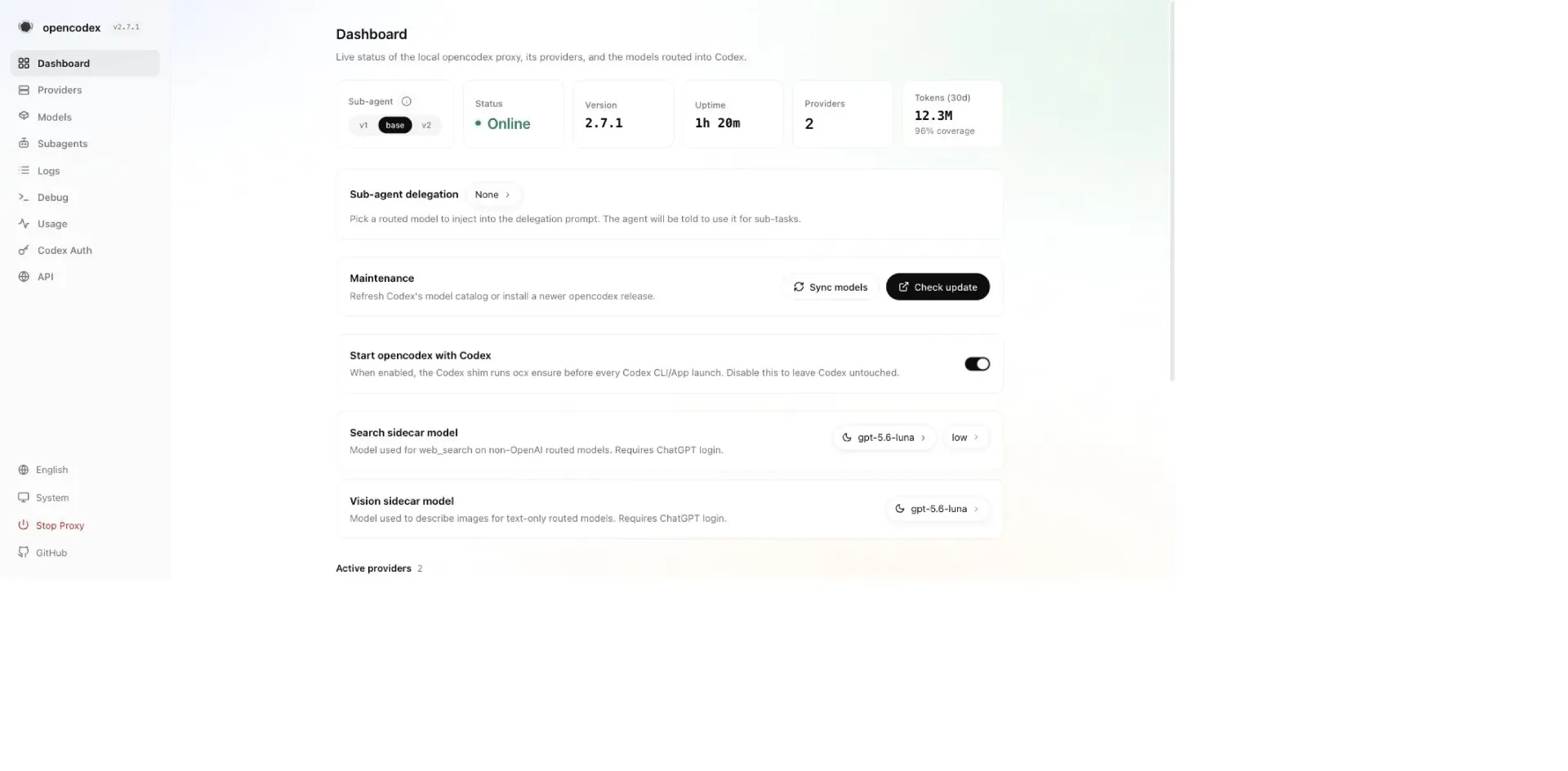
OpenCodex is an open-source interoperability layer for AI coding tools.
Its basic architecture looks like this:
Codex or Claude Code
        ↓
    OpenCodex
        ↓
Chosen LLM provider
Instead of replacing the coding client, OpenCodex changes the model backend behind it.
A developer can keep using a familiar agent interface while routing model calls to another provider.
For Codex-style integrations, the proxy receives requests from the coding client, resolves the selected provider and model, translates the request into the upstream provider's format, forwards it, and then translates the response back into the format expected by the client.
That makes OpenCodex closer to an AI gateway than a coding environment.
OpenCodex Is Not OpenAI Codex or OpenCode
The names are easy to confuse.
| Product | What it is | Main role |
|---|---|---|
| OpenCodex | Open-source proxy and router | Connects supported coding clients to alternative model backends |
| OpenAI Codex | AI coding-agent ecosystem | Executes coding tasks and agent workflows |
| OpenCode | Separate open-source coding agent | Provides its own coding-agent interface and provider integrations |
The simplest distinction is:
Codex is the agent. OpenCodex is the routing layer.
OpenCode is a different project entirely and should not be confused with OpenCodex.
How OpenCodex Works
A typical request follows this flow:
- A coding client creates a model request.
- The client sends the request to the local OpenCodex proxy.
- OpenCodex resolves model aliases, routing rules, credentials, and provider configuration.
- It converts the request into the selected provider's API format.
- The upstream model processes the task.
- OpenCodex converts streaming output, tool calls, reasoning metadata, and supported structured fields back into the client's expected format.
- The coding agent continues its normal tool-use loop.
The difficult part is not simply changing a base URL.
Modern coding agents rely on features such as:
- structured tool calls,
- streaming responses,
- multi-turn context,
- reasoning controls,
- image inputs,
- function schemas,
- error recovery,
- model-specific parameters.
A routing layer must normalize enough of these differences for the agent to continue operating correctly.
Why Developers Use OpenCodex
The main advantage is model portability without changing the coding interface.
A developer might want to keep Codex or Claude Code while using:
- Claude for difficult refactoring,
- Gemini for large-context repository analysis,
- Grok for another class of coding task,
- DeepSeek or another lower-cost model for routine work,
- OpenRouter for access to multiple providers,
- a self-hosted model for privacy-sensitive workflows,
- an OpenAI-compatible endpoint for internal infrastructure.
OpenCodex separates two decisions that are often bundled together:
- Which coding agent should control the workflow?
- Which model should perform inference?
This separation becomes more valuable as model pricing, quality, context limits, rate limits, and availability change.
OpenCodex as a Model Router
One of the most useful ways to understand OpenCodex is as a control plane for model selection.
Instead of hard-coding one provider into a coding workflow, a developer can define routing behavior centrally.
Possible routing patterns include:
- model aliases,
- provider-specific model IDs,
- default models,
- fallbacks,
- account pools,
- provider switching,
- different models for different coding tasks.
For example, a workflow could theoretically use a cheaper model for repository exploration and a stronger model for final implementation.
The coding client remains the same while the backend changes.
OpenCodex and Claude Code
OpenCodex can also be used with Claude Code-style workflows.
This matters because Claude Code is normally associated with Anthropic's model ecosystem, while developers increasingly want access to alternative providers without abandoning the Claude Code interface.
A routing layer can allow the client experience and the model provider to evolve independently.
This creates a broader architectural pattern:
Coding Agent UI
      ↓
Routing Layer
      ↓
Multiple Model Providers
The same concept applies to other AI coding tools that expose compatible or adaptable model interfaces.
Installation
Installation details can change between releases, so developers should check the project's current documentation before deploying it.
A typical npm-based installation may look like:
npm install -g @bitkyc08/opencodexThen initialize the configuration:
ocx initStart the proxy:
ocx startUseful diagnostic commands may include:
ocx status
ocx doctor
ocx health --json
For Claude Code integration, the project may provide a dedicated launcher such as:
ocx claudeBecause OpenCodex is under active development, command names, package names, and configuration behavior should always be verified against the version being installed.
What OpenCodex Changes
OpenCodex typically works by maintaining its own local configuration and adjusting the coding client's routing configuration where necessary.
This can include:
- proxy settings,
- model catalogs,
- provider definitions,
- aliases,
- environment variables,
- authentication configuration.
A well-designed setup should remain reversible so that the original client configuration can be restored without reinstalling the coding tool.
That is an important advantage over manual hacks that permanently modify client files.
OpenCodex vs OpenAI Codex
The two products solve different problems.
OpenAI Codex
Codex is responsible for the agent workflow.
It can:
- inspect files,
- understand a repository,
- execute commands,
- call tools,
- modify code,
- iterate on errors,
- complete multi-step coding tasks.
OpenCodex
OpenCodex is responsible for routing model inference.
It can sit between the agent and the model provider.
A useful mental model is:
Codex = agent logic
OpenCodex = model gateway
LLM provider = inference engine
Changing the inference engine does not automatically change the agent itself.
Protocol Compatibility Is Not Behavioral Compatibility
This is one of the most important technical points.
A model can successfully accept a translated API request and still perform poorly as a coding agent.
For example, a model might support tool calls but struggle with:
- choosing the correct tool,
- producing valid arguments,
- maintaining state across long tasks,
- generating minimal patches,
- following repository conventions,
- recovering after command failures.
Therefore:
API compatibility does not guarantee agent-quality equivalence.
This distinction is particularly important when routing Codex or Claude Code to models that were not specifically optimized for that agent environment.
OpenCodex vs OpenCode
OpenCode is better understood as a standalone coding agent.
OpenCodex is better understood as infrastructure underneath an existing coding agent.
A simple rule:
- Want a different coding-agent interface? Evaluate OpenCode.
- Want to keep Codex or Claude Code but change model providers? Evaluate OpenCodex.
- Want only the native provider stack? A routing layer may be unnecessary.
Cost Optimization
One of the strongest OpenCodex use cases is cost control.
Coding agents can generate large token volumes because they repeatedly:
- inspect files,
- reason about repository structure,
- call tools,
- process command output,
- revise plans,
- regenerate patches.
Using the most expensive model for every step may be unnecessary.
A routing strategy can potentially divide tasks into tiers.
Low-cost tasks
Use cheaper models for:
- file classification,
- simple transformations,
- repository search,
- documentation edits,
- formatting,
- repetitive refactors.
High-value tasks
Reserve stronger models for:
- architecture decisions,
- difficult debugging,
- large refactors,
- security-sensitive changes,
- complex multi-file implementation.
This makes the router useful even when all available models are technically capable of performing the task.
Model Benchmarking
OpenCodex can also simplify comparative testing.
Instead of comparing models through different coding tools, developers can keep the agent interface constant and change only the model backend.
This produces a more meaningful comparison.
Useful metrics include:
- task completion rate,
- number of tool calls,
- patch correctness,
- compilation success,
- test pass rate,
- latency,
- token consumption,
- total cost,
- number of human corrections.
The important idea is to benchmark models inside the real agent workflow, not only through isolated chat prompts.
Local Models and Private Infrastructure
OpenCodex can also be useful when connecting coding agents to local or self-hosted models.
Possible architectures include:
Coding Client
     ↓
 OpenCodex
     ↓
Local OpenAI-compatible server
     ↓
Self-hosted model
This can be attractive for:
- private repositories,
- regulated environments,
- internal enterprise code,
- offline development,
- experimentation with open-weight models.
However, local deployment does not automatically guarantee strong coding-agent performance.
The model still needs adequate:
- tool-use reliability,
- context length,
- instruction following,
- coding ability,
- structured output quality.
Security and Privacy
Running OpenCodex locally does not necessarily mean repository data stays local.
If the selected model is hosted by a cloud provider, prompts and repository context may still be transmitted to that provider.
The correct security model is:
Local router ≠ local inferenceDevelopers should evaluate:
- where prompts are sent,
- where credentials are stored,
- provider retention policies,
- logging behavior,
- proxy exposure,
- authentication,
- TLS or private networking,
- repository sensitivity.
If the proxy is exposed beyond localhost, authentication and network restrictions become especially important.
API Keys and Credentials
Avoid placing long-lived API keys directly inside files that may be:
- committed to Git,
- synchronized to cloud storage,
- copied into backups,
- shared with teammates.
Environment variables or operating-system secret stores are generally safer choices.
Example:
export PROVIDER_API_KEY="your-key"The exact variable name depends on the provider and OpenCodex configuration.
Common Pitfall: Assuming Every Model Works Equally Well
A model appearing in a provider catalog does not mean it is a good coding-agent backend.
Before using a model for production work, test:
- tool calling,
- long-context consistency,
- patch generation,
- shell-command behavior,
- structured output,
- error recovery.
A cheaper model that requires repeated corrections can ultimately cost more than a stronger model.
Common Pitfall: Complex Routing Rules
Routing systems can become difficult to debug when they contain too many layers.
For example:
alias
  ↓
fallback
  ↓
provider alias
  ↓
account pool
  ↓
model mapping
  ↓
upstream endpoint
When debugging, reduce the configuration to the smallest possible path.
Start with:
one client
one provider
one account
one model
Then add advanced routing gradually.
Common Pitfall: Ignoring Provider Terms
Technical compatibility and policy compatibility are different.
A third-party proxy may technically be able to forward traffic while the provider's subscription or authentication rules place restrictions on how access can be used.
Developers should distinguish between:
- official APIs,
- OAuth-based access,
- subscription-based access,
- browser-session credentials,
- enterprise credentials.
Always review the relevant provider terms before using non-standard authentication or routing methods.
Advanced Use Cases
OpenCodex becomes more interesting when treated as infrastructure rather than just a compatibility hack.
Cost-based routing
Use lower-cost models for routine operations and premium models for difficult tasks.
Provider fallback
If one provider becomes unavailable or rate-limited, route new requests to another provider.
Model evaluation
Run the same coding task through several models while keeping the agent environment constant.
Hybrid local and cloud workflows
Use local models for sensitive operations and cloud models for harder reasoning tasks.
Specialized subagents
Different model classes can be assigned to different responsibilities such as:
- planning,
- implementation,
- review,
- testing,
- documentation.
Who Should Use OpenCodex?
OpenCodex is most relevant to developers who:
- already use Codex or Claude Code,
- regularly compare frontier coding models,
- want to avoid dependence on one inference provider,
- need access to self-hosted models,
- want centralized model routing,
- care about model-cost optimization,
- maintain multiple API-provider accounts.
It is less useful for developers who simply want the default model configuration provided by their coding tool.
Is OpenCodex Worth Using?
The answer depends on how much value model flexibility provides.
For a developer using only one model provider, OpenCodex introduces another infrastructure layer that may not be necessary.
For developers who frequently switch between Claude, Gemini, OpenAI, Grok, DeepSeek, OpenRouter, and local models, a centralized routing layer can significantly reduce configuration friction.
The strongest use case is therefore not simply accessing another model.
It is decoupling the coding-agent interface from the model provider.
Frequently Asked Questions
Is OpenCodex an AI model?
No.
OpenCodex is a routing and protocol-translation layer. The selected upstream model performs the actual inference.
Is OpenCodex an IDE?
No.
It does not replace editors such as VS Code, Cursor, or JetBrains IDEs.
Is OpenCodex the same as OpenAI Codex?
No.
OpenAI Codex is a coding-agent product. OpenCodex is an independent routing layer that can be used with supported coding clients.
Is OpenCodex the same as OpenCode?
No.
OpenCode is a separate open-source coding-agent project.
Does OpenCodex make paid models free?
No.
Users still need whatever API access, subscription, authentication, or quota the selected provider requires.
Can OpenCodex reduce AI coding costs?
Potentially.
Its biggest cost advantage comes from routing different tasks to models with different price-performance profiles.
Can OpenCodex use local models?
Potentially, yes, when the local inference server exposes a compatible API or an adapter exists.
Does OpenCodex keep code private?
Not automatically.
OpenCodex may run locally, but data can still leave the machine when requests are routed to cloud-hosted models.
Conclusion
OpenCodex is best understood as a model interoperability layer for AI coding agents.
Instead of forcing developers to choose a coding interface and model provider as one package, it separates the two.
The architecture becomes:
Preferred coding agent
        ↓
     OpenCodex
        ↓
Best model for the task
That design is increasingly useful as coding models become more specialized and their pricing, availability, context limits, and capabilities change rapidly.
For developers evaluating OpenCodex, the best approach is to test several real repository tasks and compare tool reliability, code quality, latency, token usage, and total cost.
If the goal is to keep a preferred coding-agent workflow while gaining freedom to switch model backends, OpenCodex represents a practical approach to multi-model AI development.
Continue Reading
More articles connected to the same themes, protocols, and tools.

Referenced Tools
Browse entries that are adjacent to the topics covered in this article.