On This Page8 sections
Key Takeaways
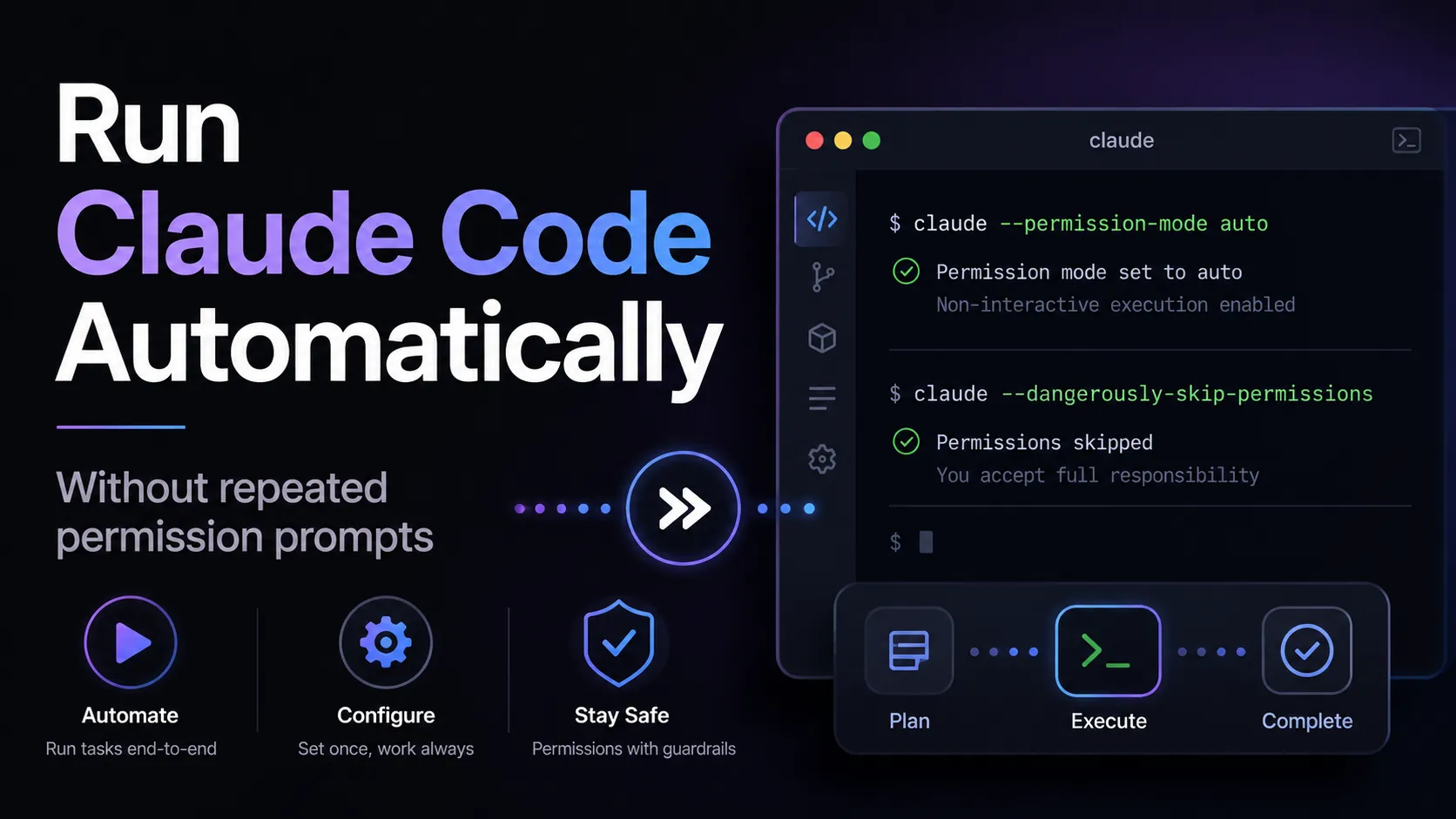
Claude Code can run without repeated confirmation prompts by starting it with claude --dangerously-skip-permissions or claude --permission-mode bypassPermissions. For most daily development, auto mode is the better default because it removes routine prompts while retaining safety checks. Use full bypass only in an isolated repository, container, or virtual machine, and block secrets, destructive commands, publishing, and production deployment.
How do you run Claude Code without confirmation prompts?
Start Claude Code in bypass mode:
claude --dangerously-skip-permissionsThe equivalent command is:
claude --permission-mode bypassPermissionsBoth commands let Claude edit files, run shell commands, and use tools without ordinary permission dialogs. Explicit deny and ask rules, managed organization policies, and blocking hooks can still apply.
For a shorter macOS or Linux command, add an alias:
echo 'alias claude-auto="claude --dangerously-skip-permissions"' >> ~/.zshrc
source ~/.zshrc
Then run:
claude-autoKeep the normal claude command unchanged so sensitive projects can still use restricted modes.
Which Claude Code permission mode should you use?
auto is the best balance for everyday work, while bypassPermissions is intended for isolated environments where uninterrupted execution matters more than interactive review.
| Mode | What runs automatically | Best use |
|---|---|---|
default | Reads and low-risk operations | Sensitive repositories |
acceptEdits | Routine file edits | Coding with command review |
auto | Most approved development actions | Long local development tasks |
dontAsk | Only explicitly allowed tools | CI and locked-down scripts |
bypassPermissions | Almost everything | Containers, VMs, disposable environments |
For most developers, auto should be the daily default. Full bypass mode should be reserved for trusted repositories and isolated systems.
How do you make automatic execution the default?
Put the default mode in the user-level file ~/.claude/settings.json:
{
  "permissions": {
    "defaultMode": "bypassPermissions",
    "skipDangerousModePermissionPrompt": true
  }
}
This configuration makes Claude Code start in bypass mode without showing the dangerous-mode warning every time.
A safer everyday default is:
{
  "permissions": {
    "defaultMode": "auto"
  }
}
Use the user-level settings file rather than a repository-level configuration when enabling broad automatic permissions. This prevents an untrusted project from silently changing the security level of Claude Code.
How do you keep bypass mode reasonably safe?
Combine bypass mode with deny rules for secrets and destructive commands, plus ask rules for actions that should retain a human checkpoint:
{
  "permissions": {
    "defaultMode": "bypassPermissions",
    "skipDangerousModePermissionPrompt": true,
    "deny": [
      "Read(./.env)",
      "Read(./.env.*)",
      "Read(./secrets/**)",
      "Read(~/.ssh/**)",
      "Read(~/.aws/**)",
      "Bash(git push --force *)",
      "Bash(git push -f *)",
      "Bash(git reset --hard *)",
      "Bash(rm -rf *)"
    ],
    "ask": [
      "Bash(git push *)",
      "Bash(npm publish *)",
      "Bash(wrangler deploy *)",
      "Bash(vercel --prod *)"
    ]
  },
  "sandbox": {
    "enabled": true,
    "autoAllowBashIfSandboxed": true
  }
}
The deny rules create hard boundaries around sensitive files and dangerous commands. The ask rules retain manual approval for publishing, deployment, and remote Git operations.
Do not expose bypass sessions to production credentials, SSH keys, cloud administrator tokens, payment systems, or live customer databases.
How can you reduce prompts without disabling all checks?
Use auto mode for uninterrupted development with automated safety review:
claude --permission-mode autoUse acceptEdits when Claude should edit files automatically but still request approval for most shell commands:
claude --permission-mode acceptEditsUse an allowlist when only routine development tools should run automatically:
claude --allowedTools "Read" "Edit" "Bash(pnpm test *)" "Bash(pnpm lint *)"This setup lets Claude inspect code, edit files, run tests, and lint without granting deployment, publishing, or Git push access.
How do you run Claude Code automatically in scripts or CI?
Use non-interactive print mode with -p. For a controlled CI job, combine it with dontAsk and an explicit allowlist:
claude -p \
  --permission-mode dontAsk \
  --allowedTools "Read" "Edit" "Bash(pnpm test *)" \
  "Run the tests, fix failures, and print a concise summary."
For a disposable container where unrestricted execution is acceptable:
claude -p \
  --permission-mode bypassPermissions \
  "Run the test suite, fix all failures, and stop when the tests pass."
dontAsk is usually better for CI because the job can use only pre-approved tools. It avoids interactive prompts without granting the agent unrestricted access to the entire machine.
Why does Claude Code still stop or ask for input?
Claude Code can still pause when an ask rule requires approval, a deny rule blocks the action, an organization policy disables bypass mode, a hook rejects the tool call, or the task requires information that was not provided.
External authentication prompts can also interrupt execution. Commands involving GitHub, npm, Cloudflare, Vercel, databases, or remote servers may stop when credentials expire or interactive login is required.
Tasks should therefore include a clear objective, completion condition, allowed commands, and instructions for handling failures.
What prompt works best for long automatic tasks?
A strong autonomous prompt defines the scope, verification steps, and stopping condition:
Inspect the project, identify the cause of the failing tests, implement the smallest safe fix, run linting and the full test suite, and stop only when all checks pass. Do not publish, deploy, push commits, delete data, or modify environment files.This structure reduces unnecessary questions because Claude knows what it can change, how to verify the result, and which operations are prohibited.
For larger coding tasks, add checkpoints:
- Inspect the repository before editing.
- Make the smallest necessary changes.
- Run type checking, linting, and tests.
- Fix any failures caused by the changes.
- Summarize modified files and remaining risks.
- Do not deploy or push automatically.
What is the recommended Claude Code setup?
The recommended configuration depends on the environment:
| Environment | Recommended mode | Additional protection |
|---|---|---|
| Daily local development | auto | Sandbox and secret-file deny rules |
| File editing with command review | acceptEdits | Manual approval for shell commands |
| CI pipeline | dontAsk | Strict allowedTools list |
| Disposable container | bypassPermissions | No production credentials |
| Production repository | default or acceptEdits | Deployment and database restrictions |
The most practical setup is auto for normal coding, dontAsk for CI, and bypassPermissions only inside a disposable or tightly isolated environment.
Conclusion
Use claude --permission-mode auto for normal development, dontAsk with explicitly allowed tools for CI, and bypassPermissions only for trusted work inside an isolated environment. The safest automatic workflow allows file editing and testing while blocking secrets, destructive Git commands, package publishing, production deployment, and live database access.
Continue Reading
More articles connected to the same themes, protocols, and tools.

Cloudflare Cost Guard Skill: How to Prevent D1, Workers, and Durable Objects Bill Shock

Herdr GUI Is Now Roamgate: The Complete Guide to Managing AI Coding Agents from Your Browser
CCBaga Explained: The Open-Source Claude Code Cleaner, Fingerprint Browser, and Network Toolkit
Referenced Tools
Browse entries that are adjacent to the topics covered in this article.