
On This Page8 sections
Quick Comparison
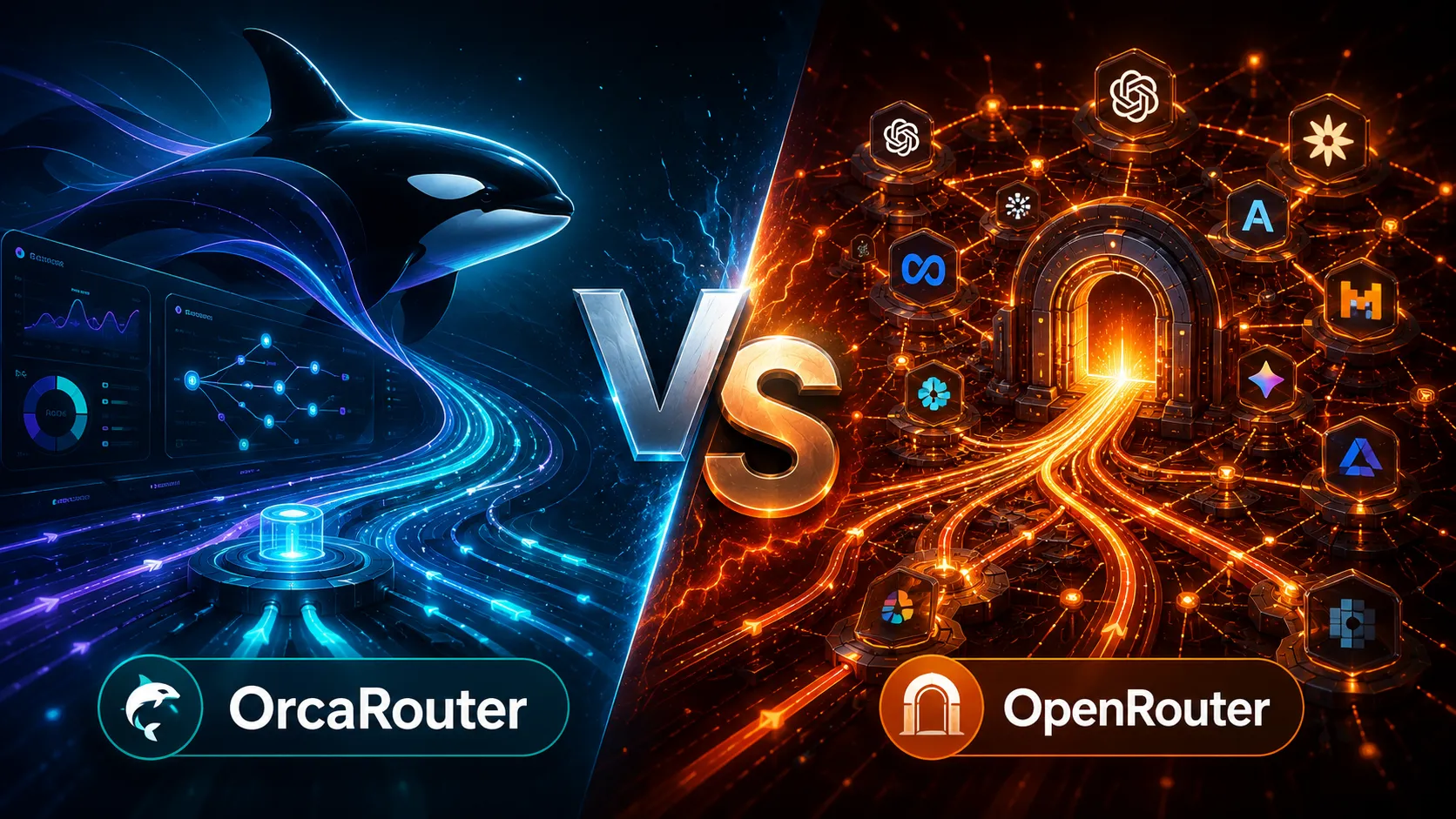
As of August 17, 2026, OrcaRouter and OpenRouter both provide a single API layer over multiple AI models, but they optimize for different problems. OrcaRouter is more routing-centric: it emphasizes adaptive model selection, programmable routing, zero token markup, and a self-hostable Lite edition. OpenRouter is more marketplace-centric: it offers a substantially larger catalog, many hosting providers for the same model, and granular provider routing based on price, throughput, latency, privacy, and region.
| Dimension | OrcaRouter | OpenRouter | Practical implication |
|---|---|---|---|
| Model catalog | 200+ models | 500+ models | OpenRouter gives broader long-tail coverage |
| Upstream/provider breadth | 11 named upstream provider families in current OrcaRouter docs | 80+ providers on paid plans | OpenRouter offers more hosting alternatives for many models; the two services count providers differently |
| Default intelligent routing | orcarouter/auto uses gated adaptive routing and can learn from workspace traffic | openrouter/auto classifies prompts into about 30 task types and ranks models using trailing 7-day aggregate spend by task | OrcaRouter is workload-adaptive; OpenRouter is market-signal-driven |
| Published router benchmark | 75.54% accuracy, RouterArena score 72.08, $1 per 1,000 queries at its May 20, 2026 submission | No directly comparable RouterArena result is published in current official Auto Router docs | There is not enough evidence for a valid head-to-head routing-quality winner |
| Hosted inference markup | 0% token markup | 0% inference markup, but 5.5% fee when purchasing credits, $0.80 minimum | OrcaRouter has the lower published platform overhead for ordinary hosted PAYG usage |
| BYOK | Default hosted BYOK fee is 5%, deployment-specific; self-hosted Lite supports BYOK | PAYG includes $25,000/month of list-price BYOK inference with no fee, then 5%; Enterprise includes $200,000/month | OpenRouter is attractive for hosted BYOK below its allowance; OrcaRouter Lite is the self-hosting option |
| Self-hosting | OrcaRouter Lite is MIT-licensed and self-hostable | Core OpenRouter routing service is hosted; OpenRouter publishes SDKs and related open-source tooling | OrcaRouter fits teams that need to run the gateway themselves |
| Privacy | OrcaRouter says prompt/output content is not persisted by default; request metadata is retained | OpenRouter says prompt/output retention is opt-in and supports per-request/provider ZDR controls | Both minimize gateway-layer content retention; OpenRouter exposes more endpoint-level privacy-routing controls |
| Enterprise SLA | Enterprise advertises 99.99% uptime SLA | Contractual SLAs are an Enterprise feature; percentage is contract-specific in public pricing | Compare actual enterprise contracts rather than assuming identical guarantees |
OrcaRouter's current model documentation lists eleven upstream provider prefixes including OpenAI, Anthropic, Google, DeepSeek, xAI, Qwen, Kimi, MiniMax, Z.ai, Kling, and ByteDance Seedance. OpenRouter's current pricing lists 500+ models and 80+ providers on paid plans.
Model and Provider Coverage
OpenRouter has the larger catalog. Its paid plans currently advertise more than 500 models and more than 80 providers. That matters when you need obscure open models, multiple independent hosts for the same open-weight model, regional endpoints, or provider-specific variants. OpenRouter can target exact provider endpoints and variants such as regional cloud endpoints or accelerated hosting variants.
OrcaRouter is narrower but still covers the main commercial and open-model families. Its public materials advertise 200+ models, while its current documentation enumerates eleven upstream provider families. The catalog also extends beyond text LLMs into images, audio, and video models from providers such as OpenAI, Google, xAI, MiniMax, Kling, and ByteDance.
The provider numbers are not perfectly apples-to-apples. OrcaRouter's documentation is largely describing upstream model vendors, while OpenRouter's provider count also captures multiple inference hosts serving the same or compatible models.
For applications that depend on provider redundancy for a specific open model, OpenRouter's broader endpoint marketplace is the more relevant metric. For applications that primarily need the major frontier vendors behind one API, the difference may have little practical effect.
Routing Intelligence and Control
OrcaRouter's strongest differentiation is its adaptive routing stack. New orcarouter/auto configurations use a gated adaptive strategy: the router estimates request difficulty, narrows candidates into weaker or stronger pools, then selects within that pool.
Its adaptive strategy uses a per-router contextual bandit that can learn from real workspace traffic across quality, cost, latency, and reliability. During warm-up, it behaves similarly to a balanced routing strategy.
OrcaRouter also exposes several explicit strategies:
- Cheapest: lowest per-token price among live candidates.
- Quality: highest quality score among live candidates.
- Balanced: lower-cost model that clears a quality threshold.
- Adaptive: learns a per-workspace trade-off from observed traffic.
- Routing DSL: rules can route by task, difficulty, session state, tenant, headers, time, or agent state, with support for parallel panels and judge/synthesis patterns.
OpenRouter's Auto Router uses a different philosophy. It classifies prompts into roughly 30 fine-grained task types, then ranks models using the share of aggregate OpenRouter spending for that task over a rolling seven-day period.
You can constrain the candidates with allowed or excluded models and select different cost tiers. There is no separate Auto Router surcharge beyond the selected model's normal cost structure.
OpenRouter is especially strong at provider routing after a model has been chosen. It can sort endpoints by price, throughput, or latency, target or exclude specific providers, set maximum prices, and use preferred latency or throughput thresholds.
Its provider performance routing can use percentile metrics such as p50, p75, p90, and p99 calculated over a short rolling window.
The trade-off is therefore architectural:
- Choose OrcaRouter-style adaptive routing when the central question is: Which model should handle this specific request for my workload?
- Choose OpenRouter-style provider routing when the central question is: Which endpoint should serve this model right now, given price, speed, region, uptime, and policy constraints?
Both can do parts of the other's job, but their most developed control surfaces emphasize different layers.
Performance and Benchmark Evidence
OrcaRouter has a concrete public routing result. Its May 2026 technical report states that OrcaRouter-Adaptive achieved an arena score of 72.08, 75.54% routing accuracy, and a routing cost of $1.00 per 1,000 queries in the reported RouterArena evaluation.
OrcaRouter also publishes gateway-level latency claims, including sub-millisecond prompt grading and total gateway-added latency below 50 ms under its documented conditions.
Those numbers should not be treated as a direct OrcaRouter-vs-OpenRouter benchmark. OpenRouter does not publish a directly comparable RouterArena accuracy score for its current Auto Router.
Instead, OpenRouter emphasizes live provider performance measurements. Its provider router tracks latency and throughput percentiles over a rolling window, which helps with real-time endpoint selection but measures a different problem from model-selection accuracy.
For reliability, both platforms support fallback before streaming begins. Once partial output has already been delivered to the client, transparent failover becomes much harder because the response is already in progress.
A production evaluation should therefore measure at least five metrics on your own traffic:
- Task success or evaluator score
- Cost per successful request
- Time to first token and total latency
- Provider/model failure rate
- Routing stability, especially whether automatic routing changes model style or behavior unexpectedly
A sample of 500-1,000 representative prompts is more informative than comparing a single gateway-level latency claim, because the selected model and provider usually dominate end-to-end latency.
Pricing and Total Cost
Both services state that the underlying model's inference price is passed through without a token-level markup. The main difference is how the platform itself is monetized.
OrcaRouter hosted PAYG: the Hacker plan is free and includes access to 200+ models, several API keys, basic observability, prompt versioning, and 0% token markup. Team pricing is listed at $49/month with additional collaboration, reporting, API-key, and support features. Enterprise pricing is custom.
OpenRouter PAYG: OpenRouter applies a 5.5% fee when purchasing credits, with a stated minimum fee of $0.80. The model inference itself is generally presented at provider pricing rather than being marked up on every token.
For a simple hosted workload, assuming you purchase only enough OpenRouter credits to cover model usage and ignoring taxes or enterprise discounts:
| Monthly underlying model usage | OrcaRouter Hacker platform charge | OpenRouter 5.5% credit-purchase fee | Difference in published platform overhead |
|---|---|---|---|
| $100 | $0 | $5.50 | $5.50 |
| $1,000 | $0 | $55 | $55 |
| $10,000 | $0 | $550 | $550 |
For very small OpenRouter top-ups, the $0.80 minimum matters. A $10 credit purchase, for example, produces an effective fee higher than 5.5% because the minimum charge applies.
This calculation does not mean OrcaRouter will always produce the cheaper final application bill. An OpenRouter route may find a cheaper provider for the same open model, achieve better provider availability, or reduce retry costs.
Conversely, OrcaRouter's adaptive model routing may lower total spend by sending simpler requests to cheaper models.
The correct metric is cost per successful task, not just platform fee.
BYOK Economics
The hosted BYOK terms change the comparison.
OrcaRouter's documented hosted BYOK model normally charges a 5% platform fee based on the equivalent request cost, although a deployment may use a different rate.
If the BYOK provider cannot serve a request, managed fallback behavior may be available depending on configuration.
OpenRouter's current pricing gives PAYG customers $25,000 of list-price BYOK inference per month without the 5% BYOK fee, after which the fee applies. Enterprise raises the included BYOK allowance to $200,000 per month.
That creates three distinct cases:
- Hosted BYOK below $25,000/month: OpenRouter has the more favorable published fee structure.
- Hosted platform-funded inference: OrcaRouter avoids OpenRouter's 5.5% credit-purchase fee.
- Self-hosted BYOK: OrcaRouter Lite changes the equation because the gateway can run on your own infrastructure using your provider keys.
API Compatibility and Developer Experience
Both are designed to minimize migration from OpenAI-compatible applications.
OrcaRouter exposes an OpenAI-compatible endpoint and also supports protocol surfaces for major providers, with translation between protocols when needed.
Its capabilities include chat, Responses-style APIs, streaming, tool calling, vision, audio, web search, structured outputs, image generation, text-to-speech, and video-related workloads depending on the selected model.
OpenRouter supports standard HTTP APIs, its own SDKs, OpenAI-compatible clients, agent frameworks, and many third-party integrations.
For a basic chat-completions migration, the difference is small: both can often be adopted by changing the base URL, API key, and model identifier.
The gap becomes more visible in advanced use:
- OrcaRouter: stronger emphasis on named routers, routing DSL, adaptive session-aware routing, and gateway-level policy control.
- OpenRouter: stronger emphasis on provider marketplace controls, model/provider discovery, routing presets, variants, and a broad integration ecosystem.
Privacy, Data Retention, and Governance
At the gateway layer, both services publish policies intended to reduce unnecessary storage of prompt and response content.
OrcaRouter states that prompts, outputs, tool arguments, tool results, and uploaded files are processed in transit and not persisted by default. Operational metadata such as timestamps, model, token counts, latency, status code, and source information may still be retained.
OpenRouter says prompt and response retention is opt-in and provides controls for routing only to Zero Data Retention endpoints.
It also exposes provider-level controls around data collection, endpoint policies, and privacy routing.
For organizations with strict data residency or provider-policy requirements, OpenRouter's endpoint-level policy metadata and routing controls are useful because they allow routing decisions to incorporate provider privacy characteristics.
For organizations whose main requirement is simply that the gateway itself not persist prompt content, both platforms publish a similar baseline direction.
In either case, upstream model providers still process requests under their own terms, so compliance reviews should consider both the gateway and the final inference provider.
Ecosystem and Self-Hosting
OpenRouter's scale is visible in its marketplace and integration surface. Its paid offering lists more than 80 providers and over 500 models, giving developers a large pool of model and endpoint combinations.
This is especially useful for experimentation, model discovery, fallback design, and applications that switch frequently among inference providers.
OrcaRouter's differentiator is OrcaRouter Lite, an MIT-licensed, self-hostable gateway. It can run locally or in containerized infrastructure, supports BYOK and streaming, and provides automatic model-routing capabilities.
Self-hosting is not automatically cheaper. You take on deployment, upgrades, monitoring, security, secret management, uptime, and provider-account operations.
It becomes valuable when control, network topology, customization, compliance architecture, or avoiding dependency on a hosted gateway matters more than operational simplicity.
Which Should You Choose?
Choose OrcaRouter when adaptive model routing is the main requirement. If your traffic mixes trivial classification, routine chat, complex reasoning, and long-running agent tasks, OrcaRouter's per-workspace adaptive routing is designed to shift requests across model tiers based on workload characteristics.
Choose OpenRouter when model and provider breadth is the main requirement. With 500+ models and 80+ providers on paid plans, it gives you a larger search space and more provider-level routing options, especially for open-weight models available from multiple inference vendors.
Choose OpenRouter for hosted BYOK workloads below its current allowance. The published PAYG structure includes a substantial monthly BYOK allowance before the 5% BYOK fee applies.
Choose OrcaRouter when you need a self-hostable routing gateway. OrcaRouter Lite is designed to run with your own provider keys and infrastructure.
Choose OpenRouter when provider-level latency control is more important than adaptive model choice. Its provider routing can use live latency and throughput signals, threshold preferences, endpoint sorting, and provider inclusion or exclusion rules.
Choose OrcaRouter when ordinary hosted token spend is large and the required models are already in its catalog. Its published hosted pricing has no token markup and no equivalent 5.5% credit-purchase fee on the free hosted tier.
At $10,000 in underlying monthly inference spend, a 5.5% OpenRouter credit-purchase fee corresponds to $550 before taxes, discounts, or enterprise terms.
For enterprise workloads, run a proof of concept rather than selecting from feature tables alone. Test the same production prompt distribution on both services and compare quality-adjusted cost, p90/p99 latency, failure rates, policy compliance, model availability, support terms, and contractual SLA details.
Bottom Line
OrcaRouter and OpenRouter overlap heavily at the API layer, but they are not identical substitutes.
OrcaRouter is optimized around the router itself: adaptive per-workspace model selection, programmable routing, zero token markup, fixed-price team features, and an open-source self-hosted edition.
Its strongest published routing benchmark reports 75.54% routing accuracy, a RouterArena score of 72.08, and $1 per 1,000 routed queries in the cited May 2026 evaluation.
OpenRouter is optimized around the model-and-provider network: 500+ models, 80+ providers, provider-level price, latency, and throughput routing, detailed endpoint policy controls, and a broad integration ecosystem.
Its Auto Router is based more heavily on aggregated market usage and task classification, while OrcaRouter's adaptive approach is more explicitly designed to learn from an individual workspace's request patterns.
There is no defensible universal winner from the published data.
If the bottleneck is model selection and adaptive cost-quality optimization, OrcaRouter has the more specialized routing architecture.
If the bottleneck is catalog breadth, provider redundancy, or endpoint-level control, OpenRouter has the larger infrastructure marketplace.
The final decision should be based on your own prompt distribution and measured cost per successful task.
Continue Reading
More articles connected to the same themes, protocols, and tools.
Referenced Tools
Browse entries that are adjacent to the topics covered in this article.