On This Page3 sections
Key Takeaways
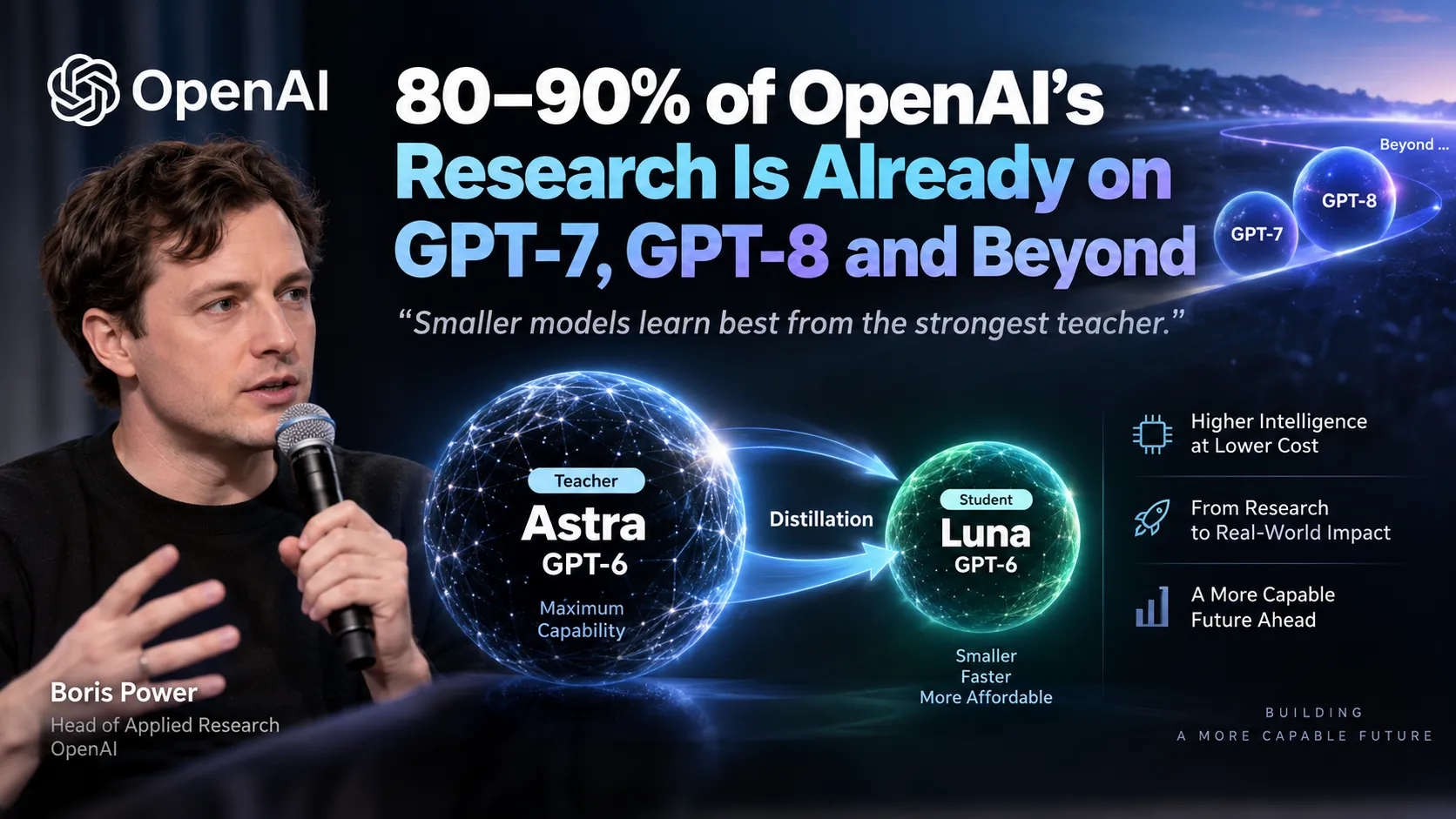
- OpenAI Head of Applied Research Boris Power said roughly 80–90% of OpenAI's research is focused on GPT-7, GPT-8, and models beyond them. The remark came during the public Fellows Forum 2026 session on September 23, 2026—not from an internal leak.
- Power described many within-generation improvements as deliberately short-term investments. His point was not that incremental releases are useless, but that they help OpenAI learn faster today while the largest long-term gains are expected from new model generations.
- Power also described a teacher-student strategy in which a frontier model such as GPT-6 Astra can help train a much smaller model such as Luna. This is model distillation—not simply shrinking an Astra checkpoint into a smaller file.
- OpenAI's official GPT-6 positioning supports the broader strategy: Astra is the maximum-capability model, while GPT-6 Sol and Luna push those advances toward faster and cheaper deployment.
- The economics are dramatic. GPT-6 Astra costs $10 per million input tokens and $50 per million output tokens, while GPT-6 Luna costs $0.10 input and $0.50 output—a 100× difference in headline token pricing.
- None of this proves GPT-7 or GPT-8 is finished, in final training, or close to release. Power was describing research allocation and long-term strategy, not announcing a launch schedule.
What Boris Power Actually Said
OpenAI's long-term research strategy became unusually visible at Fellows Forum 2026 in Menlo Park. The official event agenda lists Boris Power as Head of Applied Research at OpenAI and places him in a September 23 fireside chat titled Where Models Meet Reality with Zachary Lipton.
A circulated transcript of Power's remarks records him saying that roughly 80–90% of research at OpenAI is focused on GPT-7, GPT-8, and beyond, because the company believes that is where much of the fundamental value comes from.
That statement is more significant—and more nuanced—than the viral interpretation.
It does not mean:
- 90% of all OpenAI employees are building GPT-8;
- GPT-7 has already completed training;
- GPT-8 is nearly ready to ship;
- current GPT-6 products are considered unimportant;
- OpenAI has disclosed release dates for either future generation.
Power referred specifically to research. In a frontier AI lab, research aimed at GPT-7 or GPT-8 can include training algorithms, synthetic data, reinforcement learning, evaluation systems, agent research, alignment, interpretability, infrastructure, model architecture, computer-use environments, and automated research systems long before a final production model exists.
The accurate headline is therefore not OpenAI secretly finished GPT-8.
It is: OpenAI says the majority of its research attention is already pointed several generations beyond the models it is shipping today.
Why OpenAI Can Ship GPT-6 While Researching GPT-7 and GPT-8
Frontier AI companies effectively operate on multiple time horizons at once.
One track improves the models users have today:
"mentionedTools": [], "featuredImage": "
Continue Reading
More articles connected to the same themes, protocols, and tools.

Referenced Tools
Browse entries that are adjacent to the topics covered in this article.