
On This Page8 sections
Key Takeaways
- Hypit is not primarily a video-to-prompt tool. It gives coding agents such as Claude Code and Codex a language and runtime for turning a reference video into an editable, re-runnable production workflow containing footage, captions, B-roll, effects, audio, timing, and generation steps.
- Its most important technical idea is word-anchored timing. Speech can be aligned into semantic takes so captions, overlays, B-roll, and other events follow words or narrative moments instead of brittle absolute timestamps.
- The claim that creators no longer need to manually cut a video into dozens of clips is directionally accurate, but the underlying analysis still exists. The agent performs much more of the decomposition and reconstruction work automatically.
- Hypit's official GitHub repository currently includes three public reference-to-clone case studies: a 20-second UGC football tier list, an 18-second podcast ad format, and a 26-second street interview. Each includes one reference plus three clone variants.
- The strongest use case is not copying one video once. It is reverse-engineering a repeatable editing grammar, then reusing that workflow across new hosts, products, topics, hooks, languages, and assets.
What Is Hypit?
Hypit is an agent-oriented video production system built around the idea that a video should be represented as executable source rather than as a pile of disconnected prompts.
The project's headline workflow is simple: give an AI coding agent a reference video and ask it to clone the format. Instead of returning only a transcript or a list of prompts, the agent can create a workflow that describes the video structure, generated media, captions, B-roll, effects, timing, audio, and final render.
The official repository describes Hypit as a system that lets agents clone the whole workflow — footage, captions, B-roll and effects — with timing anchored to words instead of seconds.
Official GitHub Demo: SVML Source → Live Video
The clearest visual explanation is the official GitHub demo below. It shows SVML source on the left and the corresponding rendered video on the right.
That changes the abstraction.
A conventional reverse-prompt workflow looks roughly like this:
Reference video
→ manually cut into scenes
→ inspect each scene
→ reverse-engineer prompts
→ generate replacement clips
→ rebuild subtitles
→ rebuild timing
→ edit everything together
Hypit aims for this:
Reference video
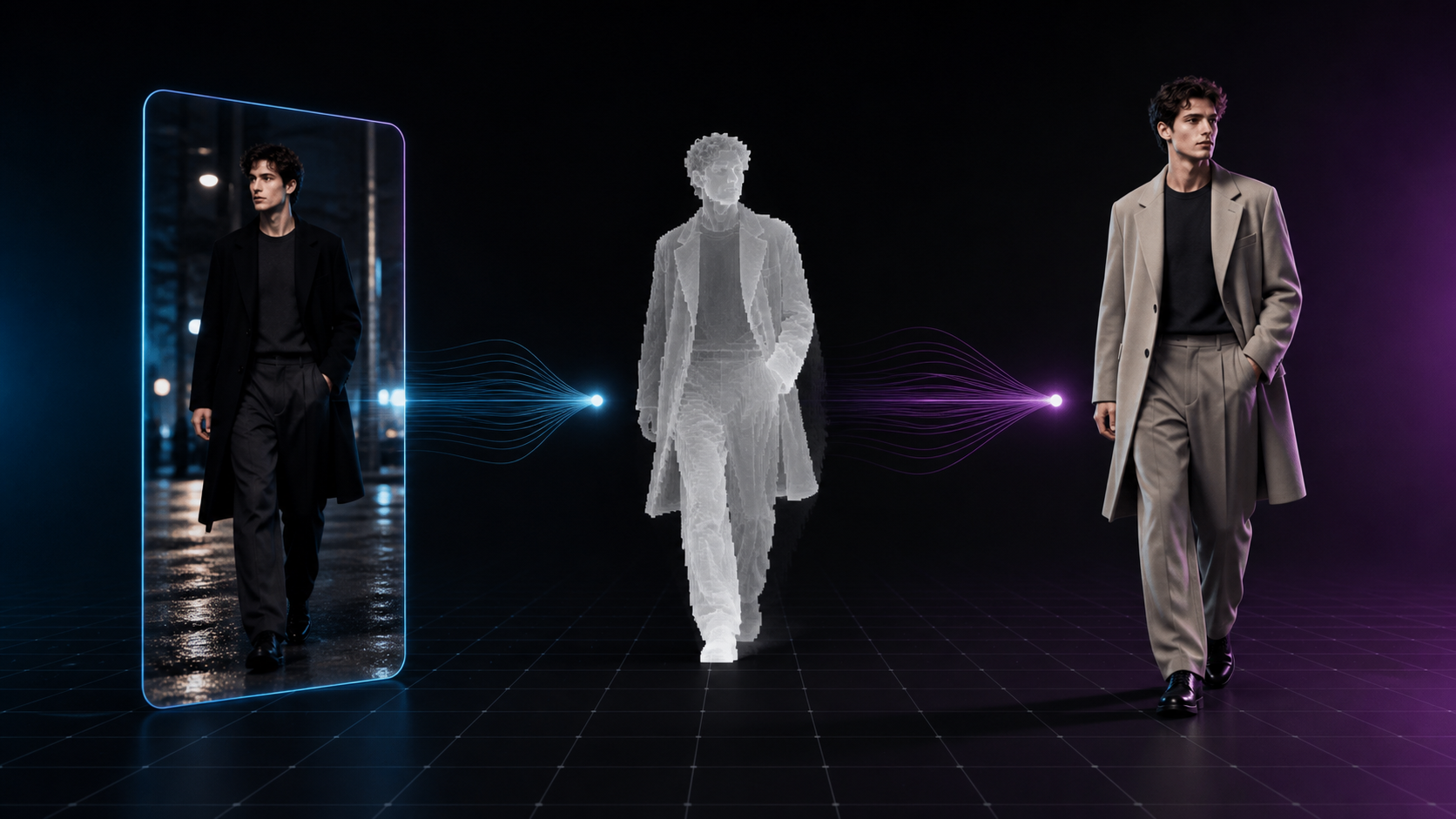
→ agent analyzes production grammar
→ agent writes an executable video workflow
→ generation and deterministic components fill the workflow
→ semantic timing aligns the pieces
→ renderer produces the final video
→ the same workflow can be reused for variants
A prompt can describe a shot. A workflow can describe a format.
Why Hypit Is More Interesting Than Video-to-Prompt Reverse Engineering
Reverse-prompt tools are useful when the problem is narrow: identify the subject, camera, lighting, composition, motion, or visual style needed to approximate a shot.
They become much weaker when the target is an edited video.
Consider a 25-second short with:
- three A-roll sections;
- six B-roll inserts;
- karaoke subtitles;
- two punch-in moments;
- a product card;
- a timed sound effect;
- a visual reveal;
- background music;
- speaker-aware captions.
Generating nine good prompts does not recreate the editorial system that made the original work.
Hypit attempts to model that system directly. Its official example sources import components for media tracks, sound, script, text, generated speech, Seedance video generation, GPT image generation, WhisperX alignment, timelines, captions, spatial layout, film composition, and rendering. The public street-interview SVML is over 300 lines and explicitly defines generated character views, voice directions, dialogue actions, multiple Seedance takes, semantic timing, effects, captions, audio, and the final render graph.
This is why the best description of Hypit is not video prompt extractor.
A more accurate description is:
an agent-driven system for reconstructing and re-running video production workflows.
The Core Idea: Anchor Editing to Words, Not Seconds
Traditional automation often hard-codes events like this:
00:02.10 show product card
00:04.35 highlight subtitle
00:06.20 insert B-roll
00:08.90 play reveal sound
This works until the script changes.
If a sentence becomes longer, a different voice speaks more slowly, or a translated version has different pacing, the absolute timing drifts.
Hypit instead uses semantic timing and word alignment so authored speech, captions, B-roll, graphics, and other timeline events can be connected to spoken content.
Conceptually:
Script segment
→ generated or recorded take
→ normalize media
→ WhisperX word alignment
→ SemanticTake
→ semantic timeline
→ captions / B-roll / graphics / effects
The difference is between saying:
show the card at 4.7 secondsand:
show the card when the speaker reaches the product revealThe second representation is much more reusable.
Real GitHub Case Study #1: UGC Football Tier List
Hypit's official repository includes a 20-second GOAT DEBATE example: a football tier-list video that puts Ronaldo in D and Messi in S.
The published workflow combines Seedance 2 Mini A-roll, GPT Image assets, WhisperX word alignment, a sound-synced ranking board, karaoke captions, animation, and music. The repository reports a total generation cost of $1.15 for the reference example and includes three clone variants.
Reference
Clone: Swap Host
Clone: Swap Effect / Ranking
Clone: Swap Topic
The important result is not that all four videos look identical. It is that the same viral structure can survive changes to narrator, ranking logic, and subject matter.
The official repository also includes the complete generation workflow and production notes.
Real GitHub Case Study #2: Podcast Ad Format
The second official example is DAILY CREATINE, an 18-second podcast-style clip.
The public production notes describe a workflow with generated host images, multiple A-rolls, lifestyle B-roll, split-screen composition, speaker-aware karaoke captions, a product-handoff moment, WhisperX alignment, and background music. The reported example cost is $1.07.
Reference
Clone: Swap Both Hosts
Clone: Swap the Product
Clone: Turn It Into a Software/App Ad
This is a stronger demonstration than a simple face swap.
The same podcast grammar is reused across:
same format
→ different characters

same format
→ different physical product

same format
→ different software product
The production notes explicitly state that the graph is intended to be a complete reproducible request graph, while also clarifying that a fresh generation run is not guaranteed to reproduce identical pixels or voices.
Real GitHub Case Study #3: Street Interview
The most convincing public example may be the NICE RIDE street interview.
The 26-second reference uses multiple generated A-rolls, GPT Image character assets, WhisperX alignment, head-tracked speaker-colored captions, an emoji reveal board, synchronized color flashes, reveal sound effects, and background music.
The repository reports a total cost of $1.09 and publishes three remixes: a host swap, a Spanish localization, and a new F1-themed story while preserving the three-stage street-interview reveal structure.
Reference
Clone: Swap Hosts
Clone: Swap Language
Clone: Swap Story and Vehicle
This demonstrates the difference between cloning content and cloning production grammar.
The characters, language, vehicle, and story can change while the broader interview structure, reveal logic, caption behavior, and pacing remain reusable.
The actual SVML source is public and shows how granular the workflow can become, including image references, voice design, scripted dialogue, Seedance requests, screen flashes, caption tracks, soundtrack layers, and final composition.
The Three Official Examples at a Glance
| Example | Length | Clone variants | Reported reference cost |
|---|---|---|---|
| GOAT DEBATE UGC tier list | 20 sec | Swap host, effect/ranking, topic | $1.15 |
| DAILY CREATINE podcast | 18 sec | Swap hosts, product, app | $1.07 |
| NICE RIDE street interview | 26 sec | Swap hosts, language, story/vehicle | $1.09 |
These are published example costs, not guaranteed pricing for arbitrary videos. The selected models, number of generated assets, provider, retries, duration, resolution, and reuse of prior outputs can materially change the total.
What Hypit Actually Produces
Hypit's workflow is source-controlled rather than locked into a single opaque render.
The authoring layer uses SVML, while reusable styling and visual recipes can live in SVS. A project can behave much more like a software project than a traditional editor timeline:
video-project/
├── main.svml
├── recipes.svs
├── build.svrun
├── assets/
├── components/
└── .hypit/
The key benefit is reproducibility.
Instead of saving only:
final-video.mp4the creator can preserve:
the logic that created final-video.mp4That becomes especially valuable when a format needs 20, 50, or 100 variations.
Does Hypit Really Eliminate Manual Video Segmentation?
It eliminates a large amount of manual segmentation work, not the need for segmentation itself.
A reference video still contains structure that must be discovered:
- scene boundaries;
- speech segments;
- word timing;
- B-roll regions;
- overlays;
- text;
- transitions;
- sound cues;
- layout changes;
- repeated visual rules.
The productivity gain comes from moving that work from the human operator to the agent and its tools.
Instead of manually writing dozens of notes such as:
Clip 14:
Start: 00:21.4
End: 00:23.7
Prompt: handheld close-up...
Subtitle: ...
Transition: ...
the agent can turn observations into structured components and timeline relationships.
The more accurate claim is:
Hypit can make manual scene-by-scene prompt reverse engineering unnecessary for many short-form workflows because the agent performs the decomposition and expresses the result as reusable video source.
Installation: Using Hypit With Claude Code or Codex
The official Skill installation command is:
npx skills add hypit-ai/hypit -gThe official GitHub README then shows a simple agent request:
/hypit Clone this video: /path/to/video.mp4, and replace the ranking content with a comparison of Hypit with other AI video products.It also supports starting without a reference:
/hypit Make a ranking video that puts Hypit in S tier.These commands are documented directly in the repository.
For serious production, a constrained brief is better:
/hypit

Analyze this reference as a reusable short-form format.

Preserve:
- hook structure
- shot rhythm
- caption grouping
- emphasis behavior
- B-roll rules
- transition grammar
- sound-effect timing
- reveal structure
- camera language

Do not copy the original script or branded assets.

Create a reusable workflow, then make a new video about:
[NEW TOPIC]

Before paid generation, show the planned external model calls
and estimated cost.
This pushes the agent toward format reconstruction rather than superficial visual imitation.
The Best Strategy: Build a Creator Style System, Not a One-Off Clone
The highest-leverage Hypit workflow is not:
one reference → one copyIt is:
multiple references
→ identify recurring production rules
→ build reusable recipes and components
→ generate new original videos using the same grammar
For a creator whose style is defined by recurring pacing, caption design, camera framing, B-roll choices, motion graphics, and reveal patterns, three to five representative videos are more useful than a single reference.
A reusable project might eventually look like this:
creator-style/
├── style.svs
├── template.svml
├── captions/
├── broll/
├── effects/
└── layouts/
The next video becomes a parameterized production problem rather than a fresh reverse-engineering job.
Why Variants Can Be Much Cheaper Than the First Build
The first reconstruction has to solve two different problems:
- Understand the format.
- Generate the material.
Later variants can often reuse much of the first answer:
- caption styling;
- layout;
- motion graphics;
- music;
- transition rules;
- background;
- ranking or reveal components;
- code-rendered visuals.
Only the host, script, product, B-roll, or selected generated shots may need to change.
This is why the official README emphasizes reuse the composition and existing material; generate the parts that change.
A reusable workflow turns video production into an incremental build problem.
Hypit Is Not Pixel-Perfect Video Copying
A workflow can be reproducible without being pixel-identical.
Generative models are probabilistic. Regenerating an A-roll shot from the same high-level specification can change facial motion, composition, micro-expressions, lighting, or background details.
The official podcast production notes explicitly say the workflow is a complete reproducible request graph, not a claim that a fresh model run will reproduce the published pixels or voices.
Hypit is better understood as preserving:
- structure;
- timing logic;
- component relationships;
- style recipes;
- prompts and generation requests;
- accepted outputs;
- editing grammar.
This is closer to cloning the production system than cloning every pixel.
Where the Marketing Runs Ahead of the Evidence
Hypit's public positioning is intentionally aggressive: one command, 100 variants, and 100M views.
The architecture makes high-volume variants plausible.
The view-count slogan should not be treated as a benchmark or performance guarantee. Distribution, retention, topic selection, account history, creative quality, and platform ranking systems still determine reach.
The more important limitation is public evidence for longer videos.
The repository's headline examples are currently 18, 20, and 26 seconds. That is enough to demonstrate the short-form workflow concept, but not enough to conclude that arbitrary multi-minute videos can already be reconstructed perfectly with one command.
For multi-minute cloning, the more realistic expectation is:
long reference
→ automated decomposition
→ multiple generated or reused segments
→ semantic alignment
→ automated assembly
→ human review
not one giant generative-video call.
Hypit vs. Traditional Reverse-Prompt Workflows
| Capability | Video-to-prompt workflow | Hypit-style workflow |
|---|---|---|
| Describe individual shots | Strong | Strong |
| Reconstruct full edit logic | Mostly manual | Core goal |
| Word-level timing | Usually absent | Built into workflow |
| Caption behavior | Manual or separate tool | Programmable component |
| B-roll timing | Manual | Can be encoded semantically |
| Motion graphics | Usually external editor | Can be code/components |
| Reusable template | Limited | Central design |
| Swap host or product | Requires re-editing | Designed for variants |
| Change script length | Often breaks timing | Semantic timing can reflow |
| Reuse prior assets | Manual | Workflow-oriented |
| Version control | Mostly prompts and files | Source + assets + run graph |
Calling Hypit a better prompt reverser undersells the project.
Its bigger ambition is to make video itself programmable by agents.
Who Should Try Hypit First?
Hypit currently looks most compelling for teams or creators producing repeatable short-form formats:
- UGC ads;
- TikTok and Reels variants;
- Shorts;
- affiliate videos;
- product explainers;
- ranking videos;
- talking-head clips;
- podcast clips;
- street interviews;
- localized variants;
- recurring creator formats;
- code-driven motion graphics.
It is especially attractive when the requirement sounds like:
Keep this editing grammar, but change the topic, presenter, product, language, or hook.
For a single cinematic shot, a direct video model may be simpler.
For a repeatable content format, a workflow system can be much more valuable.
Common Mistakes to Avoid
Treating the First Clone as the Finished Product
The first build should be treated as workflow extraction. The durable asset is the reusable structure, not just the MP4.
Feeding Only One Reference for a Creator-Wide Style
One video can contain unusual choices that are not representative. Multiple references make it easier to identify stable patterns.
Asking the Agent to Copy Everything Literally
A better request separates style grammar from copyrighted scripts, logos, proprietary assets, voices, and likenesses that the user may not have permission to reproduce.
Assuming the Official Example Costs Apply to Every Video
The $1.07-$1.15 figures belong to specific official examples. Different duration, resolution, providers, retries, and generated assets can change costs substantially.
Confusing Workflow Reproducibility With Deterministic Generation
Hypit can preserve the request graph and selected assets, but generative models are not guaranteed to recreate identical pixels on a fresh run.
A Better Mental Model for Hypit
A useful analogy is:
Prompt reverse engineering
≈ copying CSS values from a screenshot

Hypit
≈ reconstructing the page as reusable HTML + CSS + components + build system
The first method can reproduce an appearance.
The second method can reproduce a system.
That is why Hypit has potential beyond one-off viral-video cloning.
A creator could eventually maintain reusable formats such as:
styles/
├── founder-story/
├── high-energy-ranking/
├── podcast-debate/
├── street-interview/
├── product-demo/
└── educational-explainer/
A new request then supplies content and variables while the production grammar remains versioned, editable, and reusable.
Conclusion
Hypit is worth watching because it shifts AI video creation from one-off generation toward programmable, agent-managed production workflows.
Its official GitHub examples already demonstrate the core idea across three very different short-form formats:
- a UGC ranking video;
- a podcast-style ad;
- a street interview.
More importantly, each reference is accompanied by multiple clones that modify hosts, products, topics, languages, or story content while keeping meaningful parts of the production structure intact.
The practical test is straightforward:
- Install the Hypit Skill in Claude Code or Codex.
- Start with a short, structurally clear reference video.
- Ask the agent to reconstruct the full workflow rather than return prompts.
- Inspect the planned model calls before spending.
- Render the first result and fix timing or layout issues.
- Change the host, topic, product, or language.
- Measure how much of the original workflow survives unchanged.
If the second and third videos require dramatically less manual editing than the first, Hypit has delivered its real promise.
Not better prompt reverse engineering.
Less need for prompt reverse engineering at all.
Continue Reading
More articles connected to the same themes, protocols, and tools.


Referenced Tools
Browse entries that are adjacent to the topics covered in this article.