On This Page5 sections
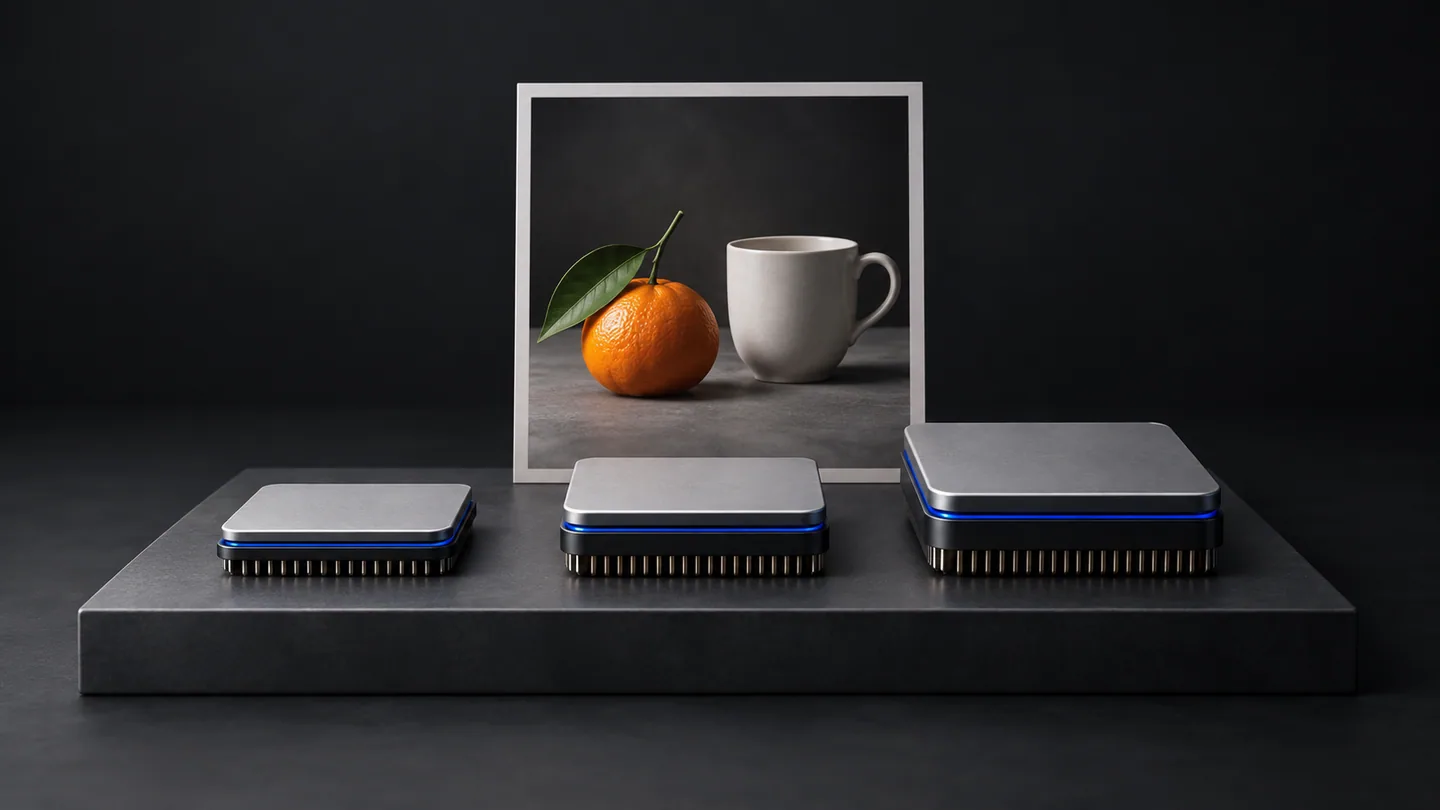
FastVLM is available in three named sizes: 0.5B, 1.5B and 7B. Choose the runtime first, then the checkpoint and precision that fit it. The browser demo uses a community ONNX conversion of 0.5B; the native Python and Apple app paths use different files.
Try the online playground or return to the FastVLM overview.
Which model should you start with?
| Model | Useful starting point | What to check |
|---|---|---|
| 0.5B | Browser experiments, quick image questions and constrained devices | Does it read the particular text, objects or charts you need? |
| 1.5B | Local development when you can allocate more memory | Choose Stage2 or Stage3 and the correct PyTorch or Apple Silicon format. |
| 7B | Evaluating the strongest scores in Apple's published table | Measure memory and latency on your intended hardware before selecting it. |
These are practical starting points, not measured hardware requirements. The size labels do not specify the complete application memory footprint. Weight precision, image processing, runtime buffers and generation length also matter.
For the middle variant, the 1.5B Stage3 guide explains the checkpoint and runtime choices in detail.
Download the files for your runtime
| Runtime | Checkpoint or source | Next step |
|---|---|---|
| Official PyTorch implementation | Apple's model zoo | Extract a Stage2 or Stage3 archive and follow the repository's inference setup. |
| Hugging Face, 0.5B | apple/FastVLM-0.5B | Read that model card's runtime-specific usage instructions. |
| Hugging Face, 1.5B | apple/FastVLM-1.5B | Check the code and model format expected by the selected integration. |
| Hugging Face, 7B | apple/FastVLM-7B | Start with the official model card and measure local resource use. |
| This site's browser demo | onnx-community/FastVLM-0.5B-ONNX | Use the playground or the WebGPU starter. |
| Native Transformers example in our Python guide | KamilaMila/FastVLM-0.5B | Follow the pinned dependencies and conversion-specific notes in the Python guide. |
| Apple's Mac/iOS app | Official app resources | Use the Apple Silicon export expected by the app. |
A Hugging Face repository name identifies a particular set of files. It does not make an Apple archive, a Transformers conversion and an ONNX export interchangeable. Check the model card and license before integrating a checkpoint.
To download an Apple Hugging Face repository into a known directory:
python -m pip install --upgrade huggingface_hub
hf download apple/FastVLM-0.5B --local-dir checkpoints/FastVLM-0.5B
For another size, change both the repository and directory:
hf download apple/FastVLM-1.5B --local-dir checkpoints/FastVLM-1.5B
hf download apple/FastVLM-7B --local-dir checkpoints/FastVLM-7B
These commands only download files. Run them individually for the size you need, then use its compatible inference implementation. When a download fails, check connectivity, available disk space and whether repository access requires authentication.
Published benchmarks
The table below preserves Apple's reported evaluation scores. It is not a new measurement by AI IDE List. Compare sizes within a row; the rows use different datasets and scoring protocols. Source: Apple FastVLM model card.
| Benchmark | 0.5B | 1.5B | 7B |
|---|---|---|---|
| AI2D | 68.0 | 77.4 | 83.6 |
| ScienceQA | 85.2 | 94.4 | 96.7 |
| MMMU | 33.9 | 37.8 | 45.4 |
| VQAv2 | 76.3 | 79.1 | 80.8 |
| ChartQA | 76.0 | 80.1 | 85.0 |
| TextVQA | 64.5 | 70.4 | 74.9 |
| InfoVQA | 46.4 | 59.7 | 75.8 |
| DocVQA | 82.5 | 88.3 | 93.2 |
| OCRBench | 63.9 | 70.2 | 73.1 |
| RealWorldQA | 56.1 | 61.2 | 67.2 |
| SeedBench-Img | 71.0 | 74.2 | 75.4 |
The 7B column leads these published rows, but the table does not establish the best runtime or total cost for your application. A smaller variant may be sufficient for a narrowly defined task, while a high-scoring model can still misread a specific image.
For a separate, inspectable example, the original site's 24-image FastVLM-0.5B evaluation retains its images, prompts, full answers and failure cases. You can also benchmark your own device. Those results have different methods and should not be combined with Apple's table above.
Interpreting the 85× speed claim
The often-cited 85× figure refers to Apple's reported time-to-first-token comparison between the 0.5B models at the highest tested image resolution. It is conditional on that setup. It does not promise an 85× improvement for your browser, every prompt or every competing configuration. Consult the FastVLM paper for the experimental conditions.
A practical selection process
- Select several images representative of your application, including difficult cases.
- Write down the expected fields or decisions before running inference.
- Check factual correctness and requested output format separately. An answer can contain the correct number and still add unsupported text.
- Measure model preparation separately from warm inference. Record device, model revision, runtime and precision with the results.
- Compare the smallest usable variant with a larger one under equivalent conditions.
Start with one image in the browser, use Python for a local workflow, or build from the downloadable WebGPU example.
Sources and review
Reviewed September 23, 2026 against the linked model cards, official repository and research paper. Published model scores are attributed to Apple; runtime recommendations above are editorial guidance. AI IDE List is an independent resource, not an Apple service.
Continue Reading
More articles connected to the same themes, protocols, and tools.
Referenced Tools
Browse entries that are adjacent to the topics covered in this article.