
On This Page8 sections
Key Takeaways
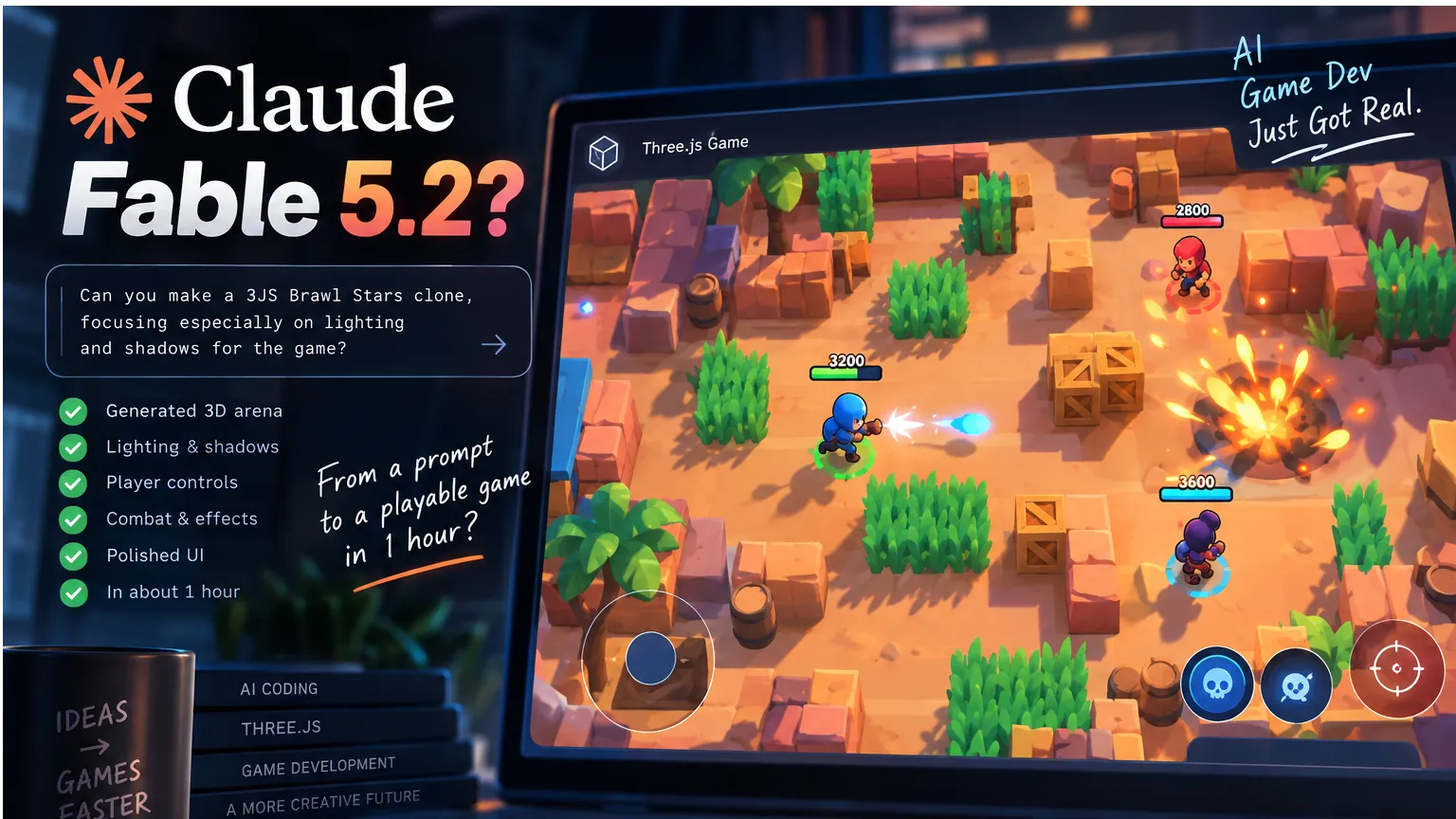
- A viral post from J A Z I I (@notjazii) shows a Brawl Stars-style 3D browser prototype reportedly generated in about one hour with Three.js and code-driven visuals. A follow-up shared a very short prompt centered on lighting and shadows.
- The model attribution is not independently verified. The tester calls it “Fable 5.2,” but Anthropic’s official documentation still lists Claude Fable 5.1 as the latest public Fable model as of September 19, 2026.
- Reuters reported on September 19 that Anthropic is considering another model release and is still evaluating its safety. That supports the possibility of next-generation internal testing, but it does not confirm the Fable 5.2 name.
- The important signal is bigger than the model name: AI coding is moving from generating code snippets to generating coherent interactive experiences from underspecified intent.
- For game developers, the near-term disruption is most obvious in prototype speed and cost, not in replacing multiplayer infrastructure, production art pipelines, live operations, QA, or game-design judgment.
What Happened?
On September 19, 2026, AI model tester J A Z I I posted a video of a stylized top-down arena game inspired by Brawl Stars. According to the post, the prototype took roughly an hour, was built with Three.js, and used code-generated visuals rather than a conventional asset-heavy workflow. The post also included a public Claude Artifact link.
A follow-up shared the prompt:
Can you make a 3JS Brawl Stars clone, focusing especially on lighting and shadows for the game?That prompt is notable because it leaves most of the implementation unspecified. It does not define controls, camera behavior, arena scale, collision rules, combat, materials, effects, UI, or performance targets. The model therefore had to infer much of the structure needed to turn a vague reference into something playable.
The result spread quickly through the AI-coding and Three.js communities. The interesting question is not simply whether the output looks good. It is what kind of capability is required to get from that small prompt to a coherent 3D experience.
Is Claude Fable 5.2 Official?
No.
Anthropic’s current public documentation identifies Claude Fable 5.1 as the latest Fable model. It was released on September 1, 2026 with a 1 million-token context window, up to 128K output tokens, adaptive thinking, and pricing of $10 per million input tokens and $50 per million output tokens. Anthropic positions it for demanding reasoning and long-horizon agentic work.
There is no official Anthropic page, model ID, or system card for “Claude Fable 5.2” in the public material reviewed for this article.
The accurate description is therefore:
a reported next-generation Fable test that community users are calling Fable 5.2.
That distinction matters. A strong demo can be genuine while the exact backend model name remains uncertain.
Why the Stealth-Testing Theory Is Plausible
The Fable 5.2 label is not based on one isolated post.
Other model watchers have reported newer Fable, Opus, and Sonnet variants being routed across different Claude surfaces and accounts. These remain community reports rather than official release notes.
There is also stronger independent evidence that Anthropic has another model in the pipeline. Reuters reported on September 19 that Anthropic is considering a new model release following the launch of GPT-6 Astra and that the model was still undergoing safety evaluation. Anthropic had not committed publicly to a release date.
The evidence can be separated cleanly:
- Verified: Fable 5.1 is publicly available.
- Reported by Reuters: Anthropic is evaluating another model and considering a release.
- Reported by testers: newer Fable, Opus, and Sonnet variants appear to be in stealth testing.
- Unverified: the final name will be Fable 5.2.
- Unverified: the exact backend model that generated this specific demo.
Why This Demo Matters More Than Another Website Clone
AI coding demos often repeat the same tasks: dashboards, landing pages, to-do apps, CRUD interfaces, and small React clones.
A 3D arena is a different class of problem.
Even a compact browser game has to coordinate:
- scene structure,
- camera placement,
- real-time rendering,
- geometry and materials,
- movement,
- collision,
- obstacles,
- combat interactions,
- animation,
- lighting,
- shadows,
- input,
- frame updates,
- visual feedback,
- UI,
- performance.
The hard part is not writing isolated Three.js calls. The hard part is cross-system coherence.
A useful prototype needs the camera to frame the action correctly, movement speed to match arena scale, obstacles to remain readable, lighting to support the materials, shadows to improve depth, and effects to communicate action without destroying performance.
That moves the task closer to interactive art direction plus engineering than ordinary code completion.
Why Lighting and Shadows Are a Meaningful Test
The original prompt specifically emphasized lighting and shadows.
In Three.js, polished shadows require more than turning on a single feature. The renderer must support shadows, lights must cast them, meshes must be configured to cast or receive them, and shadow-map resolution and camera bounds need tuning. Directional-light shadows use an orthographic shadow camera, while settings such as map size, bias, near/far planes, and filtering affect both quality and GPU cost.
Poor configuration can cause:
- shadow acne,
- floating or detached shadows,
- blurry edges,
- clipping outside the shadow frustum,
- excessive GPU work,
- unstable depth cues.
For a top-down arena game, lighting also serves gameplay. It separates characters from the floor, clarifies walls and obstacles, adds depth to simple geometry, and makes code-generated scenes feel more finished.
That is why the demo is a stronger test than a technically functional 3D scene.
Visual quality is part of the benchmark.
What the Demo Actually Shows
The strongest conclusion is narrower than the viral framing.
This example suggests frontier coding models are getting better at turning underspecified product intent into a coherent interactive prototype.
That requires several layers of capability:
Requirement inference
The prompt leaves most systems undefined. The model has to infer what a top-down arena brawler normally needs.
Spatial reasoning
A playable environment needs usable scale, navigable space, camera bounds, combat distance, obstacle density, and clear player visibility.
Visual reasoning
Lighting, shadows, materials, silhouette, proportions, particles, and motion determine whether the output feels like a game rather than a graphics experiment.
Long-horizon execution
A one-hour run is not a single autocomplete. The useful capability is maintaining a consistent implementation across many dependent changes.
That direction aligns with Anthropic’s public positioning of Fable 5.1 around long-horizon agentic work.
What It Does Not Show
The demo does not prove that AI can build a production game like Brawl Stars in one hour.
A commercial multiplayer arena game may require:
- authoritative servers,
- matchmaking,
- lag compensation,
- client prediction,
- anti-cheat,
- persistence,
- analytics,
- mobile optimization,
- progression,
- economy design,
- monetization,
- localization,
- accessibility,
- moderation,
- balancing,
- live operations,
- content pipelines,
- QA across many devices,
- security reviews.
Those systems cannot be inferred from a short visual demo.
The defensible claim is:
A tester reports that a suspected next-generation Claude model generated a visually polished Brawl Stars-style Three.js prototype in roughly an hour.
That is already significant without inflating it into “AI built Brawl Stars.”
The Bigger Shift: From Code Generation to Experience Generation
The first wave of AI coding was about writing code faster.
The next wave is about turning intent into working experiences.
Traditional assistant:
requirement -> code suggestion -> developer integration -> testing -> visual tuning

Agentic experience generation:
high-level intent -> implementation -> runtime feedback -> adjustment -> playable prototype
This changes what becomes cheap.
As code production becomes easier, the scarce skills move toward:
- choosing the right idea,
- defining the desired experience,
- judging whether the output is actually good,
- identifying user demand,
- deciding what to keep,
- shipping reliably,
- building distribution.
For games, the first major economic effect may be prototype throughput.
The winner is not necessarily the developer who generates the most code. It may be the developer who can test more ideas and discard weak ones faster.
Prototype Cost Is the Real Disruption
A traditional 3D prototype can take days before a developer learns whether the core interaction is fun.
Even a basic concept needs scene setup, camera tuning, controls, collision, effects, UI, and repeated visual adjustment.
If agentic models compress much of that work into an hour-scale loop, the workflow changes from:
idea -> build for days -> test -> continue or discardto:
idea -> generate -> play -> revise -> regenerate or extendThat matters because most game ideas should fail cheaply.
For solo developers, game jams, educational games, interactive marketing, and experimental web projects, cheaper failure can be more valuable than faster production of a single idea.
Why This Matters Beyond Games
The same capability pattern applies to many spatial applications:
- 3D product configurators,
- architecture walkthroughs,
- training simulations,
- interactive data visualization,
- virtual showrooms,
- education,
- digital twins,
- browser demos,
- lightweight CAD interfaces,
- robotics simulation.
The deeper capability is not “clone Brawl Stars.”
It is:
translate a fuzzy spatial concept into an executable interactive system.
That is a much broader opportunity.
Fable 5.2 vs. GPT-6 Astra: One Demo Is Not a Benchmark
The tester also claimed that the suspected next Fable model produced better visual output than GPT-6 Astra using the same prompt.
That is interesting anecdotal evidence, but it is not enough to establish a ranking. The public discussion does not provide a complete controlled methodology covering repeated runs, exact model IDs, token budgets, cost, retries, tool access, latency, and human intervention.
A serious comparison should control:
| Variable | Why It Matters |
|---|---|
| Exact prompt | Small changes can alter design direction |
| Model ID | Stealth routing makes attribution uncertain |
| Reasoning level | More compute may improve quality |
| Token budget | Longer runs can implement more systems |
| Tool access | Runtime feedback can materially improve output |
| Human edits | Manual fixes weaken autonomy claims |
| Attempt count | Cherry-picked runs can exaggerate quality |
| Runtime environment | Browser/GPU differences affect behavior |
| Cost | Better output may be uneconomic |
| Completion time | Speed is part of the product value |
| Functional tests | Visual polish can hide broken mechanics |
Until those controls exist, this should be treated as a capability demo, not a definitive benchmark.
A Better Way to Reproduce the Experiment
A more useful test removes the copyrighted game reference and asks the model to create an original experience:
Create an original top-down 3D arena brawler in Three.js.

Do not use copyrighted characters, names, maps, logos, textures, sounds, or visual assets from existing games.

Focus especially on:
- cinematic directional lighting
- soft dynamic shadows
- stylized low-poly geometry
- responsive keyboard controls
- smooth follow-camera behavior
- satisfying projectile combat
- readable arena obstacles
- particles and hit feedback
- polished game UI
- stable performance in a modern desktop browser

Generate the visual world primarily with code and procedural geometry.

The result should feel like a polished commercial arena game while having a completely original visual identity.
This separates general 3D game-building skill from reference imitation.
If the model still produces a polished result, the evidence for transferable spatial and design capability becomes much stronger.
How to Evaluate AI-Generated 3D Games Properly
Do not judge these demos from screenshots alone.
Visual quality
Check composition, lighting consistency, shadow artifacts, material coherence, silhouette readability, effects, and animation.
Gameplay quality
Measure input latency, movement feel, collision reliability, projectile behavior, camera stability, and feedback clarity.
Engineering quality
Inspect file structure, state management, object lifecycle, cleanup, collision architecture, frame-loop efficiency, and error handling.
Performance
Record average FPS, 1% low FPS, draw calls, triangle count, GPU time, memory usage, and startup time.
Agent autonomy
Document the exact prompt, exact model ID, total run time, retries, human edits, tool calls, token usage, and final cost.
Without this information, viral coding demos are difficult to reproduce and easy to overinterpret.
The IP Problem With “Clone” Prompts
There is also a practical legal issue.
Supercell’s Fan Content Policy says creators cannot build new products based on Supercell assets, including games based on Supercell characters, even when those games are free.
That does not mean every genre-inspired experiment is prohibited. Mechanics, characters, art, trademarks, maps, names, and overall expression raise different legal questions.
For anything intended for public release or monetization, a safer workflow is to describe the desired mechanics and visual qualities while creating original characters, environments, naming, branding, and assets.
AI makes imitation faster. It does not remove IP constraints.
What to Watch Next
The strongest evidence will come from:
- an official Anthropic announcement,
- a public successor model ID,
- a system card,
- API pricing,
- reproducible 3D coding evaluations,
- multiple independent runs,
- cost-per-prototype measurements,
- public agent traces,
- controlled comparisons with GPT-6 Astra and other frontier models.
The final model name may not be Fable 5.2 at all.
The capability trend matters more than the label.
Conclusion
The Brawl Stars-style demo is interesting because it goes beyond another landing-page clone.
A short prompt reportedly produced a coherent 3D arena prototype with lighting, shadows, controls, procedural visual structure, and game-like presentation in roughly an hour. That is a meaningful early signal for AI-native 3D prototyping.
What the evidence does not support is claiming that Anthropic has officially released Fable 5.2 or that AI can now replace the entire game-development stack. Anthropic still lists Fable 5.1 as its latest public Fable model, while Reuters reports that another Anthropic model is under evaluation.
The bigger change is economic:
the cost of turning an idea into a playable 3D prototype is falling rapidly.
For developers, the advantage increasingly shifts from typing code to choosing better ideas, specifying stronger experiences, evaluating results rigorously, and iterating faster.
The most revealing follow-up test is simple: remove the famous game reference, give the model an original concept, publish the exact settings and cost, and see whether the quality survives when the AI has to invent instead of imitate.
Continue Reading
More articles connected to the same themes, protocols, and tools.


Referenced Tools
Browse entries that are adjacent to the topics covered in this article.