

Steel
The clearest open-source and self-hostable browser-infrastructure option in this comparison, built to supply browser sessions rather than impose a particular agent reasoning loop.
Information checked: Aug 30, 2026 ·View sources
Tool details
- Type
- Developer workflows
- Platforms
- Cloud, Web API, Python, TypeScript, MCP-compatible agents
- Free plan
- Yes
- Open source
- Yes
- Bring your own key
- Yes
- Local models
- No
Overview
Best for
- Teams that need a self-hosted or portable browser API.
- Developers separating browser infrastructure from agent logic.
- Projects that want cloud convenience without abandoning open source.
Strengths
- Open-source, self-hostable browser infrastructure.
- Keeps the browser runtime independent from the agent framework.
- Broad SDK, CDP, CLI, and computer-use integration surface.
- Managed cloud provides a migration path from local testing.
Limitations & trade-offs
- Users seeking a complete hosted natural-language agent with no code.
- Small workloads that do not need Chrome.
- Teams unwilling to operate infrastructure but also unwilling to use Steel Cloud.
- Self-hosting moves scaling, patching, security, and anti-bot operations to your team.
- Advanced stealth and 24-hour sessions are enterprise features.
- Scale has a substantial monthly platform fee plus usage.
- A raw browser API still requires an agent or deterministic automation layer.
Get started
Pricing & usage limits
Official pricingFree tier available
Self-hostedOpen source
Apache-2.0 Steel Browser; pay your own compute, storage, proxy, and operations costs.
Launch$0/month + usage
$30 one-time credits, 10 browsers, $0.10/hour browser time, seven-day retention.
Scale$250/month + usage
$100 monthly credits, 100 browsers, $0.08/hour, SSO, BAA, and 14-day retention.
EnterpriseCustom + usage
1,000+ browsers, up to 24-hour sessions, reserved pools, stealth, and SLAs.
Pricing checked: Aug 30, 2026 · Subscription, usage limits, and model costs may be billed separately.
Features & details
Open browser API
- Apache-2.0 self-hosted runtime
- Managed Steel Cloud
- Node.js, Python, Rust, and Go SDKs
- REST API and agent-oriented CLI
Sessions and identity
- CDP with Playwright, Puppeteer, or Selenium
- Persistent profiles and credential injection
- Extensions and file handling
- Up to 24-hour enterprise sessions
Operations
- Proxies, fingerprints, and CAPTCHA solving
- Live view and session replays
- Scrape, screenshot, and PDF tools
- Agent observability and reserved pools
Steel Review 2026
Steel is an open-source browser API for AI agents and apps, available as a managed cloud or self-hosted runtime with CDP sessions, profiles, credentials, proxies, CAPTCHA solving, browser tools, replays, and observability.
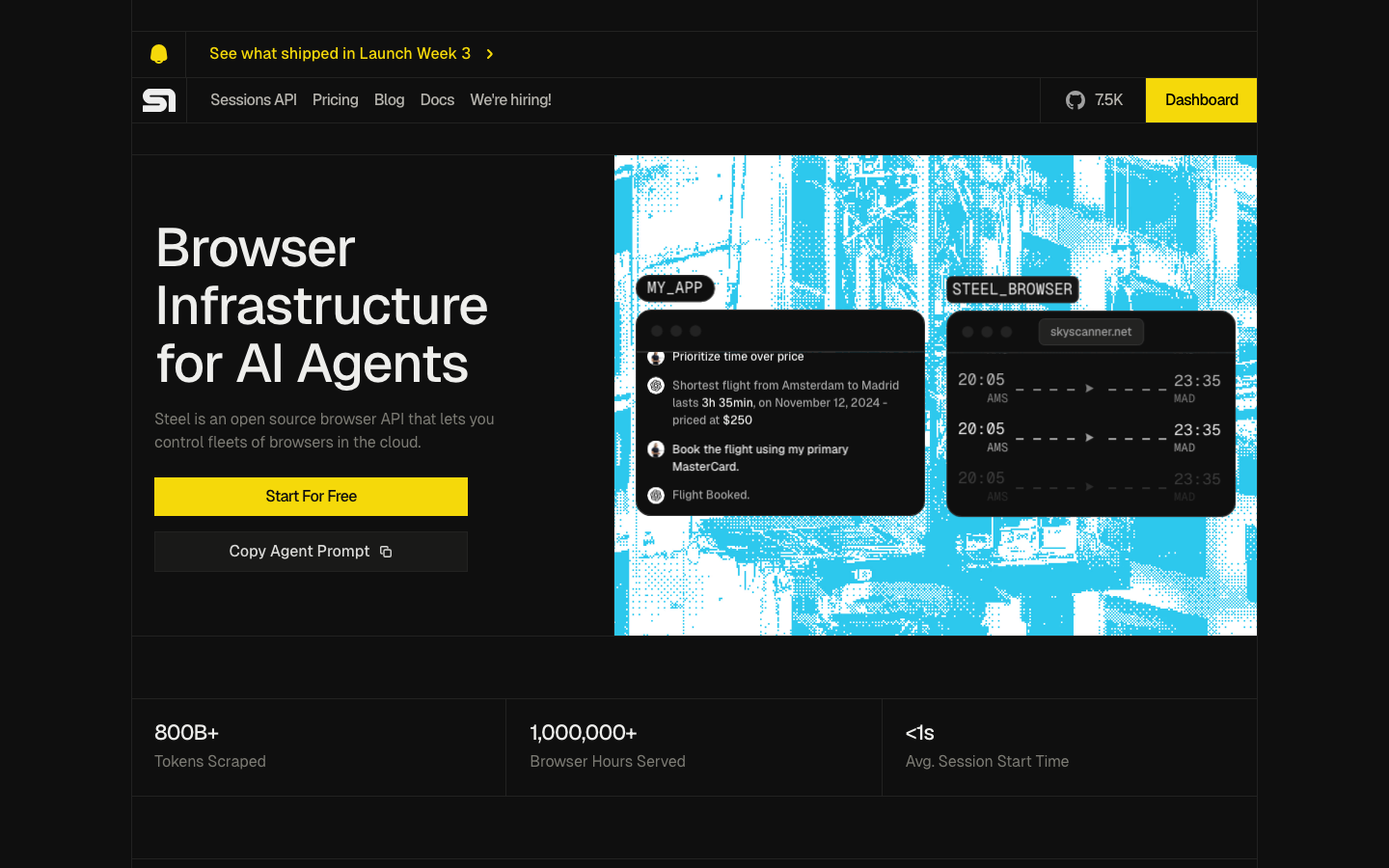
The official Steel website, captured on August 30, 2026.
What is Steel?
Steel packages the operational pieces around Chrome into an API: session lifecycle, Playwright/Puppeteer/Selenium connectivity, profiles, credentials, proxies, fingerprints, CAPTCHA solving, extensions, files, live viewing, and replays. It also exposes fast tools for scrape, screenshot, and PDF jobs. Developers can use Steel Cloud or run the Apache-2.0 Steel Browser project in their own environment.
The clearest open-source and self-hostable browser-infrastructure option in this comparison, built to supply browser sessions rather than impose a particular agent reasoning loop.
How Steel works
The basic architecture is straightforward: your application or coding agent requests a browser environment, connects through the supported SDK or protocol, performs the task, and releases the session. Production features then handle state, identity, networking, recordings, and debugging around that browser. The important buying question is not simply whether the service can launch Chrome; it is which parts of the agent stack it expects you to own.
Core capabilities
Open browser API
- Apache-2.0 self-hosted runtime
- Managed Steel Cloud
- Node.js, Python, Rust, and Go SDKs
- REST API and agent-oriented CLI
Sessions and identity
- CDP with Playwright, Puppeteer, or Selenium
- Persistent profiles and credential injection
- Extensions and file handling
- Up to 24-hour enterprise sessions
Operations
- Proxies, fingerprints, and CAPTCHA solving
- Live view and session replays
- Scrape, screenshot, and PDF tools
- Agent observability and reserved pools
Pricing
Steel Launch has no platform fee and includes $30 in one-time credits; browser time is $0.10/hour, proxy bandwidth $10/GB, and CAPTCHA solves $3 per 1,000. Scale costs $250/month plus usage, includes $100 monthly credits, lowers browser time to $0.08/hour, proxy bandwidth to $6/GB, and CAPTCHA solves to $1 per 1,000. Self-hosted software costs depend on your infrastructure.
Browser-agent costs are workload-sensitive. Estimate active browser duration, average memory shape, peak concurrency, proxy bandwidth, CAPTCHA volume, model tokens, agent steps, recordings, and retention instead of comparing only the lowest monthly plan. Prices and limits below were checked against official sources on 2026-08-30.
Best use cases
- Teams that need a self-hosted or portable browser API.
- Developers separating browser infrastructure from agent logic.
- Projects that want cloud convenience without abandoning open source.
Trade-offs
- Self-hosting moves scaling, patching, security, and anti-bot operations to your team.
- Advanced stealth and 24-hour sessions are enterprise features.
- Scale has a substantial monthly platform fee plus usage.
- A raw browser API still requires an agent or deterministic automation layer.
How it compares
Choose Steel when infrastructure portability and self-hosting are first-class requirements. It works underneath Browser Use, Claude computer use, OpenAI computer use, Gemini computer use, or custom browser code, so the browser layer remains separate from the model and agent framework.
The closest alternatives are Kernel, Browserbase, Hyperbrowser, Anchor Browser, Notte, and Browser Use. Test candidates with the same authenticated workflow, region, proxy policy, success criteria, and retry budget. Vendor-reported speed or success numbers are not directly comparable when tasks, browsers, models, and anti-bot conditions differ.
Privacy and production checklist
Steel can store session replays, profiles, credentials, files, proxy traffic, logs, and browser-tool outputs. Self-hosting gives more infrastructure control but does not remove the need for encryption, access policy, cleanup, and observability governance. Steel Cloud retention is published as seven, 14, or custom days by plan.
Use domain allowlists, least-privilege credentials, short session lifetimes, explicit user consent, human approval for consequential actions, and auditable task logs. Browser automation should respect site terms, robots policies where applicable, privacy law, and rate limits. Prefer a supported API whenever it provides the required capability.
Verdict
The most attractive option in this set when an open-source, self-hostable browser API is non-negotiable and you want the same SDK shape across local and managed deployments.
Official sources
Model support & data privacy
Supported models
- Model-agnostic browser automation
- Computer-use models through supported integrations
Privacy & data handling
Steel can store session replays, profiles, credentials, files, proxy traffic, logs, and browser-tool outputs. Self-hosting gives more infrastructure control but does not remove the need for encryption, access policy, cleanup, and observability governance. Steel Cloud retention is published as seven, 14, or custom days by plan.
Guides, reviews & fixes
Product updates
No verified product updates listed yet. Follow this tool to see new relevant content in Saved.
See the content timelineAlternatives
 KernelA low-latency browser runtime for developers who already have an agent or automation layer and want fast session acquisition, several control protocols, browser telemetry, and optional colocated compute.
 BrowserbaseThe broadest end-to-end commercial platform in this comparison, spanning browser infrastructure, AI automation primitives, web retrieval, identity, runtime, models, and debugging.
 HyperbrowserA broad managed browser cloud that can host either raw automation or several agent stacks—including Browser Use, HyperAgent, and model-native computer use—behind one SDK and operational layer.
 Anchor BrowserA security- and authentication-led computer-use platform that can turn natural-language browser goals into repeatable tasks while also exposing raw cloud sessions and SDK access.
 NotteA full-stack browser automation platform that combines raw browser sessions, an agent layer, colocated serverless functions, web data APIs, and authentication primitives in one product.
 Browser UseThe open-source browser-agent reasoning layer in this group, with an optional hosted agent and managed browser infrastructure for teams that do not want to operate Chrome fleets themselves.
Sources & verification
Verification dates record when this directory checked the information. Product release dates appear separately above.
Directory revision history
Added a complete English directory profile with official logo, current official pricing, and a verified official website screenshot.