 FlutterFlowFlutterFlow is a visual Flutter app builder positioned between no-code app builders, AI prompt-to-app tools, and developer-oriented cross-platform mobile workflows.
Rork
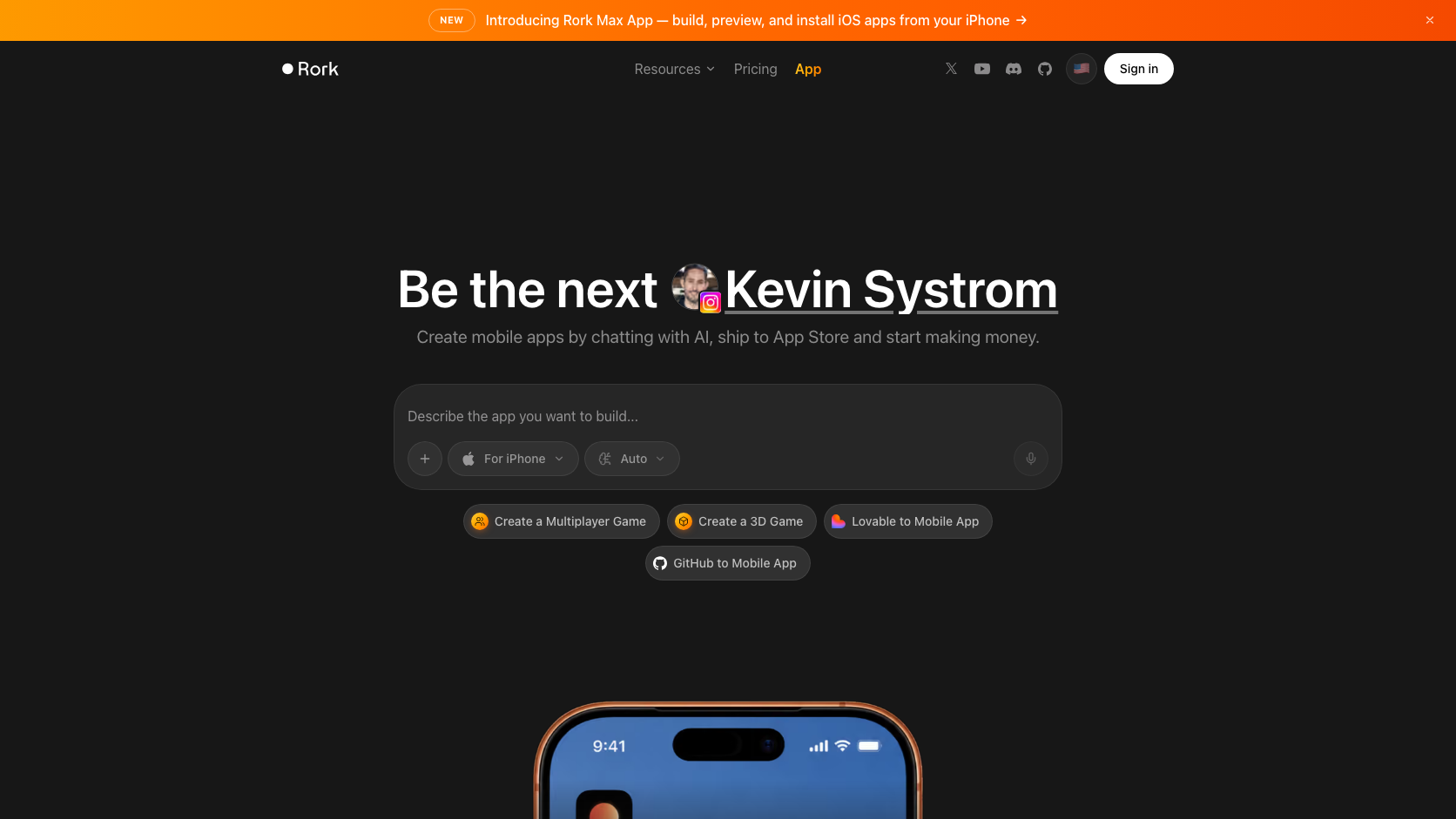
Rork brings vibe coding to mobile development. Users describe an app, iterate in a browser workflow, and generate a React Native and Expo project for native platforms and the web.
Information checked: Aug 29, 2026 ·View sources
Tool details
- Type
- App builders
- Platforms
- Web builder, iOS output, Android output, Web output
- Free plan
- Yes
- Open source
- No
- Bring your own key
- No
- Local models
- No
Overview
Best for
- Founders prototyping native mobile products.
- Web developers moving into React Native and Expo.
- Teams validating iOS and Android concepts before a full build.
Strengths
- Clear mobile-first focus.
- React Native and Expo provide a standard path beyond the builder.
- Useful for validating native app ideas quickly.
- Supports iOS, Android, and web from one project direction.
Limitations & trade-offs
- Apps requiring deep custom native code from day one.
- Teams that require local-only generation.
- Projects that are purely marketing websites.
- Generated mobile apps still require device testing and store-readiness work.
- Complex native modules may need manual engineering.
- Usage and production features depend on paid plans.
- Managed generation offers less model control than BYOK tools.
Get started
Pricing & usage limits
Free tier available
Starter accessFree tier
Limited project creation and experimentation.
Paid plansPlan-dependent
Higher usage, collaboration, and production needs depend on the current Rork plan.
Pricing checked: Aug 29, 2026 · Subscription, usage limits, and model costs may be billed separately.
Features & details
Mobile Generation
- Prompt-to-mobile-app workflow
- React Native project output
- Expo-based development
- iOS, Android, and web targets
Build Experience
- Conversational iteration
- Live app previews
- Design and feature refinement
- Code export for continued development
Production Path
- Native project structure
- Backend and API integration
- Authentication and app logic
- Handoff to standard mobile tooling
Rork Review 2026
Rork is a prompt-to-app builder focused on native mobile products, generating React Native and Expo projects that can target iOS, Android, and the web from a conversational specification.
What Is Rork?
Rork brings vibe coding to mobile development. Users describe an app, iterate in a browser workflow, and generate a React Native and Expo project for native platforms and the web.
Its mobile-first output distinguishes it from prompt-to-web builders that primarily generate responsive websites or Next.js applications.
Core Features
Mobile Generation
- Prompt-to-mobile-app workflow
- React Native project output
- Expo-based development
- iOS, Android, and web targets
Build Experience
- Conversational iteration
- Live app previews
- Design and feature refinement
- Code export for continued development
Production Path
- Native project structure
- Backend and API integration
- Authentication and app logic
- Handoff to standard mobile tooling
How It Fits an Agentic Development Workflow
Rork is most useful when its permissions, repository scope, model access, and review checkpoints are configured before the first large task. Start with a bounded project, verify the generated changes or analysis, and only then expand access. This matters because agentic tools can move faster than a conventional assistant and can also amplify a bad assumption.
For teams, the practical evaluation should cover setup time, context quality, task completion rate, review burden, model or infrastructure cost, security controls, and how easily a human can interrupt or redirect work.
Best Use Cases
- Founders prototyping native mobile products.
- Web developers moving into React Native and Expo.
- Teams validating iOS and Android concepts before a full build.
Pricing
- Starter access: Free tier. Limited project creation and experimentation.
- Paid plans: Plan-dependent. Higher usage, collaboration, and production needs depend on the current Rork plan.
Pricing and limits can change quickly. The figures or plan descriptions above were checked against official information on 2026-08-29; verify the official site before purchasing.
Privacy, Security, and Deployment
Projects are generated through a managed web service. Review source-code retention, third-party integrations, secrets, analytics, and the export path before using sensitive product plans.
Any coding agent or developer tool with repository, terminal, browser, or secret access should be introduced with least-privilege credentials, protected branches, mandatory review, isolated test environments, and clear log-retention rules.
Limitations
- Generated mobile apps still require device testing and store-readiness work.
- Complex native modules may need manual engineering.
- Usage and production features depend on paid plans.
- Managed generation offers less model control than BYOK tools.
Alternatives
- FlutterFlow
- Lovable
- Bolt.new
- Base44
- Replit
The best alternative depends on whether the priority is an AI-native editor, a terminal harness, autonomous cloud execution, code review, mobile control, or a shared orchestration layer.
Verdict
One of the most relevant mobile-first vibe-coding tools and a necessary counterweight to web-focused builders such as v0, Lovable, and Bolt.
Official Sources
Model support & data privacy
Supported models
- Rork managed models
Privacy & data handling
Projects are generated through a managed web service. Review source-code retention, third-party integrations, secrets, analytics, and the export path before using sensitive product plans.
Guides, reviews & fixes
No published guides yet. Start with the official documentation above.
Product updates
No verified product updates listed yet. Follow this tool to see new relevant content in Saved.
See the content timelineAlternatives
FlutterFlowFlutterFlow is a visual Flutter app builder positioned between no-code app builders, AI prompt-to-app tools, and developer-oriented cross-platform mobile workflows. LovableLovable is a full-stack AI web app builder positioned between no-code prototyping tools and developer-first AI coding environments.
 Bolt.newBolt.new is a browser-native AI web app builder for quickly turning product ideas into editable, runnable, and deployable JavaScript applications.
 Base44Base44 is a no-code AI app builder for creating functional web apps, websites, internal tools, and portals from natural-language prompts with built-in backend services.
 Replit AIReplit AI is an all-in-one browser-based AI software creation platform that combines prompt-to-app generation, a cloud IDE, built-in infrastructure, publishing, and collaboration.
Sources & verification
Verification dates record when this directory checked the information. Product release dates appear separately above.
Directory revision history
Created a complete English draft profile from current official sources; kept unpublished for editorial review.