
 Sourcegraph CodySourcegraph Cody is an enterprise AI coding assistant focused on codebase-aware chat, code edits, completions, and context retrieval across large multi-repository environments.
GitNexus
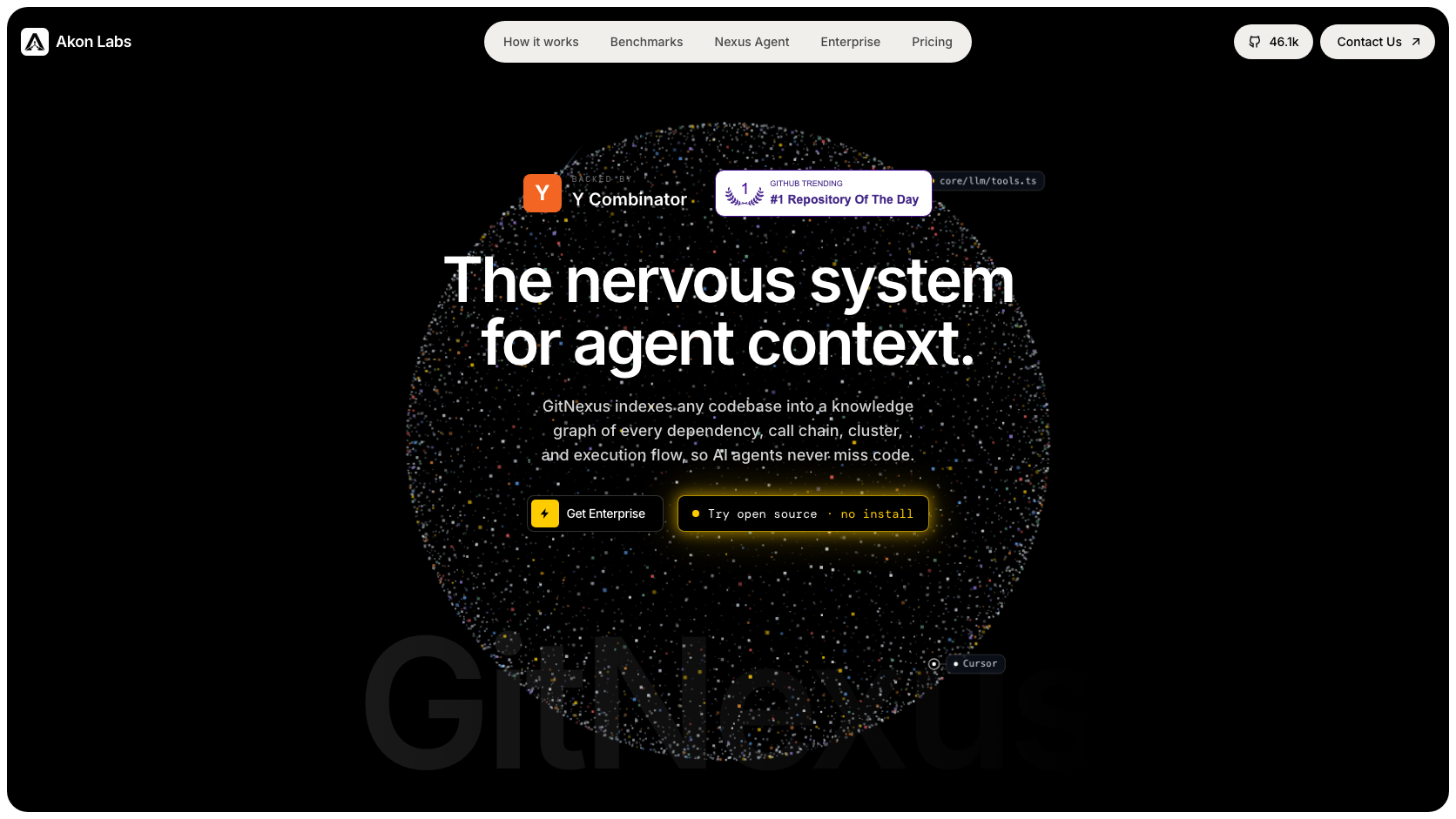
GitNexus is context infrastructure for coding agents rather than another agent. It precomputes structural code intelligence so assistants can query dependencies, call chains, and impact before making changes.
Information checked: Aug 29, 2026 ·View sources
Tool details
- Type
- Developer workflows
- Platforms
- Cloud, Self-hosted, MCP clients
- Free plan
- No
- Open source
- No
- Bring your own key
- No
- Local models
- No
Overview
Best for
- Large or interconnected repositories where agents miss architectural context.
- Teams using several MCP-compatible coding agents.
- Organizations that want a shared code-intelligence layer.
Strengths
- Improves the context layer without forcing a new coding agent.
- Knowledge graphs can reduce repeated repository exploration.
- MCP makes the same context available to multiple tools.
- Self-hosting supports organizations with stricter deployment needs.
Limitations & trade-offs
- Small projects where normal repository search is enough.
- Users looking for an agent that directly writes code.
- Teams unable to operate repository indexing infrastructure.
- It adds another indexing and infrastructure component.
- Value is highest on complex codebases, not tiny projects.
- Pricing is not presented as a simple self-serve plan.
- Graph freshness and access policy need operational ownership.
Get started
Pricing & usage limits
Contact sales
Managed or self-hostedContact sales
Pricing depends on repository scale, deployment, and organization requirements.
Pricing checked: Aug 29, 2026 · Subscription, usage limits, and model costs may be billed separately.
Features & details
Code Intelligence
- Dependency knowledge graph
- Call-chain and execution-flow analysis
- Change-impact exploration
- Cross-repository context
Agent Integration
- MCP access for coding agents
- Works with Claude Code, Cursor, Codex, and OpenCode
- Reusable context across harnesses
- Architecture-aware queries
Deployment
- Managed service option
- Self-hosted deployment
- Repository indexing
- Organization-scale context layer
GitNexus Review 2026
GitNexus by Akon Labs builds a knowledge graph of code dependencies, call paths, execution flows, and cross-repository context, then exposes that intelligence to coding agents through MCP.
What Is GitNexus?
GitNexus is context infrastructure for coding agents rather than another agent. It precomputes structural code intelligence so assistants can query dependencies, call chains, and impact before making changes.
Instead of asking every agent to repeatedly search files and infer architecture, GitNexus exposes a repository knowledge graph through MCP to multiple coding harnesses.
Core Features
Code Intelligence
- Dependency knowledge graph
- Call-chain and execution-flow analysis
- Change-impact exploration
- Cross-repository context
Agent Integration
- MCP access for coding agents
- Works with Claude Code, Cursor, Codex, and OpenCode
- Reusable context across harnesses
- Architecture-aware queries
Deployment
- Managed service option
- Self-hosted deployment
- Repository indexing
- Organization-scale context layer
How It Fits an Agentic Development Workflow
GitNexus is most useful when its permissions, repository scope, model access, and review checkpoints are configured before the first large task. Start with a bounded project, verify the generated changes or analysis, and only then expand access. This matters because agentic tools can move faster than a conventional assistant and can also amplify a bad assumption.
For teams, the practical evaluation should cover setup time, context quality, task completion rate, review burden, model or infrastructure cost, security controls, and how easily a human can interrupt or redirect work.
Best Use Cases
- Large or interconnected repositories where agents miss architectural context.
- Teams using several MCP-compatible coding agents.
- Organizations that want a shared code-intelligence layer.
Pricing
- Managed or self-hosted: Contact sales. Pricing depends on repository scale, deployment, and organization requirements.
Pricing and limits can change quickly. The figures or plan descriptions above were checked against official information on 2026-08-29; verify the official site before purchasing.
Privacy, Security, and Deployment
Repository graphs may encode sensitive architecture. Review indexing scope, source-code retention, MCP authorization, tenant isolation, self-hosting controls, and deletion procedures.
Any coding agent or developer tool with repository, terminal, browser, or secret access should be introduced with least-privilege credentials, protected branches, mandatory review, isolated test environments, and clear log-retention rules.
Limitations
- It adds another indexing and infrastructure component.
- Value is highest on complex codebases, not tiny projects.
- Pricing is not presented as a simple self-serve plan.
- Graph freshness and access policy need operational ownership.
Alternatives
- Sourcegraph Cody
- Augment Code
- Bito
- RepoPrompt
The best alternative depends on whether the priority is an AI-native editor, a terminal harness, autonomous cloud execution, code review, mobile control, or a shared orchestration layer.
Verdict
A strong candidate for the emerging agent-context category, especially when several coding agents need the same trustworthy view of a large codebase.
Official Sources
Model support & data privacy
Supported models
- Model-agnostic through MCP
Privacy & data handling
Repository graphs may encode sensitive architecture. Review indexing scope, source-code retention, MCP authorization, tenant isolation, self-hosting controls, and deletion procedures.
Guides, reviews & fixes
No published guides yet. Start with the official documentation above.
Product updates
No verified product updates listed yet. Follow this tool to see new relevant content in Saved.
See the content timelineAlternatives
Sourcegraph CodySourcegraph Cody is an enterprise AI coding assistant focused on codebase-aware chat, code edits, completions, and context retrieval across large multi-repository environments. Augment CodeAugment Code is an enterprise-focused AI coding platform for teams working in large repositories, existing IDEs, terminals, and automated engineering workflows.
Sources & verification
Verification dates record when this directory checked the information. Product release dates appear separately above.
Directory revision history
Created a complete English draft profile from current official sources; kept unpublished for editorial review.