 LangChainLangChain is a developer framework and agent engineering ecosystem for building, debugging, evaluating, and deploying LLM-powered applications.
Eino
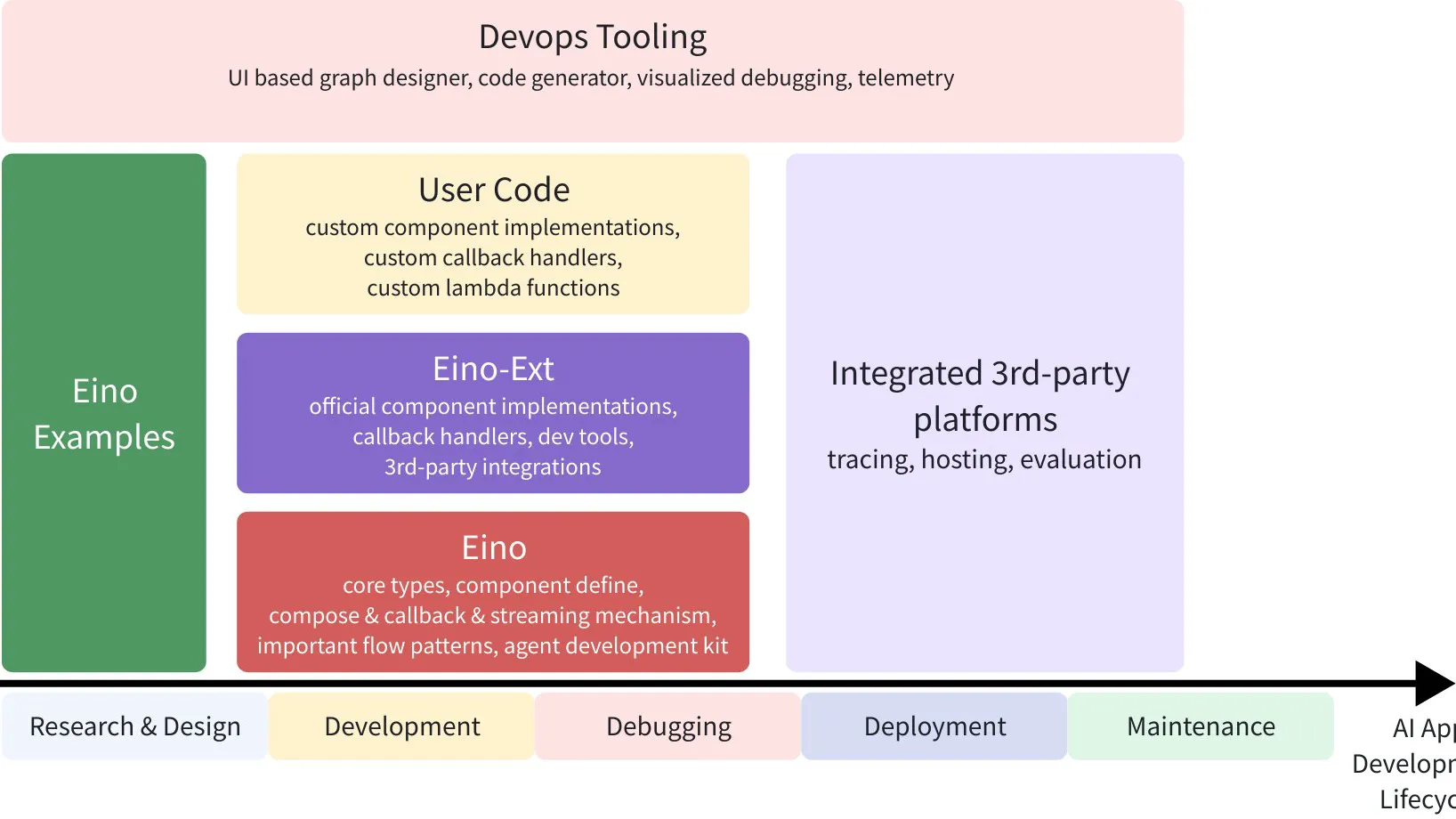
Eino is an open-source Go framework for building production-oriented LLM applications, agents, and orchestrated AI workflows.
Information checked: Jul 8, 2026 ·View sources
Tool details
- Type
- Developer workflows
- Platforms
- Go 1.18+, macOS, Linux, Windows
- Free plan
- Yes
- Open source
- Yes
- Bring your own key
- Yes
- Local models
- Yes
Overview
Best for
- Go teams building LLM applications inside backend services
- Agent workflows that need typed orchestration
- RAG systems with retrievers, indexers, embeddings, and document processing
- Human-in-the-loop agent flows with interrupt and resume behavior
- Teams that want deterministic graph workflows and agentic execution in one framework
Strengths
- Strong fit for production Go teams building AI services.
- Typed orchestration can make complex agent and RAG flows easier to maintain.
- Supports both deterministic workflows and agentic tool use.
- Open-source under Apache-2.0 with official docs and examples.
- Useful when AI logic needs to live inside backend services rather than notebooks.
Limitations & trade-offs
- Developers looking for an AI code editor like Cursor or Windsurf
- Python-first AI prototyping teams
- No-code users who want prompt-to-app generation
- Teams that need the largest possible third-party AI framework ecosystem
- Less suitable for Python-first AI teams.
- Smaller ecosystem than LangChain or LlamaIndex.
- Requires Go engineering familiarity.
- Not an AI code editor or interactive coding assistant.
- Production use still depends on external model, storage, and observability providers.
Get started
Pricing & usage limits
Free tier available
Open Source$0 / forever
Apache-2.0 framework; model API, vector database, tracing, and hosting costs are separate.
Pricing checked: Jul 8, 2026 · Subscription, usage limits, and model costs may be billed separately.
Features & details
Go-Native AI Development
- Typed component abstractions for LLM apps
- Designed around Go conventions
- Works inside existing Go services
Agent and Workflow Orchestration
- ADK for tool-using agents
- Chain, Graph, and Workflow APIs
- Interrupt and resume support
Component Ecosystem
- ChatModel, Tool, Retriever, Embedding, and Template interfaces
- Official extensions through EinoExt
- Examples for common AI application patterns
Observability and Dev Tooling
- Callback hooks for tracing and metrics
- Visual debugging and graph tooling
- Streaming-aware orchestration
Why Choose Eino?
Eino is best understood as infrastructure for AI application logic, not as an AI IDE or coding assistant. Its main appeal is that it lets Go teams build LLM workflows using familiar backend engineering patterns: typed interfaces, composable components, explicit orchestration, callbacks, and service-friendly deployment.
That makes it different from tools that are optimized for notebooks, prototypes, or prompt-only app generation. Eino is aimed at teams that already run Go services and want AI features to fit into that world cleanly. Instead of treating agent behavior as a black box, developers can model the system as components, graphs, workflows, and agents with clear boundaries.
Core Workflow
A typical Eino project starts by selecting a chat model implementation, then connecting it with prompts, tools, retrievers, document processors, or embeddings. For simple use cases, developers can call components directly. For more structured applications, they can move into Chain, Graph, or Workflow orchestration depending on how much control the application needs.
The practical distinction matters. A chain works well for linear LLM flows. A graph is better when the application needs branching, loops, state, or tool routing. A workflow is useful when data mapping between steps should be explicit and typed. This gives teams a path from a small AI feature to a more controlled production flow without switching frameworks.
Use Cases
Eino fits backend-heavy AI products: support agents, internal copilots, RAG search, document processing services, workflow assistants, multi-step automation, and domain-specific agents that need controlled tool access. It is also a good match when an agent needs to pause for human review, resume from a checkpoint, or expose a deterministic graph as a callable tool.
For example, a team could build a retrieval pipeline as a graph, wrap that graph as a tool, and then allow an agent to decide when to invoke it. That combination is useful because not every part of an AI system should be agentic. Some parts should be deterministic, testable, and observable.
Comparison to Alternatives
Compared with LangChain and LlamaIndex, Eino is narrower in ecosystem reach but more naturally aligned with Go backend development. LangChain remains a broader default for Python and JavaScript teams, while LlamaIndex is often chosen for data-centric RAG workflows. Eino is more compelling when the surrounding application, deployment model, and engineering team are already Go-based.
Compared with LangChainGo, Eino feels more like a complete Go-native application framework rather than just a Go port of common LLM abstractions. The tradeoff is that teams may find fewer community examples, integrations, and Stack Overflow-style answers than they would with older or larger frameworks.
Best Configuration
The strongest setup is to use Eino inside a Go backend service with explicit provider configuration, environment-based API keys, and callback instrumentation from the start. For production systems, it is worth separating deterministic workflow logic from open-ended agent behavior: keep retrieval, validation, routing, and business rules in typed graphs or workflows, then let agents call those controlled pieces as tools.
For local development or privacy-sensitive experiments, pair Eino with a local model provider such as Ollama where quality and latency are acceptable. For production-grade reasoning, teams will usually combine Eino with hosted model providers, vector databases, tracing, and standard Go service observability.
Migration Notes
Teams moving from Python frameworks should not expect a one-to-one migration. The better approach is to map concepts rather than copy code: prompts become templates, model calls become ChatModel components, retrieval becomes retriever/indexer components, and agent loops become ADK agents or graph workflows.
The biggest migration benefit is maintainability inside Go services. The biggest cost is ecosystem maturity: existing LangChain or LlamaIndex integrations may need to be rebuilt, wrapped, or replaced with EinoExt components. For teams with strong Go expertise, that tradeoff can be worthwhile; for teams still exploring product-market fit, a faster prototyping framework may be easier first.
Model support & data privacy
Supported models
- OpenAI
- Claude
- Gemini
- Ark
- Ollama
Privacy & data handling
Eino is a framework, so data handling depends on how developers configure model providers, tools, retrievers, callbacks, tracing, and hosting. Local model usage is possible through integrations such as Ollama, while cloud model usage sends data to the selected provider.
Guides, reviews & fixes
No published guides yet. Start with the official documentation above.
Product updates
No verified product updates listed yet. Follow this tool to see new relevant content in Saved.
See the content timelineAlternatives
LangChainLangChain is a developer framework and agent engineering ecosystem for building, debugging, evaluating, and deploying LLM-powered applications. LlamaIndexLlamaIndex is a developer framework and managed document-agent platform for building context-aware LLM applications over private, structured, and unstructured data.
 LangChainGoThe Go ecosystem’s practical LangChain-style toolkit for teams that want agent and retrieval components in a compiled, concurrency-friendly language.
 Agent Development Kit (ADK)Google’s open-source, deployment-flexible framework for production agents and multi-agent workflows.
 Semantic KernelSemantic Kernel is Microsoft’s open-source AI application orchestration SDK for connecting LLMs, plugins, memory, vector stores, and existing code into agentic workflows.
Sources & verification
Verification dates record when this directory checked the information. Product release dates appear separately above.
Directory revision history
Verified Eino as an open-source CloudWeGo Go framework for LLM applications, ADK agents, component orchestration, and workflow composition.