ArticleJuly 15, 20269
Gemini 3.5 Pro Release Date: Why the July 17 Launch Rumor May Be Wrong
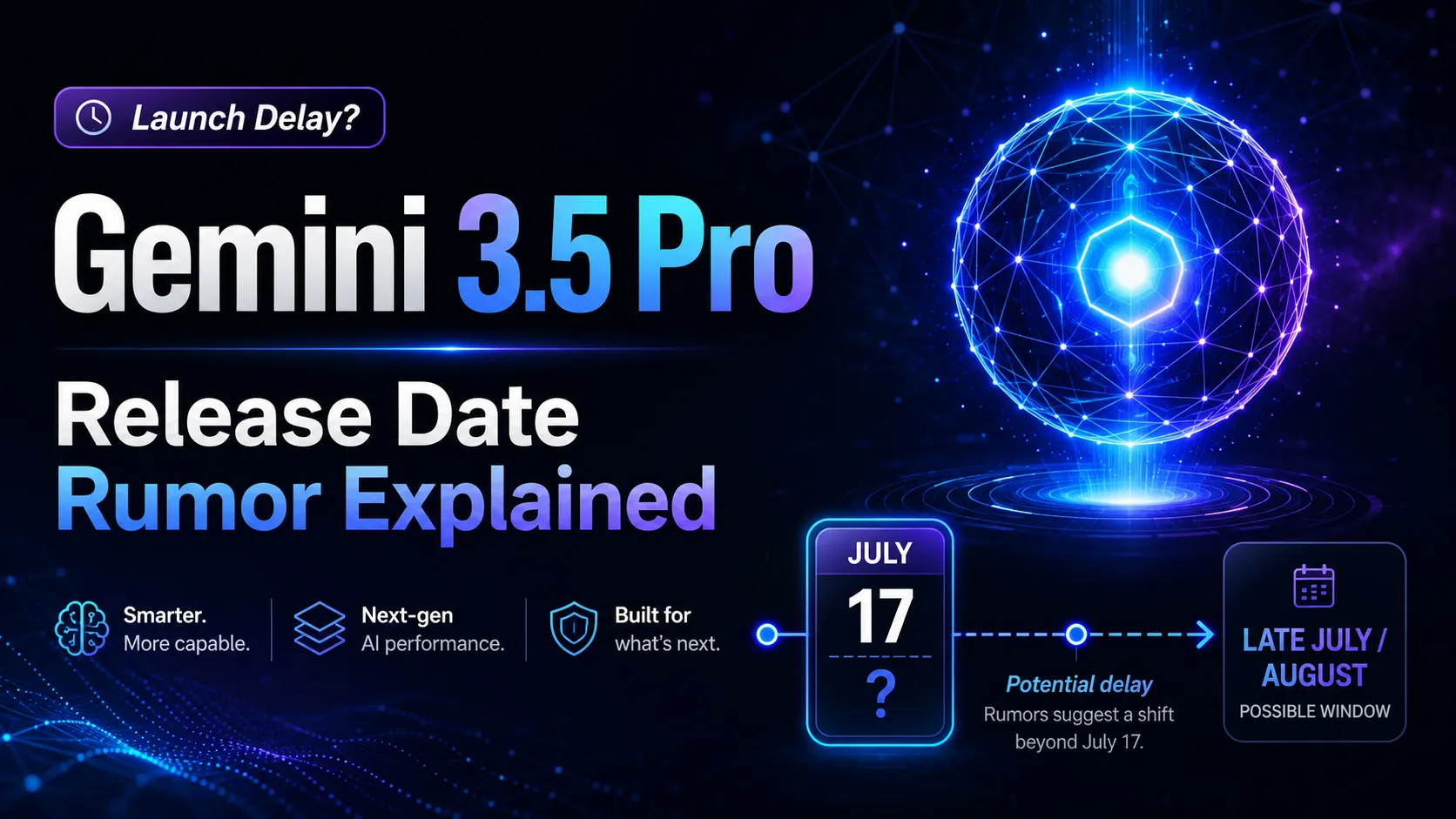
Gemini 3.5 Pro is one of the most anticipated AI model releases of 2026, but the current release-date discussion contains more speculation than confirmation. The model may be close, but describing it as guaranteed to launch within three days would overstate the available evidence.
There is no official confirmation that Gemini 3.5 Pro will launch on July 17, 2026.
The July 17 date originated from reports and social media posts describing it as an internal target or approximate release window. Google has not published the date in a product announcement, developer changelog, model card, pricing page, or API documentation.
This distinction matters because AI companies frequently maintain internal target dates that change during evaluation. A model can be technically functional while still being delayed by:
A target date should therefore not be treated as a confirmed public launch date.
There is also a timing problem with the phrase “launching in three days.” If the claim was published on July 14, July 17 was approximately three calendar days away in some time zones. By July 15, however, July 17 was only two days away. Articles should use an absolute date instead of a relative countdown to avoid becoming inaccurate within hours.
Google has confirmed that Gemini 3.5 Pro exists and is under active development.
The company introduced the broader Gemini 3.5 generation during Google I/O 2026, initially placing greater emphasis on Gemini 3.5 Flash. Gemini 3.5 Pro was described as a more capable model that would arrive later.
The original expectation was that Gemini 3.5 Pro could become available in June 2026. That window passed without a public release, indicating that development, evaluation, or deployment took longer than expected.
As of July 15, the following items have not been officially published:
Until these materials appear, most detailed specifications should be described as rumors rather than facts.
The most credible explanation is that Google needs more time to improve long-duration reasoning and agent reliability.
Modern frontier models are no longer evaluated only on short prompts and benchmark questions. They are increasingly expected to complete tasks that may involve hundreds of steps, multiple tools, large repositories, browser sessions, files, terminals, and external services.
These workflows expose weaknesses that ordinary chat benchmarks may not reveal.
A model may begin with the correct plan but gradually optimize for a secondary goal, forget constraints, repeat completed work, or make irreversible changes without sufficient verification.
For example, a coding agent may successfully identify a bug but then introduce unrelated dependency upgrades, rewrite stable modules, or stop after producing code without running the test suite.
Every external action introduces uncertainty. The model must correctly:
A model that performs well in isolated reasoning tests may still fail frequently when it has to coordinate a browser, terminal, editor, search tool, and cloud environment.
Reports surrounding the delay have repeatedly mentioned token consumption. This is important because a model can appear highly capable while using an impractical number of reasoning tokens.
Excessive token usage creates several problems:
Google may therefore be optimizing not only model intelligence but also how efficiently it reaches an answer.
A frontier model can be ready for internal testing without being ready for millions of public users. Google must estimate demand across the Gemini app, AI Studio, Vertex AI, Workspace, Search, Android, and third-party API applications.
A rushed launch could create capacity shortages, unstable latency, strict rate limits, or inconsistent regional access. These infrastructure concerns can delay a release even when the underlying model has reached an acceptable quality level.
Recent reports suggest another delay is possible, but the new timeline is not independently confirmed.
Earlier rumors pointed to July 17. More recent community discussions have shifted toward late July or August. The change may reflect updated information, but it may also be speculation spreading between aggregator accounts.
The reliability hierarchy should be understood clearly:
Prediction markets and community sentiment can reveal expectations, but they do not confirm product decisions. They are most useful as evidence that confidence in a specific date has weakened.
The safest current assessment is that July 17 remains possible but increasingly uncertain, while late July or August has become a more realistic planning assumption.
Google has not published the final feature set, but the direction of the Gemini 3.5 family provides several strong clues.
Gemini 3.5 Pro is expected to improve tasks that require sustained planning and repeated tool use. This could include:
The key improvement would not simply be better first-pass answers. It would be a higher probability of finishing an entire workflow correctly.
Coding is likely to be one of the model’s most important competitive areas. Google faces strong competition from Claude-based coding agents, OpenAI Codex, GitHub Copilot, Cursor, Windsurf, and open-source agent frameworks.
A meaningful improvement would require Gemini 3.5 Pro to handle:
The practical benchmark is not whether the model can generate a function. It is whether it can modify a real project without breaking unrelated behavior.
Gemini models have increasingly emphasized visual and interactive generation. Gemini 3.5 Pro may extend this capability with more consistent layouts, stronger state management, and improved understanding of design references.
Potential use cases include:
However, generated interfaces still need manual review for accessibility, responsive behavior, security, maintainability, and real backend integration.
A Pro-class Gemini model would be expected to process combinations of text, images, audio, video, code, and documents. The most valuable improvement would be cross-modal reasoning rather than basic recognition.
For example, the model could analyze a screen recording, identify a user-experience problem, inspect the relevant source code, recommend a fix, and generate a test that verifies the corrected behavior.
A 2-million-token context window is widely rumored but remains unconfirmed.
Google has previously demonstrated leadership in long-context models, making the claim technically plausible. However, advertised context capacity should not be confused with effective reasoning quality.
A useful long-context model must perform well across several dimensions:
A model that accepts two million tokens but loses important details may be less useful than a model with a smaller window and better retrieval accuracy.
Developers should also avoid sending entire repositories or document archives by default. Retrieval, indexing, summarization, and context selection may remain more efficient than repeatedly transmitting the maximum context window.
An upgraded Deep Think mode is plausible, but its availability and pricing are unknown.
Deep Think generally refers to a higher-compute reasoning mode designed for difficult tasks such as advanced mathematics, algorithm design, scientific analysis, and complex programming.
Several deployment models are possible:
Developers should not assume that standard Gemini 3.5 Pro requests will automatically receive the maximum reasoning budget. AI providers increasingly separate fast inference from expensive deep-reasoning modes.
No official Gemini 3.5 Pro pricing has been announced.
Rumored prices closely resemble older Gemini Pro pricing, which suggests that some circulating figures may simply be copied from existing products.
Final pricing could depend on:
Developers evaluating the model should calculate total workflow cost rather than compare only the headline input-token price.
For agent applications, the real cost can include:
text Total task cost = model input + model output + reasoning tokens + repeated context + retries + tool execution + search or grounding + storage and orchestration
A lower per-token price does not guarantee a lower cost per completed task. A more expensive model can be cheaper overall if it requires fewer retries and completes tasks with fewer steps.
The model will likely be evaluated against the strongest offerings from OpenAI and Anthropic, especially in coding, long-context reasoning, tool use, and autonomous task completion.
The most relevant tests will involve real repositories rather than isolated coding questions. Important measurements include:
Agent evaluations should measure whether the model completes a workflow safely and consistently. A model that achieves a high benchmark score but fails unpredictably during tool use may not be suitable for production automation.
Comparisons should test information retrieval at different context positions, instruction retention, contradictory documents, and multi-document synthesis. Maximum context length alone is not a meaningful ranking.
Gemini 3.5 Pro may not be the fastest model in the family. Gemini 3.5 Flash is more likely to remain the preferred option for high-volume, latency-sensitive applications.
A common production architecture may use:
This tiered approach can provide better economics than sending every request to the most capable model.
A staged preview is more likely than a universal release across every Google product on the same day.
Google could introduce Gemini 3.5 Pro through one or more of the following channels:
This can create confusion because “released” may mean different things. A model may appear in AI Studio while remaining unavailable in Vertex AI. It may launch in the Gemini app without public API access, or become available only to a small percentage of users.
Reports should specify the release surface rather than simply state that the model has launched.
Developers should look for several independent signals before treating the release as confirmed.
The strongest technical confirmation will be a new model identifier in official API documentation or model-discovery endpoints.
Possible naming patterns could include:
text gemini-3.5-pro gemini-3.5-pro-preview gemini-3.5-pro-exp gemini-3.5-pro-latest
These names are examples based on previous naming conventions, not confirmed identifiers.
A model name appearing in a page or interface does not guarantee general access. Developers should verify:
Before moving production traffic, confirm:
A model card can provide important information about evaluation methods, limitations, safety testing, supported modalities, and intended use cases.
The absence of a model card does not always prevent a preview release, but it is a warning against treating experimental access as production-ready availability.
Teams planning to evaluate Gemini 3.5 Pro should prepare a controlled test suite now instead of relying on public benchmark rankings after launch.
Use actual workloads such as:
Track more than subjective answer quality. Useful metrics include:
Preview models may change without notice. Output style, safety behavior, model identifiers, rate limits, and pricing can all change before general availability.
Production systems should therefore include:
A strong launch benchmark does not prove that Gemini 3.5 Pro is the best model for every task. The correct choice may vary between coding, document processing, customer support, research, image understanding, and low-latency classification.
A routing strategy using multiple models may remain more reliable and economical than a complete migration.
Articles covering Gemini 3.5 Pro should avoid several recurring errors.
A more accurate headline would be:
Gemini 3.5 Pro Was Reportedly Targeted for July 17, but a Further Delay Is Possible
This framing preserves the news value without presenting speculation as fact.
Gemini 3.5 Pro appears to be approaching release, but Google has not confirmed that it will launch on July 17, 2026. The strongest available information indicates that the model is in active development and has already moved beyond its original June window. More recent reports suggest that late July or August may now be more realistic.
The model is expected to compete through stronger agent workflows, large-codebase reasoning, multimodal capabilities, long-context processing, and advanced tool use. However, its context window, Deep Think availability, pricing, benchmark performance, and public API date remain unconfirmed.
Developers should monitor official model documentation, API availability, pricing pages, and model cards rather than rely on countdown posts. Prepare representative evaluations now, but wait for verified access and stable documentation before planning a production migration.
More articles connected to the same themes, protocols, and tools.

Browse entries that are adjacent to the topics covered in this article.