
On This Page8 sections
Key Takeaways
- The Codex personal wardrobe is not an official OpenAI fashion product. It is an example of using an AI coding agent to build a custom wardrobe database and management application.
- Its main innovation is personalization, not virtual try-on. The application can reflect one person's categories, capsule wardrobe limits, shopping rules, style preferences, and daily routines.
- Codex acts primarily as a software builder and data operator. It can create the interface, define the database, organize clothing records, implement filters, and update the system through natural-language instructions.
- A reliable wardrobe assistant should combine structured rules with AI reasoning. Weather, occasion, laundry status, color compatibility, wear frequency, and personal feedback should be filtered before an AI model ranks outfits.
- The larger opportunity is personal software. Wardrobe management is one example of small, highly customized applications that would previously have been too expensive or time-consuming to build.
What Is the Codex AI Personal Wardrobe?
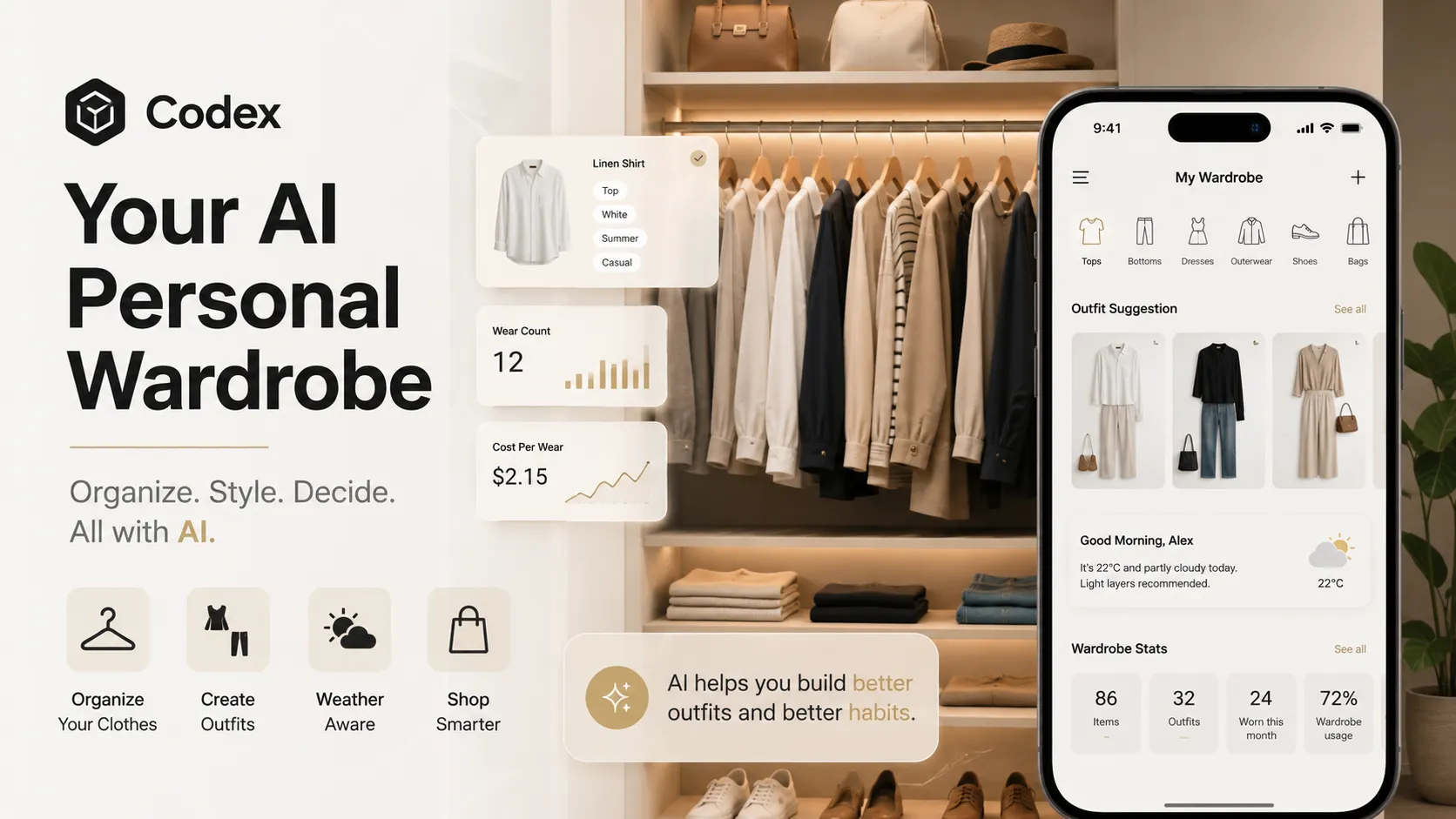
The Codex AI personal wardrobe is best understood as a custom clothing management application built with an AI coding agent.
Instead of installing a standardized wardrobe app and adapting to its fixed features, a user can describe the exact system they want. Codex can then create the project, write the code, define the data model, build the interface, and revise the application as requirements change.
A basic version may allow the user to:
- Upload photographs of clothing items
- Organize items by category, color, season, material, and occasion
- Build and save outfit combinations
- Track how frequently each item is worn
- Identify gaps in a capsule wardrobe
- Evaluate whether a potential purchase matches existing clothes
- Mark items as owned, unavailable, in the laundry, for sale, or ready to donate
This distinction matters because the phrase AI personal wardrobe can imply capabilities that may not exist in the original implementation. A simple Codex-built wardrobe does not automatically include realistic virtual try-on, body-shape analysis, fashion-industry expertise, or a trained recommendation model.
Its initial value comes from turning a physical wardrobe into a searchable, persistent, and programmable personal database.
Who Created the Wardrobe Case Study?
The widely shared example was created by AI-focused marketer and educator Anjela Petkova. The project demonstrated how a nontraditional software developer could use Codex to build a small wardrobe database around personal clothing rules.
The public version focused on a summer capsule wardrobe containing a limited number of items across several categories. The system was intended to make the wardrobe easier to visualize and to create clearer standards for future purchases.
The reported structure included:
- 6 tops
- 4 bottoms
- 2 dresses
- 2 outer layers
- 2 bags
- 2 pairs of shoes
That produces an 18-item summer wardrobe before accessories and special-purpose clothing are considered.
The underlying principle was more important than the exact number: each item should earn its place by working with multiple other items.
For example, six tops and four bottoms can create up to 24 basic top-and-bottom combinations before shoes, bags, jackets, and accessories are added. In practice, not every combination will be equally suitable, but the constraint exposes items that are difficult to style.
How Does Codex Turn Clothing Into a Database?
A physical wardrobe is difficult to analyze because most information exists only in the owner's memory. Codex can help convert each item into a structured record.
A clothing entry might use the following schema:
{
  "id": "top-001",
  "name": "White Linen Shirt",
  "category": "top",
  "subcategory": "button-down-shirt",
  "colors": ["white"],
  "material": "linen",
  "seasons": ["spring", "summer"],
  "occasions": ["casual", "work", "travel"],
  "fit": "relaxed",
  "formalityScore": 5,
  "comfortScore": 9,
  "wearCount": 16,
  "purchasePrice": 89,
  "laundryStatus": "available",
  "status": "owned",
  "compatibleItems": ["bottom-001", "bottom-003"],
  "image": "/images/top-001.webp"
}
Once this information is stored consistently, the application can answer questions that are difficult to solve by looking at a crowded wardrobe:
- Which summer tops have not been worn this month?
- Which shoes work with the largest number of outfits?
- Which items are unavailable because they are in the laundry?
- Which categories contain unnecessary duplicates?
- Which purchases have the highest or lowest cost per wear?
- Which clothing items fit both work and travel use cases?
The database becomes more valuable over time because it accumulates evidence about what the user actually wears—not merely what the user intended to wear when buying it.
What Role Does Codex Actually Play?
Codex is not automatically a fashion stylist. Its strongest role is that of a software development and workflow agent.
A user can give it instructions such as:
Build a mobile-friendly summer capsule wardrobe application. Include categories for tops, bottoms, dresses, outerwear, shoes, and bags. Each item should support an image, color tags, occasion tags, wear count, purchase price, laundry status, and compatible items.
Codex can translate that request into technical work:
- Create the application structure
- Select or implement a storage format
- Build forms for adding and editing clothes
- Create searchable wardrobe views
- Add outfit-building interactions
- Implement sorting and filtering
- Generate summary statistics
- Fix bugs and refine the interface
- Add new functions after the user starts using the application
This is different from asking a chat assistant for a temporary outfit suggestion. A normal conversation may produce a useful answer, but the wardrobe information can become fragmented across messages.
A Codex-built application stores the user's wardrobe in real files or a database. The next session can begin with the same clothing inventory, preferences, outfit history, and rules.
A simple project could use a structure such as:
wardrobe/
├── app/
├── data/
│   ├── items.json
│   ├── outfits.json
│   ├── preferences.json
│   └── wear-history.json
├── images/
├── exports/
├── wardrobe.db
└── README.md
This persistence is what turns AI assistance into a maintainable personal system.
Is It Really an AI Wardrobe or Just a Database?
At the basic level, it is primarily a database with an interface. That is not a weakness.
Many so-called AI products fail because they add a language model before establishing reliable data, rules, and user feedback. A wardrobe assistant cannot make useful recommendations when it does not know which clothes exist, what is clean, what fits, what the weather is, or what the user refuses to wear.
A strong implementation should develop in layers.
Layer 1: Structured wardrobe management
The application stores clothing items, images, tags, outfits, and availability.
Layer 2: Deterministic filtering
Rules remove unsuitable items based on weather, season, formality, laundry status, dress code, or physical activity.
Layer 3: Recommendation scoring
The system scores remaining combinations based on color compatibility, silhouette, comfort, recent use, and wardrobe rotation goals.
Layer 4: AI explanation and personalization
A language or vision model explains the recommendations, interprets loosely worded requests, and learns from feedback.
This hybrid approach is more dependable than asking a general AI model to invent an outfit from an unfiltered list.
How Can It Recommend Outfits Reliably?
A practical recommendation engine should separate hard constraints from soft preferences.
Hard constraints include:
- The item must be available
- The item must be appropriate for the temperature
- The outfit must satisfy the required dress code
- Rain-sensitive shoes should be excluded during heavy rain
- Recently damaged or poorly fitting items should not be recommended
- Required categories must be present
Soft preferences include:
- Preferred colors
- Desired level of formality
- Comfort versus visual impact
- Whether the user wants variety
- Whether underused items should receive priority
- Whether the outfit should photograph well
A simplified scoring formula could be:
Outfit Score =
  Occasion Match × 0.25
+ Weather Match × 0.20
+ Color Compatibility × 0.15
+ Comfort Score × 0.15
+ Personal Preference × 0.15
+ Rotation Benefit × 0.10
The exact weights should be configurable. A business traveler may prioritize formality and wrinkle resistance, while a tourist may prioritize comfort, temperature, and walking distance.
The AI model should receive only combinations that already satisfy essential rules. This reduces hallucinations and prevents recommendations involving clothes that are unavailable or inappropriate.
How Does It Improve Shopping Decisions?
The most commercially valuable feature may not be daily outfit generation. It may be purchase filtering.
When a user considers buying a new item, the application can compare it with the existing wardrobe and calculate:
- How many current items it can match
- Whether a similar item is already owned
- Which wardrobe gap it fills
- Whether its color duplicates an overrepresented category
- Its expected cost per wear
- Whether it supports multiple occasions
- Whether it requires additional purchases to become useful
A proposed purchase could receive a compatibility score:
Purchase Value Score =
  Existing Outfit Compatibility
+ Wardrobe Gap Value
+ Expected Wear Frequency
+ Multi-Occasion Utility
- Duplication Penalty
- Maintenance Penalty
- Required Extra Purchase Penalty
This exposes a common shopping problem: an attractive item may be inexpensive at checkout but expensive at the wardrobe level because it requires new shoes, a different bag, or another layer to become wearable.
A useful wardrobe assistant should therefore provide decisions such as:
- Buy: Fills a real gap and matches several existing items
- Wait: Useful, but too similar to something already owned
- Replace: Better as a replacement than an addition
- Skip: Low compatibility or requires several supporting purchases
- Try in person: Fit and fabric uncertainty are too high for a database-only decision
How Is It Different From Existing Wardrobe Apps?
Established digital wardrobe platforms already provide features such as item cataloging, outfit planning, wear tracking, AI tagging, packing lists, and styling services.
The Codex approach does not automatically outperform these products. Its advantage is control.
| Area | Standard Wardrobe App | Codex-Built Wardrobe |
|---|---|---|
| Setup speed | Usually faster | Requires initial building and testing |
| Custom fields | Limited to product design | Fully customizable |
| Recommendation logic | Controlled by the platform | Defined by the user |
| Data portability | Varies | Can use open local formats |
| Privacy | Depends on provider | Can remain local or self-hosted |
| Maintenance | Managed by the company | Managed by the user and Codex |
| Integrations | Limited to supported services | Can be extended through code |
| Long-term control | Product may change or close | User controls the project |
A mainstream app is usually better for someone who wants immediate results with minimal configuration.
A Codex-built wardrobe is more suitable for users who want unusual workflows, strict privacy, self-hosting, specialized clothing categories, or custom integrations.
What Advanced Features Could Be Added?
A more complete implementation can expand far beyond a visual clothing catalog.
Automatic clothing recognition
A vision model can suggest:
- Category and subcategory
- Dominant and secondary colors
- Pattern
- Sleeve and garment length
- Material estimate
- Formality level
- Suitable seasons
- Visible brand information
Every generated field should remain editable. Material, color, and fit are especially prone to incorrect classification from photographs.
Weather-aware recommendations
The system can consider:
- Temperature
- Humidity
- Rain probability
- Wind
- Indoor air conditioning
- Sunrise and sunset times
- Expected time outdoors
Temperature alone is insufficient. A humid 30°C day can require a different outfit from a dry 30°C day, while heavily air-conditioned offices may still require an outer layer.
Calendar and occasion awareness
Calendar integration can distinguish between:
- Client meetings
- Informal office days
- Travel days
- Dinners
- Weddings
- Outdoor activities
- Photography sessions
- Long walking itineraries
Sensitive calendar data should be minimized. The wardrobe does not need the full meeting description when a simple occasion category is enough.
Laundry and maintenance tracking
Recommendations should exclude unavailable items and account for:
- In laundry
- At the dry cleaner
- Needs repair
- Needs ironing
- Packed for travel
- Temporarily stored elsewhere
Packing-list generation
A travel mode could optimize for:
- Destination weather
- Trip duration
- Planned activities
- Luggage capacity
- Rewear potential
- Access to laundry
- Formal events
- Airline weight limits
The goal should be to maximize usable outfits while minimizing unique items.
Wear analytics
Useful metrics include:
- Cost per wear
- Average wears per month
- Percentage of wardrobe worn in the last 90 days
- Most versatile item
- Least used category
- Average number of compatible outfits per item
- Purchase-to-first-wear delay
- Clothing retention rate
These metrics can reveal whether the wardrobe reflects the user's real lifestyle.
Can It Support Virtual Try-On?
Virtual try-on can be added, but it is a separate technical problem from wardrobe management.
A generated image may help users visualize color combinations, overall styling, or outfit proportions. However, it may inaccurately represent:
- Garment size
- Fabric drape
- Sleeve length
- Body proportions
- Transparency
- Texture
- Fit around the shoulders, waist, or hips
- How the clothing behaves while moving
Virtual try-on should therefore be treated as an inspiration and visualization layer, not proof that an item will fit.
For purchase decisions, physical measurements, retailer sizing data, return policies, and real fitting-room results remain more reliable.
What Are the Main Limitations?
Clothing digitization takes time
Photographing and organizing a large wardrobe can become the biggest barrier. Batch uploading, background removal, automatic labels, and duplicate detection can reduce the workload, but users still need to verify the data.
Personal style is difficult to encode
Style depends on more than color matching. It includes identity, culture, proportions, confidence, sensory comfort, workplace expectations, and changing moods.
The application needs feedback controls such as:
- Like or dislike
- Too formal
- Too casual
- Uncomfortable
- Poor proportions
- Wrong color balance
- Already worn recently
- Good outfit but wrong for today
Recommendation quality depends on data quality
An AI assistant cannot reliably recommend outfits when fields are missing or inaccurate. Incorrect season tags, outdated laundry status, and incomplete fit information produce poor results even when the AI model is capable.
Maintenance does not disappear
Codex can reduce development effort, but the owner still needs to:
- Back up the database
- Review generated code
- Manage integrations
- Update dependencies
- Correct classification errors
- Secure private images and personal information
Privacy must be designed deliberately
Wardrobe data can reveal spending patterns, body information, preferred brands, travel plans, work routines, and lifestyle signals.
A privacy-conscious implementation should:
- Store original photographs locally when possible
- Avoid exposing the database publicly
- Remove unnecessary image metadata
- Encrypt cloud backups
- Restrict calendar access
- Use minimal permissions for external services
- Provide full data export and deletion
Who Should Build a Codex Personal Wardrobe?
This approach is most suitable for:
- Developers who want a practical personal AI project
- Capsule wardrobe users with explicit item limits
- Frequent travelers who need optimized packing lists
- Fashion professionals managing samples or looks
- Content creators planning outfits for shoots
- Privacy-conscious users who prefer local data
- People with specialized clothing categories not supported by mainstream apps
- Users who want custom cost-per-wear and purchase analysis
It is less suitable for users who want instant setup, zero maintenance, and professionally curated styling without any technical involvement.
What Is the Best Technical Architecture?
A private single-user wardrobe does not need an unnecessarily complex stack.
A practical architecture could include:
- Frontend: Astro, Next.js, React, Vue, or a lightweight mobile web interface
- Database: SQLite for local use or PostgreSQL for multi-device access
- Image storage: Local filesystem, private object storage, or encrypted cloud storage
- Authentication: Local-only access or passwordless private authentication
- Image processing: Background removal, resizing, and WebP conversion
- AI layer: Vision tagging, natural-language search, recommendation explanations, and preference extraction
- Deployment: Local machine, home server, private VPS, or protected cloud application
For a single person, SQLite and local image storage may be sufficient. A hosted database becomes useful when the wardrobe must synchronize across multiple devices or support several family members.
The AI model should not directly modify production data without validation. A safer workflow is:
User Request
   ↓
AI Generates Proposed Changes
   ↓
Schema Validation
   ↓
User Preview or Rule Check
   ↓
Database Update
   ↓
Audit Log
This prevents a misunderstood request from deleting items, changing purchase history, or rewriting carefully maintained tags.
Why Does This Case Matter Beyond Fashion?
The wardrobe project illustrates a broader shift from mass-market applications to personal software.
Historically, building an application for one person's highly specific workflow was economically irrational. Even a small product required interface design, database planning, programming, deployment, and maintenance.
AI coding agents reduce those costs. A user can describe a narrow problem and obtain a working system that evolves through conversation.
The same pattern can support:
- Personal skincare inventories
- Household food and freezer tracking
- Camera equipment databases
- Children's clothing size management
- Collectible catalogs
- Home maintenance records
- Travel packing systems
- Personal libraries
- Subscription management
- Gift planning databases
These applications do not need millions of users. Their value comes from matching one household or one professional workflow unusually well.
That is the most important lesson from the Codex wardrobe example: the future of AI coding may be defined as much by thousands of small private tools as by large public software products.
Conclusion
The Codex AI personal wardrobe is not evidence that a coding agent has become an expert fashion stylist. It is evidence that AI coding tools can transform an individual's rules, files, preferences, and routines into usable personal software.
The strongest version begins with a structured wardrobe database, adds deterministic filtering, and uses AI only where interpretation, ranking, or explanation creates additional value. Weather integration, wear analytics, shopping evaluation, packing lists, and optional virtual try-on can then be added as separate layers.
The most practical next step is to start small: catalog 20 frequently worn items, define a clear schema, record several successful outfits, and let Codex build a searchable interface around real data. Once that foundation works, AI recommendations become more accurate, explainable, and personally useful.
Continue Reading
More articles connected to the same themes, protocols, and tools.

How ChoicerVoicer.games Reportedly Reached 4.49 Million Monthly Visits: The Viral Game SEO Growth Case Study
Who Founded TierMaker? How a Simple Tier List Website Became a 17 Million-Visit Internet Phenomenon

Herdr GUI Is Now Roamgate: The Complete Guide to Managing AI Coding Agents from Your Browser
Referenced Tools
Browse entries that are adjacent to the topics covered in this article.