On This Page8 sections
Key Takeaways
GPT-Live will not make English teachers and professional interpreters disappear overnight. It will, however, sharply reduce the value of routine speaking practice, basic pronunciation coaching, low-risk translation, scripted customer service, and ordinary multilingual meetings. The most exposed workers are those selling standardized language output by the hour. Professionals who provide judgment, accountability, curriculum design, cultural interpretation, motivation, and high-stakes accuracy will remain valuable, but their workflows and pricing models will change.
What Is GPT-Live?
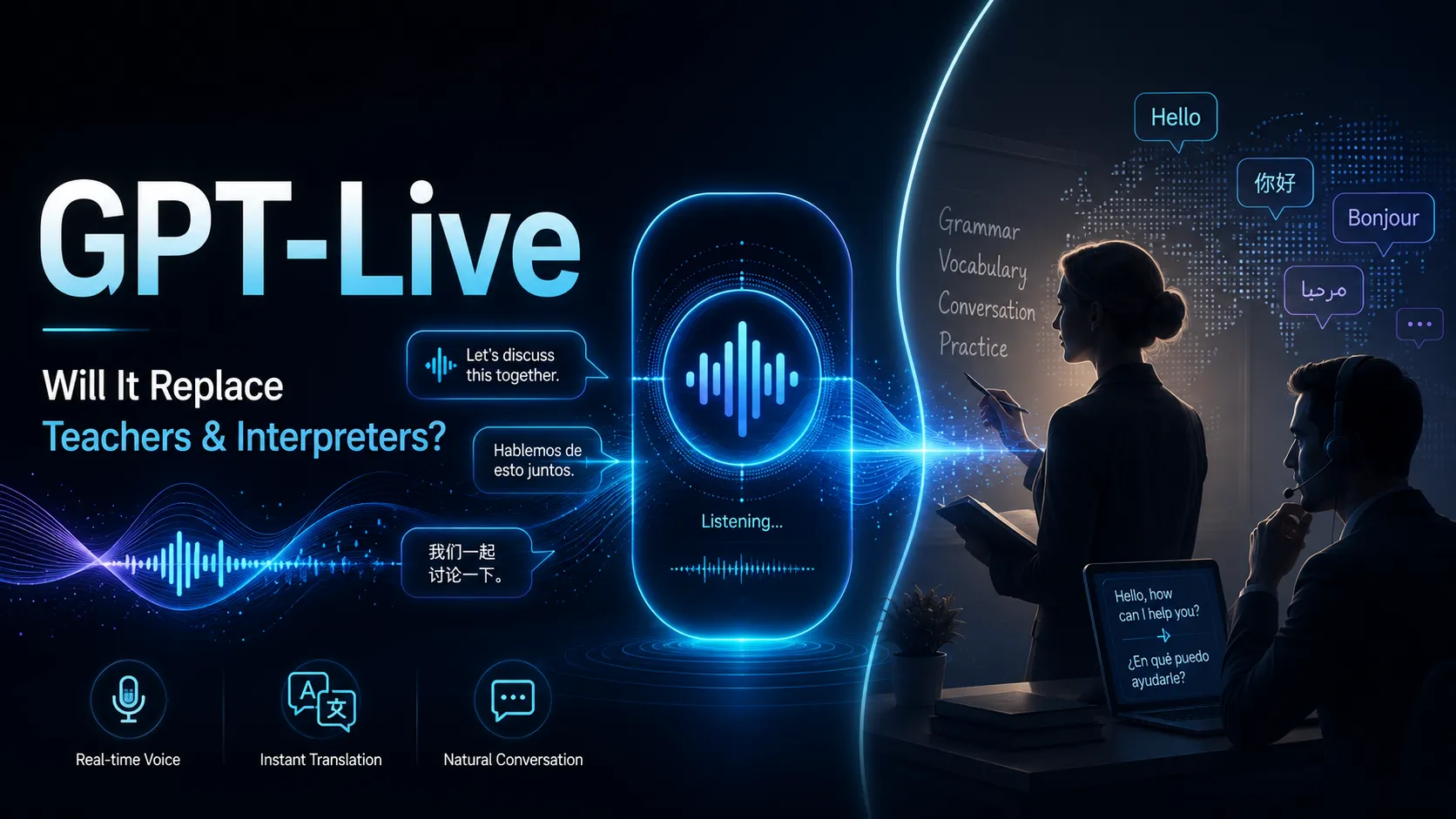
GPT-Live is OpenAI’s real-time voice model designed to listen, understand, speak, and manage conversational turns continuously. Unlike traditional voice assistants that wait for a user to finish speaking before processing a response, GPT-Live can interpret speech while the conversation is still happening.
The model’s defining feature is full-duplex communication. A user can interrupt the model, pause mid-sentence, change direction, or speak over it, while the system continues tracking conversational intent. This creates an interaction pattern that feels closer to a phone call than a sequence of recorded voice messages.
GPT-Live also separates conversational responsiveness from complex reasoning. It can maintain the spoken interaction while more demanding tasks are handled by another model or external tool, reducing the amount of silence users experience during searches, calculations, or multi-step analysis.
Is GPT-Live Really Almost Latency-Free?
GPT-Live reduces perceived latency enough to make many conversations feel nearly immediate, but OpenAI has not published comprehensive public benchmarks for every region, device, and network condition. Claims that the model has literally zero delay are therefore inaccurate.
The experience feels fast because GPT-Live does not rely entirely on the old pipeline of speech recognition, text generation, and text-to-speech playback. It processes audio continuously and can decide several times per second whether to keep listening, acknowledge the speaker, remain silent, or begin answering.
Perceived latency is also reduced through natural conversational behavior. Short acknowledgements, turn-taking signals, interruption handling, and context-aware pauses make waiting less noticeable even when the system is still processing a complex request.
| Voice capability | Traditional voice assistant | GPT-Live-style system |
|---|---|---|
| Listening pattern | Waits for a completed turn | Processes speech continuously |
| Interruptions | Often restart the interaction | Can adapt during the response |
| Turn-taking | Rigid and sequential | Dynamic and conversational |
| Complex tasks | Creates noticeable silence | Can maintain the interaction while processing |
| Emotional delivery | Usually generated after text | Preserves more audio-level context |
Is GPT-Live’s Pronunciation Better Than 99% of People?
There is no credible public evidence that GPT-Live has better pronunciation than 99% of human speakers. That statement is a social-media exaggeration rather than an official benchmark or independently verified result.
Pronunciation quality cannot be reduced to a single ranking. It includes phoneme accuracy, rhythm, stress, intonation, fluency, regional accent, emotional appropriateness, and the ability to adapt speech to a listener’s proficiency level.
GPT-Live can sound clearer and more consistent than many non-native speakers because it does not become tired, nervous, distracted, or physically strained. It can repeat a sentence indefinitely and maintain a stable pace, making it highly effective for pronunciation demonstrations and listening practice.
The model is not equally native-sounding in every language. Less-supported languages, regional varieties, code-switching, uncommon names, local dialects, and specialized terminology can still produce unnatural pronunciation or misplaced emphasis.
Can GPT-Live Work as a Real-Time Interpreter?
GPT-Live can perform practical real-time translation for everyday conversations, internal meetings, travel, customer support, product demonstrations, online communities, and other low-risk situations. It can already remove the need for a human interpreter in many interactions where minor errors are acceptable.
OpenAI’s related real-time translation systems support dozens of input languages and multiple major output languages. The broader technical direction is clear: multilingual speech translation is becoming an inexpensive software capability rather than a premium service reserved for specialized devices or human operators.
Professional simultaneous interpretation requires more than converting sentences between languages. Human interpreters prepare terminology, research participants, anticipate arguments, preserve tone, identify ambiguity, correct speakers, manage cultural references, and make rapid decisions when literal translation would be misleading.
GPT-Live remains less reliable when conversations contain overlapping speakers, poor microphones, regional accents, technical abbreviations, legal wording, numerical data, names, mixed languages, sarcasm, diplomatic language, or rapidly changing subject matter.
What Is the Difference Between AI Translation and Professional Simultaneous Interpretation?
AI translation converts speech efficiently, while professional simultaneous interpretation manages meaning, risk, context, and responsibility. The distinction becomes most important when a translation error can change a contract, diagnosis, negotiation, legal statement, or political message.
| Dimension | GPT-Live and real-time AI | Professional interpreter |
|---|---|---|
| Availability | Instant and continuous | Requires scheduling and preparation |
| Cost per conversation | Very low at scale | High professional cost |
| Repetition | Unlimited | Limited by time and fatigue |
| Everyday dialogue | Strong | Strong but often unnecessary |
| Terminology preparation | Limited or system-dependent | Extensive preparation possible |
| Cultural nuance | Inconsistent | Core professional skill |
| Overlapping speakers | Difficult | Difficult but actively managed |
| Legal accountability | Unclear | Defined by contracts and standards |
| High-stakes correction | May fail silently | Can intervene and clarify |
| Confidential negotiations | Requires technical governance | Governed by professional obligations |
Will GPT-Live Make English Teachers Unemployed?
GPT-Live will automate a large share of language practice, but it will not eliminate the need for teachers who diagnose problems, design learning programs, maintain motivation, supervise children, and take responsibility for outcomes.
The most exposed service is unstructured conversation practice. A learner no longer needs to book a human tutor merely to practice ordering food, answering interview questions, discussing daily routines, or repeating difficult sounds.
AI voice tutors offer several structural advantages:
- They are available at any time.
- They can repeat exercises without frustration.
- They can instantly change difficulty, speed, accent, or topic.
- They can simulate employers, customers, examiners, or travel scenarios.
- They can generate personalized vocabulary and grammar exercises.
- They can track recurring mistakes across many conversations.
- They cost substantially less than repeated human tutoring sessions.
Human teachers remain stronger at identifying why a student is not progressing. A learner may understand grammar but avoid speaking because of anxiety, poor study habits, weak listening skills, unrealistic goals, or fear of correction. Solving those problems requires sustained observation and human judgment.
Teachers also create accountability. Many learners do not fail because explanations are unavailable; they fail because they stop practicing. A human instructor can set expectations, adjust a curriculum, communicate with parents, evaluate effort, and intervene when a learner disengages.
Which English Teaching Jobs Are Most Exposed?
Routine and low-differentiation teaching services face the highest risk because GPT-Live can deliver the same basic function continuously at a lower price. Specialized, outcome-driven, and relationship-based teaching is more defensible.
| Language service | Automation exposure | Main reason |
|---|---|---|
| Casual speaking practice | Very high | AI provides unlimited conversation |
| Basic pronunciation repetition | Very high | Consistent speech and instant replay |
| Vocabulary drills | Very high | Easily personalized and automated |
| Basic grammar explanations | High | Standardized knowledge task |
| Entry-level adult tutoring | High | Much of the session can be simulated |
| Interview role-play | High | AI can generate realistic scenarios |
| Test preparation planning | Medium | Requires diagnosis and strategy |
| Academic writing coaching | Medium | Judgment and long-term feedback matter |
| Children’s classroom teaching | Low to medium | Supervision and social interaction matter |
| Special education support | Low | Requires individualized human care |
| Learning motivation and accountability | Low | Depends on relationships and trust |
The vulnerable teacher is not every English teacher. It is the teacher whose entire value proposition consists of reading a textbook, correcting obvious mistakes, and providing conversation time without a measurable learning system.
Which Interpretation Jobs Are Most Exposed?
Low-risk and repetitive interpretation jobs face the greatest automation pressure. Travel conversations, ordinary business calls, internal meetings, product support, hospitality, and basic multilingual customer service can increasingly be handled by real-time AI.
The International Labour Organization has classified translation and interpretation among occupations with relatively high exposure to generative AI. High exposure means that a large share of tasks can be automated or transformed, not that the entire profession disappears immediately.
Professional interpreters remain necessary in settings where errors have irreversible consequences. Courts, hospitals, diplomatic meetings, mergers, regulatory investigations, asylum interviews, technical negotiations, and live international broadcasts require accuracy, intervention, preparation, and accountability.
The interpretation market is likely to divide into three layers:
- Fully automated: travel, customer support, informal meetings, games, online communities, and low-risk calls.
- AI-assisted: corporate events, webinars, conferences, training sessions, and multilingual media with human review.
- Human-led: legal, medical, diplomatic, financial, political, and other high-consequence communication.
What Jobs Will GPT-Live Disrupt First?
GPT-Live will disrupt tasks that are spoken, repetitive, standardized, high-volume, and tolerant of occasional errors. These conditions describe a large portion of entry-level language work and voice-based customer operations.
The earliest affected roles and services include:
- Low-cost language conversation partners
- Pronunciation practice applications
- Scripted telephone support agents
- Basic multilingual customer service
- Travel and hospitality interpreters
- Internal meeting translators
- Voice-based appointment booking
- Repetitive sales qualification calls
- Standard product demonstrations
- Basic interview preparation services
These jobs will not always disappear completely. Many will be reorganized so that fewer employees supervise more conversations, handle exceptions, review transcripts, manage customers, and correct the AI when it encounters unusual situations.
Why Does GPT-Live Matter More Than Earlier Voice Assistants?
GPT-Live matters because conversational timing is as important as language intelligence. Earlier systems could generate impressive answers but still felt mechanical because users had to wait, avoid interruptions, speak in complete turns, and tolerate awkward pauses.
Real human conversation contains hesitation, overlap, incomplete sentences, corrections, filler words, emotional cues, and abrupt topic changes. A system that can manage these behaviors crosses an important usability threshold, even when its underlying factual accuracy has not improved by the same amount.
The economic effect comes from combining four capabilities in one interface:
- Natural speech generation
- Continuous listening
- Real-time translation
- Access to a general-purpose reasoning model
A company no longer needs separate systems for transcription, scripted voice responses, translation, question answering, and conversation management. Consolidating these functions makes deployment cheaper and expands the number of jobs that can be partially automated.
What Are GPT-Live’s Most Important Limitations?
GPT-Live remains an AI system that can misunderstand speech, invent information, mistranslate terminology, mispronounce names, and respond confidently when clarification would be safer. Natural delivery does not guarantee factual correctness.
The primary limitations include:
- Accent variability: Regional pronunciation and non-standard speech remain challenging.
- Speaker overlap: Multiple people talking simultaneously can reduce accuracy.
- Specialized vocabulary: Medical, legal, scientific, and industry terms require testing.
- Names and numbers: Proper nouns, dates, currencies, and figures are high-risk details.
- Context loss: Long conversations may create incorrect assumptions about earlier statements.
- Emotional misreading: Tone can be interpreted incorrectly.
- Privacy requirements: Continuous audio processing creates data-governance concerns.
- Accountability: The model cannot accept legal or professional responsibility for mistakes.
The smoother the voice becomes, the more likely users are to overtrust the answer. A fluent system can make an incorrect translation sound authoritative, which is more dangerous than an obviously mechanical tool in high-stakes environments.
How Should English Teachers Adapt to GPT-Live?
English teachers should stop competing with AI on repetition and start selling diagnosis, structure, accountability, and outcomes. GPT-Live is more useful as a practice engine inside a teaching program than as a complete replacement for an effective instructor.
A resilient teaching workflow can divide responsibilities clearly:
| AI responsibility | Teacher responsibility |
|---|---|
| Daily speaking practice | Long-term learning strategy |
| Pronunciation demonstrations | Diagnosis of persistent errors |
| Vocabulary drills | Selection of relevant material |
| Role-play simulations | Evaluation of real performance |
| Instant grammar explanations | Correction of misconceptions |
| Practice transcripts | Progress interpretation |
| Repetition and review | Motivation and accountability |
| Scenario generation | Cultural and social context |
A teacher can assign five AI conversations per week, review the transcripts, identify recurring weaknesses, and use live sessions for targeted correction. This model increases practice volume while preserving the parts of teaching that require human expertise.
How Should Interpreters Adapt to Real-Time AI?
Interpreters should move from pure speech conversion toward terminology management, quality control, high-stakes specialization, and AI-assisted multilingual operations. The future interpreter may supervise systems as often as they personally translate every sentence.
Practical adaptation strategies include:
- Specializing in legal, medical, technical, diplomatic, or financial domains
- Building and maintaining verified terminology databases
- Learning to audit real-time machine translation
- Offering post-event transcript validation
- Managing multilingual conferences and AI interpretation channels
- Providing confidentiality and compliance guarantees
- Developing expertise in culturally sensitive negotiations
- Taking responsibility for high-risk numerical and factual accuracy
Human professionals become more valuable when the cost of an error is greater than the cost of hiring expertise. That principle protects specialized interpretation even as routine translation becomes automated.
Will GPT-Live Reduce the Price of Language Services?
GPT-Live will reduce prices for standardized language services because it turns conversational practice and basic translation into scalable software. Services previously billed by the hour can be delivered continuously with a much lower marginal cost.
Price pressure will not affect every part of the market equally. Commodity services will become cheaper, while trusted specialists may charge more for verification, responsibility, customization, and intervention in difficult cases.
The market is likely to shift from paying for time to paying for outcomes. Students will pay for passing an exam, improving business communication, or reaching a measurable proficiency level. Companies will pay for accurate multilingual operations rather than a fixed number of interpreter hours.
Does GPT-Live Mean Another Wave of Immediate Unemployment?
GPT-Live represents task automation rather than instant occupation elimination. Jobs consist of multiple responsibilities, and voice generation or translation is only one part of teaching, interpreting, customer service, sales, management, and professional communication.
The immediate impact is lower demand for routine human hours. One teacher can support more students by assigning AI practice. One interpreter can supervise several automated channels. One customer-service employee can manage exceptions from hundreds of AI-handled conversations.
This productivity increase can reduce entry-level hiring even when senior professionals remain employed. The most realistic risk is therefore not that every worker is dismissed in one night, but that fewer people are needed to deliver the same volume of standardized work.
What Is the Most Accurate Way to Describe GPT-Live’s Impact?
GPT-Live does not make English teachers and simultaneous interpreters obsolete; it makes routine speech-based services cheaper, more available, and easier to automate. That distinction explains both the technology’s importance and the limits of the viral claim.
A more accurate statement is:
GPT-Live is turning basic speaking practice, low-risk translation, and scripted voice interaction into inexpensive infrastructure. Professionals who only provide standardized output face serious pressure, while those who provide judgment, responsibility, specialization, and trust remain difficult to replace.
Conclusion
GPT-Live marks a major improvement in AI voice interaction because it can listen and speak more naturally, handle interruptions, reduce perceived delay, and support real-time multilingual conversations. It will reshape language education, translation, customer support, and other voice-heavy industries.
The claim that its pronunciation is better than 99% of people is unsupported. The claim that English teachers and simultaneous interpreters became obsolete overnight is also false. The real disruption is narrower but still significant: routine language labor is becoming dramatically cheaper.
English teachers should use GPT-Live to multiply practice while focusing on diagnosis, motivation, curriculum, and measurable results. Interpreters should specialize in high-risk domains, terminology control, cultural nuance, verification, and accountability. GPT-Live replaces standardized tasks first—not trusted professionals who are responsible for what happens when language goes wrong.
Continue Reading
More articles connected to the same themes, protocols, and tools.

Referenced Tools
Browse entries that are adjacent to the topics covered in this article.