

Remix IDE
A browser-first, AI-assisted Web3 IDE focused on Solidity smart contract development, rapid experimentation, and EVM deployment.
Information checked: Jul 10, 2026 ·View sources
Tool details
- Type
- Cloud IDEs
- Platforms
- Web, Windows, macOS, Linux
- Free plan
- Yes
- Open source
- Yes
- Bring your own key
- Yes
- Local models
- Yes
Overview
Best for
- Learning Solidity and Ethereum development
- Rapidly prototyping EVM smart contracts
- Testing and debugging contracts without a local toolchain
- Deploying contracts to testnets and EVM-compatible networks
- Reviewing compiler errors and contract logic with AI assistance
- Connecting a visual IDE to existing Hardhat or Foundry projects
Strengths
- Starts in a browser with almost no local setup.
- Purpose-built workflow for Solidity and EVM contracts.
- AI assistance is integrated with compilation and analysis tools.
- Supports local Ollama models for more private workflows.
- Open-source core with a large plugin ecosystem.
- Desktop mode can connect to Hardhat and Foundry projects.
Limitations & trade-offs
- General-purpose application development
- Large multi-language monorepos
- Teams that require mature enterprise administration today
- Fully automated CI/CD-first contract pipelines
- Developers who need every AI agent feature to run locally
- Not a general-purpose replacement for Cursor, VS Code, or JetBrains IDEs.
- Browser storage should not be treated as the only project backup.
- Advanced Hardhat and Foundry workflows require Remix Desktop.
- Mobile and tablet use is not officially supported.
- Some AI agents, connectors, and team features are paid, beta, or still rolling out.
- Cloud-model prompts may be processed or retained under third-party provider policies.
Get started
Pricing & usage limits
Official pricingFree tier · From $7.99
Core Remix IDE access, RemixAI assistance, QuickDApp generation, and 20,000 initial AI credits; additional credits or a personal API key can be used.
Advertised with 40,000 AI credits, cloud workspaces, expanded AI skills, and Ollama or local-model support; rollout details may still change.
Launch offer shown against a $19.99 regular price; includes 80,000 AI credits, advanced contract agents, live-data connectors, and expanded dApp hosting.
Announced tier for collaboration, custom AI models, dedicated support, integrations, and volume pricing; confirm current availability with Remix.
Pricing checked: Jul 10, 2026 · Subscription, usage limits, and model costs may be billed separately.
Features & details
AI-Assisted Contract Development
- Plain-language smart contract generation
- Context-aware Solidity code completion
- Compiler error and code explanations
- Inline documentation generation
Smart Contract Workflow
- Solidity, Vyper, and Noir development
- In-browser compilation and Remix VM
- Transaction debugging and testing
- Slither-assisted security analysis
Deployment and Integrations
- Browser wallet and WalletConnect deployment
- EVM network and custom RPC support
- Hardhat and Foundry desktop integration
- Contract verification and Git workflows
Agentic and Extensible Tooling
- MCP access to IDE tools and libraries
- OpenZeppelin and web-search connectors
- Prompt-to-dApp frontend generation
- Plugin-based development environment
Local and Cross-Platform Options
- Browser and desktop applications
- Ollama-powered local AI assistance
- Local filesystem access on desktop
- Remote or local Ollama endpoint configuration
Why Choose Remix IDE?
Remix IDE is most useful when the main goal is to move from a Solidity idea to a compiled, testable, and deployable contract without assembling a local toolchain first. Its browser-first design removes much of the setup work associated with package managers, RPC configuration, compiler installation, and test-chain management, which makes it particularly effective for learning, demonstrations, audits, and early-stage prototypes.
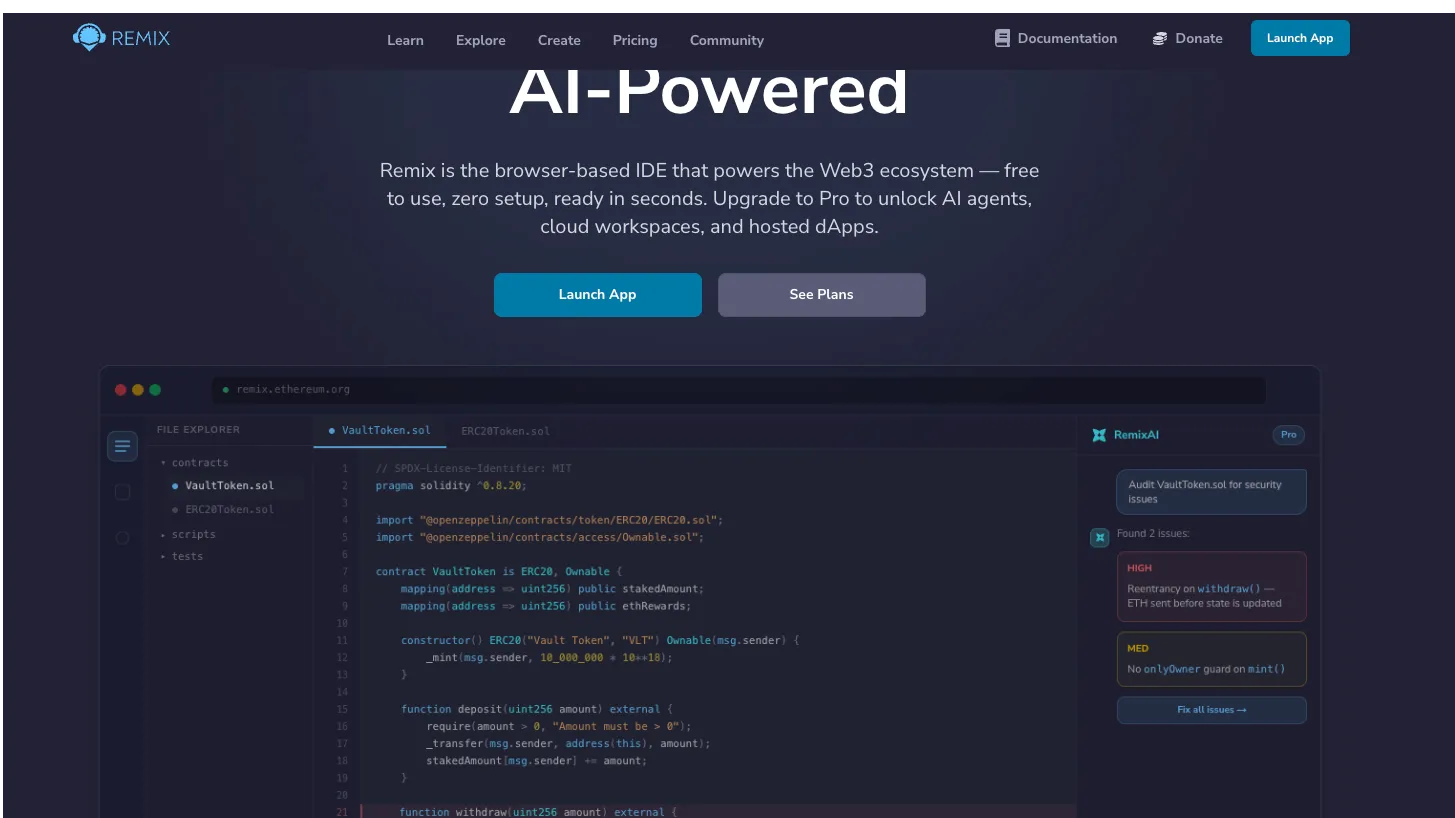
The product is differentiated by how closely its AI layer is connected to the smart contract workflow. RemixAI is not simply a generic chat window placed beside an editor. It can work with the active file, explain compiler failures, propose contract changes, interact with IDE capabilities through MCP connections, and use Solidity-oriented resources during analysis. This tighter context makes it more relevant to Web3 development than a general coding assistant that has no direct access to compilation, deployment, or contract-analysis tools.
Remix IDE should still be viewed as a specialized Web3 environment rather than a universal AI code editor. It is optimized around contracts, transactions, EVM networks, wallets, and related frontend prototypes. Developers building a large React application, a backend service, or a multi-language monorepo will usually need a broader editor and toolchain alongside it.
How Does the Core Workflow Fit Real Smart Contract Development?
The most effective Remix workflow starts with a disposable or version-controlled workspace, proceeds through local simulation, and reaches a public network only after the contract behavior has been tested. A developer can draft a contract manually or use AI to create an initial implementation, pin the intended compiler version, compile it, deploy it inside Remix VM, and call each public function through the generated contract interface.
This visual interaction model is especially valuable when transaction behavior is easier to understand by observing accounts, calldata, emitted events, storage changes, and execution traces. Instead of writing a deployment script merely to inspect one function, the developer can compile, deploy, call, and debug the contract from the same interface. That makes Remix efficient for isolating a failing transaction or demonstrating how a contract behaves.
Browser convenience should not become a substitute for project hygiene. Browser storage is not a durable source-control strategy, so meaningful projects should be synchronized with Git, exported regularly, opened through Remix Desktop, or connected to a local folder. Compiler settings, constructor arguments, network identifiers, deployed addresses, and verification metadata should be recorded outside the browser session.
For production-oriented work, Remix can become the visual layer around a more conventional repository. Remix Desktop can open local projects and connect to Hardhat or Foundry environments, allowing teams to keep scripted tests, deployment automation, dependency management, and CI pipelines while still using Remix for interactive debugging and deployment inspection.
Where Does RemixAI Add Practical Value?
RemixAI adds the most value during explanation, iteration, and tool coordination rather than as an unquestioned contract author. Compiler diagnostics in Solidity can be difficult for new developers to interpret, and an explanation grounded in the active contract can shorten the loop between an error and a valid fix. The same applies to unfamiliar functions, inheritance structures, access-control patterns, and generated documentation.
The MCP-based workflow is more significant than ordinary autocomplete because it can connect the assistant to workspace files, compilation, static analysis, OpenZeppelin contracts, and selected external data services. This lets the assistant perform a sequence of context-aware actions instead of responding only with isolated code snippets. It can, for example, inspect a contract, incorporate static-analysis findings, compare the implementation with a standard library pattern, and propose a revision.
AI-generated Solidity still requires adversarial review. A contract that compiles may contain authorization mistakes, economic vulnerabilities, unsafe external calls, incorrect assumptions about token behavior, or upgradeability risks. RemixAI can help surface issues and suggest established patterns, but it does not replace unit tests, invariant testing, peer review, or a professional audit for contracts that will hold meaningful value.
Local Ollama support creates a useful privacy and cost-control option for code completion and conversational help. The tradeoff is that local models do not provide every agentic capability available through the hosted RemixAI service. Teams should therefore decide whether a task requires maximum integration or maximum control over source-code exposure, rather than assuming one model configuration fits every repository.
Which Use Cases Fit Remix IDE Best?
Remix IDE fits education particularly well because the relationship between source code and blockchain execution remains visible. Students can compile a small contract, deploy it to a simulated chain, call functions, inspect transactions, and repeat the process without first learning a separate command-line framework. This reduces setup friction without hiding the fundamental concepts of accounts, gas, state changes, and contract calls.
It is also effective for rapid contract prototyping. Token experiments, access-control demonstrations, interface tests, minimal proof-of-concept protocols, and isolated bug reproductions can often be completed faster in Remix than in a newly configured local repository. QuickDApp extends this prototyping path when a contract needs a simple interface for demonstration or stakeholder review.
Security reviewers and experienced developers can use Remix as a focused investigation environment. A suspicious function or verified contract can be loaded, compiled with matching settings, exercised against controlled inputs, and stepped through in the debugger. This does not replace a full audit environment, but it can accelerate triage and produce a compact reproduction of a problem.
The fit becomes weaker as repository complexity grows. Large dependency graphs, extensive TypeScript deployment code, fuzzing campaigns, custom build steps, multiple packages, strict CI requirements, and coordinated team workflows are generally easier to manage in a local toolchain. In those situations, Remix works better as a companion interface than as the authoritative development environment.
How Does Remix IDE Compare With Hardhat, Foundry, and ChainIDE?
Remix IDE and Hardhat solve overlapping problems from different directions. Remix emphasizes immediate visual interaction and low setup, while Hardhat emphasizes a programmable JavaScript or TypeScript environment for tests, deployments, plugins, and automation. A beginner or auditor may reach a useful result faster in Remix, whereas a team maintaining repeatable deployment scripts and CI jobs may prefer Hardhat as the project foundation.
Foundry is a stronger fit for developers who want a fast, Solidity-centric command-line workflow with advanced testing and scripting. Remix offers a gentler visual path and integrated transaction debugging, while Foundry is better suited to terminal-driven automation, fuzz testing, and repositories where tests and deployment logic are treated as code. The two can be complementary because Remix Desktop can connect to a Foundry project and local Anvil chain.
ChainIDE is the closest conceptual alternative for users specifically seeking a browser-based smart contract IDE. The decision is likely to depend on chain coverage, preferred integrations, collaboration requirements, and the depth of the Solidity debugging workflow. Remix has a particularly strong connection to the Ethereum learning ecosystem and a mature plugin-oriented interface.
The practical choice is not always exclusive. A common progression is to learn and prototype in Remix, move the contract into Hardhat or Foundry when automated testing and deployment become essential, and return to Remix when visual inspection or interactive debugging is convenient.
What Is the Best Configuration for Reliable Use?
A reliable Remix setup begins by selecting an explicit Solidity compiler version that matches the contract pragma and intended deployment environment. Optimizer settings, EVM target, linked libraries, and metadata options should be treated as reproducible build configuration rather than temporary UI choices. These values are important for verification and should be recorded with the repository.
Testing should start in Remix VM or a local development node before a wallet is connected to a public network. Separate browser-wallet accounts should be used for development, and testnet deployments should be verified before any mainnet transaction is considered. Unknown contracts should never be given wallet permissions merely because they were generated or suggested by an AI assistant.
For local or confidential repositories, Remix Desktop with a Git-backed folder is safer than relying on browser storage. Ollama can be selected for private conversational assistance and completion, while hosted models can be reserved for tasks that need Remix's fuller agentic workflow. MCP permissions should be reviewed individually because a connector that can inspect files, run tools, or query external services changes the assistant's effective access.
Teams should keep the authoritative test suite and deployment process in version control even when Remix is used daily. This creates a clear boundary: Remix provides rapid interaction and visual diagnostics, while the repository preserves repeatability, review history, and automation.
What Should Developers Know Before Migrating?
Moving from a small Remix workspace to Hardhat or Foundry usually requires more than copying .sol files. Imports must be converted into dependency declarations or remappings, compiler and optimizer settings must be recreated, deployment assumptions must become scripts, and interactive checks must become automated tests. Deployed addresses and constructor parameters should also be migrated into network-specific configuration.
The reverse migration is possible when a local project needs visual debugging. Remix Desktop is the better route because it can open the existing filesystem and integrate with supported local environments. Developers should avoid maintaining separate, drifting copies of the same contracts in the browser and local repository.
Remix IDE is therefore best understood as both an entry point and a specialist companion. It can carry a developer from the first Solidity function to a testnet deployment, then remain useful beside a production toolchain for explanations, experiments, transaction inspection, and focused debugging.
Model support & data privacy
Supported models
- Mistral AI
- Anthropic
- OpenAI
- Ollama
- Codestral
- Qwen3-Coder
- GPT-OSS
- DeepSeek-Coder-V2
Privacy & data handling
Remix offers opt-in analytics controls and local Ollama support. Prompts sent to hosted models may be subject to the selected provider's retention or training policies, while local models keep inference on infrastructure controlled by the user. Review permissions before enabling MCP connectors or sharing private contract code.
Guides, reviews & fixes
No published guides yet. Start with the official documentation above.
Product updates
No verified product updates listed yet. Follow this tool to see new relevant content in Saved.
See the content timelineSources & verification
Verification dates record when this directory checked the information. Product release dates appear separately above.
Directory revision history
Verified product positioning, AI providers, local Ollama support, current advertised plans, and official documentation.
Official documentation reflected current RemixAI, MCP, local-model, wallet, Hardhat, and Foundry workflows.