On This Page8 sections
Key Takeaways
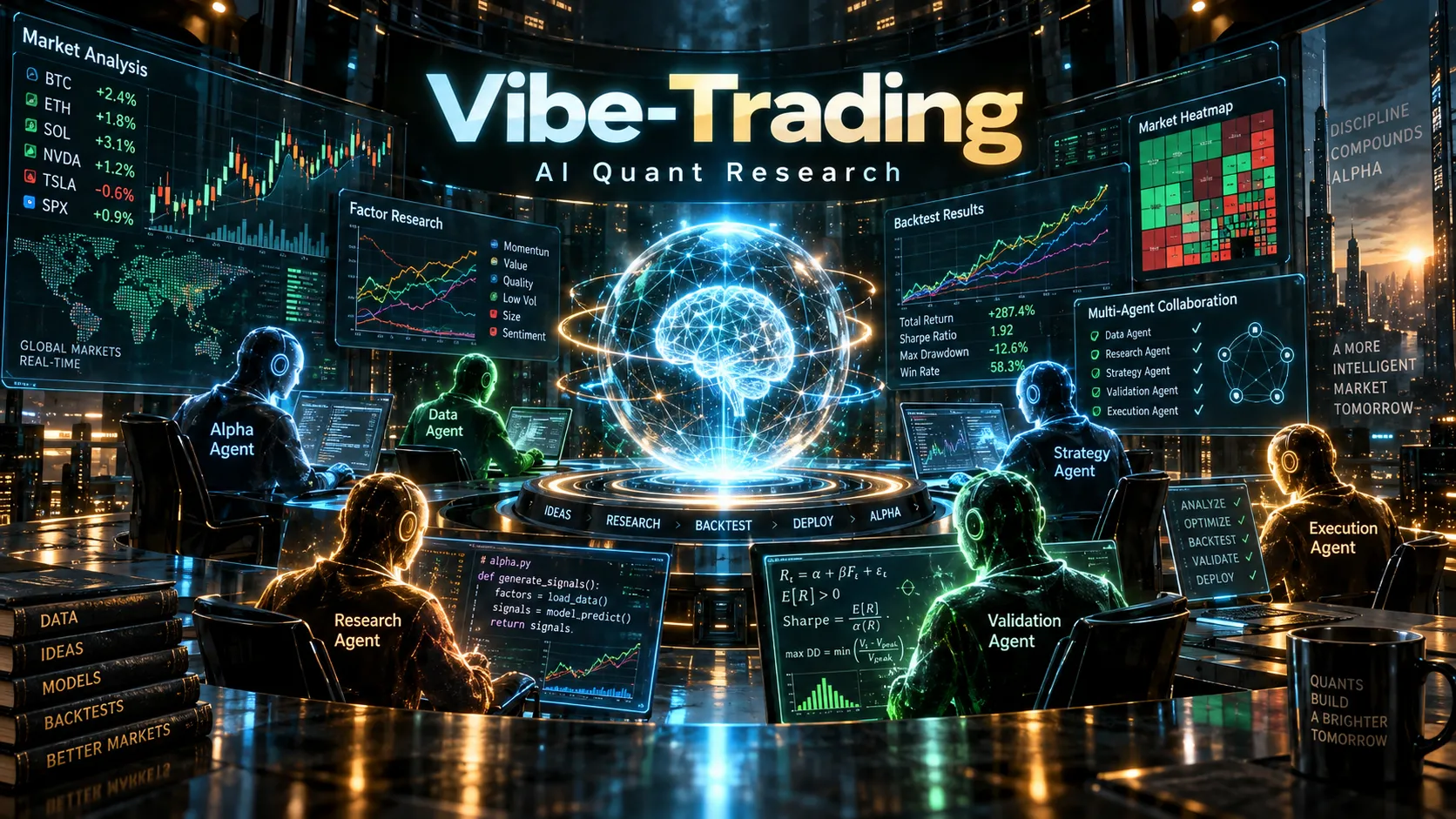
- Vibe-Trading is an open-source finance research agent from HKUDS, the Data Intelligence Lab at the University of Hong Kong, rather than a conventional trading bot or an autonomous hedge fund.
- The platform connects natural-language prompts to market data, factor research, strategy testing, backtesting, validation, multi-agent analysis, and persistent research artifacts.
- As of October 2026, the official documentation lists 90 finance skills, 462 bundled alphas, 30 swarm presets, 11 backtesting engines, 28 market-data sources, 18 broker connectors, and 74 MCP tools.
- Its Alpha Zoo combines Qlib158, Alpha101, GTJA191, academic factors, and point-in-time fundamental factors, making Vibe-Trading more than an LLM wrapper around a price API.
- The most important architectural idea is not AI stock picking. It is turning a research request into an auditable workflow: plan → ground → execute → validate → deliver.
- Shadow Account can analyze a broker journal, infer recurring trading rules, backtest a rule-based version of those behaviors, and compare the result with actual trades.
- Vibe-Trading should still be treated as research and experimental quant infrastructure. Backtests, inferred rules, and Agent conclusions do not prove future profitability.
What Is Vibe-Trading?
Vibe-Trading is an open-source AI-powered finance research environment developed under HKUDS, the Data Intelligence Lab at HKU. The repository describes it as a personal trading agent, while the project documentation more precisely positions it as an open-source finance research agent capable of turning market questions into runnable research.
That distinction matters.
A typical financial chatbot might answer a question such as:
Is momentum still working in large-cap US technology stocks?
with a narrative explanation.
Vibe-Trading is designed to go further. A research workflow can select relevant tools, retrieve market data, calculate factors, run a backtest, compare against a benchmark, perform robustness checks, invoke specialist Agents, and save artifacts that can be inspected later. The official workflow is organized around five stages: Plan, Ground, Execute, Validate, and Deliver.
Conceptually, the pipeline looks like this:
Natural-language research question
        ↓
Route to skills, data and tools
        ↓
Fetch market evidence
        ↓
Factor / signal construction
        ↓
Strategy execution or backtest
        ↓
Validation and robustness checks
        ↓
Multi-agent review when needed
        ↓
Research report + artifacts
This is the reason descriptions such as an AI quant research desk are more useful than simply calling Vibe-Trading an AI trading chatbot.
Why Vibe-Trading Is Getting So Much Attention
The GitHub project has grown to roughly 34.5K stars and 5.6K forks, with an MIT license, placing it among HKUDS's most visible open-source projects.
The attention is not only about the star count. Vibe-Trading sits at the intersection of several fast-moving trends:
- Agentic AI, where models execute workflows rather than only generate text.
- Quantitative finance, where research naturally decomposes into data, signals, tests, risk analysis, and reporting.
- MCP-based tooling, allowing finance capabilities to be exposed to other AI clients.
- Multi-agent systems, where specialized workers can perform separate research roles.
- Reproducible AI research, where outputs need evidence, metrics, artifacts, and provenance rather than unsupported prose.
The result is a system that looks much closer to a programmable research organization than a traditional stock-analysis chatbot.
The Core Difference: From AI Answers to AI Research Execution
Most consumer AI finance products follow a simple architecture:
Question
  ↓
LLM
  ↓
Narrative answer
Vibe-Trading attempts something closer to:
Question
  ↓
Research planning
  ↓
Market data
  ↓
Finance skills
  ↓
Quantitative tools
  ↓
Backtesting
  ↓
Validation
  ↓
Agent review
  ↓
Evidence-backed report
The official workflow explicitly separates planning, grounding, execution, validation, and delivery, with backtests and research runs able to leave behind charts, strategy files, reports, metadata, and reusable context.
That architecture addresses a major weakness of LLM-based financial analysis: a convincing answer is not necessarily a verified answer.
When a model says that a strategy has a Sharpe ratio of 1.7, users should be able to determine:
- Which data produced the number?
- What date range was used?
- Was the strategy benchmarked?
- Were fees or slippage modeled?
- Was future information accidentally leaked into the signal?
- Can the backtest be reproduced?
Vibe-Trading's recent development has increasingly focused on this evidence layer rather than simply adding more chat features.
90 Finance Skills: What They Actually Mean
One of Vibe-Trading's headline numbers is 90 finance skills across nine categories.
It is important not to misunderstand the term skill.
These are not 90 independent AI models. They are reusable financial research capabilities and methodology modules that an Agent can load when a task requires them.
The documented skill set covers areas such as:
- Candlestick analysis
- Ichimoku
- Elliott Wave
- Smart Money Concepts
- Harmonic patterns
- Chanlun analysis
- Factor research
- Multi-factor modeling
- Machine-learning strategies
- Pair trading
- VaR and CVaR
- Stress testing
- Hedging
- Black-Scholes pricing
- Options Greeks
- Multi-leg options strategies
- SEC filing analysis
- Earnings revisions
- ETF flows
- ADR/H-share analysis
- Crypto funding rates
- Liquidation analysis
- Stablecoin flows
- Token unlocks
- DeFi yield research
- Credit analysis
- Macro research
- Sector rotation
- Behavioral finance
The repository exposes these methodologies through functions such as list_skills and load_skill, making them available not only to Vibe-Trading's own interface but also to connected Agents through MCP.
The larger product implication is significant: users can build a reusable research playbook instead of repeatedly explaining an entire investment methodology to an LLM.
The 462-Alpha Zoo Explained
Perhaps the most eye-catching feature is Vibe-Trading's 462 pre-built quantitative alphas.
However, describing these as 462 profitable strategies would be misleading.
They are better understood as candidate quantitative signals and factors that can be analyzed, benchmarked, combined, filtered, or incorporated into larger strategies.
The current Alpha Zoo consists of five families:
| Alpha family | Count | Purpose |
|---|---|---|
| Qlib158 | 154 | Technical and price-volume features inspired by Microsoft Qlib |
| Alpha101 | 101 | Formulaic alphas based on Kakushadze's Alpha101 work |
| GTJA191 | 191 | Short-horizon factors associated with the GTJA191 library |
| Academic | 12 | Factors derived from established finance research and related proxies |
| Fundamental | 4 | Point-in-time fundamental factors |
| Total | 462 |
The project documentation notes that the Qlib group contains 154 implemented features, despite retaining the familiar qlib158 family name.
The fundamental collection includes metrics such as earnings yield, return on equity, gross profitability, and asset growth, implemented with point-in-time considerations intended to reduce the risk of injecting future accounting information into historical tests.
Why Look-Ahead Bias Matters More Than the Number of Factors
A library with hundreds of factors sounds impressive, but quantitative research fails easily if the testing methodology is wrong.
One of the most dangerous errors is look-ahead bias.
For example:
Calculate today's signal using today's closing price
        ↓
Assume the trade also executed at today's closing price
The strategy effectively knows information before it could have acted on it.
Vibe-Trading's Alpha Zoo includes safeguards such as an AST purity gate and a 300-row look-ahead sentinel test for bundled alphas.
That is more important than simply shipping another hundred indicators.
AI-generated quant research dramatically increases the number of strategies that can be explored. That also increases the danger of accidentally discovering strategies that look excellent only because of leakage, overfitting, or repeated experimentation.
A serious Vibe-Trading workflow should therefore treat factor generation as only the beginning and follow it with:
- Out-of-sample testing
- Walk-forward validation
- Different market regimes
- Transaction-cost assumptions
- Slippage assumptions
- Liquidity constraints
- Benchmark comparison
- Parameter sensitivity testing
11 Backtesting Engines Across Multiple Markets
The latest Vibe-Trading documentation lists 11 backtesting engines covering a broad range of markets.
These include:
- China A-shares
- Global equities
- India equities
- Korea equities
- Vietnam equities
- Crypto
- China futures
- Global futures
- Forex
- Composite cross-market portfolios
- Options portfolios
This matters because a backtester designed for one asset class cannot always be safely reused for another.
Crypto perpetual futures need assumptions around funding, leverage, liquidation, and continuous trading. A-share strategies may need market-specific settlement and trading constraints. Options require payoff and Greeks modeling. Cross-market portfolios introduce currency and calendar issues.
The existence of separate engine paths is therefore more meaningful than simply claiming support for many ticker symbols.
Market Data: 28 Sources and Fallback Routing
The current project metadata lists 28 market-data sources, including providers and libraries spanning equities, crypto, futures, and regional markets.
Examples include:
- Yahoo and yfinance
- Stooq
- Eastmoney
- Sina
- Tencent
- AKShare
- Baostock
- Tushare
- OKX
- Binance
- CCXT
- Futu
- MetaTrader 5
- Finnhub
- Alpha Vantage
- Tiingo
- Financial Modeling Prep
- Longbridge
- PyKRX
The important architectural feature is fallback routing.
Instead of requiring every Agent workflow to know which provider should serve each symbol, the data layer can route requests across appropriate sources.
This improves Agent reliability because a temporary failure at one API does not necessarily terminate an entire research chain.
However, fallback systems create another challenge: different vendors can return different adjustment conventions, histories, fields, or missing-data behavior. Vibe-Trading's recent releases have increasingly focused on preserving data provenance and refusing silent substitutions when expected data is unavailable. The September 2026 v0.1.15 release specifically emphasized making data identify what it actually represents instead of silently replacing missing observations with plausible values.
30 Swarm Teams: What an AI Investment Committee Looks Like
Vibe-Trading includes 30 pre-built multi-agent swarm presets.
Examples documented by the project include:
- Investment Committee
- Global Equities Desk
- Crypto Trading Desk
- Earnings Research Desk
- Macro/Rates/FX Desk
- Quant Strategy Desk
- Risk Committee
A Quant Strategy Desk might conceptually run a workflow such as:
Universe screening
      ↓
Factor research
      ↓
Backtesting
      ↓
Risk audit
An Investment Committee can instead assign different perspectives to separate workers before consolidating the evidence into a final decision.
The advantage is not that multiple Agents magically make an investment opinion correct.
The advantage is decomposition.
A single model trying to simultaneously perform macro analysis, calculate a factor, critique a backtest, evaluate tail risk, and write the final report can easily lose context or overlook contradictions. Splitting the workflow into specialized roles makes those responsibilities easier to inspect.
Persistent Research Is More Important Than Persistent Chat
Financial research is rarely completed in one prompt.
A useful system needs to retain hypotheses, previous tests, strategy artifacts, data assumptions, and conclusions so that later work can build on them.
Vibe-Trading's research workflow is designed to preserve artifacts such as reports, charts, generated strategy files, run metadata, and reusable context.
That creates workflows closer to:
Session 1:
Investigate NVDA earnings momentum

Session 2:
Add analyst revision data

Session 3:
Test whether the signal survives 2022's bear market

Session 4:
Ask the risk team to review drawdown and concentration
rather than starting every conversation from zero.
For serious research, that distinction is fundamental. The valuable memory is not merely conversation history; it is the research state.
Shadow Account: Reverse-Engineering a Trader's Own Behavior
Shadow Account is one of Vibe-Trading's more distinctive features.
The workflow starts with a broker export or generic trading CSV, analyzes actual trading behavior, extracts recurring if-then rules, constructs a rule-based shadow strategy, runs a counterfactual backtest, and produces an audit report.
The documented process includes analysis of metrics and behaviors such as:
- Holding time
- Win rate
- Drawdown
- Profit/loss ratio
- Recurring decision patterns
The system can then ask an interesting counterfactual question:
What might have happened if the trader had applied the recurring rules more consistently?
For example, historical behavior might imply a rule such as:
IF short-term momentum is negative
AND RSI is below a threshold
AND volatility remains inside a defined range
THEN consider entry
The shadow version can then be compared against the actual journal.
This can expose patterns such as:
- Early exits
- Missed signals
- Rule violations
- Overtrading
- Inconsistent sizing
- Behavioral drift
The critical caveat is that an inferred historical pattern is not automatically an alpha. A model can discover coincidental rules that describe previous trades without possessing predictive power.
Shadow strategies therefore still need independent validation.
MCP Turns Vibe-Trading Into Infrastructure for Other Agents
Vibe-Trading is not limited to its own UI.
The official documentation currently lists 74 MCP tools, while the repository skill metadata exposes a broader finance toolkit through the vibe-trading-mcp server.
That enables an architecture such as:
AI coding or research client
        ↓
       MCP
        ↓
Vibe-Trading finance tools
        ↓
Market data / alphas / backtests / reports
The basic setup is straightforward:
pip install vibe-trading-ai
vibe-trading init
vibe-trading
The MCP server can be launched with:
vibe-trading-mcpThe package and commands are documented directly in the project's current skill metadata and wiki.
This architecture may ultimately be more important than Vibe-Trading's standalone application. It allows the project to operate as a financial research capability layer for a larger Agent stack.
Can Vibe-Trading Connect to Real Brokers?
Yes, but the platform is deliberately more constrained than the phrase autonomous trading bot implies.
Current documentation lists 18 broker connectors with 55 profiles. Connections begin read-only, while live orders are possible only for supported brokers after the user explicitly enables the appropriate setup and defines a mandate.
Supported modes vary by broker. The documentation currently describes live-order support within mandates for selected platforms including Alpaca, Binance, eToro, Futu, MetaTrader 5, OKX, Tiger, and Robinhood's Agentic Trading integration, while other connectors are restricted to paper or read-only modes.
The system emphasizes controls such as:
- Read-only defaults
- Explicit broker authorization
- Bounded mandates
- Exposure constraints
- Kill switches
The official documentation therefore describes Vibe-Trading primarily as software for research, simulation, and backtesting, not as a broker or execution venue.
The Trust Layer May Be More Important Than the Agents
One of the strongest signals about Vibe-Trading's direction can be found in its recent releases.
Version 0.1.16, released on September 29, 2026, was described around the theme of making a number able to show where it came from. The release rolled up 492 commits and 116 merged pull requests from 16 contributors since the previous version.
That focus reveals a fundamental problem in AI finance.
A model may produce a perfectly formatted report containing:
- Sharpe ratio: 1.82
- Maximum drawdown: -9.4%
- Alpha: 7.1%
But formatting does not establish truth.
A trustworthy research Agent needs to distinguish between:
- Observed data
- Derived calculations
- User-proposed assumptions
- Counts
- Cited values
- Model-generated interpretation
For financial AI, provenance is a feature.
A smaller model with reliable tool evidence can be more useful than a more intelligent model that occasionally invents a return, valuation, or risk statistic.
Is Vibe-Trading Really an Open-Source Hedge Fund?
Not literally.
The phrase is effective social-media shorthand because Vibe-Trading combines functions that resemble parts of a small research organization:
Data researcher
Quant researcher
Factor analyst
Strategy researcher
Backtest infrastructure
Fundamental analyst
Macro analyst
Crypto analyst
Options analyst
Risk reviewer
Investment committee
Research archive
But a hedge fund requires substantially more infrastructure, including areas such as:
- Capital custody
- Prime brokerage
- Execution algorithms
- Market-impact modeling
- Financing
- Compliance
- Portfolio accounting
- Fund administration
- Investor reporting
- Capacity management
- Operational risk
- Real-time controls
Vibe-Trading does not replace that stack.
A more precise description is:
Vibe-Trading is an open-source agentic quantitative research workspace that can approximate parts of a small research desk.
That description is less sensational, but technically much closer to what the software actually does.
Vibe-Trading vs a Traditional Quant Research Workflow
| Stage | Traditional workflow | Vibe-Trading approach |
|---|---|---|
| Define research question | Researcher writes specification | Natural-language prompt |
| Data discovery | Researcher integrates vendors | Routed data tools and fallbacks |
| Factor implementation | Manually coded | Existing Alpha Zoo or generated research code |
| Methodology | Analyst knowledge / notebooks | Reusable finance skills |
| Backtesting | Separate framework | Integrated market-specific engines |
| Robustness checks | Researcher configures tests | Validation can be included in workflow |
| Risk review | Separate analyst or process | Specialized swarm roles |
| Documentation | Notebook / report | Research artifacts and run metadata |
| Reuse | Repository and institutional knowledge | Skills, sessions, artifacts and Agent context |
The biggest potential productivity gain appears between the research idea and the first credible experiment.
Vibe-Trading can reduce the amount of plumbing needed to move from:
Could this signal work?
to:
Here is a testable strategy with data, metrics, assumptions and evidence.
That does not eliminate the need for financial expertise. It changes where expertise is applied.
What Vibe-Trading Does Well
1. It integrates the fragmented quant workflow
Many research projects fail before the research begins because analysts spend substantial effort wiring together data, notebooks, indicators, plotting libraries, backtesters, and reports.
Vibe-Trading attempts to provide a single orchestration layer across those components.
2. It treats finance as a tool-execution problem
The model is not expected to mentally calculate every statistic. It can delegate calculations to deterministic tools.
That is the correct direction for high-stakes analytical domains.
3. It provides reusable research primitives
The 462-alphas library, 90 finance skills, multiple engines, swarm presets, and MCP interface reduce repeated setup work.
4. It increasingly emphasizes provenance
Recent releases have focused heavily on data semantics, grounding, and preventing silent substitutions.
5. It is useful even without autonomous trading
A research Agent does not need permission to control capital to create value. Faster screening, factor testing, journal analysis, robustness checking, and reporting can already remove substantial manual work.
Where Users Should Be Careful
Vibe-Trading's capabilities can create a dangerous illusion: more automation can make weak research appear more professional.
A generated report containing charts, tables, multiple Agents, and backtests can still be wrong.
Backtest overfitting
Testing hundreds of factors across many universes creates a large multiple-testing problem.
If enough combinations are tried, some will appear exceptional by chance.
Data quality
Fallback providers improve availability, but market datasets can differ in adjustments, timestamps, corporate actions, currencies, missing observations, and instrument identifiers.
Transaction costs
A strategy with a strong gross Sharpe can become unattractive after realistic spreads, commissions, funding rates, borrow costs, and market impact.
Regime dependence
Signals that worked during a low-rate bull market may fail during inflation shocks, liquidity crises, or volatility regime changes.
LLM-generated logic
Agent-generated strategy code should be treated like code written by an unfamiliar junior researcher: inspect it, test it, and verify assumptions.
Shadow Account overinterpretation
The fact that a rule explains previous behavior does not mean the rule predicts future returns.
Multi-agent false confidence
Five Agents agreeing is not equivalent to five independent researchers agreeing. Workers can share the same model biases, data sources, and prompting assumptions.
A Better Way to Use Vibe-Trading
The strongest use case is not:
Find a strategy that makes money.
A better research request is specific about hypothesis, universe, validation, and failure criteria.
For example:
Test whether 12-1 momentum remains predictive in US large-cap equities from 2015 through 2026.

Use a clearly defined universe, lag all signals appropriately, include transaction costs, compare against a broad-market benchmark, report turnover and maximum drawdown, run walk-forward validation, and show results separately for 2020, 2022, and the most recent two years.

Treat failure to survive out-of-sample validation as evidence against the hypothesis.
That prompt is superior because it asks the Agent to try to falsify the idea, rather than optimize until something attractive appears.
Who Should Try Vibe-Trading?
Vibe-Trading is particularly relevant for:
- Quant researchers wanting faster hypothesis exploration
- Developers building AI finance Agents
- Independent traders analyzing systematic versions of their own behavior
- Crypto researchers working with funding, market structure, or cross-exchange data
- Fundamental investors looking to combine filings and quantitative evidence
- Students and researchers studying factor construction and backtesting workflows
- Agent developers looking for finance capabilities exposed through MCP
It is less appropriate for users expecting a one-click system that reliably tells them what to buy tomorrow.
The sophistication of the tooling does not remove uncertainty from financial markets.
Vibe-Trading Installation
The current package can be installed from PyPI with:
pip install vibe-trading-ai
vibe-trading init
vibe-trading
A simple research task can then be launched through the CLI, while vibe-trading-mcp exposes the toolset to compatible Agent clients.
Developers evaluating the project should begin with three experiments rather than immediately connecting a brokerage account:
- Run a simple benchmarked backtest.
- Benchmark several Alpha Zoo factors on a known universe.
- Inspect the generated artifacts, assumptions, timestamps, and validation output.
If those results are understandable and reproducible, more complex Agent workflows become much easier to trust.
The Bigger Trend: Quant Research Is Becoming Agentic
Vibe-Trading is interesting beyond its individual feature list because it demonstrates a broader change in AI software.
The first generation of finance AI focused on:
Ask → AnswerThe next generation increasingly looks like:
Ask
 ↓
Plan
 ↓
Collect evidence
 ↓
Use tools
 ↓
Run experiments
 ↓
Challenge results
 ↓
Create artifacts
 ↓
Continue later
That shift is especially important in quantitative finance because research is naturally procedural.
A researcher does not simply know that momentum exists. The researcher defines a universe, retrieves data, calculates the signal, avoids leakage, specifies execution timing, tests costs, benchmarks performance, evaluates robustness, and documents the result.
Those steps are exactly the kind of structured workflow modern Agents can increasingly orchestrate.
The long-term opportunity is therefore not an AI that predicts every market move.
It is an AI system that can perform more of the repetitive research process while leaving the assumptions and evidence visible to humans.
Conclusion
Vibe-Trading deserves attention, but not because it has magically turned an LLM into an autonomous hedge fund.
Its real innovation is more practical: it packages a large portion of the quantitative research lifecycle into an Agent-executable workflow.
The current platform combines 90 finance skills, 462 bundled alphas, 30 multi-agent research presets, multiple market-specific backtesting engines, dozens of market-data integrations, Shadow Account analysis, broker connectors, MCP access, and an increasingly important evidence and grounding layer.
For developers and quantitative researchers, the most compelling question is no longer whether an LLM can discuss financial markets.
It is whether an Agent can reliably turn a hypothesis into data, code, tests, evidence, criticism, and a reproducible research artifact.
Vibe-Trading is one of the clearest open-source experiments pursuing that direction today.
The best way to evaluate it is to choose a strategy whose historical behavior is already understood, run the same hypothesis through Vibe-Trading, and audit every step from raw data to final metric. If the Agent can make that research process faster without making it less inspectable, that is where the platform's real value begins.
Continue Reading
More articles connected to the same themes, protocols, and tools.
Referenced Tools
Browse entries that are adjacent to the topics covered in this article.