On This Page8 sections
Key Takeaways
- OpenAI ranks No. 1 in consumer AI spending, followed by Anthropic, Canva, Superhuman, and Higgsfield.
- The ranking is more useful as a monetization signal than a literal global revenue league table. a16z says it is based on observed U.S. consumer spending from YipitData panels, not audited worldwide company revenue.
- Creative AI is one of the strongest paid categories. Higgsfield, Suno, ElevenLabs, Midjourney, OpenArt, HeyGen, Runway, Kling AI, Topaz Labs, InVideo, Topview, Photoroom, Evoto AI, and Synthesia all appear in the top 50.
- AI coding and product-building tools have exceptional monetization. Replit ranks No. 6, Lovable No. 8, OpenRouter No. 13, Manus No. 19, fal No. 44, n8n No. 45, Cognition No. 46, and Nous Research No. 50.
- Traffic alone can be misleading: 29 of the top 50 vendors by observed consumer spend do not appear on a16z's top-50 web or mobile usage lists.
- AI spending follows a power law. The top 1% of AI payers account for 19.5% of observed spending, more than the bottom 50% combined at 16.6%.
- The strongest paid audience increasingly resembles a prosumer market: developers, creators, designers, marketers, founders, agencies, and operators paying for tools that help them build, create, automate, or make money.
What Is the Top 50 Consumer AI Apps by Monthly Revenue Ranking?
Andreessen Horowitz published the seventh edition of its Top 100 Gen AI Consumer Apps report on October 5, 2026. For the first time, the report added a top-50 ranking based on observed U.S. consumer spending using YipitData panel data.
That distinction matters.
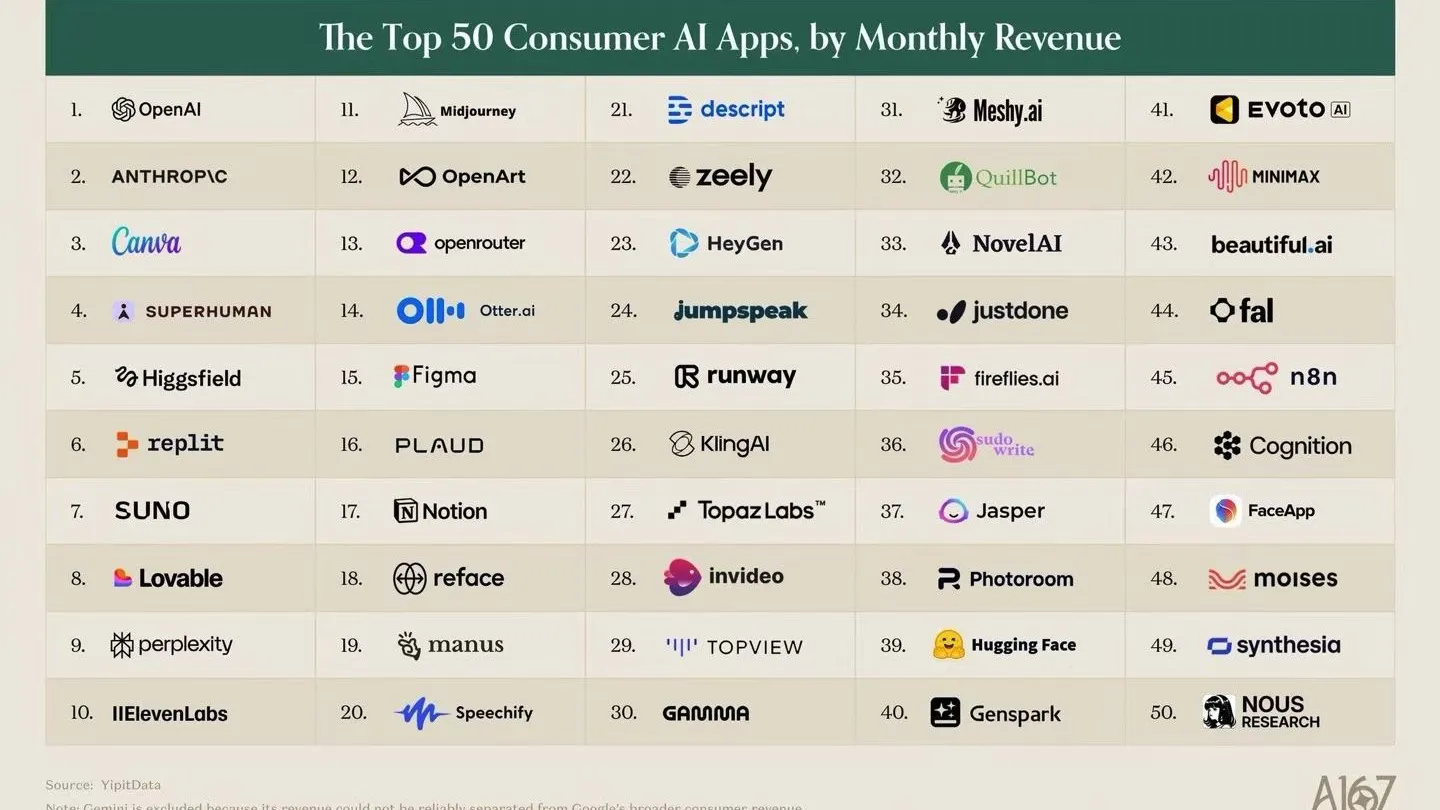
The graphic is titled The Top 50 Consumer AI Apps, by Monthly Revenue, but it should not be interpreted as a definitive list of each company's worldwide monthly revenue.
The underlying spending data is U.S.-focused and panel-based. It does not necessarily capture every enterprise contract, international payment, API invoice, app-store transaction, or corporate procurement channel.
The ranking therefore answers a more useful product question:
Which AI products are successfully convincing individual consumers and prosumers to pay?
That makes the list particularly valuable for analyzing pricing power, product-market fit, commercial AI categories, and emerging software behavior.
Top 50 Consumer AI Apps by Observed Monthly Spending
| Rank | AI app or company | Primary category |
|---|---|---|
| 1 | OpenAI | General AI assistant |
| 2 | Anthropic | General AI assistant |
| 3 | Canva | Design and creative productivity |
| 4 | Superhuman | Productivity and communication |
| 5 | Higgsfield | AI video and creative generation |
| 6 | Replit | AI coding and app building |
| 7 | Suno | AI music generation |
| 8 | Lovable | AI app and website building |
| 9 | Perplexity | AI search and research |
| 10 | ElevenLabs | AI voice and audio |
| 11 | Midjourney | AI image generation |
| 12 | OpenArt | AI image and creative tools |
| 13 | OpenRouter | Multi-model AI infrastructure |
| 14 | Otter.ai | Transcription and meetings |
| 15 | Figma | Design and product creation |
| 16 | PLAUD | AI note-taking and hardware |
| 17 | Notion | Productivity and knowledge work |
| 18 | Reface | AI photo and video creation |
| 19 | Manus | AI agents |
| 20 | Speechify | AI voice and text-to-speech |
| 21 | Descript | AI audio and video editing |
| 22 | Zeely | AI advertising and marketing |
| 23 | HeyGen | AI avatars and video |
| 24 | Jumpspeak | AI language learning |
| 25 | Runway | AI video generation |
| 26 | Kling AI | AI video and image generation |
| 27 | Topaz Labs | AI image and video enhancement |
| 28 | InVideo | AI video creation |
| 29 | Topview | AI ads and video marketing |
| 30 | Gamma | AI presentations and documents |
| 31 | Meshy.ai | AI 3D generation |
| 32 | QuillBot | AI writing |
| 33 | NovelAI | AI writing and creative generation |
| 34 | JustDone | AI writing and research |
| 35 | Fireflies.ai | AI meeting assistant |
| 36 | Sudowrite | AI creative writing |
| 37 | Jasper | AI marketing and writing |
| 38 | Photoroom | AI product photography |
| 39 | Hugging Face | AI models and developer platform |
| 40 | Genspark | AI search and agents |
| 41 | Evoto AI | AI photo editing |
| 42 | MiniMax | Foundation models and AI apps |
| 43 | Beautiful.ai | AI presentations |
| 44 | fal | Generative media infrastructure |
| 45 | n8n | AI automation |
| 46 | Cognition | AI software engineering |
| 47 | FaceApp | AI photo editing |
| 48 | Moises | AI music tools |
| 49 | Synthesia | AI video and avatars |
| 50 | Nous Research | AI models and agents |
Important: Gemini is excluded from the spending chart because its consumer revenue could not be reliably separated from Google's broader consumer revenue. Its absence should not be interpreted as evidence that Gemini has weak monetization.
The Biggest Signal: Consumer AI Is Becoming a Prosumer Market
The most interesting result is not that OpenAI and Anthropic occupy the first two positions. Large general-purpose assistants would be expected to rank highly.
The more revealing signal starts immediately below them.
Canva is No. 3. Superhuman is No. 4. Higgsfield is No. 5. Replit is No. 6. Suno is No. 7. Lovable is No. 8. ElevenLabs is No. 10.
These products generally help users produce an outcome rather than merely receive an answer.
That difference matters economically.
A casual consumer may ask a chatbot several questions per week but hesitate to purchase another subscription. A designer, developer, marketer, video creator, agency, or founder can justify substantially higher spending when software helps produce an asset, launch an ad, ship a product, automate work, or deliver something to a customer.
The highest-value consumer AI customer therefore increasingly resembles a prosumer with commercial intent.
AI Spending Is Extremely Concentrated
The spending data also shows how uneven the AI subscription economy remains.
As of August 2026, 4.5% of eligible consumers in YipitData's U.S. e-receipt panel had an active personal subscription to at least one of ChatGPT, Gemini, or Claude, up from 2.1% one year earlier. Only 13% of users paying for one AI product also paid for another.
Among people who do pay, the difference between ordinary subscribers and power users is dramatic:
- Top 1% of AI payers: 19.5% of observed consumer AI spending.
- Bottom 50% of payers: 16.6% of observed spending.
- Average monthly AI spending among the top 1%: $903.
- Median AI payer: approximately $25 per month.
- Spending by the top 1% increased roughly 80% over the previous 18 months.
This has major implications for pricing.
A single $10 or $20 subscription can leave significant revenue on the table when a product serves professional creators or builders. Serious AI products increasingly need pricing that accommodates both casual users and customers whose usage has direct economic value.
A structure such as free → $20 → $50 → $100 → $200+ can make more sense than forcing every customer into one plan.
Higher tiers need to justify their price through benefits such as:
- Larger generation limits.
- Faster queues.
- Premium models.
- Higher resolution or quality.
- Commercial usage rights.
- Batch processing.
- Automation.
- Team collaboration.
- API access.
- Longer context or agent execution.
- Priority infrastructure.
The lesson is not simply to charge more. It is to identify users for whom the product creates enough value that higher spending becomes rational.
Why Traffic Is No Longer Enough to Judge an AI Business
AI market analysis has traditionally relied on Similarweb traffic, app downloads, Google Trends, social discussion, and search volume.
Those metrics remain useful, but the revenue ranking exposes their limitations.
a16z reports that 29 of the top 50 vendors by observed spending are absent from both its top-50 web and top-50 mobile usage lists. Only seven companies appear across all three rankings: ChatGPT, Claude, Suno, Perplexity, Photoroom, Canva, and Notion.
This reveals two different types of attractive AI businesses.
High-traffic consumer businesses can monetize enormous reach through subscriptions, advertising, transactions, or low conversion rates applied to huge audiences.
Lower-traffic prosumer businesses can generate meaningful revenue from fewer users because each customer has higher willingness to pay.
That is why businesses such as fal, n8n, Cognition, OpenRouter, and Nous Research are important signals even when they do not look like traditional mass-market consumer apps.
For product builders, investors, and SEO operators, revenue density can matter more than raw traffic.
A keyword with 10,000 searches from people trying to complete an expensive task can be more attractive than a keyword with 500,000 curiosity-driven searches.
Creative AI Is One of the Most Proven Paid Categories
The ranking contains an unusually large cluster of image, video, audio, design, and creative-production products.
Notable examples include:
- Higgsfield — No. 5
- Suno — No. 7
- ElevenLabs — No. 10
- Midjourney — No. 11
- OpenArt — No. 12
- Reface — No. 18
- Speechify — No. 20
- Descript — No. 21
- HeyGen — No. 23
- Runway — No. 25
- Kling AI — No. 26
- Topaz Labs — No. 27
- InVideo — No. 28
- Topview — No. 29
- Meshy.ai — No. 31
- Photoroom — No. 38
- Evoto AI — No. 41
- FaceApp — No. 47
- Moises — No. 48
- Synthesia — No. 49
This should not be treated as one homogeneous AI media market.
These tools address many distinct jobs:
- Image generation.
- Video generation.
- Advertising creative.
- AI avatars.
- Product photography.
- Photo enhancement.
- Voice generation.
- Speech synthesis.
- Music generation.
- Audio separation.
- Podcast editing.
- Video editing.
- 3D asset generation.
The common factor is that their outputs can often be published, sold, used in marketing, or delivered directly to a client.
That makes the return on investment easier to understand than it is for a generic chatbot subscription.
Why Higgsfield at No. 5 Matters
Higgsfield's position is one of the most interesting signals in the entire ranking.
It sits above Replit, Suno, Lovable, Perplexity, ElevenLabs, and Midjourney in the observed spending list.
The conclusion should not be that the market needs another generic AI video generator.
A better strategy is to move one level deeper into the commercial workflows surrounding AI video:
- AI product video generator.
- AI UGC ad generator.
- AI fashion video generator.
- AI camera-motion generator.
- Product photo to video.
- Image to advertisement.
- AI short-form ad creator.
- Ecommerce creative generator.
- Batch video variant generation.
- AI video localization.
- Character consistency workflows.
- Creative testing for paid advertising.
As foundation models improve, workflow specificity can become more valuable rather than less valuable.
The underlying model supplies capability. The application packages that capability into an outcome a customer understands and is willing to purchase repeatedly.
AI Coding Has Become a Consumer Revenue Category
Another striking result is how many developer and product-building companies appear in what is nominally a consumer ranking.
Replit ranks No. 6 and Lovable No. 8. OpenRouter is No. 13, Manus No. 19, fal No. 44, n8n No. 45, Cognition No. 46, and Nous Research No. 50.
This reflects the expansion of software creation beyond traditional professional programmers.
AI app builders can turn natural-language requests into websites, prototypes, internal tools, and SaaS products. Technical users are simultaneously paying for model routing, inference, agents, workflow automation, and specialized software-engineering systems.
The addressable audience therefore extends well beyond people whose job title is software engineer.
It includes:
- Founders building MVPs.
- Designers creating prototypes.
- Marketers producing campaign tools.
- Agencies delivering websites and applications.
- Operators automating internal processes.
- Developers increasing output per engineer.
- Entrepreneurs launching micro-SaaS products.
- Non-technical users creating disposable software for specific tasks.
The monetization advantage is straightforward: software creation has measurable economic value.
If an AI product saves ten hours of engineering work, helps launch a paid service, or replaces repetitive contractor work, a $50, $100, or even higher monthly subscription can become an easy business decision.
Vertical AI Has Not Been Killed by General-Purpose Models
The ranking also challenges the idea that increasingly capable general assistants automatically eliminate vertical AI products.
QuillBot, JustDone, Sudowrite, and Jasper remain in the top 50. Otter.ai, Fireflies.ai, Beautiful.ai, Gamma, Jumpspeak, Photoroom, and numerous specialist creative products also rank.
This demonstrates why the argument that a foundation model can already perform a task is incomplete.
Users rarely pay merely for tokens. They pay for finished workflows.
A vertical AI product can add value through:
- Purpose-built interfaces.
- Domain-specific templates.
- Persistent project context.
- File and media handling.
- Batch operations.
- Editing tools.
- Collaboration.
- Export formats.
- Integrations.
- Automation.
- Specialized data.
- Quality controls.
- Brand trust.
- Distribution inside a specific profession or community.
The model layer can become cheaper and more commoditized while the application layer becomes more capable.
Weak wrappers are vulnerable. Strong workflows are a different proposition.
Incumbents Are Monetizing AI Too
The spending ranking is not dominated exclusively by AI-native startups.
Canva ranks No. 3, Figma No. 15, and Notion No. 17, while several other established software brands appear throughout the list.
Incumbents have three significant structural advantages.
Existing distribution
Millions of users already know the product and do not need to discover a new service before trying its AI functionality.
Embedded workflow data
Documents, projects, designs, teams, history, preferences, and existing assets already live inside the application.
Bundled AI
AI can be sold as an upgrade to an existing workflow rather than as an entirely separate purchasing decision.
This raises the bar for startups.
Simply adding a prompt field to an established software category is unlikely to create durable differentiation. Stronger opportunities typically come from a new model capability, a radically different interface, a neglected audience, a multi-model workflow, or an outcome the incumbent cannot easily prioritize without changing its existing product.
Subscription Is Still the Default — but It May Not Be the End State
Among the 44 AI-native products in a16z's top web ranking, 84% offered subscriptions, 64% offered usage charges or extra credits, 14% used advertising, and only 2% used transaction or platform fees. Products can use more than one monetization method.
This helps explain why consumer AI has developed differently from previous generations of consumer internet software.
AI has meaningful marginal costs. Video generation, image generation, speech synthesis, long-context inference, agent execution, and repeated tool calls can all consume substantial compute.
Subscriptions and credits solve that problem because revenue scales more closely with expensive usage.
Over time, at least four monetization models are likely to coexist:
- Subscriptions: appropriate for recurring productivity and predictable access.
- Usage-based credits: useful when generation costs vary significantly between users.
- Transaction or performance fees: attractive when an AI agent directly books, purchases, sells, or generates revenue.
- Advertising: viable for very large consumer audiences where marginal serving costs fall sufficiently.
A key opportunity for future AI products may be moving beyond seat-based subscriptions entirely.
What the Ranking Says About the Strongest AI Business Models
The top 50 highlights several product patterns with unusually strong monetization potential.
1. General assistants with broad daily utility
OpenAI and Anthropic benefit from breadth. One subscription can cover research, writing, coding, analysis, planning, and content creation.
The disadvantage is direct competition with the largest model laboratories and increasingly aggressive bundling.
2. Creative products with valuable outputs
Video, voice, audio, images, 3D, and design assets can consume expensive compute, but professional users are accustomed to paying for creative software.
These products can combine subscriptions with credits and premium output tiers.
3. Software-building and automation products
Replit, Lovable, OpenRouter, fal, n8n, Cognition, and similar products sit close to economic output.
They help users create software, automate processes, or operate AI systems, supporting higher-value subscriptions and usage-based billing.
4. Existing workflows enhanced by AI
Canva, Figma, Notion, Superhuman, Otter.ai, Fireflies.ai, and Gamma demonstrate the advantage of owning the workflow around the model.
Their defensibility comes from context, data, collaboration, history, integration, and distribution rather than one model endpoint.
5. Specialist products with high-intent buyers
Photoroom, Topaz Labs, Jumpspeak, Sudowrite, Moises, and similar products solve recognizable problems for customers who already know the outcome they need.
Narrow positioning often creates stronger conversion than a generic AI value proposition.
What Founders and SEO Operators Can Learn From the Ranking
The top 50 is most useful when treated as a demand map rather than a clone list.
A productive research process starts with a category where consumers have demonstrated willingness to pay and then moves downward into specific jobs.
For example, rather than competing for the broad keyword AI video generator, the market can be decomposed into more commercial tasks:
- product video generator
- UGC ad generator
- talking avatar generator
- image to video
- AI camera motion
- ecommerce video maker
- fashion video generator
- real estate video generator
- podcast to clips
- video translator
- lip-sync generator
- ad variant generator
The same principle applies to AI coding.
Instead of cloning Lovable or Replit, investigate the workflows that happen before and after code generation:
- prompt-to-spec tools
- deployment assistants
- database setup
- authentication setup
- debugging
- test generation
- SEO validation
- accessibility testing
- analytics configuration
- app-store packaging
- migrations
- monitoring
- codebase documentation
The most defensible opportunity can be hidden in the workflow surrounding the famous AI product rather than in the product's core generation feature.
A Better Framework for Evaluating New AI Opportunities
A promising AI niche tends to score well across five dimensions.
Search demand
Is the problem actively searched for, and does the query indicate that the user wants to complete a task rather than simply learn about a trend?
Payment evidence
Are customers already paying for adjacent software, API credits, freelancers, agencies, or manual services?
Repeat frequency
Does the job happen daily, weekly, or repeatedly across many assets? Frequent tasks provide stronger retention opportunities.
Output value
Does a successful result save labor, create revenue, reduce costs, or generate an asset the customer can publish or sell?
Workflow depth
Can the product own more than one prompt? Strong applications often combine input collection, generation, editing, organization, collaboration, export, and automation.
A niche with moderate search volume but strong payment evidence, repeat frequency, and output value can be more attractive than a viral keyword with enormous informational traffic.
Common Mistakes When Reading the Ranking
Mistake 1: Treating observed spending as audited company revenue
The YipitData ranking is panel-based. It provides a valuable directional signal, but it is not a replacement for audited financial statements or company-reported revenue.
Mistake 2: Assuming No. 50 is a small company
Rank shows relative position inside the observed consumer panel, not absolute business size. Enterprise, API, and international revenue can materially change a company's total economics.
Mistake 3: Comparing traffic rank directly with revenue rank
A product can serve fewer users but generate dramatically more revenue per paying customer. The difference between usage and spending is one of the most important insights in the report.
Mistake 4: Ignoring geography
The spending analysis is U.S.-focused. AI businesses with especially large Asian, European, Latin American, or other international audiences may be underrepresented.
Mistake 5: Copying the category instead of the job
AI video, AI image generation, and AI coding are already crowded categories. Better opportunities frequently emerge from a specific audience, workflow, input type, output format, distribution channel, or commercial outcome.
Mistake 6: Assuming stronger foundation models destroy every application
Improving models can eliminate weak wrappers, but they can also make sophisticated vertical applications cheaper and more capable.
The better competitive question is whether the application owns workflow, context, audience, proprietary data, integrations, brand, or distribution.
What to Watch Next
Several trends are likely to define the next phase of consumer AI monetization.
Power-user pricing will continue expanding. The spending concentration already shows substantial willingness to pay when AI is connected to productive work.
Creative AI will fragment into specialist workflows. Generic generation becomes easier as models improve, shifting differentiation toward control, consistency, editing, production pipelines, and commercial templates.
AI agents may create transaction-based businesses. Systems capable of booking travel, purchasing products, hiring services, or completing end-to-end business processes could monetize the transaction instead of charging only for software access.
Multi-model products can remain valuable. Customers often care more about getting the best result for a task than which model vendor supplied it. Routing, orchestration, quality control, and model selection can therefore become product features of their own.
Distribution will matter more as model quality converges. When multiple products can access similarly capable models, audience ownership, workflow design, brand, integrations, SEO, and customer-acquisition economics become increasingly important.
Conclusion
The 2026 consumer AI spending ranking shows a market that is much more sophisticated than a simple chatbot leaderboard suggests.
OpenAI and Anthropic lead, but the strongest signal sits underneath them: consumers are paying heavily for creative production, software building, productivity, automation, and specialized workflows.
The central lesson is that AI monetization is not proportional to traffic. A comparatively small group of power users can support substantial revenue when an AI product helps those customers create economic value.
For builders, marketers, and investors evaluating the next AI opportunity, the better question is no longer simply: Which AI app has the most users?
The more useful question is:
Which repeated job is valuable enough that a serious user will continue paying to get it done faster, better, or at greater scale?
The top-50 spending ranking suggests that this is where many of the most durable AI businesses are being built.
Continue Reading
More articles connected to the same themes, protocols, and tools.

Higgsfield AI Influencer 2026: New Character Builder, Genjutsu Workflow, Pricing & Full Guide

EveryGen AI Video Generator Review 2026: Models, Pricing, Studio Workflow & the Everygen.ai Confusion

Claude Sonnet 5.5 on Amazon Bedrock: The Complete 2026 Setup, Pricing, API & Migration Guide
Referenced Tools
Browse entries that are adjacent to the topics covered in this article.