On This Page8 sections
Key Takeaways
- Hermes AI usually refers to the Nous Research ecosystem around Hermes Agent, while Hermes 4 is a separate open-weight reasoning-model family.
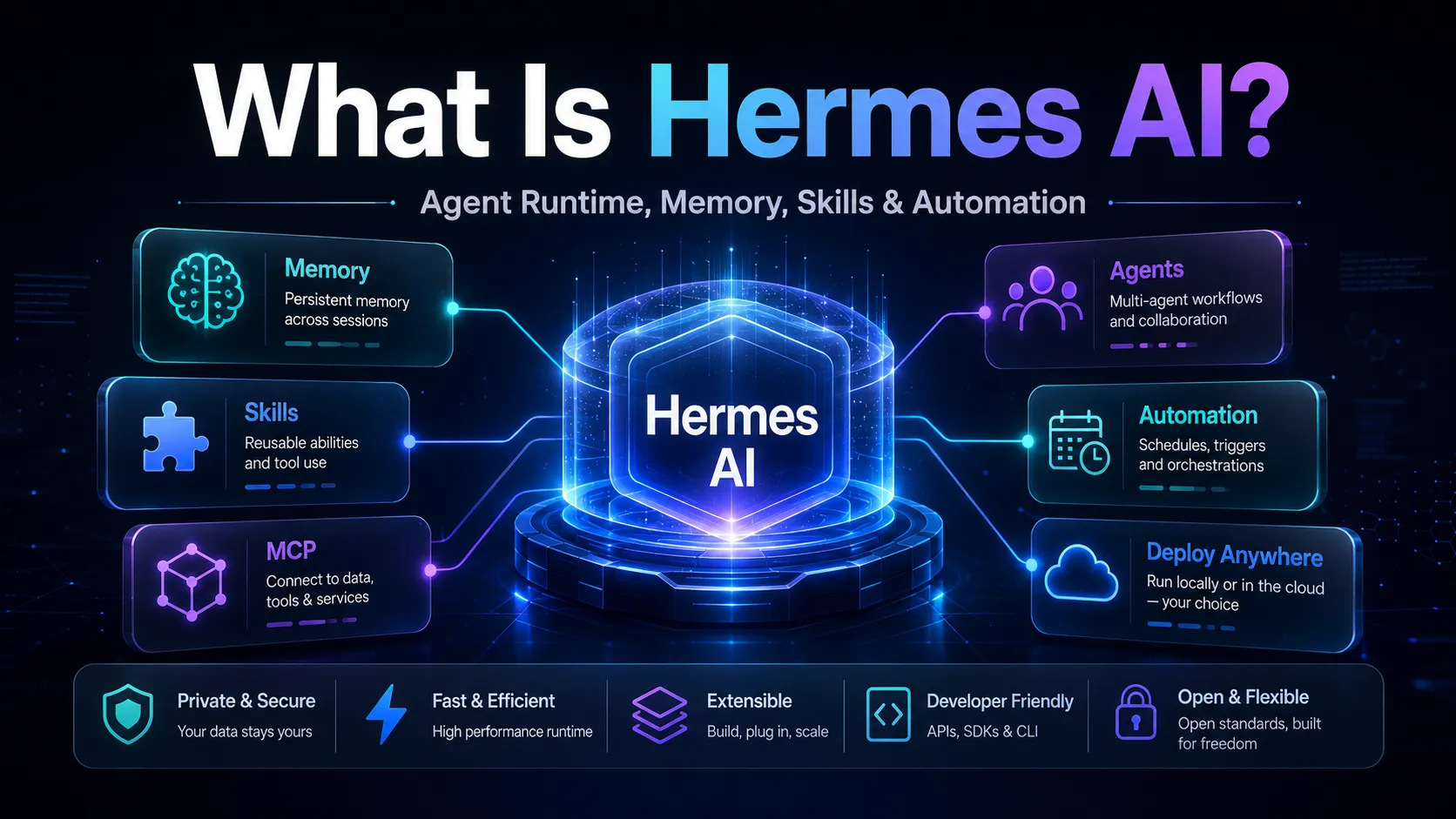
- Hermes Agent is an open-source autonomous AI agent with persistent memory, reusable skills, terminal and file tools, web/browser access, scheduling, messaging integrations, subagents, MCP, and multi-agent workflows.
- Hermes is model-agnostic. It supports Nous Portal, Anthropic, OpenAI Codex, GitHub Copilot, OpenRouter, Gemini, DeepSeek, Bedrock, Azure Foundry, local Ollama/vLLM endpoints, and custom OpenAI-compatible providers.
- As of August 25, 2026, the latest stable release is Hermes Agent v0.20.5, tagged
v2026.8.19and released August 19, 2026. - The main differentiator is not any single model. It is the agent runtime: Hermes can remember, act, schedule, delegate, coordinate multiple agents, and reuse learned procedures across sessions.
- Hermes Agent is MIT-licensed and open source. Optional Nous Portal plans provide hosted models, tools, credits, and cloud infrastructure.
What Is Hermes AI?
Hermes AI is best understood as the AI-agent and model ecosystem created by Nous Research.
The name can be confusing because it refers to several related components:
| Product | What it is | Best understood as |
|---|---|---|
| Hermes Agent | Open-source autonomous agent | The system that acts |
| Hermes 4 | Open-weight reasoning models | The models that think |
| Nous Portal | Hosted models, tools and credits | Optional infrastructure |
| Hermes Desktop | Graphical Hermes interface | Desktop control surface |
For most users searching for hermes ai in 2026, Hermes Agent is the most relevant product. It is the actively developed system that combines models with tools, memory, scheduling, communications, and autonomous execution.
The most important distinction is simple:
Hermes Agent is not a model.
A user can run Hermes Agent with a Hermes model, but can just as easily connect it to Claude, Codex, Gemini, DeepSeek, local open-weight models, or another compatible provider.
What Is Hermes Agent?
Hermes Agent is an open-source, persistent AI agent built by Nous Research.
Unlike a conventional chatbot that primarily follows a prompt → response loop, Hermes is designed around longer-lived execution:
goal
  ↓
retrieve memory
  ↓
select skills
  ↓
reason with a chosen model
  ↓
use tools
  ↓
delegate or schedule work
  ↓
verify results
  ↓
persist useful knowledge
The project emphasizes an agent that can improve its usefulness over time by retaining memory and turning successful procedures into reusable skills. Its architecture includes persistent memory, a Skills system, more than 60 built-in tools, MCP, messaging gateways, Bot Mode, voice, and other agent capabilities.
This makes Hermes closer to an agent runtime or personal automation platform than a simple AI chat application.
What Is Hermes 4?
Hermes 4 is a family of open-weight hybrid reasoning models from Nous Research.
The Hermes 4 family includes large models based on Llama 3.1 as well as a smaller model based on Qwen3. It was trained to combine explicit reasoning with broad instruction following.
Its post-training data spans millions of examples covering reasoning, structured outputs, instruction following, coding, and tool-use trajectories.
This matters because Hermes 4 was designed with agentic behavior in mind. But it is still only one possible brain for Hermes Agent.
A useful mental model is:
Hermes Agent = agent runtime
Hermes 4     = language model
Nous Portal  = optional hosted infrastructure
Why Hermes Agent Is Different
The strongest part of Hermes is not one headline feature. It is how several agent primitives work together.
Persistent Memory
Hermes includes built-in cross-session memory and can also connect to external memory providers.
Supported memory systems include options such as Honcho, OpenViking, Mem0, Hindsight, Holographic, RetainDB, ByteRover, and Supermemory.
When configured, an external memory provider can:
- Inject relevant context into the agent
- Prefetch memories before a turn
- Synchronize conversations after responses
- Extract memories at session end
- Expose provider-specific search and storage tools
The value is retrieval, not simply keeping an endless transcript. Good memory should surface the right project facts or preferences without wasting the context window on irrelevant history.
Skills and Self-Improvement
Hermes Skills are reusable knowledge and procedure packages stored under ~/.hermes/skills/.
The Skills system follows progressive disclosure: skills can be discovered when relevant rather than loading every instruction into every prompt. Hermes also supports the open Agent Skills format.
Skills may be:
- Bundled with Hermes
- Installed from a Skills Hub
- Loaded from external skill directories
- Written manually
- Created or updated by the agent
That last capability is the foundation of Hermes' self-improvement story.
If the agent discovers a reliable procedure for a recurring task, that workflow can become reusable skill knowledge. Future runs can start with a better procedure rather than rediscovering everything from zero.
The downside is equally important: bad procedures can also become persistent. Production setups should review agent-created skills and consider write-approval controls for sensitive environments.
More Than 60 Built-In Tools
Hermes includes 60+ built-in tools across multiple categories.
The tool surface spans areas such as:
- Terminal execution
- File reading and editing
- Code search
- Web search
- Web extraction
- Browser automation
- Vision
- Image generation
- Text-to-speech
- Code execution
- Subagent delegation
- MCP
- Multi-agent coordination
This is why model choice alone does not determine Hermes' usefulness. An excellent model without the right tools may accomplish less than a cheaper model connected to a well-designed workflow.
Multi-Model and Provider Support
Hermes separates the agent runtime from inference.
Current provider support includes:
- Nous Portal
- Anthropic
- OpenAI Codex
- GitHub Copilot
- OpenRouter
- Google Gemini
- DeepSeek
- Hugging Face
- AWS Bedrock
- Azure AI Foundry
- NVIDIA NIM
- xAI
- MiniMax
- Qwen
- LM Studio
- Ollama
- Custom OpenAI-compatible endpoints
Hermes can also configure fallback providers when the primary model hits rate limits, authentication failures, or server errors.
This creates an important architectural advantage: users can change the model without replacing the workflow.
A team might use a premium reasoning model for planning, a lower-cost model for routine tasks, and a local model for sensitive work.
Local Models
Hermes works with local OpenAI-compatible model servers such as Ollama and vLLM.
A simplified local configuration can look like:
model:
  default: qwen3.5:9b
  provider: custom
  base_url: http://localhost:11434/v1
  context_length: 131072
Local inference can be useful for privacy, offline operation, experimentation, and cost control.
However, self-hosting Hermes does not automatically make every workflow local. Web tools, cloud models, hosted memory providers, browser services, or media-generation APIs may still send data externally.
Evaluate the complete tool and provider chain when privacy matters.
MCP Support
Hermes supports Model Context Protocol (MCP) servers over stdio and remote HTTP.
MCP can connect Hermes to external systems such as:
- GitHub
- Databases
- File systems
- Internal APIs
- SaaS tools
- Browser stacks
Hermes discovers MCP tools and supports per-server filtering so only selected operations need to be exposed to the model.
For users migrating from Claude Code, Hermes can import compatible agent configuration, including MCP servers, skills, and instructions.
The security rule is straightforward: expose the smallest tool surface necessary. A huge MCP server with broad write permissions increases both prompt-injection risk and the impact of a mistaken tool call.
Subagents
Hermes can delegate bounded work to isolated subagents.
A parent agent might ask different subagents to:
- Research competing libraries
- Inspect different parts of a repository
- Analyze test failures
- Review an implementation
- Compare alternative plans
Subagents are useful when the main session needs a result but does not need every intermediate token in its own context.
For longer-lived collaboration, Hermes provides a more durable mechanism: Kanban.
Hermes Kanban
Hermes Kanban is a persistent multi-agent task board.
Tasks are stored in SQLite, and workers run as separate processes with their own identity, session, and workspace. Agents can create tasks, block them, request review, attach artifacts, leave comments, and hand work between profiles.
The difference from ordinary subagent delegation is significant:
| Capability | Subagent delegation | Hermes Kanban |
|---|---|---|
| Ideal duration | Short | Long-running |
| Persistent identity | Limited | Yes |
| Restart recovery | Limited | Designed for it |
| Human input | Minimal | First-class |
| Review workflow | Manual | Built in |
| Audit trail | Session-oriented | Durable board state |
Typical uses include:
- Research → analysis → writing
- Parallel software development
- Code-review pipelines
- Recurring operational work
- Persistent specialist agents
- Human-in-the-loop workflows
A current limitation is that Kanban is single-host by design. Its SQLite board and dispatcher assume workers live on the same machine.
Persistent Goals vs Kanban
Hermes offers different primitives for different levels of autonomy.
- Normal chat: a few interactive turns
/goal: keep one session working until an outcome is complete- Subagent: delegate a bounded task
- Kanban: coordinate durable tasks and multiple workers
- Cron: execute work on a schedule
Goals remain in one session, while Kanban introduces persistent cards, dependencies, assignees, and handoffs.
This is a strong design choice because not every task needs a heavyweight swarm.
Bot Mode
Bot Mode turns Hermes profiles into named specialist assistants.
Each Bot can have its own:
- Role
- Model
- Memory
- Skills
- Credentials
- Conversation history
- Routines
Under the hood, a Bot is still a Hermes profile. Bot Mode is a desktop interface over that existing primitive.
This makes it practical to maintain separate assistants such as researcher, coder, seo-analyst, or ops-review without mixing all of their context together.
Mixture of Agents
Hermes supports Mixture of Agents (MoA) as a selectable provider.
Reference models run first, then an aggregator model receives their analyses and produces the final response or tool calls.
Conceptually:
Model A ─┐
Model B ─┼─→ Aggregator → Final answer
Model C ─┘
This can improve difficult planning or review tasks where multiple perspectives are valuable.
The cost is predictable: more models mean more latency and more inference usage. MoA should be used selectively rather than as a default for routine work.
Messaging and Scheduling
Hermes is designed to live outside a single terminal window.
Supported surfaces include integrations such as Telegram, Discord, Slack, WhatsApp, Signal, messaging gateways, and CLI-based workflows.
Scheduling enables workflows such as:
- Daily research briefings
- Dependency audits
- Backup checks
- Repository health reports
- Market monitoring
- Content alerts
- Recurring operational reviews
Recent releases have also expanded cron functionality with persistent memory and per-job reasoning controls, reinforcing Hermes' focus on long-lived automation.
Desktop, CLI and ACP
Hermes can be used through several surfaces:
- CLI
- TUI
- Hermes Desktop
- Messaging platforms
- Cloud deployment
- Compatible editors through ACP
Editor integration can be started with:
hermes acpACP lets compatible editors use Hermes as an agent backend while retaining Hermes' provider configuration, tools, approvals, memory, and skills.
This matters for developers who want the same agent configuration across terminal, desktop, and editor workflows.
How to Install Hermes Agent
The standard macOS/Linux installation is:
curl -fsSL https://hermes-agent.nousresearch.com/install.sh | bashThe installer can handle Python, Node.js, ripgrep, ffmpeg, and other dependencies depending on the environment.
After installation, configure a model provider:
hermes modelA sensible first setup is deliberately small:
- Configure one reliable model.
- Test CLI or Desktop.
- Verify file and terminal permissions.
- Add only the skills needed for one workflow.
- Connect MCP servers selectively.
- Configure persistent memory after deciding what should actually be remembered.
- Move untrusted execution into a sandbox.
- Add messaging and cron only after the base workflow is reliable.
- Introduce Kanban only when tasks genuinely need durable multi-agent coordination.
Is Hermes AI Free?
Hermes Agent itself is MIT-licensed and open source.
Costs can still come from:
- Model inference
- Hosted tools
- Browser automation
- Media generation
- External memory services
- Sandboxes
- Hermes Cloud
As of August 2026, Nous Portal has offered subscription tiers ranging from free access to higher-priced plans that bundle monthly credits and hosted model access.
Pricing and model availability can change, so current plan details should always be checked before purchase.
The practical takeaway is:
Hermes is the orchestration layer. Model and tool usage create most variable cost.
Hermes Cloud
Hermes Cloud is the optional hosted deployment path.
It is designed for one-click deployment, persistent memory, scheduling, messaging, and isolated agent environments.
Hermes Cloud is useful for always-on bots and scheduled automation. Self-hosting remains more attractive when infrastructure control, custom networking, or strict data-locality requirements dominate.
Security: Is Hermes Agent Safe?
Hermes can perform real actions, so security is a core part of deployment.
Its defense-in-depth approach includes controls around:
- User authorization
- Dangerous-command approval
- File-write protection
- Container isolation
- MCP credential filtering
- Context-file prompt-injection scanning
- Cross-session isolation
- Input sanitization
The terminal layer can flag destructive command patterns such as recursive deletes, filesystem formatting, destructive SQL, system configuration changes, and pipe-to-shell execution.
File-write protections can also block sensitive locations such as SSH credentials, cloud credentials, Kubernetes credentials, authentication files, and project .env files.
These protections reduce risk, but approval is not the same as isolation.
For untrusted repositories or unattended execution, use Docker or another sandbox backend. Hermes can support multiple execution environments depending on configuration, including local execution, containers, remote hosts, and hosted sandboxes.
Prompt Injection Still Matters
Hermes can scan context files for suspicious patterns including instruction overrides, hidden content, secret-file access, credential exfiltration, and invisible characters.
No scanner is perfect.
Risk rises when one agent can simultaneously browse arbitrary websites, read repositories, access MCP tools, use credentials, execute commands, and send messages.
A strong deployment follows least privilege:
- Enable only necessary tools.
- Use narrowly scoped credentials.
- Filter MCP toolsets.
- Constrain file-write roots.
- Sandbox untrusted execution.
- Keep approvals on for destructive actions.
- Review persistent memories and agent-created skills.
Common Hermes AI Mistakes
Mistake 1: Treating Hermes Agent and Hermes 4 as the same thing.
The agent is the runtime; Hermes 4 is a model family.
Mistake 2: Judging Hermes only by one model.
Tool selection and task quality can vary dramatically across providers. Keep the workflow constant and test multiple models.
Mistake 3: Treating memory as an unlimited context window.
Persistent memory should be curated. Saving everything creates stale facts and irrelevant retrieval.
Mistake 4: Automatically trusting agent-created skills.
Self-improvement can preserve a flawed workflow as easily as a good one. Use review controls for important environments.
Mistake 5: Exposing every MCP tool.
More tools increase ambiguity, prompt size, credential exposure, and attack surface.
Mistake 6: Using Kanban for tiny tasks.
Use subagent delegation for short bounded work. Use Kanban when work must survive restarts, cross roles, or retain an audit trail.
Mistake 7: Running autonomous code directly on a sensitive workstation.
For untrusted code, isolation is a stronger boundary than command approval.
Hermes AI vs Claude Code
Hermes Agent and Claude Code overlap in coding, terminal tools, skills, and agentic workflows, but their centers of gravity differ.
Claude Code is primarily a software-engineering agent.
Hermes Agent is a broader autonomous-agent platform that also performs software engineering.
Hermes emphasizes:
- Persistent memory
- Multi-provider inference
- Messaging gateways
- Scheduled automation
- Named Bots
- Durable multi-agent Kanban
- General research workflows
- Self-hosting and local models
Claude Code can be the simpler fit when the job is primarily repository-centric coding around Claude.
Hermes is more compelling when the desired assistant needs to persist across sessions, run on schedules, switch models, communicate through multiple channels, or coordinate multiple specialist agents.
Who Should Use Hermes AI?
Hermes is a strong fit for:
- Developers building long-lived coding agents
- Researchers combining web, files, and automation
- AI power users who want persistent memory
- Operators running scheduled reports
- Founders combining research, content, code, and operations
- Self-hosters who want provider flexibility
- Teams exploring multi-agent workflows
It may be unnecessary when a simple chatbot already solves the problem or when deterministic scripting is more reliable than model-driven decisions.
How to Evaluate Hermes Properly
Do not judge Hermes with one flashy prompt.
Evaluate five things:
- Task completion: Did the requested outcome actually work?
- Tool reliability: Did Hermes choose the right tools without unnecessary loops?
- Recovery: Can it recover from command, provider, and data failures?
- Memory quality: Does remembered context improve later runs?
- Autonomy-to-supervision ratio: How much useful work happens before a human must intervene?
For coding, also track:
- Tests passed
- Regression rate
- Unnecessary file changes
- Time to verified completion
For research, track:
- Claim traceability
- Source coverage
- Citation accuracy
- Unsupported inference rate
These metrics reveal far more than a model benchmark alone.
Is Hermes AI Worth Using in 2026?
Hermes Agent is notable because it combines several trends that are often separate products:
- Open-source agent runtime
- Persistent memory
- Agent Skills
- Model routing
- MCP
- Scheduled automation
- Messaging
- Subagents
- Multi-agent coordination
- Desktop and CLI interfaces
- Optional cloud deployment
The project is also moving quickly. Hermes Agent v0.20.5 shipped on August 19, 2026, reflecting an active release cadence and rapidly expanding feature set.
That pace is a strength for innovation but a warning for production deployments: pin versions, test upgrades, and prefer current documentation over months-old tutorials.
Frequently Asked Questions
Is Hermes AI made by Nous Research?
Yes. Hermes Agent and the Hermes model family are Nous Research projects.
Is Hermes AI the same as Hermes 4?
No. Hermes Agent is the agent runtime; Hermes 4 is a language-model family.
Is Hermes Agent open source?
Yes. It is distributed under the MIT License.
Can Hermes run locally?
Yes. Hermes can run on a user's computer or server and can connect to local OpenAI-compatible model endpoints such as Ollama and vLLM.
Does Hermes require Nous Portal?
No. Nous Portal is optional. Hermes supports direct providers and custom endpoints.
Does Hermes support MCP?
Yes. Hermes supports stdio and remote HTTP MCP servers with tool discovery and filtering.
Can Hermes remember information between sessions?
Yes. It includes built-in persistent memory and optional external memory providers.
Can Hermes create its own skills?
Yes. Skills can be installed, written by users, or created and modified by the agent.
Can Hermes run multiple agents?
Yes. It supports both short-lived subagent delegation and durable Kanban-based multi-agent workflows.
What is the latest Hermes Agent version?
As of August 25, 2026, the latest stable release is Hermes Agent v0.20.5, tagged v2026.8.19.
Conclusion
Hermes AI is best understood as a stack, not a single chatbot.
At the center is Hermes Agent, Nous Research's open-source autonomous agent runtime. Around it sit persistent memory, reusable skills, dozens of tools, MCP integrations, scheduling, messaging, subagents, Kanban workflows, Bot profiles, many model providers, and optional cloud infrastructure.
Separately, Hermes 4 is Nous Research's open-weight reasoning-model family. It can power agentic workloads, but Hermes Agent does not depend on it.
That separation is the key strategic advantage: the model can change without replacing the agent workflow.
The best way to evaluate Hermes is to give it one real recurring task, provide only the tools and permissions it needs, run untrusted execution inside a sandbox, and measure whether memory and skills make later runs more reliable and efficient than the first.
If they do, Hermes is delivering something more valuable than another chat interface: it is turning successful work into reusable agent capability.
Continue Reading
More articles connected to the same themes, protocols, and tools.

Referenced Tools
Browse entries that are adjacent to the topics covered in this article.