On This Page8 sections
Key Takeaways
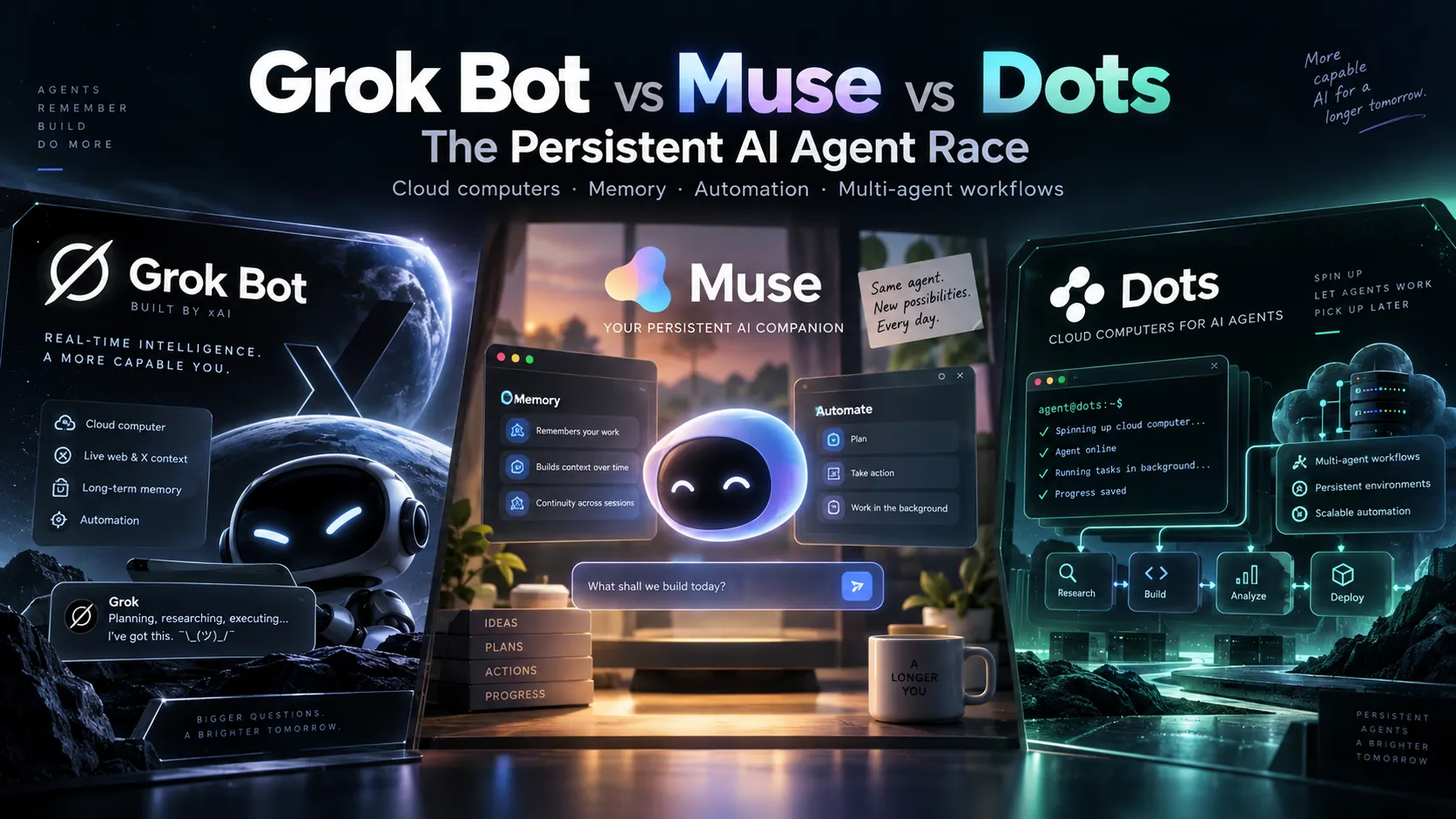
- Grok Bot, Meta Muse, and OpenAI Dots are persistent agents rather than conventional chatbots. Their core advantage is continuity: they can keep context, use real tools, and continue work beyond a single prompt.
- OpenAI Dots is centered on one persistent primary agent inside the ChatGPT ecosystem. It uses GPT-6 Astra, has its own cloud computer and browser, connects to more than 4,000 apps through plugins, and can be reached through ChatGPT, Slack, Teams, and voice. OpenAI
- Meta Muse is positioned as a personal agent for everyday life and business. It runs inside a dedicated Muse Secure VM and uses a separate Sentinel layer to review outbound actions and enforce permissions. Facebook
- Grok Bot is the most explicitly role-based of the three. Users create durable Bots with names and jobs; Bots can coordinate, hand off work, save skills, and run routines on schedules or supported events. Grok API Documentation
- A recent V2EX discussion makes an important counterpoint: persistent environments, memory, browser control, BYOK, and GUI automation were not invented by this new generation. Earlier products such as AgentMore, AutoClaw, and Coze had already explored parts of this design space. V2EX
- The real competition is moving beyond which model is smartest or which VPS has more CPU and RAM. The harder product problem is combining persistent state, permissions, identity, triggers, app access, auditability, and human approval into something people can trust every day.
Why Grok Bot vs Muse vs Dots Matters
The AI agent market is moving from short-lived task execution to persistent delegation.
A traditional chatbot follows a simple loop:
prompt -> answer -> session endsA task-oriented agent extends that loop:
goal -> plan -> use tools -> return resultPersistent agents go further:
goal
-> remember context
-> monitor for changes
-> use apps and computers
-> continue in the background
-> request approval when necessary
-> resume later
That difference changes the product category. The user is no longer starting from zero every time. The agent can retain working context, stay signed in to tools, react to events, and accumulate knowledge about an ongoing job.
This is why comparing Grok Bot, Muse, and Dots only by model benchmarks misses the larger shift.
Grok Bot vs Muse vs Dots at a Glance
| Dimension | Grok Bot | Meta Muse | OpenAI Dots |
|---|---|---|---|
| Primary mental model | Multiple named AI teammates | One personal AI agent | One primary persistent dot today |
| Execution environment | Persistent cloud computer with browser, filesystem, and terminal | Dedicated Muse Secure VM with browser | Own cloud computer and browser; can also connect to a permitted laptop |
| Persistence | Memory, files, browser sessions, preferences, and role context compound over time | Learns from conversations and remembers relevant personal context | Learns preferences and feedback while maintaining persistent project context |
| Automation | Skills plus routines triggered by schedules or supported events | Background work, proactive suggestions, cross-app task completion | Background work, proactive research, plugins, and connected workflows |
| Multi-agent model | Multiple Bots can coordinate, message each other, run in parallel, and hand off work | Muse can use subagents internally while presenting one personal-agent experience | Starts with a primary dot; OpenAI says teams of dots are planned |
| Security model | Approval boundaries, secrets, plugins, action logs, and team controls | Sentinel, secure credential handling, approval gates, audit trail | Plugin permissions, Custom Rules, auto-review, safety monitoring |
| Ecosystem direction | Bot templates, skills, routines, plugins, Cursor and Grok access | Consumer apps, WhatsApp, commerce, business connectors, Meta platform | ChatGPT, Codex, Work, Slack, Teams, voice, and 4,000+ plugin-connected apps |
| Strongest product idea | AI teammates with distinct jobs | Personal agent for life and business | Persistent work layer inside ChatGPT |
The important distinction is not that one product has a browser while another does not. All three can operate beyond a normal chat window. The distinction is how each product organizes persistent work.
OpenAI Dots: A Persistent Agent Inside the ChatGPT Ecosystem
OpenAI introduced Dots on September 29, 2026 as always-on agents powered by GPT-6 Astra. A dot has its own cloud computer, can work toward goals 24/7, and can connect to more than 4,000 applications through OpenAI's plugin ecosystem. It can also communicate through ChatGPT, Slack, Microsoft Teams, and voice. OpenAI
The product is designed around continuity rather than isolated sessions. OpenAI says a dot can work on several projects, continue while the user is away, and use a connected computer when permission is granted. Users can inspect the dot's computer while it works. OpenAI
At launch, the product model is still centered on a primary dot. OpenAI says users can start with one primary dot today, while teams of dots are part of the longer-term direction. Specialist dots with dedicated identities and responsibilities are beginning through focused enterprise pilots. OpenAI
That makes the current Dots architecture closer to:
one persistent agent
-> many projects
-> many connected apps
-> delegated work in Codex / ChatGPT Work
-> approval and review
rather than a user manually creating a separate agent for every role.
Dots' most important advantage is ecosystem continuity
Dots does not arrive as an isolated agent product. It inherits the broader ChatGPT environment.
Plugin permissions can be shared across Dots, ChatGPT, ChatGPT Work, and Codex. A dot can start or manage work in Codex or Work, while remaining the persistent conversational layer that follows the user's goals over time. OpenAI Help Center
For someone already using ChatGPT for research, Codex for engineering, and connected apps for business data, this reduces the amount of context that must be repeatedly reconstructed.
Dots separates proactive research from unrestricted action
One of the more important implementation details is that proactive research uses restricted read-only tools. During that mode, the agent cannot directly send messages, change plugin content, or control a browser or computer. Actions outside those boundaries go through normal action rules and safety checks. OpenAI Help Center
OpenAI also provides Custom Rules for allowing, blocking, or requiring approval for supported actions, plus an auto-review system that checks potentially consequential actions. Certain sensitive actions, such as changing a password, remain with the user. OpenAI
This matters because an always-on agent creates a larger security surface than a chatbot. Persistence is useful only if the permission system is equally persistent and understandable.
Meta Muse: A Personal Agent With Security as a Core Architecture
Meta launched Muse on September 8, 2026 as a personal AI agent designed to carry out work rather than merely answer questions. Muse can open a browser, fill forms, handle tasks such as email and travel, continue after the app is closed, and return when it needs approval. It can be accessed through the Muse app and WhatsApp. Facebook
The most distinctive part of Muse is not simply computer use. It is the security architecture around computer use.
Muse runs inside a dedicated Muse Secure VM. Meta says a separate Sentinel agent is isolated from Muse at the system level and reviews outbound internet activity. Credentials are stored so that Muse can use them without directly seeing passwords or payment details, and sensitive actions such as sending an email or making a purchase require approval. Muse also exposes an audit trail of completed and planned actions. Facebook
Conceptually, the architecture looks like this:
User goal
   |
   v
Muse
   |
   v
Proposed tool or network action
   |
   v
Sentinel / permission checks
   |
   +--> allow
   +--> block
   +--> ask user
   |
   v
External app, browser, or connector
That separation is important. An agent should not be the only component deciding whether its own action is safe.
Muse is broader than a productivity chatbot
Muse is being positioned across consumer life, commerce, and business operations.
Meta says Muse can remember useful context, suggest actions without a new prompt, work with shopping and payment flows, and use connected business tools. By September 29, Meta had announced Muse for Small Business with connectors including Asana, Box, Canva, Dropbox, Figma, Granola, HighLevel, QuickBooks, Klaviyo, Lovable, Notion, Shopify, Slack, Stripe, Zoom, Facebook, and Instagram business accounts. Facebook
Meta's research team also describes Muse as capable of launching subagents and coordinating multi-agent work internally. The user-facing product still feels like one personal agent, but the execution layer can be more complex underneath. Facebook
This creates a different product philosophy from Grok Bot. Grok Bot exposes multiple teammates to the user. Muse can hide more of that orchestration behind a single personal-agent identity.
Grok Bot: AI Teammates With Jobs, Skills, and Routines
Grok Bot makes the role-based agent model explicit.
Official documentation describes a Bot as a durable AI teammate with a name, job, conversation, and working context that develops over time. Each Bot can use a persistent cloud computer with a browser, filesystem, and terminal. Bots can continue working while the user's laptop is closed. Grok API Documentation
Instead of asking one universal assistant to handle every area of work, a user can create distinct roles such as:
Research Bot
SEO Bot
Developer Bot
Support Bot
Finance Bot
The separation is organizational. Each Bot can have a specific goal, tool set, working style, approval boundary, and recurring schedule. Grok API Documentation
Multi-Bot collaboration is a first-class feature
Grok Bots can run in parallel, message one another, participate in group conversations, share context, and pass ownership of a task. Grok API Documentation
That makes workflows such as the following natural:
Support Bot detects repeated bug reports
        |
        v
Research Bot gathers evidence
        |
        v
Developer Bot reproduces the issue
        |
        v
Developer Bot prepares a fix
        |
        v
Human reviews the change
The user does not have to manually copy context between every step.
Skills and routines turn successful work into reusable operations
Grok Bot separates reusable instructions from automation.
A skill records how to perform a task: required inputs, decision rules, steps, validation, output format, and approval boundaries.
A routine tells one Bot when to run a workflow. Routines can run on schedules and, where supported, from events such as Slack messages or GitHub notifications. Background routines can continue while the user's laptop is closed. Grok API Documentation
This is a significant product distinction. The system is not only trying to make an agent smarter; it is trying to turn successful agent behavior into a repeatable operational process.
Grok Bot's shared computer model deserves attention
There is also an important implementation detail for security-conscious users. Grok Bot documentation notes that Bots can share a computer environment, and deleting a Bot does not necessarily remove files or signed-in sessions left on that shared computer. Team documentation similarly distinguishes between logical Bot identities and the computers used for individual or shared conversations. Grok API Documentation
That does not make the product inherently unsafe, but it means a user should not assume that every named Bot is equivalent to a fully isolated virtual machine.
For operational deployments, access scopes, service accounts, secrets, and approval rules should be designed with that shared-state model in mind.
Is This Really a New Generation of AI Agents?
A recent V2EX discussion asks a useful question: are Grok Bot, Muse, Dots, and similar products genuinely new, or are they repackaging capabilities that previous personal-agent products already offered?
The post points to products such as Zhipu AgentMore, AutoClaw, and Coze and argues that persistent cloud environments, memory, browser access, BYOK, and GUI control already existed in earlier products. V2EX
That critique is useful because it prevents a misleading narrative in which 2026 suddenly invented the persistent agent.
The underlying primitives are not all new.
What is changing is how those primitives are assembled into a product.
An earlier agent stack could look like:
LLM
-> tools
-> browser
-> VM
-> memory
The emerging persistent-agent stack looks more like:
Model
-> persistent runtime
-> durable identity
-> memory and working state
-> browser / computer
-> connected apps
-> event triggers
-> secrets and credentials
-> permission policy
-> human approval
-> audit trail
-> reusable skills
-> agent-to-agent coordination
The difference is operational completeness.
A persistent computer alone is not enough. The product also needs to answer difficult questions:
- What can the agent do without asking?
- Which credentials can it use?
- How are secrets kept away from the model?
- What happens when an email or webpage contains malicious instructions?
- Can the agent act while the user is offline?
- What event should wake it up?
- Can a successful workflow become reusable?
- Can another agent take over the task?
- Can a human inspect what happened afterward?
- What happens when the environment contains stale sessions or files?
Those are product and systems-engineering problems, not benchmark problems.
Model Choice Still Matters, but It Is Not the Whole Market
The V2EX discussion also raises model choice and BYOK as an important advantage of earlier or more open agent products. That concern is especially relevant to developers and power users. V2EX
Model flexibility can matter for several reasons:
- Cost: repetitive automation may benefit from cheaper models.
- Privacy: some teams need a specific provider, deployment region, or self-hosted option.
- Capability: different models can be stronger at coding, research, vision, or computer use.
- Vendor risk: a workflow tied to one model provider can become expensive to migrate.
- Experimentation: developers may want to route tasks dynamically rather than accept one default model.
However, mainstream adoption may depend on a different question:
Did the agent finish the job correctly, safely, and with minimal supervision?
That is why model selection and productization should be treated as separate competitive dimensions.
Open agent runtimes can compete on configurability and BYOK. Integrated products such as Dots, Muse, and Grok Bot can compete on continuity, permissions, app access, and low-friction execution.
Neither dimension makes the other irrelevant.
Three Different Product Philosophies
The strongest way to understand the products is not to declare one universal winner, but to look at what each product is trying to become.
Dots: the persistent work layer
Dots is deeply connected to ChatGPT, Codex, Work, plugins, Slack, Teams, and OpenAI's broader application ecosystem. OpenAI's current product starts with one primary dot, while specialist and multi-dot structures are expanding from there. OpenAI
Its direction resembles:
AI work operating layer -> persistent context -> connected tools -> delegated execution
Muse: the personal-life and business agent
Muse is designed around one agent that understands the user and takes action across the web, apps, commerce, communications, and increasingly business systems. Meta's emphasis on Secure VM, Sentinel, hidden credentials, approvals, and audit trails shows that the company sees trust architecture as central to the product. Facebook
Its direction resembles:
personal context -> cross-app action -> secure delegation -> ambient assistance
Grok Bot: the AI teammate layer
Grok Bot encourages users to create multiple durable roles, give each one a job, teach repeatable skills, and attach routines to schedules or events. Grok API Documentation
Its direction resembles:
job definition -> specialized Bot -> reusable skill -> routine -> multi-Bot coordination
That makes Grok Bot conceptually closer to an AI team runtime than a single universal assistant.
What Developers and Teams Should Actually Compare
Feature checklists can make persistent agents look more similar than they really are. A better evaluation uses operational questions.
1. Persistence quality
Do not ask only whether the product has memory.
Ask:
- Does it remember durable preferences or just summarize old chats?
- Are files and browser sessions persistent?
- Can it resume a multi-day project without rebuilding context?
- Can users inspect and correct what it has learned?
- Does stale context create hidden failure modes?
2. Permission granularity
An agent that can read Gmail is different from an agent that can send email.
A useful system should distinguish:
read
draft
modify
send
purchase
publish
delete
administer
The broader the action surface, the more important explicit approval rules become.
3. Credential isolation
The agent should not need raw passwords in its conversational context.
Muse explicitly separates credentials from the agent's visible runtime, while Dots documents secure sign-in flows and action review around connected systems. Facebook
For any persistent agent, teams should verify how secrets are stored, exposed to tools, logged, and revoked.
4. Automation triggers
Scheduled tasks are only the beginning.
The more valuable question is whether the agent can react to a new support ticket, a GitHub event, an incoming message, a calendar change, a failed deployment, a new file, or another system event.
Grok Bot's routines explicitly support scheduled execution and supported event-driven workflows. Grok API Documentation
5. Human review
Persistent agents will eventually make mistakes.
The important design question is not whether mistakes can be eliminated completely. It is whether consequential actions are easy to review before they happen and easy to audit afterward.
Dots uses approval rules and auto-review. Muse emphasizes approvals and a full action trail. Grok Bot encourages explicit approval boundaries inside skills and routines. OpenAI Help Center
6. Isolation between agents
Multiple named agents do not automatically mean multiple isolated computers.
Teams should verify whether Bots share browser sessions, whether files persist across roles, whether credentials are shared, what deletion actually removes, and whether one workflow can reach another agent's resources.
This becomes increasingly important as agent teams replace single-agent workflows.
7. Cost per completed workflow
Token pricing alone becomes a weak metric once agents can browse, run code, use remote computers, trigger subagents, and work for long periods.
A more useful measure is:
total agent cost
---------------------------
successful completed workflows
Retries, failed browser actions, duplicate work, human corrections, premium tools, and background automation all belong in that calculation.
Common Pitfalls With Persistent Agents
Persistent agents create capabilities that ordinary chatbots do not have, but they also create new failure modes.
Prompt injection becomes more consequential. A malicious instruction hidden in a website, document, or email matters more when the agent has access to real tools and accounts.
Old context can become bad context. Persistent memory is valuable only when outdated assumptions can be corrected or forgotten.
Logged-in sessions can outlive the task. A browser session that persists for convenience also persists as an access path.
Automation can amplify small mistakes. A bad one-time output is inconvenient. A bad routine executed every day can become an operational incident.
Role names can create false confidence. Calling something a Finance Bot does not automatically prevent it from accessing resources used by another Bot.
Approval fatigue can destroy the UX. Asking for confirmation on every trivial action makes the agent unusable; asking too rarely makes it difficult to trust.
The winning systems will need to make these boundaries understandable without turning users into security engineers.
The Bigger Shift: From Chatbots to AI Organizations
The category is moving through several stages:
Chatbot
-> tool-using agent
-> persistent agent
-> agent team
-> AI organization runtime
The first stage optimized answers.
The second optimized task completion.
The third is optimizing continuity.
The fourth will optimize coordination between persistent roles.
The fifth will require identity, access management, budgets, policies, audit logs, escalation paths, and organizational governance for groups of agents.
That is why the most interesting question is no longer whether an AI agent has a cloud VM.
A cloud VM is becoming infrastructure.
The strategic layer is everything built around it:
Who owns the identity? Who controls the permissions? What wakes the agent up? What does it remember? Which apps can it use? Which actions require approval? How do agents coordinate? How can a human inspect what happened?
Those questions are likely to define the next phase of the agent market.
Conclusion
Grok Bot, Meta Muse, and OpenAI Dots share a common foundation: persistent context, real execution environments, connected tools, and the ability to continue work beyond a single chat session.
Their product philosophies are different.
- Dots is evolving toward a persistent work layer across ChatGPT, Codex, Work, plugins, and enterprise systems.
- Muse is evolving toward a personal agent that can act across life, commerce, communications, and business while placing unusual emphasis on security architecture.
- Grok Bot is evolving toward a system of named AI teammates that can learn workflows, run routines, and coordinate with one another.
The V2EX criticism is still valuable: persistent cloud environments and memory are not new enough to justify the hype by themselves. V2EX
What is new is the attempt to turn those capabilities into a complete operating model for delegated work.
For developers evaluating this category, the best test is not a benchmark prompt. Pick one bounded workflow that normally repeats every week, connect only the minimum required tools, define explicit approval boundaries, and measure whether the agent can complete the workflow reliably over time.
That is where the difference between an impressive demo and a genuinely persistent AI teammate becomes visible.
Continue Reading
More articles connected to the same themes, protocols, and tools.
Referenced Tools
Browse entries that are adjacent to the topics covered in this article.